

キルラキル
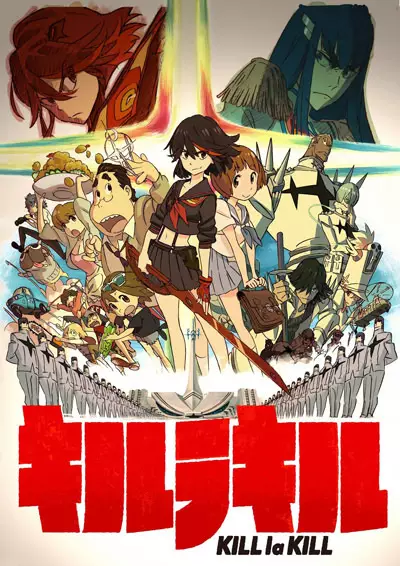
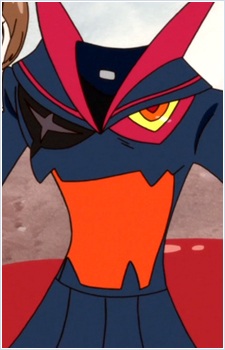
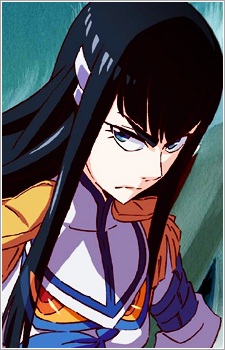
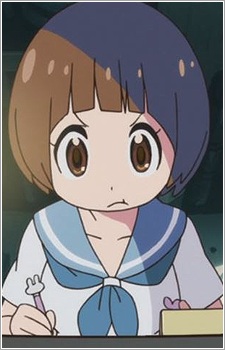
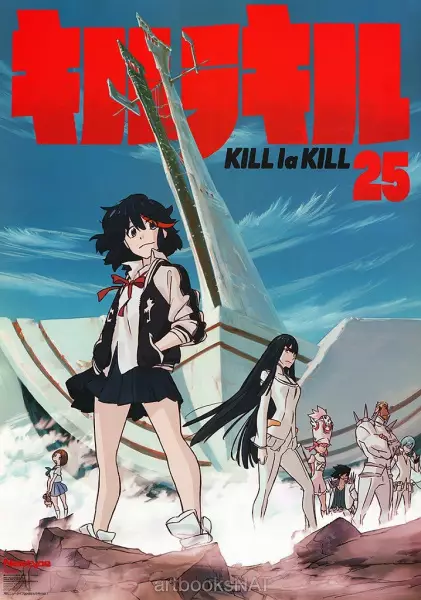
After the murder of her father, Ryuuko Matoi has been wandering the land in search of his killer. Following her only lead—the missing half of his invention, the Scissor Blade—she arrives at the prestigious Honnouji Academy, a high school unlike any other. The academy is ruled by the imposing and cold-hearted student council president Satsuki Kiryuuin alongside her powerful underlings, the Elite Four. In the school's brutally competitive hierarchy, Satsuki bestows upon those at the top special clothes called "Goku Uniforms," which grant the wearer unique superhuman abilities. Thoroughly beaten in a fight against one of the students in uniform, Ryuuko retreats to her razed home where she stumbles across Senketsu, a rare and sentient "Kamui," or God Clothes. After coming into contact with Ryuuko's blood, Senketsu awakens, latching onto her and providing her with immense power. Now, armed with Senketsu and the Scissor Blade, Ryuuko makes a stand against the Elite Four, hoping to reach Satsuki and uncover the culprit behind her father's murder once and for all. [Written by MAL Rewrite]
Главный
Главный
Главный
Главный
Второстепенный
Второстепенный
Второстепенный
Второстепенный
Второстепенный
Второстепенный
Второстепенный
Satire
March 28, 2014
It's been said by many veteran anime watchers that anime is dying. In the old days we had our Cowboy Bebop, Trigun, Wolf's Rain, Neon Genesis Evangelion, Akira, FLCL, Berserk, Fist of the North Star, and Miyazaki; we had Space Captain Harlock, Lupin the Third, Yu Yu Hakusho, and Ghost in the Shell. Even if you haven't seen these, you've likely at least heard of them and the impact that they've had on anime as a whole. Anime was an intellectual, creative medium that reflected flair and pizzazz. It wasn't just silly entertainment for kids, like many Western cartoons, and people of all ages couldenjoy it. As of late it seems that anime has been stuck in a rut of moe, harems, rom-coms with unrealistically dense male MC’s, and onii-chan/imouto obsessive garbage. Lately there's been a lack of courage to sack up, step outside of the box, and say, "Hey, let's try something new." After you peruse season after season of the same regurgitated genres you might find yourself wondering if anime has lost its way... And, to answer that question, Trigger will look down and whisper, "No." Watching the story of Kill la Kill unfold was confusing, exhilarating, comical, lively, and goddamn refreshing. What began as a simple revenge story, with a shaky plot direction, overabundance of fan-service, and obnoxiously flashy fight scenes, ended in a surprisingly competent and satisfying fashion. Although Kill la Kill is entertaining, it is still a series that prioritizes style more than substance. This isn’t to say that the series is shallow in the slightest, but it’s often difficult to overlook the abundance of panty shots, suffocatingly tight and revealing outfits, the FLCL-esque action, and all their allure. While there is a lot of wild enjoyment to be had in Kill la Kill, it's also easy to disregard what makes this series so brilliant. Part of the genius behind Kill la Kill is the fact that the show itself is a parody of many overused tropes in recent anime. Over-sexualized, provocative clothing and fan-service for no reason? Check. Student council is overpowered? Check. School system that emphasizes uniforms? Check. Story about revenge? Also check. Not only does the series poke fun at commonalities in anime, it also fires shots at the oppressive nature of the Japanese education system. The most astounding part about all of this is that Kill la Kill doesn't just adhere to the common tropes itself for shits and giggles; it actually takes these tropes and literally makes them its plot. Even if you don't take the stance on viewing the series as a parody, you'd probably still find the series entertaining and fun to watch on a different standard. That's ingenuity, ladies and gentlemen. Trigger did something interesting with its characters in Kill la Kill that you don’t see in anime too often, adding to the fresh factor of the show. They took a series that banks on testosterone-based, over-the-top action and made the main characters girls. It's not often that you come across an anime with a strong female lead that can not only stand up for herself, but also against tyranny and male counter parts. Ryuuko personifies these values. There’s a struggle within our current modern-day society to fit in with social norms. It’s tough to be that black sheep individual that goes about their own business without being judged by the majority, hence why we generally follow fashion trends, region-specific social etiquette, and so forth. The growth of Ryuuko reflects this as the development of her character is steadily shown across the span of the series. Ryuuko starts off as a bland teenage girl with attitude looking for retribution against the one who killed her father. When introduced to Senketsu — a revealing sailor uniform made of life fibers — she is submitted to humility in exchange for power. It’s things like this that should make you raise an eyebrow and wonder whether or not this is reflective of the advantages and disadvantages that sexuality offers women. Maybe I’m looking too much into it, or maybe I’m right. What’s great about Kill la Kill is that there isn't a right answer. You take from it what you want. While Ryuuko portrays big themes and intricate lessons woven into her character, it would be a crime to disregard the rest of the cast of the series. The character body of Kill la Kill is quite diverse and there are plenty of likable characters. Each character brings something to the table in terms of entertainment and, as a whole, makes sure that there’s never a dull moment. Characters that are depicted as the antagonists, such as Satsuki and the Four Devas, are likeable. Mako, who is essentially the fool, is actually funny. The way these characters fit the mold of wacky, but wacky with personality, is astounding. Characters feel like they fit into the show seamlessly and that can be hard to come by. The art and animation is similar to the chaotic, yet extremely fun style that Gainax offered in both FLCL and TTGL. It’s hard to ignore the resemblance when Hiroyuki Imaishi and Masahiko Ohtsuka, originally from Gainax, are now a part of Studio Trigger. The action defies logic and physics, the art is stellar, the animation is fluid, the backdrops are majestic, and all of it meshes together nicely. The sound criteria of Kill la Kill is also quite exceptional itself. The OP’s and ED’s are good, the OST is great, and the voice acting is on point. There’s nothing else to ask for. With that being said, I think the biggest problem is that Trigger has with Kill la Kill is that while retaining the style, they also retained dips in the quality of the art and animation, similar to those in TTGL. There's a lot of repeated animated scenes, such as the Kamui change scene, the shot of the heel clicking the ground, and even sword swinging. It’s not horrible or extremely detrimental to enjoyment, but it is there. The animation drops for a series as chaotic as Kill la Kill is understandable, given that Studio Trigger is also very new, and so I’d take this fault with a grain of salt. For Studio Trigger’s first original, seasonal anime series, Kill la Kill came in and went out with a bang. While it doesn't quite hit the status of masterpiece, I’ve been made a fan. I will be looking forward to whatever creativity their future works will bring.
Второстепенный
HelghastKillzone
March 27, 2014
Welcome to Kill la Kill. This is where fanservice is plot, style is substance and every episode plays out like the finale. This is anime. From the makers of FLCL, Gurren Lagann and Panty and Stocking, Kill la Kill is the first television production series under the newly formed Studio Trigger. Its is a tale of a transfer student, Matoi Ryuuko, wielding a scissor-sword, comes to Honnouji Academy to look for her father's killer. Opposing her is the Student Council President, Kiryin Satsuki, as well as her personal guard of the Elite Four, who are developing uniforms of immense power. After an initial fight, where Ryuukoends up being defeated, she stumbles across a sailor uniform that gives her the power to overcome her enemies and give her the answers that she seeks. Kill la Kill takes all the worn-out tropes and clichés of anime, amps it up to eleven and then delightfully invert them to give something exciting and fresh. While Ryuuko's tale of revenge is a tad predictable, it is the execution of the plot points that makes it stand out from its peers. Everything is exaggerated to the extreme including the school setting, characters, concepts to the absolutely epic action that happens. The show makes a point of never dwelling on a single event for too long and continually ups the ante in every single episode. There is little filler and the show is pretty subversive by playing with the viewer's expectations and then completely changing the outcome. When the action does slows down, there is a metric ton of references and homage to western culture ranging from Marvel Comics to classical music and literature. At the same time, Kill la Kill is mindful of its own Japanese heritage and folklore, drawing parallels to Oba Nobunaga, anime of old and new while not overly heavy-handed with its references by keeping it quick and tucked away in the background. Some elements of comedy are thrown in, complete with visual gags, puns and slapstick humor. However, a point of contention is the hit and miss nature of Mako's antics, which may not go well with every viewer. On a first glance, Kill la Kill's visuals is reminiscent of cell animation at its peak during the late 1990s with its warm color palette and strong outlines. The backgrounds are drawn to the style of oil paintings and provide a epic and cinematic feel to the show instead of the drab outlines that other shows often present. In the animation department, Studio Trigger takes every possible shortcut in producing this show by utilizing extended single frames, sometimes even coming down to Inferno Cop levels. However, the style and energy placed into the visuals, more than make up for it technical shortcomings. Studio Trigger knows that this is an anime and plays around with that fact by slapping GIANT RED TEXT on everything and breaking the fourth wall constantly through changing perspectives and character proportions. Everything is presented with the force of a runaway freight train and doesn't let up until the viewer either gives in or walks away. The animation quality sometimes does take a nose dive that is too steep to ignore (Episode 4) with repetitive sequences, sloppy frames and limited motion. As well, the hilariously bad CGI in some places (I'm looking at you Episode 3), is enough to break the viewer's immersion. That being said, I applause the production team for making Kill la Kill never having a dull moment onscreen and being innovative with such a limited budget. Much like the explosive theatrics that is plastered all over the screen, the characters are outstanding in the way they inject themselves into the show and overarching plotline. Ryuuko's tomboyish behavior, recklessness and imaginative fighting tactics solidifies her as one of the strongest female leads I've seen in recent years. At the same time, she does get embarrassed my her scandalous-looking outfit and is vulnerable due to her past of growing up as a delinquent loner, making her feel like more of a teenager being thrown into absurd situations and less than any pre-established archetypes of a typical shouen show. Her nemesis and my personal favorite, K Satsuki, is the student council president who runs Honnouji Academy like a fascist regime and literally radiates power. Although she is on par with Ryuuko's combat power, Satsuki prefers to use her various schemes and henchmen to do her dirty work and knows more than she lets on. Bolstering the two already formidable leads, the supporting characters are very memorable in their own right with the Elite Four, the eccentric Mako, the nudist stripping homeroom teacher, and various factions duking it out. Each characters adds their own brand of wackiness into an anime that doesn't holds anything back. The soundtrack composed by Hiroyuki Sawano (of Attack on Titan and Blue Exorcist fame) is outstanding in every aspect and holds up the show when the animation decides to takes a break. By combining genres ranging from rock, electronica, vocals, jazz and bass, Sawano creates a score that is distinctive, addictive, energetic and flows perfectly with the over-the-top nature of Kill la Kill. Some standouts includes the rock-oriented 'Before my body is dry', 'Blumenkranz ', and the disturbingly haunting theme of Harime Nui. The character voices is equally as strong as the soundtrack with Ami (Code Geass's Kallen Stadtfeld and Spice and Wolf's Holo) portraying the hot-blooded and bash Ryuuko, Yuzuki Ryouka (Air's Minagi ) as the totalitarian Satsuki and the relatively new Suzaki Aya as Mako. Opposing the main leads, Paku, Romi adds an edge of as the sadistic Kiryuuin Ragyou and Tamura Yukari (Higurashi's Rika) as the batshit-crazy psycho Harime Nui. Male leads are also excellent with their respective VAs doing exceptional work on voicing Sanageyama, Gamagoori, and the fabulous Mikisugi. Although the primary draw of Kill la Kill is the sheer ludicrousy of action that happens, there is a good amount of depth in terms of the themes nudity, clothing and sexuality. The amount of nudity and fanservice shown in Kill la Kill far exceeds any typical anime, showing off asses, breasts and glowing nipples left, right and center. In fact, Ryuuko's skimpy uniform only gets more powerful when the user shreds her shame and embraces her naked self. However, more often than not, the exaggerated use of fanservice is sometime more along the lines being a parody rather than anything sexual or pandering to the audience. While other shows uses sexiness to pour gravy over the main course of the plot and characters, the nudity is interwoven into the narrative and provides context for analysis and discussion. And this is where the beauty of Studio Trigger's masterpiece lies, where it can appeals to the causal action-oriented viewer by giving them a rollercoaster ride on afterburners while layering the show for analysis and discussion for the more savvy anime fan. For its first production work, it feels that this is the culmination of Studio Trigger's legacy by combining the energy and randomness of FLCL, the over-the-top nature and scale of Gurren Lagann, and sexualized content of Panty and Stocking into something very unique and very deserving of all the hype that it is given. 10/10 TL DR: Simplistic plot but perfect execution Characters that you can't help but cheer for Awesome animation for such a small budget Can be as shallow or deep depending on what the viewer wants the show to be High rewatchability Go watch and judge for yourself.
FelixSerica
March 28, 2014
Witnessing the Kill la Kill hype train chugging along made me enter the show with negative expectations. The generic revenge plot, school setting and ridiculous designs left me folding my arms and rolling my eyes. It was and still is boldly proclaimed that Trigger is 'saving anime', whatever that means, but while Kill la Kill may be refreshing, is it really a cut above the rest? For better or worse, I could not help but feeling vindicated for holding my initial expectations. With the closing of the last episode, I felt I had just watched a slideshow rather than an engaging narrative.It should be stated that having a show that doesn't revolve around the banality of the fantastical construct that is 'moe' is heartening. Perhaps a narrative of personal struggle, coupled with great conflict and violence is rather cliche, but it is certainly more entertaining. Ryuuko as a character is interesting in that she isn't a flower that immediately wavers in the face of adversity or isn't immediately 'put in place' by a man. Unfortunately, that is basically all she has going for her, otherwise she is just another angst ridden teenager with a chip on her shoulder. Sure, Kill la Kill is indeed a show that not only has a strong female lead, but is dominated by powerful women, however that alone does not warrant high praise. Trigger talked of 'taking risks' but it seems Ryuuko is purposely not fleshed out to be broadly appealing. Her anger, loneliness and eventual commitment to her friends is something shared with many protagonists. The narrative as a whole leaves something to be desired. From episode 3 it was obvious that they couldn't draw out Ryuuko and Satsuki's clashing of heads for a whole 24 episodes. The show already heavily alludes to Satsuki as being more than what she projects. Given that this is a Japanese narrative, it is based on kishōtenketsu and the plot is hinged on a twist. You think with narrative structure based on plot twists, you would go for something interesting. However, Trigger in their infinite wisdom decided to go with the generic 'I am your father' twist. While it was honestly unexpected on my part, it was still wasted potential. Besides that, there are jarring transitions between a more light-hearted action/comedy to more serious action/drama. I honestly fail to see why Trigger thought Mako and her family were absolutely indispensable for the narrative. While the show is already over the top, ramming in the crass antics of the Mankanshoku family amid conflict with wide reaching ramifications is on the level of Michael Bay's Transformers. What purpose does Mako even serve other than that of a pure plot device? She is that of a generic best friend character who's only defining trait are her long winded motivational rants. Her relationship with Ryuuko is an implied one, they are forced together in episode one with absolutely no development what so ever. Kill la Kill relies heavily on it's stylistic elements, so good action should be among one of it's hallmarks. Despite that, the quality of the fight scenes are underwhelming, as they are dependent on speed lines and characters shouting at one another. It could be said that in Kill la Kill the characters fight first and foremost with words, fists and weapons being secondary arms. While I understand that aesthetics are a matter of subjectivity, I can't leave out my conviction that most of the designs are just plain terrible. It seems all they did was take the standard Japanese school uniform and added as many spikes and stars as humanly possible. If the transformations aren't hulking masses of arbitrary geometry, than they are merely skimpy shoe laces with bulging shoulders. All in all, I can't praise Kill la Kill to high heaven, but I can't exactly hate it either. It's OST is remarkable and really propels the show where it is lacking, even if I cannot appreciate all the tracks. That said, if this is what constitutes 'saving anime', then we are truly screwed, this should be among the average, not the exceptional.
cloudflowe
March 15, 2015
Note: I don't agree with half the stuff I said in this review and I think my writing style is quite immature and undeveloped, but the community got a kick out of it, so I'll leave it here. Kill la Kill has been praised as hilarious satire of action anime, but it ultimately fails to communicate to the watcher that it is satire by attempting to include profound thought amidst a spectacular display of skin and stupidity. Story: 3/10 When I saw Ryouku Matoi arriving at Honnouji Academy with half of a scissor to discover who killed her father, I'll admit that I was excited by the premiseof this show. However, the plot for the first third of the show was repetitive and dull, and felt like 8 episodes of filler. Then, Ryouku finally made her way to battle the woman she had been seeking, lost, and the show proceeded into an arc revolving around the concept that high schools have more authority in Japan. While the dialogue is witty, the events are poorly written and crappily explained, and most of the time, one isn't even sure why the characters fight. Now, the show's elaborate screaming fight scenes would be okay if it was satire, as most deem it to be, but Kill La Kill leads you to believe that it's taking itself seriously. There are dull conversations about how clothing somehow became sentient (huh?) and that it corrupts the human race (the explanation for how it corrupts humans is so shitty and half-assed i didn't bother trying to understand it.) Ultimately, I would accept the story as satire if it didn't try to be ridiculous, non-sensical, and philosophical/intelligent all at once. Art:5/10 While the fighting animation of the show is fluid and exciting, the environments are undeveloped and rely upon a dull color palette. On top of that, the characters look like they are still sketches, filled with haphazard lines and only a few bright colors. It's hard to tell the difference between Ira Gamagori and the desert with two buildings(half of the show's setting) behind him. Sound: 8/10 Kill la Kill features catchy openings, closings, and a stellar fight theme in "Before my Body is Dry," but "Before my Body is Dry" is the only song that the show ever plays. The lack of variety is pretty sad. Character: I'm not sure whether to give Characters a "2" or a "10." Honestly, they're ridiculous and poorly developed (they remain pretty stagnant throughout all 24 episodes, except for Ryouku.) This lack of development is fine if this is satire of action anime, but KLK still attempts to make a point about malicious clothing and human shame, so the one quality that could have made ridiculous characters and lack of development for everyone but Ryouku is perfectly fine is made null by the show's ardent desire for us to take it seriously by adding in more bullshit. Enjoyment: Most jokes are pretty funny, and Mako Mankashouka is utterly hilarious, while Guts is pretty cool, too. The Verdict: 5/10 As long as you don't go into Kill la Kill expecting it to have legitimate, intellectual weight and commentary, you'll find a show that is pretty funny, and Ryouku's pretty hot. It's a shame Kill la Kill couldn't decide if it wanted to be satire or serious.
jawnmewn
March 28, 2014
Sometimes a show doesn't need to have the most coherent plot or a cast of sensible and realistic characters to succeed in entertaining its audience. These shows appeal to our emotions and excel at utilizing momentum and suspense to keep us watching and demanding more. While Kill La Kill doesn't bring us anything revolutionary or extraordinary in terms of plot development or character design, the manner in which Trigger presents and delivers the show in a way where you can't help but give it your full attention as you watch an episode. Through a mix of over-the-top fan service, exaggerated confrontations and battle scenes, ridiculousand nonsensical humor, all under an equally insane and, for lack of a better word, creative premise and plot, Kill La Kill brings us a show that, at the very least, will keep you entertained and amused throughout the series. Enter Matoi Ryuuko, our fresh, fierce-looking transfer student at Honnouji Academy, where Kiryuuin Satsuki's word is law and your star rank represents your position in society. A girl on a mission to find her father's murderer, with only half of a giant red scissor blade as her clue, Ryuuko stops at nothing to seek the truth, even if it means toppling the very foundation of the Academy itself. She's not alone, however; the ever-energetic and friendly Mankanshoku Mako and her family serve as Ryuuko's beacon of support and source of the occasional pile of delicious croquettes. By fighting her way to the top of the Honnouji hierarchy with her trusted Kamui Senketsu, yet another memento of her late father, she may get the answers to her questions, and maybe, just maybe, something much more than that. Ryuuko's character development throughout the show was nothing stellar, yet at the same time I found myself becoming angry at the reckless situations she throws herself into, smiling silly at her goofy relationship with Mako, and cheering madly for her as she defeats numerous powerful adversaries. While the whole "there's this girl who has enormous potential but is initially weak, yet later through the support of her friends and the ones that believe in her makes her a force to be reckoned with" concept is fairly cheesy, cliche, and overused, Kill La Kill makes the best of a bad situation and uses it to their advantage. Whether it's Ryuuko challenging Satsuki in a battle in which she clearly would be outclassed yet comes out even due to the support of Mako or the strength of her resolve, or it's Ryuuko getting full of herself with her newfound strength, getting overconfident, then falling to an enemy she underestimates; while scenarios like these are extremely cliche, the unique flair and style Kill La Kill adds to these situations makes it captivating and entertaining to watch. A heavily debated topic that Kill La Kill often sparks is over the concept of fan service. While your standard anime fan service will offer things such as, but not limited to, beach scenes with an irregular average guy to incredibly cute or beautiful girl ratio, a skirt flipped by the wind much to the chagrin of the embarrassed yet pretty young school girl etc etc, Kill La Kill's so called "fan service" is delivered in the form of heavily revealing battle outfits and consistent nudity with minimal censorship through light or objects. However, unlike most fan service scenes where the actual concept in question is brought to the viewers attention, Kill La Kill does a good job avoiding that. While there are parts where people ogle at Ryuuko's transformed state in Senketsu, or the Elite Four squabbling amongst themselves and telling each other to go put on some clothing, the show very well could have removed it completely and for the most part the foundation of the show would not have changed. For those who like it, all the more power to you. For those who despise it, looking past it or ignoring it will not diminish the impact the show has. Fitting for a show like Kill La Kill, the art and sound complement the show tremendously. The artwork seems like it was drawn with vigor and the use of sharp lines and sketch marks makes battle scenes come to life. The soundtrack, in typical action anime fashion, does a very good job in matching the scene the episode is depicting. From tension-filled and ominous scenes accompanied by dark and sinister music to action-packed and flashy battle scenes with sharp and vivid background sounds, Kill La Kill does an excellent job piecing together a well coordinated story and soundboard. Kill La Kill excels in drawing its audience in with larger than life battles, ridiculous yet clever nicknames for various special moves, secret operations, and over-the-top clothing, and fairly unpredictable plot twists and turns that evoke a wide range of emotions ranging from disappointment to shock and awe. It's a show that will be hit or miss for a majority of viewers, but one thing is for sure; it's difficult to be bored or not entertained while watching Kill La Kill.
Ранг
#676
Популярность
#58
Участники
1,838,249
В избранном
39,259
Эпизоды
24