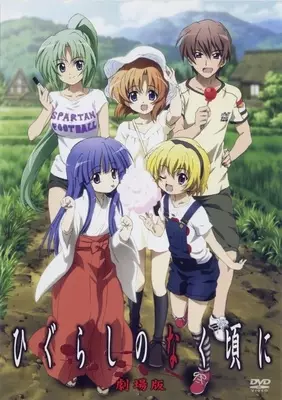

Higurashi: When They Cry – Kai
ひぐらしのなく頃に解
In the small village of Hinamizawa, Rika Furude and her friends live together in relative harmony. Beneath this mask of peace, however, lies a hidden darkness, one that Rika understands all too well. In this eternal summer, she has been witness to unspeakable horrors. Every time the clock resets, Rika must try to find the villain behind these senseless deaths before tragedy strikes again. However, trying to decipher a mystery when only half the clues are present proves time and again to be disastrous, and each time she believes that things will change, she inevitably fails. As the annual festival approaches, Rika begins her descent from hope to despair in her struggle to break the chains of fate entangling them all. [Written by MAL Rewrite]
Главный
Главный
Главный
Главный
Главный
Главный
Главный
Второстепенный
Второстепенный
Второстепенный
Второстепенный
lawlmartz
June 3, 2015
"Someone taught me something- that the power of belief will give rise to a miracle that will cut through fate." - Hanyuu Preface: Birthday review! This review is solely for Higurashi Kai, which I will refer to as "Kai" from this point on. Since it's a part two, it's necessary to have seen the first set, as it's divided into "question" and "answer" arcs. This series formulates the many, complex answers to the question: What exactly is happening to Hinamizawa in June of 1983? Artwork and Animation: 7Like its predecessor, Kai is approaching 10 years old, and looks somewhat dated when put up against more recent efforts, both by studio Deen and others. By no means does it detract from the show though, as the somewhat rough look gives it a dated feel too, and brings the rural 1983 Japanese mountains to life in a way that pulls you in with how it frames and presents the visuals. It's overall a very dark show, both in atmosphere and coloration, which intertwine excellently together to give it a dense, oppressive feel. Sound and Voice Acting: 9 The opening, "Naraku no Hana (Flower in Hell)", by Eiko Shimamiya is a wonderfully haunting song that really sets the mood for the show, with lyrics to match. The ending song, "Taishō.a", by anNina is even more foreboding, with soft violin and piano that really affixes the ending scenes in the mind's eye, like an ellipsis at the end of a particularly thought provoking sentence. Kenji Kawai, who also did the original Higurashi and Fate Stay Night's composition does more great work here. Most of the music is very atmospheric, setting the mood and tone for the show. It's very subtle, not in your face loud or obnoxiously playing over the characters. It creates tension, and resolution when necessary- very good. Let's just say that Kai is the Yukari Tamura show, because her performance as Rika is nothing short of stunning. Certainly the best of her career, and that's saying something. As the focus is 90% on Rika throughout the show, we get a lot of time with her, and in three different voices. Ms. Tamura truly put in an award worthy performance for bringing little Rika to life through as many emotions and moods as can be brought through a visual medium in which the actors themselves are not present. Just excellent. However much talent Yukari Tamura showed, it's nearly matched by Miki Itou's Miyo Takano. As a character who wasn't fully fleshed out in the original series, she plays a much larger role here, and is explored through an emotional and compelling voice role. Characters: 10 The cast of Kai expands somewhat from the original series. The introduction of some new characters along with expanding the roles of previous supporting and main characters also expounded upon the intrigue that drives the heart of the show. Higurashi is a show that will lie to you. I was constantly on edge, trying to figure motivations and goals out, because it's never clear; not until it's too late. The focus changes from one of each arc having a main character to just two "real" main characters. This enables the character driven portion of the story to be a lot more fleshed out and have less of the disjointed feel that the original had, where the perspectives of the different characters were constantly changing. This is much more nailed down, and is better for it. The familiar and the new faces all have weight in the story- no one is there just for the sake of having the "token character" for plot devices. Story: 10 "The sin of this world is like Old Maid. Everyone pushes the one Old Maid onto one another. It's not a game you seek to win, but one in which you seek to make someone the loser. The sacrifice." - Miyo Takano ---- Kai takes a somewhat different tonal and execution approach to its predecessor, in that it's a much more complex and intrigue driven narrative than outright horror. Gone are the short arcs that depict brutal murders and a hanging sense of "something is just...'wrong'", and in their place is a deep narrative filled with deceit, betrayal, hunger for power, cold blooded hate, and a myriad of dark themes. Where Higurashi is the "tell", Kai is the "show". The best suspense and mystery narratives are those that are not heavy handed in shoving the plot down your throat, but allowing you to discover for yourself, to guess and be proven wrong, and to ultimately be surprised and perhaps even shocked by the outcome. This is Higurashi. While everything is revealed to you in time and nothing left unresolved, the manner by which it slowly unveils creates a nearly tangible level of tension. Again, everything starts out happy and fun, but you know that it's just not going to end well. Kai, and Higurashi before it are shows that eliminate the element of surprise about how the arcs go, though. That's not to say they're predictable; no, it's that you "know" it's not going to end well... it's just how that ending comes about that is shocking and/or heart rending. Just when I thought it was going to be a good ending, so many things that can go wrong do, and it ends in a sorrowful way again. Unlike Higurashi part one, Kai is divided up into a mere 3 arcs, which allowed the plot to develop slowly, but with more (necessary) exposition. Again, it's a slow burn of a show: it twists and turns within the arcs, and when I thought I had everything figured out, it managed to turn everything on my head with revelations of who and why. Higurashi is predictably unpredictable- and that's the genius behind it. It doesn't have to be a straight Whodunnit horror show involving cutesy school kids, even thought that could have been plenty entertaining on its own. No, Kai takes it to the next level with a cleverly crafted political conspiracy and treachery by those in positions of power over others. The mysteries of the first series are just the base bricks built into the steps of the pyramid of deception, betrayal, and conspiracy of Higurashi in sum total. These, which ultimately lead to a narrative of immense proportions, and heights of weighty answers that were previously inconceivable from the prior portions of the story. A maze of irrational questions constructed elaborately by deft hands, that turn to a dark hallway with answers that are both revelatory and thought provoking- a real masterpiece. Enjoyment: 10 One of the things I liked most about this show was the very first episode, which serves as a direct epilogue to Higurashi part one. One of the most edge-of-my-seat, intriguing, and addictive openings to a series I've seen, that served as an awesome introduction to the unveiling of the mysteries of Hinamizawa to come. A note: Due to the incident in 2007, where a 16 year old Kyotanabe girl murdered her father with an axe to the neck, some of the violence in the anime was censored, and certain parts edited out altogether (along with the cancellation of the last episode of School Days, airing the same time). With this event, there was a noticeable shift in the amount of extreme violence content vs the original series and manga. Not that the show is lacking such content altogether, but for a show that has built a reputation on brutality alongside Alfred Hitchcock style horror storytelling, it was strangely absent in some places. As mentioned above; the story was unpredictable, and in the best possible way. The characters all have their parts to play, and with an expanded cast- all of them get a fair share of development and exposition, though it would have been easier to sideline them. They all remain relevant, and the tone of the series is also very consistent- I very nearly felt time ticking by in their universe as I anxiously watched the events of June 1983 unfold once again. Overall: 10 As both a mystery and a psychological horror show, Kai succeeds with flying, dark colors. As an intense, relentless narrative and a tragic, but ultimately beautiful story, Higurashi Kai surpasses all expectations. It has the necessary elements for an Alfred Hitchcock or Rod Serling worthy masterpiece; the characters, the story, and the atmosphere to back it all up. It's all there. All Higurashi needs is an audience. tl;dr + Dark, twisting narrative + Great, compelling characters + Detestable villain that you can't help but sympathize with on some level. +/- Lack of ultraviolence? (see above) Recommend? Ab-so-lute-ly. If you've not seen Higurashi no Naku Koro ni and are reading this for some strange reason, please, go watch the original- you owe it to yourself to see a show of this caliber, because there aren't many of them. "My will will weave an absolute future. No one can hinder me or overthrow it: even fate is up to me to decide, with my unwavering, absolute will." -Miyo Takano
Второстепенный
SamFury
September 19, 2009
Disheartening Sunset Higurashi no Naku Koro Ni Kai [Kai] is the sequel to the popular original [Higurashi] that aired the year before, based off the 07th Expansion's sound novels of the same name. The first season covered the four arcs of the original game and the first two arcs of the sequel. Kai covers the last two arcs of the second game and give closure to mysteries presented in Higurashi. Kai's story is satisfying at the very most. The riddles that hung like loose threads are woven together nicely giving us most of the big picture. A few questions are left unanswered, which hopefully Rei, thesecond sequel, will answer. With this in mind, it's still hard to say that Kai at any way lives up to the drama of the first. The characters become paper actors, two dimensional, lacking their psychological depth. I commend the series for giving Furude Rika personality, being the main protagonist between both halves of the show. It could be debated she was the shallowest of the Hinamizawa crew in the first outing, but I feel that rest of the club was sacrificed and should have maintained their complexity. The atmosphere as well is very upbeat, at each turn of the plot, glass balls of sunshine and hope illuminate the way for our protagonists. It's disappointing considering the most engaging element of the original was the dances of blood and gore and the gritty realization that their is no light at the end of tunnel. Production We come across similar fare in Kai. There is no noticeable improvement in animation or art which is unfortunate. In the first the super deformed character model served a foil to the violence committed by the characters. In Kai, they serve as symbols for Higurashi's new found optimism, which I found to be more ineffective as a device. The music and voice acting were similar to the first. I must say I appreciated Yukari Tamura's work behind Rika. The Violet haired priestess moved between bouts of depression and when she wore a mask of delight, which Tamura handled expertly. The line "Nippa" was endlessly endearing, feeling an 'Aww' form at my lips every time she uttered the word. Watchability and Enjoyment Kai requires you to watch the original, making it even less accessible than Higurashi, which required you to have a strong stomach. Kai isn't as addictive as the first either, I found myself trudging from episode to episode just to learn more about the skeletons in Hinamizawa's closet. Though, sometimes at the end of each twenty-one minute session I was left wondering, "How come no one is being hacked to fucking pieces! This is HINAMIZAWA! Why ain't the bodies hitting the floor?!" Maybe I'm just a Sadist. Themes Kai looks up, where as Higurashi looked down. The glass ceiling of fate is meant to be shattered by will power. Ignore the glass shards that will come raining down on those around us, we must always move forward. In Higurashi fate acted as an iron maiden, not a question of if, but when it's spikes would make swiss cheese out of your soul. In Kai, fate is tub of play-doh, ours to mold and create. Closing Thoughts Higurashi no Naku Koro Ni Kai is easy to recommend to those that have seen the first for one reason alone: the antagonist is finally revealed. The show fails to deliver a product as engrossing as the first but that is the nature of sequels I suppose. Unless it's Godfather II of course.
srsng
May 30, 2009
June 1983 marks the fateful event in the quiet village of Hinamizawa. Can this predestined event be broken? When the doors of Higurashi naku koro ni closed, we are left with so many loop holes and questions that are left un answered. 1. Who is this Oyashiro-sama? 2. Why is there someone dying and disappearing every year at the night of the Watanagashi festival? Is this really a curse or someone else's doing? Higurashi naku koro ni kai, the second season explains most of the events in the first season. Unlike the first season, this is told mostly in the perspective of the shrine maiden Rika. Viewers will againget to see the different angles of the incidents once again and how it seems to keep repeating itself for many years. Rika, who now lives for the thousandth time in Hinamizawa, wishes for a miracle to happen in order to change the fate of not only the village but also her friends. But when she was about to give up all hope and succumb to fate, Maebara Keiichi and her friends try to help her out. But will it be enough to bend the will of destiny? There's only one way to find out. This series sends us a message that we have different doors ahead of us each leading to a different outcome and it's up to us to decide which one to take. All in all, this thought provoking series gives a satisfying closure to this well-planned mystery thriller story. The only question remaining is that will you be able to break through your fate?
z-pak
January 3, 2008
I will say this now, if you have not seen the anime called Higurashi no Naku koro ni, then this review will be as useful as the dust that lies under your bed. With that said, most of what I have to say about Kai will be a rehash of what I said in my season 1 review; therefore, I will not be giving a detailed review. Instead, I will say what I thought were the stronger aspects in Kai compared to that of the first season. No doubt, both seasons of Higurashi were wonderful and one cannot exist without the other. Because of this, itis not exactly fair for me to use the same criteria I use with a stand alone season series or a stand alone anime. Thus, I rate and review Kai based on what was different, whether it be an improvement or not, from season 1. Story: As said earlier, Kai is a direct continuation of where season 1 left off. Kai shows the last two answer arcs of Higurashi plus an anime-exclusive arc to fill up the holes to answers that were missing from season 1. Every mystery or question posed in the first season is answered nicely. The way everything falls together is very well thought out. The solutions provided to the mystery leaves very little things unanswered. Art/Animation: Vast improvement in the art department from the last seasons. Animation, however, while it is much better, can still be inconsistent. Well, Higurashi was never known for its animation, and it does its job fine without KyotoAni, Bones, or Madhouse quality animation. Sound: One aspect of Kai that was the same as the first season. The first season had an OP that matched very well with its atmosphere and mood. Kai was no different. Instead of the creepy, unsettling feeling, Kai uses an OP the shows the drama and desperation of Rika's struggle. The voice acting is still superb, and besides the major theme that is used in Kai and some new tracks, the music remains the same. Characters: I found the character development to be better and given more time in Kai. While the first season introduced and partially developed the characters, they are fully fleshed out in Kai, especially Rika. Even the characters that you think played minor roles in the first season, Akasaka, Tomitake, Takano, Irie, and Ooishi, gets a good deal of development. Enjoyment: While I had a lot more fun brainstorming theories and (sometimes, not always) being confused, I enjoyed Kai for other reasons. Firstly, I loved Minagoroshi-hen. It is, no doubt, my favorite Higurashi arc. While some people might enjoy watching psychotic girls beat the hell out of a certain, horrible uncle (I mean, who does not?), I had just as much fun watching Keiichi give his epic speeches. After all, Keiichi is called the Magician of Words for a reason. I also enjoyed watching as everything unfolded. Overall:This would average out to a 9.4. I did think there was improvement of pacing, being a lot more consistent, quality wise, than season 1, and the awesome ending. The pacing in season 1 felt rushed at some parts and caused certain facts to be left out. Thankfully, most of that was rectified in Kai. So yes, in some ways, I did think Kai was superior to the first season. The first season did really well in setting up the mystery and atmosphere. While Kai's atmosphere may seem too different from that of season 1, it is actually a lot closer to its original source material (the VN). Of course, I will not be going into this, but overall, the way the story unfolds is wonderful, especially if some of your theories turns out to be correct. Even with all that said, this series is not perfect. While the ending itself and final episode was brilliant, the lead up to that ending was weak and could have been executed better. Even with that said, Higurashi, as a whole, is a series that I would definitely recommend. Final verdict: 9/10
Ceptryn
November 28, 2008
Imagine you are an Olympic boxer, about to enter the gold medal match. It's going to be you're toughest fight, the world title holder thrice in a row. You've studied his moves, you're prepared, you know you can win and relish the challenge. You enter the ring and prepare for the greatest fight of your life. The bell rings! You launch forward... only to find your opponent collapsed on the ground due to a heart attack. You won! But what's the feeling? Elation? Disappointment? Or a weird mixture of both? Whatever that emotion is, that's what'll you feel upon completion of Higurashi Season 2. Brilliant twists, unparalleledsuspense, the series builds to a full crescendo as the true devils behind the horrors of this countryside village is revealed is stunning fashion. All that is left is for the final confrontation, the one that will end it all... You brace yourself. You know what the characters you've grown to love are up against, you know it'll be an uphill struggle. Yet, you know that with their sheer brilliance, they'll likely succeed. The three final episodes are finally here, and you prepared yourself to wowed, just as you were for the past 26 episodes... eager to see just what ingenious plan Kiechi and his group of resilient girls have brewed. Then... suddenly, you're watching something the looks like came straight of Home Alone. The antagonist's forces, always so powerful, so disciplined, and so deadly, has magically transformed into a mob of bumbling fools. The comedic, idiotic and pathetic ways in which the villains appear totally out of place. Its like watching Terminator, where after surviving massive explosions and shot gun shellls to the head, Arnold suddenly got killed by a Knife in the gut. You scream `WTF?'? Where's those snipers? Where those silencers? Did all the villains just drop themselves in a a barrel of toxic goo and had their IQ reduced by 50? It seemed like he writers just run out brilliant ideas something so powerful could be defeated... and decided to take the easy way. This a true pity, given that the second arc was a true masterpiece, one-upping everything in both seasons combined. In the end, a final rating for Higurashi ni Ki difficult to give. Up till the final episodes, the series deserves a 10/10. The meets, and even surpasses the incredible standards set by the season before. They have managed to construct a mystery that is unpredictable, and yet fits naturally with all clues given before, creating that elusive `Eureka' moment that is almost magical. Yet, Higurashi fumbles at the critical moment, where the protagonists must use this knowledge to change their hellish destiny. The ending episodes are not bad (They deserve 7/10), but look immeasurable weak when compared to the hand standards set before. Is it worth watching? Absolutely! Is it an masterpiece? Almost. But just like seeing Terminator die to a knife wound, one just cannot help but feel a little disappointment at the ending and endings tend to have a last impression.
Ранг
#489
Популярность
#488
Участники
518,419
В избранном
7,646
Эпизоды
24