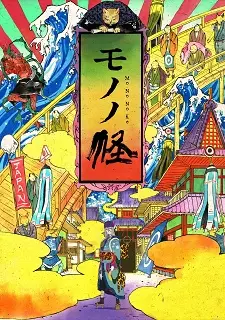

モノノ怪
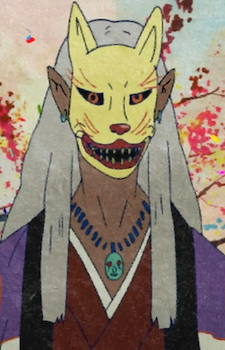
The "Medicine Seller" is a deadly and mysterious master of the occult who travels across feudal Japan in search of malevolent spirits called "mononoke" to slay. When he locates one of these spirits, he cannot simply kill it; he must first learn its Form, its Truth, and its Reason in order to wield the mighty Exorcism Sword and fight against it. He must begin his strange exorcisms with intense psychological analysis and careful investigative work—an extremely dangerous step, as he must first confront and learn about the mononoke before he even has the means to defeat it. The Medicine Seller's journey leads him to an old-fashioned inn where Shino, a pregnant woman, has finally found a place to rest. The owner has reluctantly placed her in the last vacant room; however, as she settles in, it quickly becomes clear that the room is infested by a lethal band of mononoke, the Zashiki Warashi. With his hunter's intuition, the Medicine Seller begins his investigation to discover the Form, the Truth, and the Reason before the Zashiki Warashi can kill again. [Written by MAL Rewrite]
Главный
Второстепенный
Второстепенный
Второстепенный
Второстепенный
Второстепенный
Второстепенный
Второстепенный
Второстепенный
z-pak
May 2, 2008
Wow, what a series. Mononoke is the spinoff/sequel of the Bakeneko arc (eps. 9-11) in Ayakashi ~ Japanese Classic Horror. This is not to be confused with the final arc in Mononoke, which ironically, is also called Bakeneko. Although the original Bakeneko tale was brilliant, Mononoke is just as enticing, beautiful and well written as its predecessor. This series lets its art tell the tales. It is not afraid to experiment and has its own distinct style. This is a truly wonderful series especially visually and thematically. Story: This anime is broken into five different stories lasting about 2 to 3 episodes each. Every one ofthese stories features a different supernatural spirit; many of them rooted from Japanese folklore. It is up to the Medicine Seller to uncover the Katachi (shape/form), Makoto (truth), and Kotowari (reason) of the spirit. Now, this sounds like your average, spirit-of-the-week sort of deal, doesn't it? But it isn’t. That's one aspect that makes this series so great. All the stories are unique and do not feel like a rehash of the same story as the previous. Even by the final arc, I was still shocked and entralled by its revelations. So yes, there are unexpected twists in every arc. Each tale also holds very thoughtful themes. You would expect a series about supernatural ghosts to be about the, well, dead spirits, but that's also not the case. Most of the stories are quite deep and to some degree disturbing. In fact, Mononoke is very thematically based on human nature, since it's the humans and their actions that transform the spirits into these vengeful mononoke. Art: I’ll say it now. The art style may put off some people, especially based on first impressions. I thought the art was absolutely gorgeous, fitting, and unique. Mononoke uses an art style that resembles the Japanese "ukiyo-e", filled with vibrant and colorful backgrounds, textures and designs. Because of this two-dimensional, almost paper cut-out appearance, the anime uses a lot of camera movements and symbolism. This is why a few of the stories may need multiple viewings to get the full meaning of everything. In this way, I feel Mononoke uses its art to its full potential to present the story. I also loved how the style in each arc deviates just a bit so that each story distinguishes itself from the others. Sound: Sound plays a very important role in this series. Because the art style somewhat limits what it can show on screen, sounds are used to reinforce that. It sets up the tense atmosphere, adding suspense and leaving you anticipating for more. The voice acting is very well done, especially hearing those screams of terror and shock. Other than that, I didn't really like the opening and ending songs. I actually liked the Ayakashi OP and ED better. Character: There is only one reoccurring character in all the stories and that is the ever-so-awesome Medicine Seller! Yes, he is nameless and simply known as “Kururi-uri-san/sama/insert other honorific” or medicine seller. Although not much is known about him, I think it's very fitting since it adds to his mysterious nature. He does, though very subtly, develop. In all honesty though, I found it incredibly enjoyable watching him make deadpan comments while the other characters are freaking out over the weird happenings/hauntings. Lastly, the story-only-characters get a good deal of development despite each story being 2 to 3 episodes in length. Enjoyment/Final notes: I finished the series in 2 days, meaning I watched about 6 episodes per day. So yeah… I enjoyed it a lot. And as mentioned earlier, some arcs may take a second or even third viewing to get everything. I know I will watch it again. It's such an excellent anime and was so worth the watch. 9.6/10 easily rounded to a 10/10 for my list.
ElectricSlime
November 2, 2007
My initial impression of Mononoke was literally, "...". After giving it a chance I am glad that I wasn't quick to judge and saw it through. Mononoke is a collection of short stories revolving around mysterious spirits/creatures known as, from the title, Mononoke. The writing and directing of the series are excellently done and really immerse you in the story itself. Each arc is a new story with new characters that are well fleshed out in the beginning of each segment. The Medicine Seller, Kusuriuri, is the only recurring character and is mysterious as always with each new arc. The artistic styling of Mononoke is trulyone of a kind, the colours are amazing and with HD encodes it truly shines. Each new environment is unique, colourful, and captivating. The colours and use of quick camera movements add to the suspense. The animations themselves are intentionally very stiff at times but as the action speeds up they become very fluid and top notch. The backgrounds are rarely stationary, but appear as though you are observing a painting at the same time. Often times the animations of common things such as snow or water are displayed in a very unique way that makes you simply want to get lost in it. The sounds of Mononoke are fantastic. There is often times complete silence, but that only adds to the suspense. The OP and ED are very nice, nothing exceptional, but nice. The use of sounds, such as screams, thumps and other such frightening sounds are extremely realistic. I hate to admit it but I was genuinely frightened at certain points. Apart from the Medicine Seller, each arc sees the introduction of new characters. Each character usually represents a different Japanese stereotype. Samurai, priests, monks, government types, children, and many others. Kusuriuri's alternate self, I won't give anything away, is almost worth watching the story for on its own. The Medicine Seller is a very sarcastic person and often times at a very serious moment he'll crack a joke that is totally absurd and you can't help but laugh. At only twelve episodes Mononoke is well worth the time and although it is very, very Japanese in respects to content, it doesn't take away from the enjoyment in the least. As I mentioned before, Mononoke is excellent at generating fear out of the simplest of situations with very little audio. The characters are all very genuine and are often times in tears and losing their minds in a very believable manner. I've wasted enough of your time, now go watch this show. You definitely won't regret it.
TheCriticsClub
December 10, 2013
When someone talks about the genre of horror, immediately a few things come to mind: blood, violent motion, bone and flesh torn asunder, gore essentially approaching abundant forms of shock value. These are what characterize the images that litter the horror genre today. However, one cannot discount the impact of simpler techniques. Muffled voices, the bloodcurdling scream, the manic dip toward insanity; these are all subtler methods which give rise to the imagination and thus leave a more impressionable impact. Mononoke adopts such techniques in each of its standalone stories, and it may not be surprising that these implementations are often left unappreciated. Yet, byadapting these horror tools along with an artistic presentation, rhythmic score, and strongly representative story, it is no wonder then that Mononoke is an excellently produced work. Story Before we embark on Mononoke's journey one may first need to understand the very concept of Mononoke. One of the basic types of Ayakashi (tl. "unnatural spirit") is formed from the soul of a living or non-living material. Oftentimes, regret causes this, and when an Ayakashi is merged with strong human emotions such as vengeance, sadness, or fear, it develops into a Mononoke (tl. "hostile spirit"). This is the foundation for conflicts in each story and what typically stems from each Ayakashi's backstory. The story itself follows a Kusuriuri (tl. "medicine seller") who travels from one place to another exorcising each Mononoke he comes across. The anime presents five standalone arcs. Each one consists of 2 or 3 episodes, which may sound as if there is not enough time allocated to serve each story properly. Fortunately, this uncertainty is untrue. Each arc is thoroughly interesting, bizarre, and complex; viewers will be astonished by the profound impact each short story relays. Every arc meticulously refines its pace in order to provide characters enough time to adapt to their roles. Once the primary conflict is staged and the Mononoke is revealed, Kusuriuri puts himself to the task of unraveling its Katachi, Makoto, and Kotowari (tl. "Form", "Truth", and "Regret") — the three requirements for him to release his "Sword of Exorcism". What makes Mononoke a highly commendable work is its highly structured format, as well as its exploration of every character's motives. Kusuriuri simply can't draw his sword and exorcise the Mononoke until a predetermined set of conditions is followed. Moreover, whilst watching Kusuriuri reveal a Mononoke's Form, Truth, and Regret, we come across a saddening tale of how it came into existence. Mononoke does an excellent job in attracting viewers with its harrowing tales, and its precisely carved narrative makes it an unforgettable experience. Animation Aesthetically, Mononoke is one of the most finely detailed pieces in existence. From vibrant and colorful backgrounds to highly detailed characters and costume designs, Mononoke has crossed every barrier in this field in order to achieve excellence. The pasty color palette may seem an odd choice for a horror anime, but make no haste; it merges perfectly with the setting and culture of this work. The backgrounds are perforated with different textures all of which that complement each standalone narrative. Generally, Mononoke can exist in any form and in this anime they are designed explicitly (and sometimes intentionally vaguely) in order to vary with respect to their arcs. Toei Animation has done a wonderful job in designing every character intelligently and distinctively in correspondence to their personality. Kusuriuri's design in particular manages to stand out on every frame. Moreover, his climactic transformation remains one of the most excellent aesthetic achievements in anime: it produces such a profound form and with fantastically surreal animation. Characters Matching the astounding art, what makes the characters so memorable is how they are portrayed. Not only are they emotionally distraught and relatable, groups of them often form a well-represented allegory. Mononoke is also an eclectic social commentary, ranging from remarks on corruption within governmental policies to more localized analyses of vengeance and despair. One role which continues to outshine all others is the recurring character Kusuriuri. Unnamed, unrevealed, and from beginning to end an unknown, this enigmatic figure is the lone consistent tool from story to story. He breathes ambiguity, and his role always wedges into the plot should it ever begin to stale. He also does not share any form of development, and yet his indecipherable status always mystifies viewers in order to keep Mononoke's harrowing atmosphere at its greatest. Sound The Opening and Ending themes may seem peculiar, but they are certainly stylish, and as unhinged periodic pieces, they imperceptibly suit the series' direction. However, what marks Mononoke is not the music but the sound effects. Each opportuned implementation pervades the room with mystery and sheer awe. Mononoke also takes inspiration from kabuki plays, which is an interesting spin as much of its presentation follows panelwork very typical of this theatre current. Perhaps above all, Mononoke is an experiment on convention. Its presentation offers a instantaneous, visceral reaction, and its story takes great efforts to rely on its atmosphere to tell the tale. However, it allow follows a highly structured narrative, which roots its foundation in order to prevent stories from becoming too insane. As a waltz through the Ayakashi mythos, Mononoke is one series never to forget. ------------------------------------------------------------------------------------------------ This review is the final product of a team composed of members from the "Critics and Connoisseurs" club. The writers were: leaveit2me ladyxzeus Zarashy Editing was done by: nil-
Fleure
July 8, 2016
The wooden curtain opens with a sinister smile revealing the first scene: A wave of vibrant, whirling umbrellas cascade down the street; the rain continues to pour in assorted shapes, accompanied by the patter of hollow conversations latching on to the sounds of its perpetual fall. On top of the path rests a towering hotel embellished by color, wood, and ruse. Slowly, an enigmatic wanderer appears at the gate of the inn, with a wooden box strapped on his back requesting to stay there. He is identified as the medicine seller. Shortly after, a young pregnant woman, dressed in desperation, finds herself at the same inn;seeking shelter and protection. There is, however, something amiss in the rainbow-tinted inn, and right away, its secrets provoke the senses; they seem to be everywhere – in the walls, in the unseen guests, in the corridor. After a heated argument between the innkeeper and the girl, she finds herself in an isolated room, lathered in opulence but infested by shadows of all shades. Following this unsettling vision, the show starts to bare its true face. There is something indeed amiss here and the Medicine Seller’s true purpose is brought forth: he came to hunt the horrors that plague the inn, otherwise known as “Mononoke”. That is the basic premise of the 12-episode series titled Mononoke. The series is divided into five arcs, in which, the Medicine Seller (or Kusuriuri) attempts to seek, hunt, and exorcise these otherworldly spirits known as Mononoke. Essentially, Mononoke could be defined as a class of spirits, however, the ones Kusuriuri is concerned with are closest to humans, because they manifest from humans. These are corrupted entities that seem to bring sorrow, suffering, and destruction where they go and to who they haunt. Thus, this is a tale of the unknown, of mystery, of psychology and pathos, of ancient lore, and lastly, of horror that may disguise itself as a series of ghost stories, but only superficially. One of Mononoke’s greatest strengths is its ability to intertwine the aforesaid elements with subliminal insight that gives it its multi-dimensional form. Most supernatural stories will focus on the imminent horror factor, or inducing temporary fear simply by virtue. Mononoke does something completely different. Rather than focusing on the external fear synonymous with the spirit(s) and their curses, it looks inward, to the living, rather than the dead. This is meticulously explicated by Kusuriuri’s methodology. In order to exorcise any Mononoke, he needs to first recognize its Form (physical), Truth (circumstance), and Reason (motivation). Much of this is revealed through digressing into the psyche of the parties involved in each arc, where Kusuriuri exploits the inner turmoil of each respective character and how that turmoil projects itself on to the Mononoke in ways that are not just terrifying, but often times, heartbreaking and utterly human. Really, it’s the “human” element of the series that makes it so compelling which is mostly through the manner it incites and decrypts human nature and its capacity to wander in the dark. It’s carnivorous, yearning for fear and emotion; yet, it isn’t done through manipulation, shock value, or contrivance. Rather, Mononoke opts for psychological precision. The show doesn’t aim to deliver some insane amount of singular “character development” but rather uncover what lies in the dark, and thereby showing the ability for what is presented as good, innocent, virtuous to be equally bad, tainted, and sinful. Consequently, the show is heavily driven by its themes and self-contained plot rather than individual characters. The aforesaid will lead many to flock to the notion of “bad characterization” or not enough “character” “development”, but one needs to contextualize what a work is actually trying to do/achieve before arbitrarily applying a set of self-drawn commandments. Characters can be utilized in many different ways as can a story be told in multiple ways. The characters of Mononoke are outwardly static, including Kusuriuri but that does not mean they are superfluous. They are internalized or “developed”/personified in many ways, whether it be through human analytics brought forth by yours truly ~the Medicine Man~ or the interactions, actions, and reactions that are revealed as a product of surfacing truths and unearthing secrets. Mononoke functions as a collective exploration of the temporal realm through the supernatural and both are interlocked by these ordinary characters that are deeper than they may initially look. Essentially, the characters are immensely important, for it is through them and their stagnation that the show is able to conduct its psychological experimentation. Each character’s predicament is sealed by fate, but the stories aren’t about the end; they’re about how such an end could come about and the choices that led to it. By dissecting the unknown, Kusuriuri finds himself in the middle of intersecting realities that are as terrifying as they are tragic. What makes all the stories consistently effective is the finesse with which the show handles each character’s state, and the mononoke that transpires from them (whether they be a projection of corrupted desires, or a product of unrequited yearning, or a manifestation of unspoken crimes). Therefore, the “unknown” or “horror” isn’t really about the monsters or ghosts, but what creeps inside seemingly ordinary folk, and the will that could innately exist to ignite suffering. Through these various arcs, the characters in those arcs, and Kusuriuri himself, Mononoke presents accounts that are deeply disturbing and equally enlightening. Furthermore, this also reinforces the unacknowledged strength of episodic structures. Mononoke shows that the quality of the plot or other elements isn’t internally compromised if the work lacks a continuous/overarching plot or a constant cast developing linearly and consistently. Its anthological nature fares well for it and its intentions for it turns out to be far more vicious in its horror, tragic in its drama and stylized in its art that every piece of it comes together effortlessly. It fully embraces the power of the medium and extends its boundaries far beyond traditional story-telling into a work of innovation, wonder, mysticism, and art. And, elementally, nowhere else does this concentrated sublimity appear more than in Mononoke’s visual presentation. The best way to describe the art and animation of Mononoke is: idiosyncratic. It is so particular and unique that I’d be willing to wager it exists only to tell the stories that Mononoke did. Right off the bat, the art style may come off as incredibly gaudy, over-the-top, and immensely theatrical (Curtains open and close at whim supported by decisive gongs dictating the flow of various scenes; highly sensitized color palettes are constantly at the forefront, clashing in folly, but never jarring; costumes and getups are so lurid that they seem to have fallen right out of a stage set; faces are painted with perfect expression that each frame seems like a change of masks, rather than emotion). Yet all of this works beautifully. Mononoke reminds me of something running in an aged-Kabuki theater, at least aesthetically, which is actualized through the bizarre sets of color, costume, and personalities, the artistically-tuned performances, and the emphasis on extravagance. Mononoke’s visuals are a feat in and of themselves, but the real laudable aspect is how that art is integrated into the narrative. The reason I stress to call this work, a work of “art” (besides its literal merits) is because of its ability to use its elements to create something whole that transcends its own platform and deliver – with individuality, acuity, and sincerity – its subject and themes with clear prowess and understanding (of itself and its ambitions). Take its approach to horror for example. Even though the art-style is the last thing from traditional horror, given how theatrical it is, the way it infuses horror is with complete subtlety. To elaborate, each arc is extremely claustrophobic, as in, the framing or setting of the arcs always occur in a juxtaposed manner. Whether it be stuck in a room of a humongous hotel, or a ship on the open seas, or a prison cell, or a train car speeding through a tunnel, the unsettling feeling of being “boxed-in” never leaves. It produces this inescapable void from the get-go and maintains that in the background, but it’s by far one of the most prominent things it does to invoke and sustain fear and discomfort. Not only are we forced into the corners of depraved minds, but we are confined there, with an evil that has the capability to exist everywhere, and within everyone. Furthermore, its usage of color is one of the best I’ve seen. Works of horror will generally opt for a gloomy, desolate mood which favors subdued grays, blacks, with the exception of red for obvious reasons. Mononoke on the other hand probably utilizes every color on the spectrum but does so effectively. I would never have imagined that such a palette could ever tell stories so terrifying and do so with the power that they do. Combined with its psychological propensity, the visual direction of the series is one of the best I’ve had the pleasure of experiencing; both as a work of Horror, and as a work of Art (and for once, we don’t have to separate the two). Mononoke is a superb show, but it isn’t for everyone. It is unconventional in every sense of the word. It relies heavily on its own art, such as the barrage of interconnected, but flashing painting like images, or color-doused symbolism to tell its story. Not everything is spelled out here, and a lot of the stories feel like stories within stories since they do stem from various Japanese lore (such as about the concept of Mononoke itself, or what certain acts/paintings/symbols signify). Yet, it is accessible enough, universal enough, that it still communicates the stories of these people, spirits, and time wonderfully. Additionally, as much as I have praised the art, this style can be off-putting to many since often times it might prove to be distracting enough to deviate from the actual narrative. The cut-out style of many backgrounds is a good example of this. Lastly, people under the impression that this is a run-of-the-mill horror featuring gore porn or cool fights/deaths, let me be the first to convey that is not the case. The horror is more personalized through the tragedies of each situation, not through spirits killing randomly (as one would find in a Hollywood tale of biblical possession). Truly, there is no better way to watch Mononoke, than as if watching a play. Yet, good art has the ability to transfer fiction into reality, and acquaint its consumer with its own feelings and dilemmas. In effect then, the shadows that lurk on the stage also lurk off-stage. And as the wooden curtain closes with the last gong and a similar smile, and the once busy street full of spinning umbrellas is left barren, Mononoke will also leave you with shadows of your own; standing on what you thought was a stage.
Beatnik
June 23, 2008
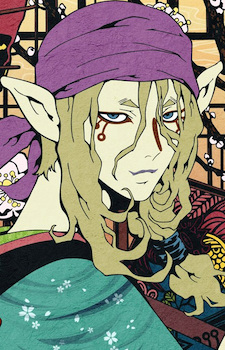
This is like Die Hard, but with angry spirits, a medicine seller, in Edo-period Japan. Ok, so it's not like Die Hard at all then. Well, actually... They both involve antagonists, usually out to terrorize or for revenge, who force the hero to hole themselves up in an interior location with troublesome civilians, while using their wits and skills to battle to an explosive and emotional resolution. See? Here's where Mononoke carves itself an identity to make itself stand out from John McClane's frolics with Euro-trash in cramped quarters: (we're all ignoring the 4th instalment, right?) Mononoke is a visual splatter of psychedelic imagery that's like thecreation of a prodigious savant child born from Stanley Kubrick, or Darren Aronofsky, take your pick. The colours just jump out at you no matter where the scene is or what's occurring, they're alive and part of the narrative. A narrative that's kept lively through snappy editing. Scene and shot transitions flow, snake, and leap all over the place, using every cinematic method available. There's even flip-book mimickery; character reactions told through pages turning one after another furiously, for no reason other than to jar the viewer and emphasise the stark dialogue being delivered. Our hero, the medicine seller with ears from Middle-earth, surely has stark delivery. Only willing to speak when he has a reason to, if only more anime characters were like this. There's no filler to be seen in this show, whether it's absent from the dialogue or story. But for a show so dependant on scaring the viewer witless through bizarre imagery, narrative coherency isn't so important, mood is. The use of colour is actually a really smart way to affect our mood, because scenes that are so bright and vivid actually work in a way that you wouldn't expect. "Why am I getting freaked out by this empty room, even though it’s decorated so colourfully? Oh wait, because Yasaharu Takanashi's score is making creepy noises and I thought I just saw an Oompa Loompa in that corner for a moment but it must have been my imagination..." The set-up to each story arc is eerie, the climax visceral, and the resolution always emotional. Mononoke is a brilliantly written, edited, and directed Edo-period-and-beyond horror that is inspiring in its design and delivery. 12 episodes. One medicine seller. The odds are against Kusuriuri. That's just the way he likes it.
Ранг
#219
Популярность
#746
Участники
364,772
В избранном
9,220
Эпизоды
12