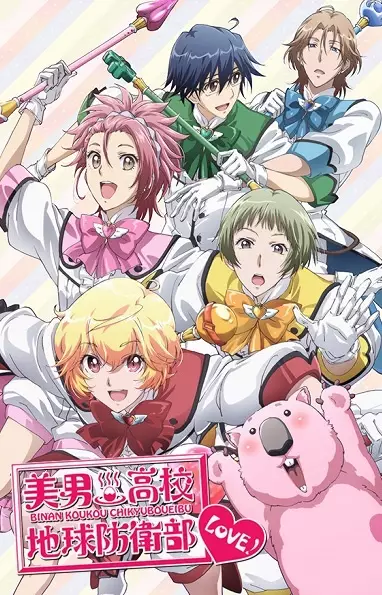
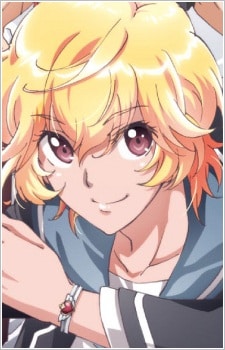

Cute High Earth Defense Club LOVE!
美男高校地球防衛部LOVE!
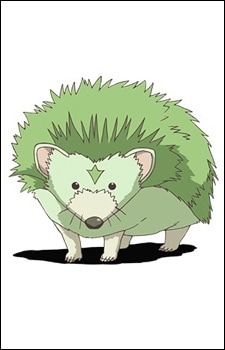
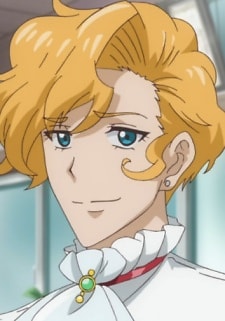
Why should girls get to have all the fun? These magical boys are here to save the world from the loveless... at least that's what the pink wombat who gives them their magical powers wants them to do. In Binan Koukou Chikyuu Bouei-bu Love!, the main characters are the members of the "Earth Defense Club" at the Binan High School, though all they really want to do is hang out, goof off, and relax at the nearby Kurotama Bath. One fateful day, though, a pink wombat appears out of nowhere and forces these five high school students to become "Battle Lovers" and protect Earth from a trio of villains who are taking orders from a green hedgehog. Over the course of the series, the Battle Lovers will take on a variety of fiends, including the chikuwabu monster, a chopstick phantom, a monster remote control, and plenty more strange enemies! Will the heirs to the throne of love be able to protect Earth from those who want to destroy love? Or will the Earth Conquest Club fill the world with hate?
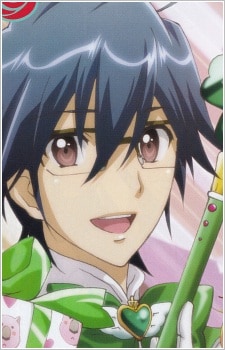
Главный
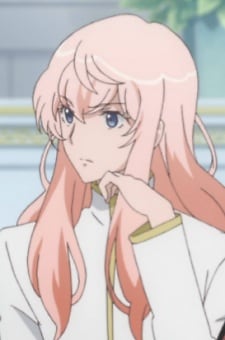
Главный
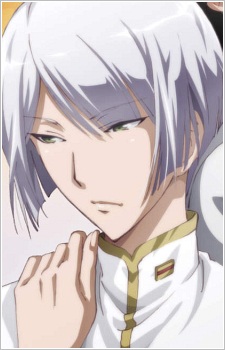
Главный
Главный
Главный
Главный
Второстепенный
Второстепенный
Второстепенный
Второстепенный
Второстепенный
somaisbatman
March 24, 2015
I've noticed a trend with myanimelist. Works of anime that act as parodies of genres are often taken way too seriously and get poor overall ratings. Binan, which we will henceforth refer to as Magical Boys, suffered this treatment as well. Up until the final episode aired, this show was stuck with a 6.7 rating. Does it really deserve this little? Nope, it's actually one of the best things that aired this winter. Story: 7/10 Magical Boys is very cyclical up until the very end, and I think that's why it turned a lot of people off initially. For the most part, it uses a fight-of-the-week setup,an obvious homage to the magical girl genre, but just like in those shows, this can lead to a predictable, repetitive show. However, each enemy is unique and the last episode throws a spectacular plot twist, so if you can put up with this style you'll be in for a good time. Art: 8/10 Very colorful overall, the art in this show is consistent and bubbly. It's very pleasant, and all of the characters are pretty much color-coded so you'll never get confused. Sound: 7/10 I like the opening, it's very peppy and catchy. The same can't be said for the in-show music, which was mostly forgettable, and some tracks just keep getting used over and over, another homage to the magical girl genre that comes out as a pain instead of nostalgia. Character: 9/10 When first introduced, the main characters are as one-dimensional as can be. Red magical boy loves snuggling, blue magical boy is lazy, pink magical boy is all about girls, yellow magical boy loves money, and green magical boy has no traits whatsoever that I remember. Some characters are introduced and immediately established as the villains. So why did I give this a 9/10? All of the characters are vividly memorable, and bonds between them develop or are revealed throughout the series. All of the side characters shine as well. My personal favorites are Goura, red magical boy's older brother who runs the hot springs, and Mr. Tawarayama, the magical boy's teacher who is probably dead. All of these characters are designed to have one strong trait, and the show plays to this very well, and there wasn't a single character I didn't like by the end (except for the photography club, those jerks) Enjoyment: 8/10 Like its magical girl predecessors, Magical Boys has some predictable fight scenes. Those aren't why I stuck around though. A good portion of each episode is banter between the characters, and it's often pretty funny or just bizarre, and often segues into the villain's motive. Speaking of villains, they're diverse and just as strange as the conversations. Overall: 8/10 Magical Boys is a much better experience then many people expected it to be. You may come for the mahou shojo parody, but you'll stick around for the general wittiness, self-aware humor, and overall comfy atmosphere that emerges from watching this show.
Второстепенный
rampao
March 27, 2015
I don't always write a review, but when I do, it's for THE Magical Boys anime, Binan Kokou Chikyuu Bouei-bu! Love! (Handsome High Earth Defense Club! Love!) I first saw this anime as a recommendation to another anime that I've recently watched, and I was aghast upon seeing bishounens wearing frilly clothes and magic wands. Then my heart skipped a beat. Could it be? Yes! It is! Finally, a Mahou (Bi)Shounen anime! I quickly went to Youtube and searched for their transformations, and for the next few minutes, I found myself laughing and shaking my head at the ridiculous scene that followed. At first, I wasquite reluctant to watch it since it might feel awkward watching pretty boys undressing and magically transforming into magical warriors, but hey, I gave episode 1 a try, and from there, I knew it was sold. I honestly felt it was too ridiculous and outrageous to be true, but it is! And that's the name of the game for this anime, outrageous! Being an affectionate parody of the mahou shojou genre, it doesn't take itself seriously, often breaking the fourth wall and (surprisingly) the characters themselves blurt out what the watchers are thinking. And it's a comedy anime directed by the same person who directed Nichibros and Gintama too! STORY: 7 The premise is really simple. Like the synopsis says, it's about the tale of five high school boys who transform into magical warriors known as Battle Lovers to fight off monsters. It takes on an episodic pattern with a different monster per week to defeat. But what pushed me to give it a 7 is the way it slowly presents small details every week (along with the usual monster-of-the-week-routine) that all culminates to the story's climax. It's like dangling something so obvious in front of you that you disregard it because it's too outrageous, and by the time you reach the end, you'd go "Wooooaaah!". ART: 8 Nothing much to say here. The colors were lively and refreshing, not too painful to the eyes. It gives you a relaxed yet vibrant feel. The background is simple yet well-drawn. And of course, all the characters are very pretty (it's called Handsome High for a reason), even the side characters have unique designs. SOUND: 8 Nothing special, but I gave it an 8 because the seiyuus did a good job with their characters, giving them a unique touch. Of course, not to mention the catchy and upbeat OP, the emotional ED, and the epic background music in climax scenes. And then there's the bubbly music when our heroes are transforming. CHARACTER: 10 The show's biggest strength. Each character is unique in their own way. They're conveniently color-coded for easy remembering, but what makes them unique are their quirks. Quirks taken up to eleven. Like seriously twisted quirks. Of course, another aspect is that the characters themselves comment on the absurdity of the things happening around them, that they tend to read the viewers' mind and break the fourth wall, making them lovable and enjoyable to watch. At first, they seemed one dimensional but as the show progresses, they prove to be more than just a one-sided character, they have back stories of their own (specially Atsushi and Kinshiro). And one thing I liked about this is that ALL the characters had something to do with the plot, and that each character is equally important. ENJOYMENT: 10 I really enjoyed this ride called Binan Kokou Chikyuu Bouei-bu! Love! From the outrageous and hilarious humor, to the self-conscious characters, to the heartstring-tugging scenes. There's no deep plot behind the silly facade, and that's what makes it good. It's so outrageous and (as I've said before) it doesn't take itself seriously, making it a light-hearted and memorable show. I've still got a lot of things to say about this anime, and those feelings can't be written in words. I really enjoyed the twelve episodes of pure hilarity, and would jump in joy and shed tears of happiness if they gave this show a season 2. It's really one of the underrated Winter Anime of 2015 (of course it's overshadowed by the other anime of the season) and I can truly say it's one of those hidden gems. Love Forever! Love out! PS: If you don't mind watching bishies bathing together and being all close and friendship and stuff, and is looking for a good laugh, then this show is for you. If you think you can't handle the show's self-conscious shipping (yeah, the characters at one point ship themselves), then stay clear.
chesudesu
March 24, 2015
Cute High Earth Defense Club LOVE! is a parody on the mahou shoujo genre. The elements it mocks are obvious and the characters actually acknowledge it - unlikely heroes flashily transforming into their ridiculous costumes with out-of-this-world powers battling monsters-of-the-week while upholding their valiant virtues of love and friendship. As a quirky deconstruction of the style, the series manages to pull it off with as few hitches as possible. Even the construction of the episodes is a parody. It is all in the episodic nature of the monster-of-the-week ploy, leaving a few hints of the over-all plot until unveiling it, albeit slowly, in last few episodes,and, of course, the all-too-grand climatic final episode. It's not worth enjoying if it is taken too seriously. After all, Boueibu is just a bunch of boys randomly given powers of love to save the Earth from hatred. The design and animation could have been more flashy - as flashy as Sailor Moon and Free! combined. At the very least, it could be described as fitting to Boueibu's identity as a parody of a genre. The surprise, however, is the music. I expected something decent at best but I was amazed at the remarkable effort given to the sound. Boueibu is what one would call a "basic" anime. While it is "basic", it nevertheless captures our attention with the charm of its characters and the wit of the script. The combination of the two elements is refreshing despite being only a cover-up for the series' identity as a parody with nothing else to work on save for the fact that it has magical boys instead of magical girls. It unexpectedly leaves you rolling on the floor or facepalming while laughing at its ludicrousness. There is an irony in Boueibu in that one would have to take it seriously in order to realize that it's not to be taken seriously. It serves as an example to the anime audience to remind them of how one can still enjoy a series without taking it too seriously. It doesn't need you to think about ulterior motives or predict courses of action. Boueibu only requires one to pay attention. It doesn't stand out too much but at least it does. Cute High Earth Defense Club LOVE! is a half lighthearted and half gut-busting comedy and I easily recommend it to anyone who seeks such.
TheBrainintheJar
August 13, 2016
I’m glad this exists, but not sure how I feel about it besides that. We need an anime like this. Everyone talks about how the male point of view is dominant in media. Earth Defense Club provides plenty of fanservice for females. It’s a gloriously feminine anime, all hearts and hot boys. It also has a wink-wink satirical element, which often goes against it. The attempt at being gloriously feminine is fantastic. It’s not even moe. The character design is useful to note the difference between male power fantasies, and females’ fantasies about guys. Ultra-mascular guys aren’t fanservice for females, but for males. The strength and endurancethey show isn’t automatically sexually attractive, but something males wish for themselves. The design of the guys here isn’t macho. It’s pretty in a distinct females’-fantasy way. There is elegance and softness to their looks. It is not genderbending. The looks simply have sex appeal and confidence to them, but also a naturalness. A developed body like in JoJo clearly shows the person worked on it. An effortless body like of these characters points to superior genes. These looks are also friendly, which is necessary for sex appeal. For a change, the male design is meant to appeal to females. It’s also good when you don’t consider this factor. The purpose of character design is to express the characters’ traits, and they’re all designed according to their personality. Yumoto’s carelessness and love for cuteness is in his wide-eyes and childish hair. Yufuin has the indifferent eyes of a lazy person. Since everyone is meant to be sexually attractive, there’s no variety in body structure. However, even a small difference in the eyes – order-obsessed Kin’s narrow ones, beauty lover Akoya’s feminine ones – tell us enough. Once you go past the visuals, it becomes unstable. Is it a satire of magical girl? Or does it take the female catering of the genre to its extreme? It cannot decide between the two. It cannot decide whether it wants to reveal the absurdities, or have fun with the cliches. Both elements fight, and often negate each other. The enemies are too silly to take seriously, but they’re never wild enough. They’re wild enough to be considered ‘satirical’, but it’s mostly tokenism. The transformation scenes are fantastic and well-done. After they end the characters have to get self-aware about their customes. It’s confusing. Am I supposed to enjoy the hot-boy-and-love world, or to mock it? This balance between satire and tribute is nearly impossible. There is a way to accomplish it, but that means not being satirical. You take the genre’s cliches and push them to the limit in order to see how much Coolness Factor you can gain. This approach must never become self-aware. The appeal of it is that the creators don’t care about how ridiculous they get. Earth Defense Club cares too much about how cool it is. Its detachment also harms the character development. At their core, they’re great. After a few episodes, you notice that half of them don’t offer much beyond their hobbies. Some are well-written, with interests that match their personality. Yumoto, Yufuin and Ryuu don’t just name-drop their obsession. They have their own unique reactions to every situation (Yufuin’s indifference, Ryuu’s aggression). Naruko, for the most part, doesn’t do anything but reminds the viewers he’s into money. The enemies often have an inner conflict, a motivation that makes them evil. This is the basic and brilliant approach to creating antagonists. The show never builds on it though. Besides ranting for a while, they don’t do much. Their monologues aren’t funny or have any insight into why they became monsters. At first, it’s exciting how every villain of the week has clear motivations. It doesn’t manner when they end up functioning in the same manner – rant for a while and then get Love Attacked. The last episode contains a cool twists. The creators use it like a person who just won a million dollars buying 1000 bottls of craft beers. Craft beers are awesome, but if you won a million dollars there are better ways to spend it. The twist is cool, and made the wink-wink satire makes sense. However, they literally do nothing with it. It’s revealed there was something bigger than conquering the earth, power up and defeat the big bad. The mere existence of the show is enough to make it worthwhile. Not everyday you see an anime about hot magical boys. It had a chance to do something new, to show a gloriously feminine show and be as fun as JoJo. Sadly, in the end it’s still insecure about hearts and pink and love and hot boys. The novelty value is enough to carry it for 12 episodes but I can’t imagine this working as a second season. 2.5 hot boys out of 5
BanjoTheBear
June 12, 2015
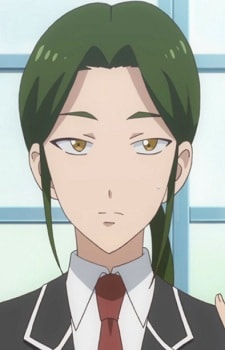
(This has been adapted from my blog/reddit thread. Spoilers ahead!) Binan Koukou Chikyuu Bouei-bu LOVE!, contrary to its name, showcases a lot of hate, or at the minimum, dislike. Be it those around you or a pair of chopsticks, the show demonstrates that people often have those aspects of life that somehow seem to rub us the wrong way. Personally speaking, I’m not too fond of the Beatles’ music. Their style just doesn’t do anything for me. But where negative emotions are found, there is always positive thinking just around the corner. That is, if nothing else, the show provides us with the message that “allyou need is love.” STORY Earth Defense Club follows five high school guys – Yumoto Hakone, Atsushi Kinugawa, Io Naruko, En Yufuin, and Ryuu Zaou – who are one day visited by an alien life-form known as Wombat. Upon his arrival, the men are forced to become the “Battle Lovers,” using their newfound powers to bring warmth and happiness to their fellow students turned monsters. “Magical girl” anime are a staple of the medium, and are really only possible under its format. Thus, Earth Defense Club capitalizes on this very idea. En, Yumoto, and the rest are themselves “magical girls,” but it becomes pretty apparent that the show isn’t truly about this subset of anime. Instead, it’s the parody that it generates that gives it its distinct edge. The shiny transformations are plenty, the corny one-liners are in full-force, and the enemy happens to be winning until the group (eventually) unleashes their super, “all together now” move to save the day. It knows exactly what it wants to do at all points throughout the series, because it targets so many different facets of what it is poking fun at. Delving into so many areas that make up this genre, though, leads to an inherent problem: distinguishing the intentional parody from what it is legitimately trying to do. Because calling everything that the anime does “as part of the parody” makes it seem like it can do whatever it wants without ever being in the wrong. For example, the show is quite repetitive in its presentation, with a new monster to defeat per episode. The lead up to the victory might be slightly different – a small argument between friends disjoints the group, the enemy is defeated literally seconds after arriving instead of prolonging the fight, etc. – but witnessing the same conclusions day-in and day-out don’t reinforce the message of love it’s trying to get across. Instead, it only hurts it by revealing its inability to explore all sides to the subject it is tackling. On the other hand, the anime’s “plot twist” at the end coincides with its original goals of being not just light-hearted but carefree in terms of coherency. By being so ludicrous in its narrative, it allows the audience to understand that the show still understands where it initially came from. The aforementioned repetition is a bit more rampant than the unique scenarios like the conclusion, so the overall effectiveness at being a parody isn’t as strong as it could have potentially been. Still, not all of the repetition works against itself. More specifically, there are two venues in which it leans in its favor: the casual conversations and the bathhouse. The former is strange due to how normal it comes off as being. The club members often have “Seinfeld” discussions, or talks involving the most basic of concepts. They might make a comment about the food they like to eat, the interests they have, or about what it means to be mature. While the dichotomy between the down-to-earth talks and the silly, “magical girl” moments contrasts nicely, it’s the connection between the two that’s the most important. For the “Battle Lovers” might seem to have random conversations when in fact what they say between each other directly leads into the problems at hand. Meaning their everyday words are not just relatable but contextually relevant, too. The second venue gets a bit more esoteric, but it is alluded to. Looking at the show as a whole, nearly every set of events includes a bathing scene at the bathhouse. Why? Is it just to show the men naked as much as they can? Or is there a deeper meaning? It turns out its both. Of course, it’s supposed to be a bit of fan-service. But there is an important detail about the bathhouse; it’s Yumoto’s and his brother’s. Considering his position as the masthead of the group (and his brother’s former status as the greatest “Battle Lover”), the bathhouse is a metaphor of love. Baths are warm, quite relaxing, and bring about a sense of comfort. Love is the same way; when it’s received, when one bathes in it, it induces heightened elation as a result of these very same feelings. The final move is even entitled “Love Shower,” implying the gentle and water-like substance that love tends to be. Thus, the guys who daily cleansed themselves in the baths they adore so much weren’t just destined to become champions of love; they were surrounded by it for longer than they ever knew. ANIMATION Earth Defense Club doesn’t boast the best of art styles. It’s rather boring to look at, with the same drab club rooms, the overused school locations, and the bathhouse that has nothing but the previously mentioned love-water. In other words, the repetitiveness does not help the anime whatsoever in this circumstance. The character designs are fine for what they are, and may even be a parody on their own. Each of the main characters is only distinguished by their color of hair and for their signature color – En is blue, Atsushi is green, Ryuu is pink, etc. – while in “Battle Lovers” mode. The same can be said for the student council members; each is refined and effeminate when compared to everyone else. The monsters that appear are quirky but such designs work well with the comedy of the show. For instance, the super-handsome, ballerina man becomes a “Black Swan” whereas the creepy, grade-loving nerd becomes a screw due to the ones he apparently has loose in his head. Like the conversations, each isn’t chosen out of thin air; their designs are based on the issues they are facing before they become these evil creatures, proving that there was a nice amount of attention placed here outside of just a variance in color. Actual animation is somewhere slightly below average. Much of the show has the group of guys talking among one another at length. Meaning, lots of sitting without much movement is had. Even when they are taking part in their fights, the variance in abilities is so minimal that the show chooses to reuse the very same scenes as much as it can, highlighting its inability to animate what needs animating. CHARACTERS Much of the cast of Earth Defense Club has nothing else about them besides the personality shtick they each hold. Ryuu loves girls, Io loves money, Yumoto loves to cuddle, En loves to do nothing, and Atsushi loves to be friends with others. Even the student council members have their own loves. The word love is being used frequently here on purpose; it’s the whole point of the anime to make it abundantly clear that there is not only someone willing to give love but also something to love as well. As the introduction stated, there exists parts of the world around us that we don’t particularly like all that much, even if it happens to be irrational. And the students who become the monsters throughout the series have their hatred manifested, but it’s always trumped by the love the club (albeit forcefully) brings to these despondent individuals. In other words, love isn’t an emotion that is lost once less-than-happy feelings are acquired. It’s always around us; it just takes a bit of understanding – and perhaps a joint magical effort – to make said love come true. As for individual character exploration, the anime fails to do this properly. And quite often when it is attempting to have the cast be more than their singular trait it comes off as poorly handled. A situation like En and Atsushi feuding lets us witness the “power of friendship “ – which is itself another parody – is fun, but doesn’t do much for the characters outside of having them realize what they knew all along. And it’s this constant return to the status quo that makes it impossible for the characters to see any sort of important growth. Reiterating at this point, but the repetition that is always used once again prevents the show from giving the guys any sort of meaningful focus since it always ends up the exact same way: small talk in the beginning, fight monster to save them, and end up taking a bath together. Arguably, though, there is a character that does see a change in his person that does follow along with the parody elements of the anime. Kinshirou Kusatsu, the student council president, joins the forces of evil to gain the title of “Chevalier White.” His motivations are left clouded for nearly the entire time outside of hating that which is foolish, wanting to eradicate anything that, to him, is a blemish on this planet. While his behavior is quite arrogant, there are hints of something kinder: the ending theme and specific parts of the show reference a previous relationship between him and Atsushi. Everything eventually comes to light; Kinshirou believed to have lost his friendship with Atsushi thanks to some curry, holding a years-long grudge against his previous best friend. It’s absolutely silly that their division was caused by a simple meal. This not only reinforces the notion that we as people have some rather strange dislikes but also fits snuggly within the confines of the anime’s already ridiculous premise and direction. Once this massive misunderstanding is cleared up, the show continues down its parody path: the two groups come together to save the Earth from destruction. In the end, everyone lives “happily ever after,” with no amount of curry being able to change this. SOUND The opening theme is actually surprisingly catchy after listening to it quite a few times. The clapping and group-singing work with the orchestral instruments to give a track that is pretty generic but oddly fun to listen to. While it doesn’t cause one to “fall in love” with the piece itself, it’s at least not as lame as much of what the anime normally offers. The ending theme is split; the latter half is pretty interesting due to the increased emotion put behind it but the first half is somewhat slow and boring. But that’s sort of the point: it’s in essence, and as was discussed slightly earlier, a “love song” from Kinshirou to his former friend Atsushi. Sadly for the track, though, nobody is going to be missing it any time soon. The soundtrack is rather forgettable, being used mostly for simple background music as opposed to setting any sort of mood or being worthy of a replay. The tracks themselves are usually calm and dainty during downtime and magical sounding when the guys embark on their escapades. But nothing in particular is significant and the music isn’t lovely to hear, making it a less-than-stellar OST overall. As far as voice-acting is concerned, the performances were average at best. A special shout-out is deserved for Kazutomi Yamamoto as Yumoto for his somewhat feminine voice for the peppy, happy-go-lucky, and always energetic kid. ENJOYMENT When first getting into this one, I knew it would be strange. I can’t say I’m a huge fan of the “magical girl” genre, but the show did its best at making it funny and comedic. The novelty though quickly wore off the further along it went, with the “same” enemies being dealt with and having to sit through Yumoto’s grating personality. Many of the jokes rarely brought about laughter because everything else around it was just not good. However, there was one, recurring joke that usually managed to make me smile. And that was Mr. Tawarayama. When the show often forgot or remembered him, combined with his sickly status, it made for some pretty entertaining scenes. Better still were the tongue-in-cheek reminders of his condition when the show would pan over the clubroom with their teacher slumped over in the corner not doing much of anything because he was quite literally dead. The final joke was even based on the teacher, giving the anime as funny of a send-off as it could hope to attain. Binan Koukou Chikyuu Bouei-bu LOVE! is a pretty intriguing parody that is unfortunately dragged down by everything else around it. The characters are weak, the art is lackluster, and the music is not worth mentioning. Despite all of the love the Earth Defense Club provides, this one does not get, or deserve, love of its own. SUMMARY Story: Good, nice parody on “magical girls” that utilizes some of its repetition to its advantage Animation: Bad, boring art style, purposeful monster designs, below average actual animation Characters: Bad, one-dimensional characters that exemplify love, little growth due to repetition, but Kinshirou at least follows the themes and parody elements Sound: Bad, okay OP, okay ED, bad soundtrack, average VA work Enjoyment: Bad, the novelty wears off quickly with only Mr. Tawarayama providing the laughs Final Score: 3/10
Ранг
#5558
Популярность
#2576
Участники
87,224
В избранном
548
Эпизоды
12