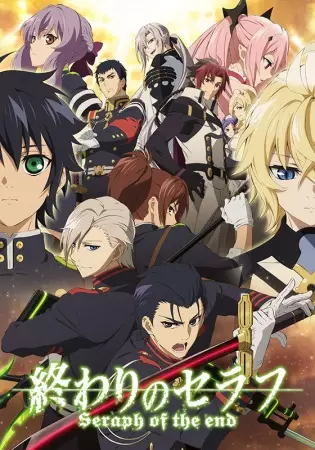
Seraph of the End: Battle in Nagoya
終わりのセラフ 名古屋決戦編
Yuuichirou Hyakuya is finally reunited with his childhood friend Mikaela Hyakuya, whom he had long presumed to be dead. Upon their reunion, however, he discovers that Mikaela has been turned into a vampire. Determined to help his friend, Yuuichirou vows to get stronger so that he can protect Mikaela as well as the comrades in the Moon Demon Company. Kureto Hiiragi receives information that a large group of vampires will be gathering in Nagoya, preparing for their assault on the Imperial Demon Army's main forces in Tokyo. Led by Guren Ichinose, Yuuichirou's team is one of many selected to intercept and eliminate the vampire nobles. With the Nagoya mission quickly approaching, the members of Shinoa squad continue to work towards fully mastering their weapons, while learning how to improve their teamwork. Yuuichirou must gain the power he needs to slay the nobles and save his best friend, before he succumbs to the demon of the Cursed Gear. [Written by MAL Rewrite]
Главный
Главный
Главный
Главный
Главный
Главный
Главный
Второстепенный
Второстепенный
Второстепенный
Второстепенный
bananasplitta
January 23, 2016
The Story: 10/10 Why? Well, the storyline is good! Alot of action, less talking. Plus family love? Love how they made the story! Art: 10/10 Really detailed and good artwork! The background is really nice and detailed. Sound: 10/10 Good sound effect, the opening is really good. Character: 10/10Good-looking. Other animes made the characters weird while these characters are cute and handsome! Its really amazing how they made their outfit and stuff. Enjoyment: 10/10 I'm new to this story and it took me 2 days to complete season 1 and 2. Yup 2 seasons in 2 days. This is very enjoyable Overall: 10/10 This. Story. Is. Awesome. Hope there's season 3!
ZephSilver
December 28, 2015
Второстепенный
Generic: such a simple word, yet one that can also encapsulate a great deal of information with its utterance. Simply attach it to the title of a show and it works as a description without any need for further elaboration. Just say "it's generic" and a picture is immediately imprinted onto the minds of the audience as to what is to be expected. It's even better saying it out loud, follow after me and let's say it together: "Owari no Seraph is generic!" Now doesn't that just roll off the tongue with so much ease? Fits like a glove doesn't it? It's like the word itself wastailor-made for this show. And perhaps that word is all that's needed to sum up this series. There's really no change when it comes to this ill-conceived hogwash of clichés and overused tropes. It's still a poor man's version of better shounen stories, it's still subpar in quality, and it's still an intoxicating pile of throw-away excerpts from better-established premises and ideas. Owari no Seraph is the "How to make a Basic Shounen for Dummies" in visual format. If 1st season didn't hammer that point in, then this season surely made sure to get the job done. But I guess there is one noticeable change worth noting, and that's that the show somehow manages to get worse. Through the magic of fujoshi bait, God awful writing and the power of friendship, this anime becomes a firework display of stupidity rarely achieved by many. It pushes forward into the throw-away abyss at breakneck speeds. And in its own way, it succeeds. It has proven that when you really try hard enough, when you really push long enough, and when you really care enough, you can enter even denser shounen bullshit territory. Ladies and gentlemen, I present to you "Generic: the anime." Picking up from where we left off, we follow our protagonist MustProtectMyFamily-kun and the squadron of vampire slayers, as they gear up for an impending all-out battle with the vampires, in what is to be an attempt to regain control of Earth for the sake of humanity's survival. And while all this is going on, in the background, there's an even more sinister plan being conjured up by ImTheObviousBadGuy-sama and his cohorts. Now the setup for this season isn't all that bad, in fact, it's a traditional one that, if done right, can be quite rewarding to watch unfold. It's the classic clash of ideals, where opposition reaches a breaking point of unreachable compromise. The end all be all fight where the stakes are set on the highest pedestal. A Zero-sum dice roll, where only one side can walk away rewarded. These are the kind of stories that litter literature, cinema and TV on constant rotation, but despite that, can still offer up the same thrills and chair-gripping engagement expected from the best of them. But even when considering the long shelf-life that these kinds of stories offer, if it's poorly written, no amount of the garnishing and repacking can be done to salvage it. And to no one's surprise, Owari no Seraph isn't going to be a show that defies that unspoken rule. You see, the problem with Seraph isn't the premise or idea, but rather the piss poor execution of it. The show just doesn't seem to have the proper comprehension of what is needed for it to make this kind of story work. Its ineptitude runs deep into the core foundation of the show, from the garish narrative decisions to the downright terrible plot conveniences tossed in to bail itself out of a tight squeeze. Every turn and corner lead into another questionable writing decision that really exposes the lack of foresight on the part of the creator, and improper planning on the part of the scriptwriters. Throughout the show's run-time, this leads to numerous situations where our characters come face to face with death, only to have a last-minute dues ex machina tossed in to fish them out of troubled water. And this doesn't just happen a few times, it happens in an endless cycle, most notably with our main protagonist MustProtectMyFamily-kun, who inexplicably survives more shit than even what's possible with the aid of basic plot armor. It's like he himself becomes the embodiment plot armor, to the point where his existence is met with guaranteed immunity, regardless of consequence. This creates some of the most uninspired character struggle imaginable. There is zero tension to a story that goes out of its way to perform back flips around its lead. But this isn't only limited to him, almost everyone that's given a name and a back-story is automatically in the safe-zone, even if they're stabbed through vital organs. I can't properly explain this without taking a special mention of the show's ending. For the sake of avoiding spoilers, just pay attention to the numerous times where our main characters not only live through death marker injuries but also walk it off like it wasn't that big of a deal, it's quite laughable. The only ones 'biting the bullet' are characters that are clearly introduced for the sake of dying a few episodes later. The moment they're introduced, a death flag is planted smack dab on their forehead. It's an old trick that wasn't good in other stories and isn't good here either. But Owari no Seraph S2 isn't all bad, if anything, there was a noticeable improvement in its art and animation. The fights carry more weight behind it (non-figuratively speaking), the character models remained far more consistent from frame to frame, and the issue regarding the flat backgrounds are better worked around. It's a more palatable experience overall, and that, at the very least, deserves some credit. Also, the color choices seemed better implemented. For example, the reds (burgundy to be more specific) and greens were far more eye-catching than the often acid washed look of the 1st season. It wasn't that big of a change but it was enough to be noticed on a panel to panel comparison. As far as the soundtrack goes, most of the content from season one finds itself worked back into this season. If you liked S1's music score then S2 should suffice. However, the opening wasn't as instantaneous as the first. It feels more commonplace in comparison to the harmonious balance found between the vocals and instruments of the 1st season's musical number. Not a bad opening per se, just not as catchy as bellowing out "I'LL BE THERE, HOLD ON, THEY'LL CHANGE US SOMEHOW, SO WHERE ARE YOU NOWWW?", but it still gets the job done in its own way. Not singing in the shower level, but hey, music is subjective, so that depends entirely on the listener. Owari no Seraph's 2nd season does improve a few aspects that 1st season was lacking but it also implemented things that were far worse as well. It took one step forward only to take two steps back. It's not the most aggravating title to watch but at the same time, it doesn't have a reason to exist (outside of Wit Studio milking a fanbase it helped establish). Enjoyment: 5/10 Despite the more noticeable issues this season had in comparison to the 1st, I still can't bring myself to hate this franchise. It's really just a soulless product that comes and goes without registering any sort of response from me. The fights were better put-together but the narrative was more stupid. The animation was more eye-catching but the content being animated was dumb. In a way, it just balanced itself out. A series that's forever just "ok" in my head. Overall: 3.5/10 Owari no Seraph is a show that's either passable or outright rejected betting on one factor, and that's personal experience. Like I've stated in my season one review, this anime serves as a gateway title to help you get a little insight into the medium's norm and season two only furthers that trend. But where the line is drawn is that factor, that personal experience. If you've been an active follower of anime for an extended period of time, you've undoubtedly seen numerous titles that play out in the exact same order to what Owari offers. And from that vast selection, you've probably seen it play out far better as well. So with that in mind, this anime isn't made for long time anime viewers, it's made for the bright-eyed newcomers who haven't consumed enough of these fast food titles to grow sick of them yet. Owari no Seraph can serve as a title to get others into the medium, but as far as those already steadfast in it, I cannot in good conscience recommend this John Smith: serial number 28927.
Digitamer101
December 9, 2015
Micro review: The characters are shallow but the story is interesting. Do not watch this anime if you don't like waiting for answers to plot points. Do not watch this if you only plan to watch a few at a time. This anime requires a binge session to finish it as it can get tedious, but it is (kinda) worth it. Story: 5 Art: 7 Sound: 7 Characters: 2Enjoyment: 5 I have now finished this anime and as such my review has changed, slightly. I will leave my old review up as I still agree with it as i wrote it, 9 episodes in. Go to the bottom for full season review. Up to episode 9: [Such a waste of an intriguing plot idea and character (Mika) The first season was not the best, I will admit. Yet I felt that the story had promise and Mika was way underdeveloped. The second season is everything that is wrong with the first on steroids, all beefed up and loud. One dimensional characters that are just the tropes of typical animes. No character development or really plot progression. All that happens could be summed up in a fraction of the time if there were not purely random and unexplained scenes mixed with boring drawn out flashbacks. The only thing that kept me watching was the story, and I found out that it is really not all that complex after reading a summery. The characters are stuck in a time paradox. One where any actual character development is stuck and all that they can do is spout the same exact lines over and over. Art and sound are good. Yet, as hard as you try to dress up a pile of trash to make it look fabulous, it's still garbage. Only watch if you need anything to watch and have no better options to binge. If the story is grabbing you then look it up online] Full season: On a whim I decided to finish this anime late one night, and I am glad I did. Kinda. It is still not the best anime by any shot but I can kinda see it going somewhere next season, so I hold out hope there. The main issue with it is that it is trying to be the next big hit anime *cough (Attack On Titan) cough*, but FAILS hard. It has a great story, I knew this from the start; this was why I even continued to watch it and why I finished it. Too bad the characters and writers let the story down. There are simply too many mysteries in the story and more keep coming the longer you watch. With no answers to solve the past questions you just end up lost in what is going on always. Characters motivations are there, but we have not got any idea what they are. This is the shows biggest failing, the writers are writing in too many character traits without fleshing out the others added before. This leaves you with a confusing mess of a "family" of characters whose motivations are one dimensional and come off as just lame. Read the manga if you have the itch for answers that I have after finishing. Maybe it is the better read, or at least it is more complete at this point.
Stark700
December 26, 2015
Owari no Seraph is back. Initially, I was disappointed with the first season. With heavy amounts of exposition and lack of charisma for quite a bit of episodes, my expectations going into the sequel wasn’t high. However, season 2 turned out to be pleasantly different. No, I wasn’t expecting this to be a significant improvement but it does set its foot a bit further than mediocrity. Branded as a sequel, it’s absolutely imperative to be familiar with the first season to get the full experience. As the title implies, the majority of the second season takes place in Nagoya, a city on the surface that isalso home to noble vampires. Originally, it was actually home to humans until the Apocalypse. What is the Apocalypse? For a brief recap, it’s pretty much when a lethal epidemic wiped out a major part of humanity years before the start of the show. From this event, vampires became the rulers and treats human like livestock while also keeping some human children alive for their own purpose. One of these children named Yuichiro Hyakuya managed to escape and was taken in by the Japanese Imperial Demon Army, a group of resistance who plans to liberate themselves from the vampires’ rule. Flash forward to present day and we got a resistance group fighting not for pride or liberty. But for survival. Adapted from the manga, the second season is actually quite faithful or at least captures the magic of the story especially in the first 10 episodes. The first season had a ridiculous amount of info dump and exposition, so much with the buildup and to the point that it became distracting. Luckily, this sequel is more about the action and the execution. A few concepts in this season deals with how humans desperately fight for survival in the face of unimaginable circumstances, the higher-ups of the Japanese Imperial Army taking a keen interest in Yu, and Yu’s own personal goal to make Mika into a normal human again after realizing that he has turned into a vampire; the very thing he loathes. A lot of the episodes also deals with interpersonal problems and how certain characters such as Shinoa bears responsibility for herself and others. In the face of danger, characters make decisions that gambles on life and death. Some even defy orders for their own personal reasons. As such, expect the sequel to bulk emotional drama as well. The latter half of the show will easily get the viewers to recognize how dangerous the vampire Nobles can be. Death is reality and the humans realizes that whole earthly. While there is a lot of battle on the frontlines, the show also seems to enforce human drama. The most prominent would be the relationship between Yu and Mika. The latter is no longer human while Yu tries to restore him back to normal. Their conversation unites them with both delightful and painful memories of the past. Just do note that there’s a bit of feeling of subtle BL that fans likes to play their minds with in one of these episodes. While the show isn’t actually a BL, it’s easy to fantasize after seeing the deep chemistry between Yu and Mika. Other characters in the series also makes an impact of various degrees. Shinoa’s character is much more serious as she has a lot of burden on her shoulders. Meanwhile, Guren shows what his comrades means to him when faced against unprecedented odds on the frontlines. What’s much more interesting though is the presence of the Hiragi family. Kureto, the heir of the family’s current heir, is a character that is a bit different from his comrades. With a cold personality and strong emphasis to accomplish any task at whatever the cost, he also often demands respects from others. To me, he is like the anti-thesis of the main characters. Although he is fighting for the good of mankind, his ways of doing so often puts odds against his own comrades. One could even speculate that he is a manipulative individual as he assigns Guren’s group into near impossible missions. Speaking of family, it still remains a main theme throughout the second season. Besides Yu and Mika, the Moon Demon Company still has a prominent presence. Yu treats it like his own family and often seeks to protect them. Even if this takes toll on his own body and spirit, Yu is selfless in nature. Obviously, this also translates into his desire to turn Mika back to what he was before – a human. The way the sequel is directed improves as each episode adds more and more to the main themes and concepts. Even the storytelling gets more interesting with the developments despite some pacing issues and omitting some parts of the manga. On the negative side, the antagonists of the show still remains dense and stereotypical. Characters like Crowley hardly gets any characterization while most of the fights against the strongest vampires lacks excitement. (most of them are more like one sided fights). Furthermore, Kuel continuously hides secrets from others and we don’t get the chance to know her true purpose. I suppose Mika is more like an anti-hero in this season although his actions are questionable with his vampire nature. But in retrospect, the antagonists aren’t appealing either in character or role. Wit Studio adapts the sequel although the artwork hardly improved. The character designs still looks essentially the same as they did for the previous season although I like the way the Hiiragi family members are designed. Kureto in particular expresses a ruthless nature that is decorated quite well. In addition, most of the demons has a credible design to induce fear. We also get the introduction of some new noble family members, antagonists that looks even more menacing than before. The battles they participates in are some of the main highlights of the sequel as camera angles and action scenes features them quite well. Match that with the stereo soundtrack and we got quite a season. The OP and ED theme songs also conveys what the show is capable of that gives off more of its atmospheric setting – a battlefield with nothing but potential for destruction and chaos. After taking a breath in and out, I think this second season is an improvement of the previous. It capitalized the main story’s purpose while delivering memorable fights and expressing a variety of emotions. While the technical features still generally remained the same, the show is easily watchable for those looking into some stylistic action. I can’t say for sure that the sequel will be a pleasurable experience for everyone though. It still omits manga material at some parts and can seem a bit too serious for its own good. One particular episode with Yu and Mika in the second half of the show can be uncomfortable to watch for some people. And also, I feel like they stuffed a lot into the finale, perhaps too much and leaves too open. But for all its downsides, the battle in Nagoya will be one to remember.
BanjoTheBear
September 7, 2016
(This review has been adapted from my blog/reddit thread. Spoilers ahead!) A few weeks ago, I shared a meal with my grandparents, brother, and other cousins. During the dinner, we talked about all manner of topics. Our grandfather’s brother named Georgie. The notion that bigger teeth brings beauty later in life. How awesome that grand meatball tasted. At one point, the topic turned to familial connections, the bonds we share with each other. I stated that I would die for them. They are my family, so this statement sounds obvious. At least, I hope it is obvious for most. I sincerely believe it. Strangers pass by. Friends comeand go. But family. Family is forever. Yu of Owari no Seraph: Nagoya Kessen-hen believes the same. Unfortunately for Yu, he does not get to have dinner-made conversations. Instead, he gets an almost abysmal anime. STORY This second season (really the second half to the split-cour) of Owari no Seraph (called Nagoya from here on out) begins shortly after the first season (really the first half). The anime has a glaring issue that persists across most of this season: nothing actually happens. Hyperbole, yes. Events occur and characters move, sure. But the conclusions or outcomes are no doubt insignificant when the bigger picture is looked at. The anime has essentially five main conflicts that occur one after another. The first conflict is Yu’s team contrasted with Makoto’s team. The second is the multi-front battle. The third is the rescue attempt of Guren. The fourth is Yu aiding Mika. And the fifth and final conflict is the angel and demon clash at the end. Each conflict introduces drama, and each conflict does almost nothing. The first conflict is designed to accentuate the inexperience of Yu and the other members. They get beat by Guren and reluctantly accepted by Makoto and his team. A nice approach – except for that fact that Makoto’s team gets decimated over the course of a few episodes. Two members are killed off by some vampires, two others are killed off by the angel-demon contraption, and Makoto is left alone. Meaning the initial comparison has nothing come of it since the (supposedly) less experienced squad moves on without a single loss. The second conflict brings about a lot of action. People die, swords swing, and tension ensues. The purpose of the attack is to wipe out the vampires once and for all. But, as the anime shows, that is all a lie. The attack is nothing more than a sacrifice. In other words, the battling is just the myriad of characters and soldiers stalling for time – they are fighting for nothing. This conflict is hurt further by the audience knowing nothing of the situation. The audience learns next to nothing about the vampire society. The audience learns next to nothing about the behind-the-scenes deception of the vampires and the humans. The audience learns next to nothing about the more otherworldly aspects – namely the angels and demons. The third conflict revolves around getting Guren back after he gets captured. Yu being Yu, he decides to bring the fight to the vampires to save Guren, a man he considers part of his family. The resulting failure of the rescue – the attempt meant, in the end, nothing – is certainly an asinine development. But it is the later betrayal of Guren (regardless of whether he is in control or not) that turn his speeches on camaraderie and family into nothing. Plus, Guren ending up back with the humans means the rescue triply meant nothing. The fourth conflict is arguably the only one that means anything more than nothing. Established in the first half of the split-cour, Mika works to save Yu from the “evil” humans, forcing him to go to impossible lengths to save Yu. Furthermore, the conflict is the only one that exists throughout most of the season leading up to its finale in the grocery store. Mika becoming a vampire, despite fighting off the temptations for years and years, could arguably be more nothing-based drama. But this conflict, compared to the others, actually has a meaningful impact on both the characters involved. The fifth and final conflict is easily the sloppiest. The angel-demon contraption has nothing in terms of context. The vampires and the humans all do nothing as the demon comes forth. Krul Tepes is (supposedly) killed off when she does almost nothing to retaliate. Kazuki does nothing to save his sister despite how much his character is built on his strong relationship with her. Yu essentially resets everything back to how it was before the contraption appeared (minus a few characters), meaning nothing important happened plot-wise. Collectively, the narrative does next to nothing. ANIMATION Nagoya continues, for the most part, the artistic direction and actual animation that it had with its first half. The background art itself still has a painting-like quality to it. While the locations tend to blend together as grays, browns, and blacks, this dreariness contributes nicely to the dreary mood of the anime. Lighting is not as much of a focus, unfortunately, causing the anime to lose an opportunity to further cast darkness over the show. Nagoya’s animated sequences are a mixed bag. Downtime does have some fluidity in eye or head movements, and there are even subtle shifts, such as Shinoa moving her hair out of the way to better hear Yu’s heart or Yu scooching backward while Mika rests in his arms and bites on his neck. Of course, the anime also includes many a battle, yet, despite the swords, axes, and pikes, the anime rarely depicts choreographed fights. As such, the battles become less flashy and more simplistic with lots of cuts or smoke. Considering that the anime touts itself as having action, having these animated sequences be so lackluster adversely affects the anime. However, there are certain sequences that prove Nagoya does not always rest on its laurels. In particular, the sequence where Mika battles through a road of enemies to get to Yu involves a lot of movement, perspective, and coolness. Other sequences, like the final fight between Yu and the demon or Yu and the gang versus the top-hat vampire, while not as involved, make the anime less static than it tends to be otherwise. Lastly, the character designs remain the same as before. Shinoa, Yu, and the other humans are rather plain in design. Some have accessories like bows or glasses. Some have oddly colored hair. But generally their designs are not that intricate. The vampires are more eccentric than the humans, making the vampires’ designs more unique and therefore slightly stronger. For both groups, their actual outfits are decorated with buttons, medals, and other additions. Most interesting of all is the choice of color. The humans wear black attire whereas the vampires wear white. Color symbolism often dictates that black equates to evilness and white equates to goodness. Meaning, having the colors swapped between who one would usually believe the good and bad guys to be induces a subconscious muddying of morality. An idea that, while not explicit, has a presence in the anime. CHARACTERS The characters of Nagoya are difficult to discuss mostly because the anime refuses to properly do much with them – nothingness seeped into the characters, too. Out of the entire cast, only two characters receive adequate attention: Mika and Guren. Mika continues mostly where he left off. The vampires dislike or toy with him, he hates humans, and all he thinks about is Yu – and blood. His refusal to fully turn himself into a vampire by consuming human blood (he has satiated his thirst through Krul Tepes’s blood all this time) begins to consume him, and it is this consumption that Nagoya focuses on with his character for about three-fourths of the season. His inability to control himself, his anger at himself for his urges, and his conflicting feelings towards humans. All the while, he never stops thinking about Yu. His actions always revolve around finding or helping Yu and not disappointing him (by becoming the very creature that Yu hates). Consequently, in what is perhaps the anime’s smartest bit of writing, he and Yu finally reunite when Mika is at his most desperate. I.e., Mika’s thirst for blood and Yu reach an apex. Yu, valuing family above all else (more on this shortly), gives Mika exactly what he wants: himself. Yu shares a private moment with Mika, he gives Mika his blood, and he reassures Mika that Mika will always be family to him – vampire or otherwise. The moment is nice, signifying development of Mika’s character. Afterwards, Mika still has trouble trusting humans, but he at least comes around for Shinoa and the others, turning him into the best character that Nagoya has to offer. Guren is the other prominent character. Outwardly, he is a jerk, a rude and arrogant dude. Inwardly, he cares deeply for his squad mates – perhaps more so than anyone else. Over the course of the season, he leads, he falls, and he “betrays.” Quotes because it technically is not his fault. His weapon had been implied to be difficult to control due to the strength of the spirit possessing it and Guren’s love for said spirit. (Shinoa’s older sister in both cases.) So him succumbing to temptation is not completely out of the question. The real problem with the betrayal is that it (like the story) does next to nothing. Yes, Guren’s tears while in his possessed form indicate that his true self hates the kin-killing monster he becomes. But it serves little purpose. His actions do not drastically affect the outcome of the season. He does not confront major players besides Yu who, in response, just spouts even more dialogue on family. And, most importantly, Guren’s betrayal does nothing for himself. The betrayal (and, indeed, the whole season) does not provide growth for his character whatsoever. To be fair, Guren is humanized through a flashback involving him and Yu. He compares himself to Yu, encouraging him, advising him to live and push on until the day he can fight for the one who needs his help. Shinya, seemingly his best friend, also humanizes Guren indirectly: Guren wholly trusts Shinya, counting on Shinya to save everyone in his stead and proving how good a friend Guren can be. These instances make up for some of the improper handling of his character but not all of it. Now, due to the focus on Mika and Guren (and the focus on a story that does nothing), the rest of the cast is forgotten about. Deeply forgotten about. And that is putting it lightly. Yu starts to leave his him-against-the-world mentality, relying more on his comrades and acting more friendly towards them. However, he still spouts the same dialogue about family over and over. He is certainly consistent in his ideals which deserves a small amount of praise, but he repeats the same thoughts on family ad nauseam, turning him into an annoyance rather than a worthwhile character. He does seem to gain some control of his powers near the end of the season, but, because the angel and demon concepts had gone unexplained up to that point, his control does not make much sense. Shinoa, arguably the most popular character of the anime, loses her edge. In an attempt to mold her into a more serious, reliable leader, the anime cuts down on her smug, snarky attitude – her defining trait. The tradeoff, not surprisingly, failing to work. As a leader, she gets her group into horrible situations and even causes issues (and deaths) for others based on her decisions. And because her smugness heavily disappears, so does her intrigue. And despite her older sister gaining (a minimal amount of) relativity, Shinoa’s overall importance to the anime diminishes. The rest of the main group – Mitsuba, Kimizuki, and Yoichi – are painfully forgotten about. Mitsuba has an older sister that seems to be working for the evil humans, but, similar to Shinoa, that relationship is not expounded on. Kimizuki gets a small moment near the end of the season where his beloved sister, the girl who his entire character revolves around, is subjected to horrific treatment. But when he is thwarted with a single sword stab and when he chooses to abandon his sister without putting up much of a fight, Kimizuki becomes more of a joke than a person. As for Yoichi, he may as well not even exist for how much the anime ignored him. Everybody else cannot be discussed because they are even less prevalent than these three. And as far as themes are concerned, the obvious one is family. Different aspects of family are shown as the season goes on. Yu proves how far people are willing to go for their family when he throws himself into the fray. The commander of the humans proves what happens when one does not care about family. And the notion that family means more than shared blood rings throughout the season. The anime does not explore family on the vampire side, so the theme itself is not as strong as it could have been, but the theme is explored to some overall extent nonetheless. A less obvious theme is that of temptation. Vampires are tempted by blood, and humans are tempted by freedom. But the theme is more nuanced than that. Mika is tempted (indirectly) by Yu. Guren is tempted by his weapon. Yu is tempted by family. For many of the characters, the prospect of attaining their desires drives them forward. To be fair, the theme itself has no outright exploration, but, since the angel-and-demon backdrop exists, the theme of sin – temptation and greed go hand-in-hand – cannot be ignored. Does Mika, Guren, and some themes make up for the incredible amount of other problems the cast have? Barely. Just barely. SOUND The opening track of Nagoya has to be talked about first because of how poor it is. The tone, especially in the beginning, is overly optimistic. As such, it contrasts too much with the dreary mood that the rest of the anime steeps itself in. The song also does not do the vocalist justice. She is either forced to sing in a standard, almost conversational tone or forced to strain for specific notes. The only interesting part of the piece is the otherworldly sound-effect that seems as though it is produced by dropping a piece of metal in an icy cavern. But (obviously) that is not enough to make the OP even remotely worth listening to. The ending track, however, is a lot stronger. The beginning and middle adopt a captivating tone that is simultaneously chilling and beautiful. Varying the pace of the piece also furthers the song’s complexity which in turn furthers its strength. This time, the vocalist can flex her prowess, matching the song’s highs and lows, quicks and slows. The ending lyric is a bit silly – a “Trick Star” does not make much sense in the context of the anime let alone in real life – but, overall, the ED stands as a nice addition to Nagoya. The original soundtrack (expectedly) uses the same kind of music that the first half used. Most of the tracks are filled with drums, triumph, and ominous sound-effects, setting the atmosphere in a manner that befits the oft soldierly show. None of the tracks are particularly noteworthy, however, so they remain as simple additions rather than praiseworthy ones. Voice acting sees a similar fate. Saori Hayami’s feminine voice for Shinoa is still attractive to hear. Miyu Irino as Yu can be a bit grating when he starts pouting or yelling. And Kenichi Suzumura as Crowley coats his words with a childish lilt. The only above average performance comes from Kensho Ono as Mika for the struggle and pain one can hear in his voice. ENJOYMENT This type of show, where the characters are in danger of being killed off or maimed or otherwise needing help, usually gets me. I have to know if the characters are going to be all right because I just do not like being kept in the dark about their safety. And so, I found myself being pulled along by this one. But that was the only trait keeping me interested. I was not a fan of any of the characters. Yu was too annoying; Mika was even more so. Mitsuba, Kimizuki, and Yoichi were barely relevant. Guren was too much of a jerk, and the other vampires were either too arrogant to root for or too lame to take seriously. And since Shinoa lost a lot of her smug, she too was not as fun to follow. The action as well was uninteresting. None of the fights were cool or memorable. In fact, a lot of them blended together, especially when Yu and the humans almost never seemed to win or even succeed in any way. The anime’s comedic moments were sparse. The anime’s drama was not gripping. The anime’s romance could have been more pronounced. I was simply not entertained by the vast majority of what the anime set out to do. Owari no Seraph: Nagoya Kessen-hen has a slew of issues. The story does nothing, the characters are forgotten about, the animation is par for the course, the music likewise so, and, as a whole, it fails to entertain. Family may be forever, but, thankfully, this anime is not. SUMMARY Story: Terrible, so much nothing in the narrative it hurts Animation: Fine, nice background art, okay character designs, and about average actual animation Characters: Bad, themes on family and temptation surround Mika, Guren, and a spectacularly awful rest of the cast Sound: Fine, bad OP, good ED, okay OST, okay VA performances Enjoyment: Bad, the safety of the characters was the only enticing part Final Score: 3/10
Ранг
#1671
Популярность
#252
Участники
849,147
В избранном
3,015
Эпизоды
12