Crest of the Stars
星界の紋章
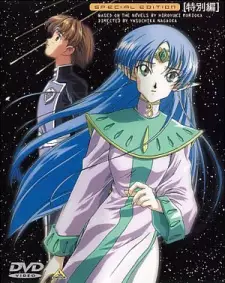
In the distant future, humanity is under attack by the Abh Empire, a race of advanced humanoid beings possessing vastly superior technology. As countless worlds fall to the Abh, mankind establishes the Four Nations Alliance—a resistance faction made up of the United Mankind, the Republic of Greater Alcont, the Federation of Hania, and the People's Sovereign of Union Planets. Seikai no Monshou tells the story of Jinto Linn. When he was young, his father—the president of Martine—sold their world in exchange for a high position in the empire. Now a young count, Jinto must learn the ways of Abh nobility and live among those who subjugated his people. Helping him is Lafiel Abriel, an austere Abh princess whom Jinto quickly befriends. While traveling to Jinto's new school in the Abh homeland, their ship is caught in a violent space battle between the fleets of the Alliance and the Abh. Jinto and Abriel are thrust into the conflict, unaware that this skirmish marks the beginning of a full-scale war between the Abh Empire and mankind. [Written by MAL Rewrite]
Главный
Главный
Второстепенный
Второстепенный
Второстепенный
Второстепенный
Второстепенный
Второстепенный
Второстепенный
Второстепенный
Alexius
July 14, 2008
While it was by far not magnificent in terms of its appearance or in terms of a number of those other elements that we greatly take for advantage from the more recent anime with improved graphics and sound, this older "space drama" drew me in from the first episode, beguiling me with its interesting story and interesting cinematography and storytelling. It's hard-pressed to find an anime like Seikai no Monshou, with its same blend of both serious and entertaining drama and dialogue, and its very intense space battle action scenes. Seikai no Monshou has a story that was both pure in its innocence and compelling inits complexity, featuring a not-so-simple delving into the politics of humankind and interstellar relations, as well as the genetically-enhanced race of the Abh, something just as interesting in its own right. Following closely, none of the episodes (as few as there were with only 13) failed to entertain me and none of them seemed off-key at all, blending into a story that was wrapped up without fail with the final episode, transitioning gently and with ease into the next "season" or series of the saga. Like I said earlier, however, the art was lacking, but even then I was surprised by how much it fit and how little I was distracted by it. It's not something that I would entirely dock many points off for. Too, the cinematography and interesting angles used to portray the story would also help buoy this particular area up. The sound too was fairly "old", but still managed to fit with the show quite well; the voices, on the other hand, were done magnificently (in the subbed version, definitely not the dubbed). The characters in this show, while not completely original, did progress and were developed well, the main two characters and their relationship even more entertaining to watch and feel how well they manage to grow into each other and balance each other out so nicely. They definitely did not feel flat, which I always hate. Overall, this show is one I recommend to anyone who'd like to watch an intellectual sci-fi space show (with no mechas) that brings together politics and drama well enough to both entertain your adrenalin and give some practice for your brain. A great show that I really enjoyed!
darkcommanderq
December 18, 2010
Overview: Crest of the Stars is by far one of my all time favorite anime. That said it is not for everyone. The show is set far into the future were humans have colonized the entire galaxy. The two main characters Jinto and Lafiel are well developed and entertaining to watch. If there is a down side to this show it is that it is rather slow paced, and involves a great deal of dialog. Although there are action scenes in the show, this is not for people with short attention spans. Story: There are two stories taking place in crestof the stars, both of which are connected and continue into the squeals. The first story is that of Jinto and Lafiel, without giving to much away, suffice to say that a good deal of the show focuses on there journey as they are tossed around by the events around them. The second story is that of galactic politics. Both stories are well told, and they intertwine throughout the show. Art: Although it is a bit dated by todays standards the visuals are still as stunning as when i first saw the show several years ago. This is a prime example of aged excellence. Sound: Crest of the stars simply would not be as good a show if not for the amazing orchestra in the background. The opening theme song does get old after a while, but the music during the show is some of the best iv herd in an anime. This is not to say the music in and of itself is superb, but rather the fusion of art, sound and context of what is happening on screen at the moment is masterfully executed. (But the music is the strongest part hear because it invokes powerful emotion in various parts). Charecters: All of the characters in crest of the stars are well portrayed and developed. The show even hints at cast members back ground just to give you more feel for the world. Also Jino and Lafiel are two of my favorite characters out of any anime. Enjoyment: The reason why enjoyment is lower than the other areas is simply because crest of the stars is a slow anime. It can in certain places drag on a bit, when a more modern adaptation would be paced a bit quicker. Despite this all of the other elements that make up the show more than compensate for it. (once again though if you have a short attention span you will probably get board before any of the really intersecting things happen).
literaturenerd
July 21, 2019
Crest of the Stars is an odd anime. It's a grand scale Space Opera like Galactic Heroes, but it's very unique at the same time. It's famous, and in some circles infamous, for being the most elitist anime EVER made. Having watched Banner of the Stars and about 900 other anime, I can confirm this is likely true. The word "elitism" gets tossed around MAL a lot. Anyone who thinks Evangelion and Texhnolyze are better than Angel Beats and Bleach gets called an "elitist" and soon self identifies that way. What actually is elitism? Definition: Elitism is the belief or attitude that individuals who form an elite—aselect group of people with a certain ancestry, intrinsic quality, high intellect, wealth, special skills, or experience—are more likely to be constructive to society as a whole, and therefore deserve influence or authority greater than that of others. The vast majority of shows and directors who are called "elitist" don't fit the bill. Hideaki Anno is an otaku who loves Cutey Honey, suffers from depression, and takes an interest in human psychology. He isn't an elitist and his shows aren't elitist. Mamoru Oshii is a socialist, so that immediately rules him out. Masaki Yuasa is playful and eccentric, but hardly an elitist. If Galactic Heroes were truly an elitist series, Yang would be the villain and Rudolph von Goldenbaum would be portrayed as the hero. This of course is not the case. So how does Banner of the Stars win this title? Banner is pro-colonialist, political diatribe set in space that tries to use Nietzsche's "On the Genealogy of Morals" to prove that superior races should rule over inferior ones. Hoo boy! In the future, humans use genetic engineering to create a master race of elves. The elves are more intelligent than humans, stronger, more beautiful, create better art, and create their own morality based on their superior Will to Power. The elves disdain democracy as a product of inferior peoples trying to drag down the strong, and the anime goes WAY out of its way to say the elves are 100% correct. While Galactic Heroes wishes to show the flaws and benefits of different government types, Banner of the Stars just wants to shove its message right down your throat. The Elves believe it would benefit the humans to be ruled over as slaves, which is a point our main human character agrees with! The only humans that oppose the elves are simply jealous and "butthurt" that the elves are so much better than them. The humans suffer from a "Slave Morality" which is based on weakness, resentfulness, and jealousy. The Elves judge good or evil by the result. They create their own values. The humans judge good and evil by intent and irrational emotions. The humans call the conquering elves "evil", merely because the elves being superior hurts their fee fees. The Slave Morality doesn't seek to create value, merely to drag down the superior to their level. In essence, anything the Masters stand for becomes "evil". While this series is certainly bold and shocking, I don't feel it adds anything of value to anime. It's a very simplistic, teenage surface reading of Nietzsche to push a frankly disgusting political agenda. The characters are as interesting as cardboard cut outs, and the animation is just meh. The production values are the only reason I didn't give this a 1. I'm a very fair critic. Banner of the Stars is basically what would happen if Legend of the Galactic Heroes was written by William Luther Pierce...and then was boring as fuck on top of it. At least the script writer went on to write Witch Hunter Robin...which is just boring. At least Robin wasn't stomach churning, cringey, AND boring. The director hasn't worked on much else, but at least he went on to direct Shin Cutie Honey, the 90s reboot with the massive tits. If you're interested in subversive art, I guess you could give this a try. On a technical scale it isn't that bad, because Sunrise agreed to make it for some unknown reason. How the hell do I end a review of the farthest right anime ever made? Well...I guess I could bring out the dead memes. (Disgusted Chinese Man) Banner of the Stars...It's just so tiresome!"
MisterGibbon
November 1, 2016
Crest of the Stars is a show that starts off with such great artistic promise, and such effortless mastery of the art of storytelling, that it might seem downright insane of me (or anyone, for that matter) to ultimately award it a score of 1. The problem then, is that it presents a distorted picture of its own premise, and it isn't until close to the very end that it reveals itself to be something that's shockingly nasty and horrifying, and in a way that makes its artistic accomplishments come across in extremely horrible taste. And till then, it comes across as an especiallycharming and thoughtful show, carrying you along for a rather fascinating ride through its strange and curious world. But as I now intend to explain, it is this very "journey" that is a misdirection, and one carried out in unbelievably bad faith. The show introduces a very intriguing concept - a race of genetically modified space-faring humans called the Abh, who are long-lived, youthful-looking and generally confine themselves to space colonies rather than live on terrestrial planets. These Abh have advanced far ahead of ordinary humans by utilising their genetic modification technology and the freedom of their space habitats to create a population of humans who are superbly adapted to even the most challenging conditions in space, and virtually never age until very late into their lifespans. Their society is also unbelievably permissive, where they can breed with just about anyone with the help of artificial wombs. On the other hand, they are shown to be territorially aggressive, invading terrestrial planets where the regular humans (called Terrans in the show) live, and claiming them as territories of their Empire. They don't even want to live there (they seem to prefer their Space habitats), but they nevertheless exert their authority over the planets, going to the trouble of toppling the existing governments in place and appointing Terran puppet figureheads to rule on their behalf. This much is verifiable fact. This is also the premise around which the show revolves - just who are the Abh really, and why do they act this way? To demonstrate where they go with this premise (and ultimately get to WHY I'm denouncing this show in such strong terms), I'll need to give at least a general outline of the plot, but I'll try and describe only the broadest strokes, without giving away any spoilers: In the beginning, the show focuses on the atmosphere of political upheaval caused by the Abh invasion and takeover of governance in a planet called Martine. Subsequently, we get to see the effects of this change on the fate of a young boy (our protagonist, Lin Jinto) caught in the middle of all this, an unwitting pawn in the game. Due to various events, he is thrust into a position of civil service, and is awaiting transfer to Abh country for further education and training. Here he meets our other lead, Lafiel Abriel - an Abh cadet assigned to escort him - and they develop a spontaneous but believable cameraderie and friendship. The stage then shifts to the inside of the Abh spaceship transporting them, where Jinto gets to meet the Abh in person for the first time, and through his interactions the audience gets to learn of their strange and curious ways. It's full of interesting little details that add a sense of charm to the whole thing. Then, the ship they are travelling in is put in danger, and the focus shifts to the immediacy of the situation - how our leads are going to survive and reach their destination to carry out their duty. This setup makes for some genuinely gripping adventure, that carries this show into about three-quarters of its 13-episode length. The scenes are genuinely tense and suspenseful, and you really don't know what to expect next. And through all of this, you have gradually come to care for the two leads. They seemed really likeable to begin with, they are put through all sorts of danger, and then really come through for each other in ways that you can't help but be moved by. And so you find yourself caring about what happens to them when they finally reach their destination... And it's here that the show delivers its killing blow: the trials and tribulations of our young heroes are ultimately relvealed to be nothing more than convenient plot devices to showcase the baseness and cruelty of the Terrans opposed to Abh rule. They are shown to be deeply envious of the eternally youthful and long-lived Abh race, and want to subject them to their own dominion and make them their slaves (I swear I'm not making this up). Any humans who are less than enthusiastic to the idea of Abh dominion are portrayed as grotesque caricatures of spite, envy, prejudice, greed, selfishness and cruelty, and even their visual portrayal looks obnoxiously cartoonish and ugly. And the Abhs, in contrast, are made to come off as larger-than-life beings who could do no wrong (unless of course they have half-human ancestry...), and they are accordingly animated to look stately and elegant, with their elf-like features, blue hair and proud but noble bearing. The show goes out of its way at every turn to illustrate how impeccable the Abh are in their character, and how even do-gooder humans are inwardly driven by rather unflattering motivations. In short, it becomes increasingly clear that all these exaggerated portrayals were in the show's way of justifying the Abh's entirely unprovoked aggression on humans - some of whom weren't even aware of their existence, let alone be on hostile terms with them - all the while shifting your attention to the immediate danger facing the two leads. And consequently, you realize with shock and horror that all those seemingly nasty and unfounded things the Abh-haters said about them earlier on...were actually true. There is one scene in particular early on, where an old woman is overcome with an inexplicably hysteric reaction of sheer loathing and even dread, just at the mere sight of an Abh. In the context of the show's later developments, this reaction suddenly makes a frightening amount of sense (just imagine how it must feel knowing that the very same overlords you've known and loathed since your childhood are still young and strong, and will very likely outlive not only you but your children and grandchildren as well). And in the face of this, the show insists that the Abh are humanity's only real hope - on one hand, it tries to pass off all their horrifying actions as extremely smart moves that are beyond the understanding or appreciation of lowly mortals; and on the other, it tries to suggest that their enemies are actually driven only by bitter jealousy of the Abh's apparent "greatness" and superiority. An important device for furthering this illusion is the show's own narrator, who speaks in Abh-language with an air of lofty detachment. At various points throughout the show, he plays the role of providing historical context to whatever is being depicted on-screen. But as the show progresses, he starts inserting one sneaky insinuation after another into his narration; until by the end, he is quite explicitly showering unconditional praise on everything Abh, and utter contempt for all Terran institutions. The show also executes another crafty sleight-of-hand to maintain the audience's sympathy towards its protagonist - through the course of the 13 episodes, it subtly shifts from portraying Jinto as an unwilling hostage of the Abh system, to a regular Earthling helping a stranded Abh out of ordinary decency, to an outright Abh sympathiser who implicitly approves of all the atrocities they would commit in the name of a "wronged" people, to a full-fledged member of a nobility that is subjugating his own home planet. And in the end, the show would have you believe that it was the humans (including his father, among others), rather than the Abh, who were the cause of his misery and hardship. And then there's the Abh themselves - initially portrayed as romantic star-faring gypsies dragged into a war they didn't want ("Kin of the Stars" is what the show poetically calls them), they are subsequently shown to be brave, chivalrous and decisive when pushed into battle...until somewhere along the line you realize that all the Abh you get to see are in fact soldiers in some or the other capacity, and their entire society is in fact organised along militaristic lines. The show has an enigmatic and bombastic prologue scene depicting the Abh fiercely engaged in what appears to be an epic and heroic battle for their lives - but all they were actually doing was destroying the defences of an unwary and ill-equipped planet that barely even knew of the Abh's existence. Quite the heroes, these guys... Now let's just say that none of this really matters to you, and all you want to know is if this is an enjoyable show on the simple level of an adventure story, or perhaps a romance. Whatever the angle with which you may initially have approached the show - be it sci-fi, politics, drama, romance, or whatever else - in the end you'll find that your hand closes in on empty air. Why do I say this? Because when you get to the last couple of episodes, all the show's initial promise of thematic exploration and character development is crudely cast aside, because it's time to push their ultimate aganda. You can see this for yourself - the plot regresses into something jaw-droppingly preposterous (that is, until the conclusion, when the intent becomes sickeningly clear), and the characters are reduced to being zombie mouthpieces for the author's ideology. The transformation is quite shocking and hard to miss, and it's at this point that you're suddenly snapped awake, and suddenly become aware of the underlying immorality of the whole thing. On a technical level, the show is extremely accomplished at evoking just the right kind of mood and ambience. The visuals are low-key and present an air of nocturnal tranquility, both in the surface worlds and in space (though in the later episodes it goes for the opposite effect). The music is equally serene, and has a distantly operatic feel. But that's precisely what makes the experience so jarring when you get to those last few episodes - the disconnect between the horror that's being shown on screen, and the way the show expects you to feel about it, induces a feeling of disorientation and nausea even at a basic sensory level. It's not an experience I'd recommend, to say the least. As for the characters - Jinto initially comes across as an innocent and unwilling pawn in a game that he had no control over, but in the end you get to see his fawning admiration and sycophancy towards the Abh, to the point that he counts himself as one of them, and overlooks the fact that they are in fact invaders and unlawful rulers of his homeworld (I can only guess he will end up fathering another patricidal Abh in his own turn...) Likewise, Lafiel also initially comes off in a similarly sympathetic light as someone who is grateful to someone who saw her for the individual she was rather than for her status in Abh society, but by the end you see another side to her - a blindly self-righteous aristocrat who notes how her people were wronged in the past, but thinks nothing of the atrocities and injustices that her own people are committing on innocent populations. Ultimately, her purpose in the show is revealed to be that of a Starship Troopers-variety "Paragon Soldier", existing only as a mannequin model to exemplify all that is supposedly "noble" about the Abh. The Terrans are grotesquely ugly both in appearance and character like I mentioned earlier, but it's the Abh who will creep you out big-time when they finally reveal their true colours - only to get passed off as noble heroes by the show. Even creepier is the hornet symbolism of their emblems, which captures their shockingly blind hive-mentality, as well as their impulsive vengefulness and ferocity, rather too uncannily. So there you have it - Crest of the Stars started out as a grandly ambitious and extremely promising Space Opera show that seemed to challenge even Legend of the Galactic Heroes in its scope and emotional impact. Instead, it turned out to be something so nasty it beggars belief, and leaves you feeling sickened and horrified. The world of this show is a quietly creepy theatre of cruelty, populated by ugly and horrible people on both sides, where fairness and decency never stood a chance because the stakes were rigged all along. If, like me, you feel nostalgic for 90's-era animation, or have a soft corner for shows with a tranquil and reflective atmosphere (and this show has it in spades), this show may seem like the best thing the anime medium has had to offer - at least initially. But in the end, you're left feeling thoroughly cheated at an entertainment level - and not to mention utterly appalled at the horror you had to witness.
BanjoTheBear
March 11, 2015
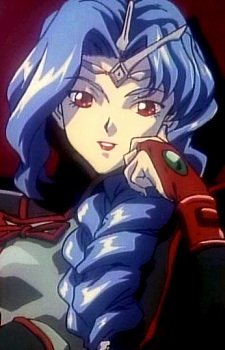
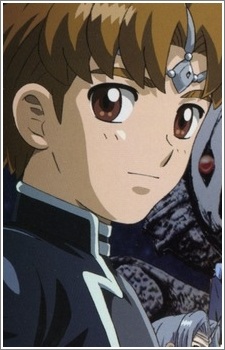
(This has been adapted from my reddit thread) People often have vastly different upbringings. While there are obviously certain positive or preferred ways in which to flourish, occasionally, given the situation, such luxuries cannot be granted. Sometimes it's entirely based off of financial standing or the location where one lives. Other times it's based off of racial or ethnic disparity. But no matter the case, it is almost always outside of one's control. And so it becomes less about how the world sees you, and more about how you see yourself. Such is the anime Crest of the Stars, a simple beginning to a galactic journey. STORY Crestof the Stars places Jinto, a young male Terran-turned-Abh nobleman, into the spotlight. Before making his way to the capital of the Humankind Empire Abh, he is greeted by the heir to the jade throne, Lafiel. But before they can make it home, an unexpected event occurs. The anime purports itself to be one about romance and space. But it becomes quickly apparent that the ideas and focus regarding the universe take precedence over the development of Jinto and Lafiel's relationship. In this way, the show is often aptly described as "Spice and Wolf, in space." And that's a compliment; while the character dynamics between our hero and heroine are looked at less than the world-building (galaxy-building), what is given is not to be scoffed at. Their adventure sees them come together, with protecting, quarreling, helping, annoying, caring, bickering, and understanding being rampant throughout. While it isn't actually romance, it's a start, for before a couple can be lovers, they must first become friends. Hearkening back to the galaxy-building, this is perhaps Crest of the Stars's strongest point outside of the relationship between Jinto and Lafiel. There are a ton of different pieces of information given throughout the show. For example, there is an entire language specifically crafted for the Abh; factoids about the Four Nations Alliance and their tense relationship with the "Kin of the Stars;" scientific offerings in terms of measurements, space-travel, and technology; exploration into the Abh's culture and way of life; and minor yet intriguing pieces that round out the experience. It's done adequately enough, not feeling too overwhelming while still maintaining its own, unique identity. Where the anime begins to misstep is in the events that take place, or more specifically, their importance. The show is roughly sectioned into two parts: a quarter of which deal with large-scale war skirmishes and the remaining focusing on Jinto and Lafiel's escapades. But where the macro instances hold both literal and figurative weight, the micro ones do not. That is, the main couple's actions never feel as if they mean anything, in any regard. Whether it's fighting their way out of a Baron's domain or hijacking a vehicle to make it to the nearest city, their mark on everything that is going on around them is significantly smaller. Now, the purpose of placing so much emphasis on the two makes sense; the idea is to establish, explore, and eventually enact the relationship between Jinto and Lafiel. And while their relationship was done nicely, the events around them were not. Crest of the Stars also misaligned itself in regard to its overall focus. Here, the show at first plays with the idea of our characters being "birds trapped in cages." That is to say, their free but restricted in what they are capable of doing. Despite winning the hierarchical lottery, what the anime depicts are two young adults struggling to deal with a universe that looks at them for what they are, as opposed to who they are. And that's vastly interesting...but is sadly dropped. The show goes from showcasing Lafiel's interracial distance and Jinto's unfair discrimination to more action-oriented scenes and having Jinto "find his place." It's an awkward transition, mostly because the former thematic direction was well-crafted but is suddenly forgotten and replaced with a more general message. ANIMATION The best way to describe Crest of the Stars's art and animation would be a "mixed bag." The art for the anime can be rather pleasant at times. The battleships, the star systems, the surface of planets; there are a multitude of different areas that are explored, each providing an appropriate mood for the given situation. The inside of the ships match the blue-hair of the Abh; outer space is dotted with stations and stars; and amusement parks, city streets, and forests are interspersed throughout the planets. At times, though, the anime uses this strange filter to give the effect of light or brightness that deters from the visuals rather than supports them. The character designs follow a similar trend. The Abh are beautiful and regal, with their pale skin, sharp eyes, and distinctly blue hair. Lafiel fits this description, but always sporting her military outfit. Unless, of course, the situation demands a change. Jinto dons similar attire, with a white-and-red cloak, brown, parted hair, and various costume changes when appropriate. The largest issue comes from their often irregularly shaped heads and jaws. It can, like the filtering, be wholly distracting. Actual animation is normally average to above-average. While there is a lot of talking and sitting -- at dinner tables, in a shuttle, or within a strategy room -- characters are usually moving or reacting to the words and sentences being said. Furthermore, the aforementioned battles demonstrate their prowess, with huge explosions, lasers, missiles, cruisers, and gunfire going off at all times. CHARACTERS Crest of the Stars, while involving space and war, is still an anime about our main duo: Jinto the Terran and Lafiel the Abh. As a descendant of the Abh, and especially of the royal family line, Lafiel finds herself in a precarious position. Direct yet respectful, she can normally be quite ignorant of the emotions and customs of non-Abh people. This is easily attributed to her race; they are taught to "move forward" when making decisions, are usually apathetic towards other species, and keep themselves away from non-Abh prevalent areas. But due to her logical reasoning and knowledge of the rest of the galaxy, she is able to support Jinto through the first half of their perilous adventure. And while she finds that completing one's mission is admirable, she wishes she could do more. That is, she looks at herself as being "useless" in the grand scheme of things. The attack on Gosroth, fleeing from ships encircling the planet of Sufugnoff, getting exhausted from an absurd amount of running; despite demonstrating her prowess as a capable woman and an amazing friend, she still believes herself to be bringing those around her down, or at the minimum, not contributing enough to the efforts at hand. However, Jinto believes otherwise. Jinto was born and raised, for a time, as human. However, following a betrayal by his father towards their home planet, Jinto technically became a nobleman in the Humankind Abh Empire. Extremely caring to those around him and rather witty, he often finds himself being "useless" as well. More so than anything else, he feels useless alongside Lafiel. Not being able to console her during times of grief, taken hostage, unable to man spacecraft; he's described as nothing more than a "commodity" that needs to be transported from one area to the next. But he moves from being the helped to the helper come the second half of the anime. This movement, where the roles are switched between Jinto and Lafiel, also occurs with a shift in location. They go from Abh-controlled territory to United Mankind dominion, and subsequently Jinto becomes the leader. And after having been the one in reliance and the one relied upon, he discovers that everyone goes through what he has. That people hold "strengths and weaknesses," that everyone is a "bird in a cage." Everyone needs aid from time to time, whether you're a noble count or a royal princess. It makes no difference, for when one's weaknesses are at play, he or she must lean on someone's strengths. In other words, someone else will bring the key, open that birdcage door, and set that bird free. Looking at both Jinto and Lafiel, both here and within the anime, it becomes evident: they're "the same, but different." It's not just about him being a Terran and her being an Abh, it's in the way they carry themselves, how they're perceived, and what they know of their counterpart's culture. In short, they learn from each other over the course of the show. Jinto realizes the difference between killing and protecting, and that there are times when one has to face danger head on. For Lafiel, she comes to understand that the logical choice isn't always the correct path; sometimes you have to do what's right instead of what's right. Beyond learning from each other, they learn about each other, too. Their various customs, lore, and upbringings allow them to connect with one another more so than with anyone else they have known their entire lives. And that's what Crest of the Stars accomplishes: creating the start of a dichotomous, trusting, and loving relationship. SOUND The OP is quite orchestral in its composition. The track begins with hard drums and violins, leading into a fantastical arrangement with that strange feeling of space permeating it. With more trumpets, violins, and high and low points, the piece ends in mysterious fashion, making it a nice fit for the show at hand. The ED is one of the most 90's songs I've listened to in quite a while. The slow piano and simple acoustic guitar playing fill the background initially. The vocalist is "by himself" for the first half, but when the second half kicks in, a common drum-and-cymbal beat appears alongside the, "I wanna fly away!" lyric. Coupled with the "oh-ohhh-oh" singing and its general slowness, it can actually be quite catchy to listen to. The rest of the soundtrack mostly follows in the OP's footsteps. More space-like pieces filled with trickling instrumental effects and violins; flute and low-keyed piano ones during more tense situations; chimes, flutes, and violins in unison follow the more thoughtful moments; and guitar and drums when battles are underway. Each track fits well during the scenes in which they are played, but sadly, none are impressive on their own. Voice-acting-wise, everyone involved performs in or around average. There are no special shout-outs to be had. ENJOYMENT With romance as my favorite genre, I went into this one expecting to see a good amount of it. But as it went on, and as was already detailed somewhat, it was not about romance; it was about leading up to romance. Which isn't necessarily a bad thing. It was great to see Jinto and Lafiel risking their lives to save one another on numerous occasions, despite having only met a few days prior. And honestly, anything beyond what they gave near the ending of the season would have been too much, and would have betrayed what the goal of the anime was. Which, reiterating once more, is starting their relationship. In the following seasons, I'll be awaiting to see their blossoming romance unfold. The war and the fights, both in space and on land, were fun to watch at times, but not nearly as interesting as Jinto and Lafiel's dynamic. There, it would be funny at times, with Jinto making jokes with Lafiel and her being rather fun herself, despite her background. As a final note, Dorin Ku, Jinto's only friend back on his planet of Delktoe, had a surprisingly well done segment; from his ten minutes of screen time alone, he was able to personify the epitome of "best friend." Which made it a shame to see him leave as quickly as he appeared. But as a final negative, there were too many "100 vs 2" moments, breaking some of the "reality" of the situations that took place. Crest of the Stars is an anime featuring racial disparity, space wars, and an interesting couple. While the story and animation are lacking, the characters and music help to alleviate some of its shortcomings. But this is just the beginning of Jinto and Lafiel's relationship, and subsequently the beginning of the series. Hopefully, what is left in store will be able to pick up the slack. SUMMARY Story: Fine, "Spice and Wolf, in space," adequate world-building, weightless events, thematically lost Animation: Fine, nice art style, weird filter, okay character designs, good actual animation Characters: Good, Jinto and Lafiel begin their dichotomous, trusting, and loving relationship Sound: Good, good OP, nice ED, good soundtrack, average VA work Enjoyment: Fine, not enough romance to my liking, some fun writing here and there, they win too many clearly stacked battles Final Score: 6/10
Ранг
#1633
Популярность
#3284
Участники
57,573
В избранном
481
Эпизоды
13