


ナンバカ
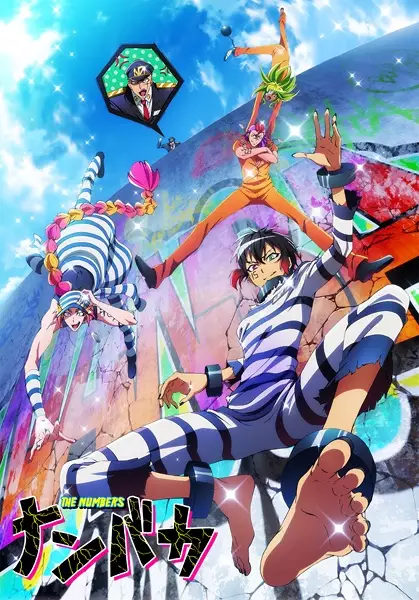
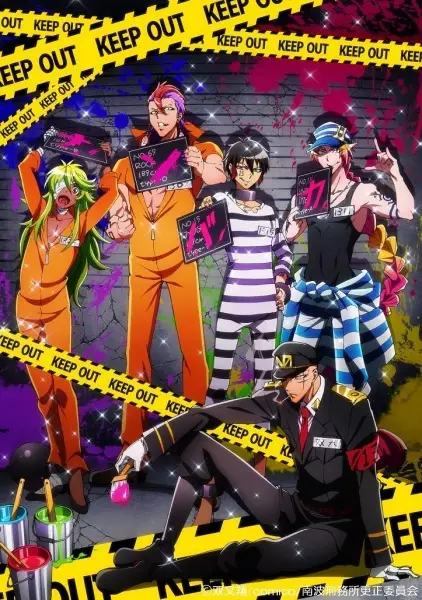
Nanba is the world's most formidable prison, built to incarcerate criminals who are too slippery to stay in ordinary confinement. The four inmates who occupy Cell 13 are particularly cunning on that behalf, having escaped every other prison with a perfect success rate. There is Juugo, a specialist in locks who has spent the majority of his life in prison; Uno, a gambler with great intuition; Nico, an otaku whose body reacts strangely to drugs; and Rock, a bruiser with a love for food. The daily shenanigans of the four prisoners always cause trouble for the building supervisor, Hajime Sugoroku, who desperately tries to prevent them from breaking out of Nanba. Nanbaka follows the comedic, sparkle-filled exploits of these prisoners and their guards. From three square meals a day to sports festivals, prison life in Nanba isn't actually that bad—and it is the closest these four have to a home. [Written by MAL Rewrite]
Главный
Главный
Главный
Главный
Главный
Второстепенный
Второстепенный
Второстепенный
Второстепенный
Второстепенный
Второстепенный
Plasmatize
January 30, 2017
Many have heard the old proverb, "If you chase two rabbits, you will not catch either one". By extension, the more rabbits one chases at once, the harder each is to catch. Nanbaka takes this a step further: it starts going after one rabbit, then gets distracted by a bird and later a fish. It unfortunately fails to catch any of them, but at least it looks cool trying. At its core, Nanbaka is a zany, colourful gag comedy in a prison setting! ...Or is it an action shonen? No? A character drama? In practice, it frequently switches targets when it may have been wiser tostick to one. From the get-go, Nanbaka presents a fast-paced series of varied jokes, ranging from visual humour to ironic subversion to borderline non-sequitur. They weren't exactly original, and didn't get to me personally, but variety and quick pacing are handy tools for holding interest whenever a punchline doesn't quite hit the mark. At this point, I respected Nanbaka for what it was. It had a clear identity, and showed commitment to it. However, the show quickly lost its focus from there. In my eyes, a lack of focus is one of the fastest ways to kill viewer interest, and often a sign of poor writing. Nanbaka soon falls into this trap; rather than continuing its gag comedy roots, it tries to take on multiple identities at once. As soon as the action and drama arrive, the pacing slows considerably and the jokes become less varied or frequent. This would be fine if the new elements meshed well, or were at least strong additions to the series, but instead, they just make things messier. The action elements suffer from weak choreography. This is expounded on by mid-action cuts to narration by onlooking characters - an issue seen in many action anime. For once, Nanbaka could have made this trope work in its favour by filling the narration with its usual zany jokes. Alas, it's just the usual filler dialogue to stretch out the no-longer-action while explaining attacks that didn't really need to be explained and/or stating things that are obvious to the viewer. Despite the action portion's weaknesses, the drama is where I find Nanbaka to be the least successful. At these points, the show suddenly takes on a more serious tone than the accompanying gag comedy and action. This results in a weird situation in which a viewer is simultaneously expected to take the show seriously while also not taking it seriously at all. It's not the tonal shifts that are the issue - rather, it's their frequency and the show's inability to sell them. Furthermore, compelling drama requires compelling characters - something Nanbaka does not have. Most of them come down to one-dimensional quirks or hobbies and maybe the occasional simple backstory. They're too simple to be interesting on their own, and it makes investment difficult. And this brings up what I believe to be Nanbaka's main weakness, and the source of nearly all its problems: it's characters. Even with its wildly differing subject matter, this show certainly wasn't doomed from the start. It simply lacked the tools needed to succeed. While there were several things that could have helped the show (improved action pacing and choreography, or a more memorable soundtrack to quickly and effectively shift tone), ultimately, I believe that characterization is the one key missing weapon it really needed to hit all its desired targets. Stronger characters can create chemistry which helps to sell the comedy and elevate it from "gag" to "riot". In turn, these jokes can be a quick and effective way to show characterization. From there, these improved characters help to invest a viewer before the show switches to action, and when drama builds, the viewer will more readily buy into it. But without this depth of character, the act falls apart, undercut from its very foundations. Despite all my criticisms of Nanbaka, one positive I can mention is the show's art. It has a unique, sparkly, insanely colourful style that immediately draws attention. I'll admit, this alone made it easier for me to sit through Nanbaka's weakest points. The style, however, is not nearly enough to carry the show on its own against its many weaknesses. In the end, Nanbaka gets a tad too ambitious for its own good, and misses the fundamentals as a result. What could have been a notable series sadly ends up as a disorganized, zig-zagging mess, with no clear identity beyond its visual style. When it does manage to catch a rabbit, it's not a particularly tasty one.
Второстепенный
gnerkus
December 29, 2016
The action/comedy multi-genre is saturated with great shows and awful shows. The great shows are not only deliver brilliant action scenes through the quality of the technical aspects, they’re also hilarious and consistent with the comedy. The poor action/comedy shows either skimp on the quality of the art and sound involved or lack consistency in the comedy or both. Action/comedy shows are at their best when they’re funny or exciting but not when they drift off into needless drama. Nanbaka falls between the two; it starts out great with an interesting premise and acceptable comedy. But it loses its focus along the way near the endof the series and slowly becomes boring. [Repeated prison escapists] Nanbaka is an action/comedy anime series based off a web manga originally created by Futamata Shou and his influence glows throughout the show. It is directed by Takamatsu Shinji, who’s directed brilliant comedy series like Gintama and The Daily Lives of Highschool boys. The series is revolves around the daily antics of four inmates in the self-proclaimed, most formidable prison in the world. The inmates of the infamous ward 13, Juugo, Uno, Rock and Nico, often try to escape the prison’s walls and are always stopped in their tracks by the fearsome guard, Sugoroku Hajime. But Juugo is also on the lookout for the man who gave him his unremovable shackles and his colleagues question their motives for trying to escape the prison. [An interesting premise abandoned] Nanbaka begins as a ‘gag’ comedy with an interesting premise: the main characters frequently try to escape from the prison. In the first few episodes, we see them break through several high security gates only to be caught and beaten by the head guard, Hajime. The hilarious execution of this premise coupled with the diverse skill set of the inmates makes these episodes interesting to watch. The premise also leaves a lot of room for creativity; the prison could be viewed as a dungeon, for example. As thin as the plot was, it was replaced by a pointless intra-prison arc. The intra-prison arc was not boring by any chance; it was even more exciting than the initial episodes though less creative. The event introduced most of the cast of the show and showcased the abilities of the inmates and guards alike. It was hilarious and full of explosive battles with fluid animation and lots of special effects. It was pointless but still fun to watch. Unfortunately, the show slides into a series of dramatic sketches following the last battle in the arc. The last few episodes seemed like the opposite of the first episodes; they had direction but were boring. They just seemed to tick off all the common tropes for drama present in an action show; a self-deprecating main character who learns to lean on his friends. It wasn’t awful; it just wasn’t what was sold by the show at the start. Also, the drama would have been better had there been more characters involved. [A diverse and wild cast] Nanbaka has a large cast of characters from various nationalities. Some are declared in the show like Juugo’s British and American fellow inmates. Others are inferred from their design like the inmates of ward 5. With this comes a variety in the design; some inmates wear their prison clothes while others do not. Unfortunately, the personalities aren’t as diverse. Almost all the characters, inmates and guards alike are hyperactive and aggressive; most of the inmates have no motives at all. Only the main characters seem to want other things hang out in prison. Juugo likes to break out of his cell, 13, for the fun of it; it’s later revealed that it’s the only skill he has. He’s also in search of the man who placed shackles on him but this only becomes a focus of the show much later. Uno is the self-proclaimed pretty boy of his cell; Rock is the muscle who likes to eat and Nico is playful and immune to drugs. That’s about all there is to them although they reveal other skills that only last the duration of the intra-prison event arc. The other characters of note are ward 13’s head guard, Hajime, who’s a workaholic and the warden who has a crush on Hajime. Fortunately, what Nanbaka lacks in characterization, it makes up for in its art and character design. [Glitter, gloss and pretty boys] The art style of Nanbaka is distinct and loud. The background and character art is sharp and colourful; the colours are bold and bright; the characters are drawn with prominent outlines. It’s artstyle is similar to that of Jojo’s Bizarre Adventure but it’s recognizable for the tones of colour used. It’s uniqueness lies in its overall theme: femininity. It’s difficult to miss the glitter that pervades the environment in the show. The characters glitter, the prison walls glitter, even the ocean that surrounds the prison glitters. In addition to the glitter is the gloss that’s also on everything, from hair to their clothing. The characters also tend to wear more jewellry than the average male and often have painted fingernails. Then there are characters that are effeminate in their appearance, voice and mannerisms. This art style, coupled with the jazzy themes, gives the show a 70s feel. [Jazzy with a spice of rock] The opening (Rin! Rin! Hi! Hi!) gives away the catchy jazz style that pervades the entire show. It’s a brilliant intro to the flamboyant show and one of the most memorable for me in the Fall season of 2016. Sadly, only Uno’s melody (a score that plays when he’s about to play a trick) comes close to being as memorable as the opening music. The rest of the scores are either gentle jazz tunes or generic rock music that’s designed for fight scenes in anime. I wouldn’t say I enjoyed Nanbaka in its entirety as some of the episodes were a chore to watch, often because of the obvious drama. The comedy grows less hilarious past the halfway point; it even loses its most popular running gag. The show was mostly enjoyable for its first few episodes and its flamboyant art style. It did get its technical aspects right and would have been a much better show had it stayed on course.
RalV26402
May 19, 2019
This anime, for me, is the epitome of the 'well you had us in the first half' meme. The tonal shift in the 6th episode gave me whiplash and made me feel like I had all of a sudden started watching a different anime. At its best Nanbaka is a fun show about a group of lovable morons. The group dynamic was so fun to see and made me love all of the characters. At its worst it casts aside all of that for a much darker and more serious action type anime and in doing so loses all charm from the characters and anyattachment I had to them. Tl:dr, should have stayed a 'gag' anime.
ktulu007
March 22, 2017
Nanbaka is a prison comedy series. The manga was originally written by Futamata Shou. In late 2016, Satelight began airing an anime adaptation. You may remember them as the studio behind Heat Guy J & Sousei no Aquarion. So, how does this one compare to their other works I've reviewed? Let's take a gander. Story: Nanba is, supposedly, the world's most formidable prison. With the toughest guards, the most inescapable perimeter, the sparkliest design and the finest dining and recreation services. We follow four prisoners, Juugo, Uno, Rock & Nico, who have escaped from prisons all over the world as they go about their lives andmake trouble for the guards. Insert shenanigans here. The biggest issue with this series is that it attempts to blend zany, really over the top comedy, with some more serious back stories and an underlying plot about a certain character having serious enemies who may well pose a threat. This results in a pretty significant case of tonal clash. Then we have the humour itself. Honestly, it doesn't work a lot of the time. A lot of it is based around the characters being stupid or something over the top and random happening. I've talked about this before with a different less than good comedy, but randomness isn't funny. A good zany, absurd comedy will have some internal logic that will be largely consistent, being bent on rare occasions for a jape. Pure randomness is what you get when an eight year old tries to make up a joke. “So, a guy walks into a pub and asks the bartender for a pint. The bartender says, 'I can't serve you. I'm a cockatoo.' And the guy looks up and notices that he is.” And it's not funny but you give them a pity chuckle because they're eight. Problem is, this was written by an adult who should know better. That being said, some of the goofs based around characters acting like idiots are pretty funny. There are times when those get executed well. I'll give it credit on that, it does have some funny bits. Characters: The major inmates in this series can all be described very simply. They have a tragic back story and very little personality. Now, I have maintained that a comedy doesn't need deep, complex characters. It needs characters with strong dynamics who can play off of one another really well to deliver the laughter. However, the whole tragic back stories element and the more serious stuff the series tries to do arguably makes this a series that should have more complex characters. Even putting that aside, the character dynamics are pretty underwhelming and don't generally lead to good comedic moments. A lot of the side characters suffer from one joke syndrome. Take the Warden. Her joke is that she has a crush on Hajime, the guard in charge of our protagonists, and people misinterpret her intense gazes. Art: The art isn't very good, to put it nicely. While I will give it credit for having unique character designs, the backgrounds are pretty lazy. Additionally, Satelight made the perplexing decision to put everything in sparkle vision. I'm not kidding, the entire bloody anime is sparkly. Now, here's the thing. Sparkle vision can work when used in certain circumstances for comedic effect. Fullmetal Alchemist is a great example. However, putting everything in constant sparkle vision doesn't have any comedic effect. Instead, it just hurts your eyes. Sound: The cast in this is perfectly passable. I can't call them brilliant in this, or even good, but it's also one of those series where the acting can't make up for the lack of characterisation. The music was handled by Fujisawa Kenji and it's all right. Which may actually make it the strongest element of the series. Ho-yay: There's a bit. We have the gay stereotype character voiced by Kimeru. Juugo also mentions liking both guys and girls, and there are reasons to believe he was serious. Final Thoughts: Nanbaka is a pretty weak comedy. It suffers from tonal problems, humour that falls flat more often than not, constant sparkle vision and dull characters. That being said, it does have its funny moments and I can't really say it was bad. If you're a fan of randomness and comedy stemming from characters being morons, you might enjoy it. For me, the final rating is going to be a 4/10. Next week I'll look at Osomatsu-san, which will hopefully be a better class of comedy.
The_Ruise
January 13, 2017
Nanbaka is an action dramady that definitely excels at the comedy aspect, but failed to impress me with its more serious plot-building episodes; which seem to outnumber the mostly or strictly comedic ones. I was just in it for the laughs, but it got totally serious after the tournament arc, after which it dove head-first into hidden dark sides and tragic backstories galore. These were never BAD by any means, just kind of mediocre. This being the case, it was never so dull as to make it difficult for me to finish watching an episode, or several in a row.
Ранг
#2858
Популярность
#754
Участники
360,219
В избранном
2,382
Эпизоды
13