
スカイ・クロラ
In an alternate timeline, the world has seemingly achieved peace. Bereft of international conflicts, wars are now waged between private corporations in place of peaceful nations. Yuuichi Kannami, a recent transfer in Area 262, simply does his job as a contracted fighter pilot. However, the more time he spends at his new base, the more mysteries come to light. The Sky Crawlers exhibits this reality through the eyes of Kannami as he endeavors to understand the "Kildren," humans genetically altered to be teenagers forever with faster reflexes, and his predecessor, the ace pilot known as "Teacher." However, what troubles Kannami the most is how all this connects to the base commander, Suito Kusanagi. Area 262 has the answers, but the truth comes with a price the young pilot may not be ready to pay. [Written by MAL Rewrite]
Главный
Главный
Второстепенный
Второстепенный
Второстепенный
Второстепенный
Второстепенный
Второстепенный
Второстепенный
Второстепенный
kiriska
August 13, 2009
STORY - The Sky Crawlers is a thinking movie. It’s a cynical commentary where there is so much more going on underneath the surface than you might initially think. Walking into it with no real idea as to what it was about, I was both tried by its deceptive slow pacing and amazed by its eventual depth, relevance, and poignancy. The movie follows the life of Yuichi Kannami after he’s transferred to a small military outpost in a setting similar to WWII-era Europe. He and his comrades are fighting a war, but appear largely indifferent to both their occasional dogfights and everyday life. However, fromthe start, Kannami appears to be haunted by the ghost of the man he’s replaced — a soldier that had been killed, though his plane remains for Kannami to fly. The story unravels with no real urgency, but something always seems to be off. Events occur in a disconnected and puzzling fashion. The pacing would suggest that the film is only showing something boring and ordinary, but that’s obviously not the case. Gradually, it becomes clear that the characters appear to be caught in an infinite loop of actions and lives. They’ve been there before. They’ve done that before. They are who they’ve always been, never changing, and without regard for anything in the past or future. They have died before. They have lived before. Themes of repetition, disconnection, meaning, childhood, and adulthood appear, chastising a refusal to change or evolve and those who have become complacent. They are themes that can be related to other issues, such as the human condition and post-industrial disillusionment, and the film makes a suiting metaphor for a number of parallels. It’s difficult to say where the story ends up thematically without revealing too much, but suffice to say that it’s a tidy package with a well-done, albeit cynical, conclusion. A call to action, perhaps. Mamoru Oshii is known for his heavy films, but this is the first that’s really struck a chord with me. Be sure to stay through to the end of the credits for the final punch. CHARACTERS - It’s appropriate, I suppose, that I find it difficult to see the characters in The Sky Crawlers as actual people. They are odd entities, vehicles for a story, and portrayals of something that isn’t quite real enough or human enough to be called a person. Kannami is curious about his predecessor, but not too curious. He might ask questions, but seems perfectly content to let the issue drop if an answer is denied. Still, his apparent apathy and complacency is easy to latch on to and you remain curious even if he doesn’t seem to care. You want him to care, you wish he would, and you react to the subtly disturbing mood of the film: the quiet unchangingness of everything. Kusanagi first appears to be similarly indifferent, but there is a coldness and desperation to her that permeates the stoic exterior. She’s creepy. She becomes the first sign that something is not quite right about the environment, the situation, and distantly, the war they’re all fighting. She’s the one that seems to know what’s going on. Of course that must be why she and Kannami seem drawn to one another, but that strange deception exposes itself in expository dialogue so blatant that it’s almost alarming. And throughout it all, forced apathy reigns supreme. They are interesting foils, mostly because they are not so different at all. ARTSTYLE & ANIMATION - To be honest, despite the various recommendations I’ve received for this movie, one of the original reasons I was ever interested was because I’d been shown much of the concept art in a class and really wanted to see the film attached to it. The backgrounds, environments, and animation in The Sky Crawlers are all beautiful. Interiors are lush with detail and very intricate, though often, the abundance of little things makes the larger scene appear awkward. For example, the doors may have detailed ridges and corners, but they’re also gigantic and oddly proportioned compared to the people. Similarly, the fighter jets and vehicles are slick and look incredibly convincing and the dogfights are beautifully animated… but then you notice that their designs are very peculiar — all of the propellers are on the back, which makes no logical sense at all. They might look nice, but if they were actually constructed, they would never fly. Addendum -- So I've been informed (thanks, jotunheim) that there were apparently a handful of WWII-era planes designed to be propelled by rear-end propellers such as the Saab 21 and Kyushu J7W Shinden. The physics of these things still baffles me, but I'm not an engineer, so this is an interesting discovery. In any case, I suppose my revised view is that it's a compelling design choice for the Sky Crawlers -- despite that the planes actually existed, they weren't common and that perhaps adds to the slew of things that are just a little off about the movie -- something to make you a little uncomfortable and wonder a little more. Something not quite right, but possible. As usual, the price of fancy environments is simple characters. The limited cast of characters in the movie all have exceedingly simple designs, though all are extremely effective, especially Kusanagi, who strikes you as odd and slightly off-kilter from her design alone. The plainness of Kannami is also significant in that it makes him nearly anonymous. There are no features that might distinguish him from any other man; he is interchangeable, replaceable, and in many ways, relate-able. Particularly for this kind of story, the anonymity and capacity for audience sympathy in the character design alone goes a long way. MUSIC - I’m generally a fan of Kenji Kawai’s work, so it’s no real surprise that I enjoyed The Sky Crawler’s poignant, and often subtle, soundtrack. Many of its tracks are drawn out and thoughtful, accompanying similar scenes for maximum effect. They’re eerie and occasionally force a feeling of anticipation. Action scenes are highlighted by fast-paced and shrieking violins, punctuating every twirl of a jet plane and burst of firing. It’s all wonderfully appropriate. Additionally, The Sky Crawlers had some very well placed silence, which is likely something you don’t notice that often. Some scenes are long and slow and completely silent save the stray sound effect — they are disconcerting in a way, but both force you to focus both on the immediacy of what’s going on and allow you time to think about and collect everything else that’s happened. It’s very effective silence. The ending theme, “Konya mo Hoshi ni Dakarete…” by Ayaka, has a lot of similarities with the music in the rest of the movie and is therefore also quite fitting. Ayaka’s voice is rather nostalgic and the soft piano is both peaceful and sad; in the latter part of the song, the energy picks up considerably before resigning again, which fits oddly well with the pacing of the movie itself. VOICE ACTING – I’ve only seen this subbed, but both Kannami and Kusanagi are wonderfully portrayed and have a great balance of conflicting and confused emotions, which is especially surprising since neither of their voice actors seem to have any other credits. OVERALL - The Sky Crawlers is fascinating exploration of a lot of ideas I probably couldn’t do justice trying to describe or explain. The most important thing is to be receptive to those ideas and to not try and force the film into any pre-imagined mold. Despite the dogfights, most of the action here takes place internally; once again, this is a thinking movie with classical themes that are sure to bridge interests and culture gaps. If you like to think, if you like philosophy, psychology, and human nature (certainly, this is a human v. human story), you’ll probably enjoy The Sky Crawlers.
Beatnik
April 8, 2009
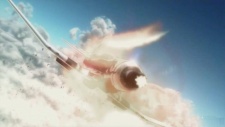
This is a strangely cold movie with barely any empathetic or relatable characters shuffling around gorgeously rendered backdrops with an unusually lacklustre Kenji Kawai soundtrack effort. It’s from Mamoru Oshii so it’s automatically thoughtful and has something to say, yet as a movie it fails because Oshii’s auteur sensibilities don’t fit with the backdrop of this particular tale. The surface story borders on the mediocre, though the backdrop premise is intriguing with the message of warfare that’s been relegated to sport-like competition between warring corporations. It’s a topical and timely subtext, especially during one scene where a conflict is taking place on a screen in alocal pub in replacement of the more traditional game of football. There is so much attention to detail, as expected of Production I.G., but juxtaposed against the bland character designs it’s distracting how good it is. The characters themselves are so lifeless, their dialogue so perfunctory, the voice acting so bored, it really is a struggle to watch them lounge around an airfield chugging away at cigarettes. Almost an hour and a half into the movie it’s revealed that director Mamoru Oshii was directing a romantic drama on the boil, though unfortunately for the viewer the heat was on low the entire time, thus making us endure the pointlessly glacial pace filled with ineffective scenes that don’t survive repeat watches. A slow pace in of itself is not a bad thing, but something worthwhile being conveyed in every second and frame is essential, vivid characters are essential, and Sky Crawlers lacks them for most of the running time making the pace a chore to get through rather than an immersive experience that other directors, like famed live-action director Takeshi Kitano, excel at. Back to anime though, Oshii himself has handled this difficult balance of pace and content well with his two previous major anime films, but this time it doesn’t work. With his Ghost in the Shell films, the pace served as a montage to show the unique environment to the viewer, and to also allow the viewer time to breathe and pause, time to contemplate the heavy philosophy conveyed in the film, but with Sky Crawlers there's nothing to contemplate except for superficial thoughts like 'what happened to the previous pilot?', ‘what are kildrens?’, etc. Hardly so important as to slow the brakes of the film to allow us time to chew it over. Oshii manages to direct the story well without resorting to heavy exposition, the narrative proceeds with characters moving the story forward, but then when that point comes where the story comes to the boil, he resorts to having a character basically waffle revelations and exposition to the viewer. It’s a shame and again relegates anime behind live action movies, most of which would choose to simply continue to let the characters drive the story forward and let the mysteries of the film become apparent more fluidly rather than in the forced anime nature of having a character basically stare at the camera and just give an unnatural speech. It’s a competently made film with a decent story, and although Oshii’s directing method is always a divider of viewers, it’s not the issue this time round. The biggest problem is that the screenplay needed a few more redrafts before being green-lit for production, because there is no good reason for the way it’s been paced for the first hour and a half, especially considering the lack of unique and bold world design on show. Good films should make efficient use of their running time. Great films should have something worthwhile to convey in every single frame. Sky Crawlers has many wasted frames that could have been used in other ways. Crawling around a futurescape ala Ghost in the Shell is impressive, but crawling around the sky and a depressing airfield populated by animated mannequins for two hours is not, no matter how visceral the aerial dogfights are, how superb the sound production by Skywalker studios is, or how romantic you consider the ultimate story in the end.
santetjan
May 29, 2009
Based on a series of books by Mori Hiroshi, The Sky Crawlers, the latest film by Oshii Mamoru (of Ghost in the Shell fame), tells a tale within a world that is essentially at peace, wherein wars have once again become the domain of contracted mercenary groups who fight each other in the name of their contractors, be it for some profound reason or simply for entertainment, these wars being fought to a large extent by 'Kildren', long-lived beings who are not quite human. The film opens with the arrival of Kannami Yuuichi, a 'Kildren' ('Kild'?), at a small forward base of his company in Europe,where he is seen settling in amongst his new surroundings. Though a few battle scenes are depicted, most of the film follows a slow, almost languid pace, showing the interactions between Kannami and the small cast of characters of the film, most importantly the base commander, Kusanagi Suito. Over the ensuing days, through the use of slowly moving dialogues and long stretches of silence, rather a few questions are raised on the 'Kildren', their existence and meaning, only a few of which are answered, and, more importantly, attention is given to Kusanagi and the results of her having lived for longer than she perhaps should have. On an interesting note, one major question is left both answered and unanswered: those viewers preferring to see the question unanswered can safely turn the film off when the end titles start rolling, while those who prefer to see an answer can watch the little scene afterwards. Ostensibly, The Sky Crawlers seems to wax philosophical on the nature of war, mentioning how it is a clean, brutal way of determining winners and losers in whatever game, political or otherwise, is played. Yet, for being constructed around a message on war, there is very little focus on the actual military situation in the story or the battles themselves. Yes, there are a few scenes containing aerial dogfights and a campaign briefing, but they are very short and tend to serve more as scene markers (more on this later). There is, however, another message, hidden in plain sight. The message is not deep. It is not novel. In fact, everyone watching the film will have the feeling of having seen exactly the same story once before. The Sky Crawlers is simply about interaction between humans - and about interaction between those who can't be called exactly human. The film voices once more the questions of what happiness is, what the effects of change (external and internal) are on it, how it is achieved and, most importantly, how it can be recognised at all. In order to do so, it shows the differences between those who are able to understand both human interaction and human emotion, acting upon it in a natural fashion, and those who have either never had or have lost this ability to understand, to whom it is not natural. Thus, no matter how suggestive a situation, nothing will happen if it is not clearly expressed or shown and no action will be taken unless it has been discussed or asked, while even on acting the hesitation and unease remains. The effect of this is that those who have an ability to read between lines will undoubtedly be particularly unimpressed by what happens and the slow pace in which the story progresses, but also that those who do need the whole sentence are exposed to scenes that, because they are clearly expressed and/or aided by visual markers, become very powerful in their clarity, at times perhaps even touching uneasily on the recognisable. It is in this view that the film is strongest and the role of Oshii Mamoru as a visual director appears most clearly. It is no coincidence that one of the greater truths voiced in the film is shown through almost glazed eyes, voiced by a Kusanagi who is pale and dishevelled and clearly has had to much to drink, speaking with that lack of inhibition and that truthfulness of the drunk. It is no coincidence that the intrinsic emotional violence of the passionate encounter is accompanied by the visual promise of physical violence. And while it is a coincidence that the female protagonist is named Kusanagi, her striking resemblance to one of Innocence's gynoids is too strong to be a coincidence, and so it is not surprising to see her with an almost child-like body, a mature poise and an old mind, both as human and as inhuman as that other Kusanagi is. The film strongly uses both time and space to place its protagonists and enhance their being in the world and their being special. Again, both are clearly presented visually. Most of the film is set in the countryside of what is clearly the British Isles, most likely Britain but perhaps Ireland. It is wholly unclear in what time the film should be set. On the one hand, the advent of world peace and the existence of the Kildren may point to some future date, yet on the other the aeroplanes that we see are all propeller-driven while a prominent car looks suspiciously like one of the big American 1950s vehicles, suggesting an alternate near past. Finally, the map hanging in the commander's office shows present-day Europe. Whatever the exact time period in which the film is placed, visual markers abound in marking the progress of time, showing both how things change and how things are eternally unchanging: the film shows the characters amidst standing stones, some marked with glyphs, legacies of an ancient past; before the typical dry-stone hedges of the British countryside and collections of chinaware, common in a past that is closer to us; and in a roadside diner where the people of the present day congregate. The same sky rolls over all these temporal markers in an essentially flat land, as day follows unchangeably on day and the markers of the past form part of the spatial realm of the present. In the same vein the viewer is shown paintings of past people hanging in a restaurant, looking over the shoulder of the present characters, while a monologue is uttered on how some things never change. Spatially, most scenes are cramped in only a few places, connected to each other by societal and economic ties, and the characters move between their barracks, the diner, a brothel and the countryside. Only once in the entire film is a larger settlement shown and for most of the film there is a striking lack of people. It is interesting to note that the mercenaries (and what might almost be termed their camp followers), Japanese all, are shown to speak two languages, Japanese amongst themselves and English to the locals. In this manner is shown how the protagonists differ from their surrounding society that comes on top of their being Kildren, ensuring a type of clinging together. Because of all this, the concept of change looms large. Living in what is essentially a foreign country, in an area where past and present seem to flow together, the close-knit group of Kildren roam from one placid day to another, while due to their longevity they ought to see the same drama played out time and again, whatever the small changes over time, as well as the same groping for what is essentially simply not well understood. Change, both temporal and spatial, is quite often accompanied by more action-oriented scenes. Travel and, especially, the few combat scenes in the film have a tendency to serve more as markers separating one time period or area from the following, fast-forwarding as it were the story for a moment. The characters, as well, are defined by change, or the lack thereof. Long-living, the Kildren's physique simply stops developing at some point, the question remaining whether the mind follows suit. The difference in attitude on aging and changing is what defines both protagonists, Kannami and Kusanagi, and drives much of their interaction. The former emphasises continuously that he is child, still, and entitled to be one, given that he might die at any moment in battle. Thus, he seems to shirk much of an adult's sense of responsibility, not by actively refusing but by not getting involved. Kusanagi, on the other hand, older and with a better sense of time's progress, and, most importantly, being confronted with actions of the past, seems to stand in between child- and adulthood, unwilling to take responsibility but unable to refuse it, in the end having both more to lose and less to look forward to. The result is that the two interact in an atmosphere of palpable carefulness, melancholy and distance, avoiding getting hurt while suggesting offering closer companionship. All remaining characters seem to function more as walking commentators, divulging snippets of the past without mentioning their own roles therein. Most remain rather flat when compared to the expressed mess the more noticeable characters are in and, even with a hint of an unpropitious romance offered later on, remain really asides. It is telling that one character that is never shown but only referred to seems to be more developed than most of the characters with speaking roles. That said, while development is rather non-existent and characterisation doesn't go beyond each having a clear role, these roles are executed very well and each fulfil a function in the story. With regard to the art and animation used, the film can be called a hybrid of typical Oshii style and the style favoured by Production I.G in its latest releases. Throughout the film the audience is treated to wide, open vistas of mostly empty countryside. Especially under the intensely blue, cloud-specked skies that dominate many such shots, both buildings and people are kept very small. When the screen shows all in a more human scale, however, the relative emptiness is being replaced by a profusion of detail. Not only is every crack in every wooden beam of some little room visible, but most spaces that are worked and lived in are veritably cluttered with all kinds of apparel, embellishments and personal belongings, capturing the eye in most of the many silent, languid scenes that the film is filled with. Some such trappings, especially the seemingly omnipresent chinaware plates and vases might hint at symbolism, at some meaning, but nothing is explained or even mentioned. Equally noticeable between the scenes on a grander and on a more human scale is the difference in colourisation. Whereas, barring some rainy skies, though even here rays of sunshine flitter through, the open vistas are coloured in with the brighter spectrum of the colour palette, both soft and sharp, especially the indoor scenes are shadowy, gloomy, sometimes even drab, with all brighter dashes as well being generally more dark of tone in their crimsons and navy blues, the rare light bulb orange and pallid white only giving this stronger emphasis. In sharp contrast to their detailed surroundings, the characters themselves seem to follow the standard used by Production I.G in their newer releases (Ghost Hound, Toshokan Sensou, et al.), being drawn with a paucity of lines, leaving especially the face as devoid of details as possible. While this has been used to great effect in other shows, where the style provides for the wide range of very visually recognisable expressions asked of the characters, The Sky Crawlers is almost minimalist in this regard, thus leaving the characters rather empty of detail. Mostly likely deliberately, this applies more strongly to the Kildren than to the ‘normal’ humans presented. As far as design of especially the backgrounds go it seems that the makers opted for realism, even if they went out of their way to prevent having any area entered that can be recognised as actually existing. The realism of setting, even if embellished at times up to a point where it starts deviating from reality, is apparent in almost all details, especially of contraptions of human make. The main exception is formed by the aeroplanes, which for the most part are unlike any that have been in general, active use, added, almost, as if only in this manner can they befit the equally unreal Kildren. Clearly being intended as a theatrical release, The Sky Crawlers seems to want to disturb your neighbours. Volume levels vary disparately, with sound effects, especially those of the aeroplane engines, being louder by far than music, which in turn has a tendency to overwhelm the voices. The net result is an assault on one’s hearing, especially as one sometimes has to strain to hear what is said. It doesn’t help that the orchestral pieces that form most of the music is rather lacklustre, accompanied at times by the sort of female chanting that composer Kenji Kawai famously used in the Ghost in the Shell films, which is quite out of place in this film. On the other hand, quite a few scenes are unaccompanied by music. In fact, the film toys with meaningful silences overly much, thereby removing their meaning, though at least then the dialogue is more pleasant to listen to. The voices are mainly subdued, as per the story at many times properly devoid of extremes in expression. The Sky Crawlers shook me far more strongly than it ought to have done, all things considered. As has been mentioned above, the interplay between what is said and what is shown on screen is at times strong enough to make for very memorable scenes, especially because the film manages, at times, to visualise some of the concepts it mentions. For all that it might have a predictable story, has a pace that is at times too slow for its own good, has emotions enter the fray in explosive amounts when at all and does not voice anything that can be considered innovative, the questions raised on change and happiness, on how change affects humanity and is needed for continuation remain important ones. As so often with this type of film, it is not the happiest of stories, but there is a certain serenity in its calm sadness.
kurodayuchi
July 15, 2009
If you love me, will you kill me? I’m tired of this endless cycle… The Sky Crawlers is a movie about genetically altered humans beings called Kildren (kill+children) who can never grow and are bound to endless aerial battles in an alternate historic period. This is a standard synopsis, the real one is that this is a story about meaning of the existence, wars, love, suicide, destiny, and emptiness. It’s not a movie for general public taste; actually, most of people will probably want to give up on the movie before the first hour, since even though it’s a movie with war as a central subject andhas some battles, the development is somewhat slow. The silence of their empty lives almost dominates the entire movie and the great moments are like slices of their lives; nothing really outstanding by an action point of view, but really deep in a psychological one. Having said that, the visual effects are really something else. The air battles are truly well done, and the 3D effects catch the eyes. It’s a partnership between Warner Brothers and I.G., so this is not so surprising. Besides, it’s from the same director of the Ghost in the Shell movies. The OST is just beautiful. There are a lot of variations of the main theme, from piano to harp, and most of the songs are depressing. There are the ones fitted for battle, and the ones fitted for sadness. As an adaptation of a novel, the development of the plot sometimes seems to have some flaws. As a matter of fact, the series’ author said that this was the most difficult of his works to adapt. But these “flaws” are almost part of the charm of the movie; you’ll receive some answers, but you will still wonder about a lot of unsettled things. They don’t know who they’re fighting against nor why – a reflection about war itself. The main characters are just children, but they have to act like adults, and this paradox is explored all the time. They go to places like a brothel, but at the same time they like engaging in childish activity, such as playing with toys. All of them try to fill their emptiness with something: Yuichi Kannami, the main character, doesn’t even remember his past, so all he does is trying to comprehend why he’s there, their purpose. Kusanagi, a female commander, has a morbid point of view, always caring a gun to commit suicide or murder. They kill in the air, but on earth they’re just like normal human beings - the sky is like a cage to these birds. If you have some patience to watch something that’s nothing like simple-minded, this movie is definitely going be a favorite.
dtshyk
August 1, 2008
It's hard to rate this after viewing once, but I would say this movie is epic: a fateful love story with magnificent CGI. Story They reorganized the five volumes of the original novels except for the ending. This change in the end of the story was unexpected for me, so I'm still trying to understand what Director Oshii wanted to say from it. The theme of the movie was "the meaning of living a plain life." So he might want tell us that there should be something new in our lives even if we think they're featureless. Art The dog fight scenes were breathtaking works. I choose The SkyCrawlers to be the best air fight movie of the decades as well as Macross Plus. Contrary to the dynamic fight scenes, the description of the pilots' lives on the ground was flat. I know they intentionally did it to make a contrast between the vivid fights and the ordinary dull life. Sound The Skywalker Sound studio did an amazing job, again! Their outstanding performances put more realism to the dog fight scenes and made it a perfect art. Characters I don't like Kikuchi Rinko's acting as Kusanagi Suito. Other voice actors were doing well especially Kase Ryo as Kannami Yuuichi. Kusanagi is a half-adult and half-child or Killdre character, so the acting must include both sides, but her acting was indecisive in that point. Enjoyment In the middle of the movie, I felt "Oh this is another Innocence, great arts with a tiresome story", but as approaching to the end, something different came to my mind "The director was coming down to our eyelevel." This movie is about us and not being put unworldly. I need to rewatch this to fully grasp the meaning of Kannami's decision. Overall, this is a thought provoking movie for the young generations having uncertainty in the modern life. The awesome CGI is worth watching by itself.
#3251
Популярность
#3173
Участники
61,206
В избранном
334
Эпизоды
1