


Time of Eve
イヴの時間
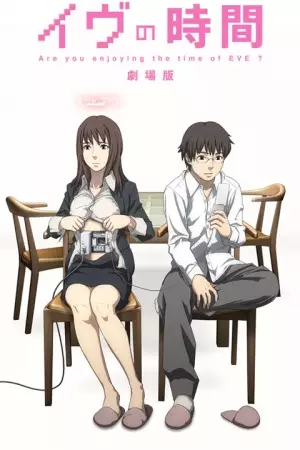
In future Japan, in a time when android housekeepers have become commonplace, society strictly abides by the Three Laws of Robotics, which all androids must follow. Under the influence of the Robot Ethics Committee, androids are treated the same way as lesser technology, such as household appliances. However, a minority with an adoration for androids exists, categorized as "android-holics," and are shunned by the general public. Rikuo Sakisaka was raised to accept society's precept about androids, and is perfectly aware that they are not human. That is, until the day he discovers a strange message buried within the activity logs of his household android, Sammy. This leads him to Eve no Jikan, a cafe with only one rule that its patrons must adhere to: there must be no distinction made between humans and androids. Curiosity drives Rikuo to learn more about the shop, and he attempts to unearth the reason behind Sammy's peculiar behavior. [Written by MAL Rewrite]
Главный
Главный
Главный
Главный
Второстепенный
Второстепенный
Второстепенный
Второстепенный
Второстепенный
Второстепенный
Второстепенный
Ladholyman
September 20, 2009
Time of Eve is a rather peculiar show to review. For one thing, it is only six episodes long, clocking in at around 15 to 20 minutes each, but the finale extends for about 30 minutes. Usually, short anime are not able to properly convey the right combination of character development, plot, and conflict. Time of Eve, however, does all that and more. I must say that it is probably the best science fiction anime since Planetes, and definitely worth your time. Let's start with the art animation. Those familiar with Yasuhiro Yoshiura's previous works, such as Pale Cocoon and Aquatic Language, will find themselves quite athome with the animation style. Striving for an elegant sense of simplicity, Yoshiura's character designs are pretty and easy on the eyes. Every character has their own distinct quirks. Yoshiura also uses quite a bit of CG, from coffee makers to ceiling fans, but the CG is not at all overbearing or overwhelming in any way. In fact, they are very detailed without distracting the 2D character art. As for the animation itself, it is very awesome. The characters blink cleanly, running animations are buttery smooth, and the robots are made to be convincingly real, in a cute type of way. One thing worth noting is the clever use of camera CG work. Yoshiura uses a panning effect to great effect, allowing certain mundane actions (such as walking down a hallway) to look quite epic.I have to say that if this show ever gets released on Blu-Ray, I'll buy it in a heartbeat. While there aren't many songs played during the course of the show, the limited OST is still impressive. Insert songs fit nicely, as do the finale ending song. What makes up for the limited soundtrack is the voice acting and the sound effects. Rikuo is voiced by the talented Jun Fukuyama (you might here some Code Geass Lelouch vibes). Sammy is voiced by Rie Tanaka, who creates a timid character but with a firm resolve. Nagi is voiced by Sato Rina, who brings to life a character that stands true to her beliefs. Other talented voice actors round out the cast, from Yukana as Akiko and Tomokazu Sugita as Setoro. All in all, I have no qualms with the sound quality of this show, other than the fact that there aren't a lot of background music tracks (That is understandable, since this show is only 6 episodes long) The story and the character development together provide the strongest parts of Time of Eve. Every episode is essentially a one shot on a visitor (or two visitors) to the cafe, Time of Eve. While that may sound mundane on the surface, the screen play reveals each character seamlessly, precisely, and engagingly. This is done through peppery, fast, back-and-forth dialogue and tight pacing. Although you may not know everything about a certain character, you will know just enough to understand their conflicts, their hopes and fears, and how their lives intertwine with each other. While watching, you will laugh, cry, jump up in bewilderment, and open your mouth in shock. And that's just for one episode. Yasuhiro Yoshiura has learned from his previous work, Pale Cocoon, and concocted a show that does not waste any time or a single line of dialogue. You will find yourself attached to each and every character, human and android. Time of Eve came out sporadically, about one episode every two months. That means by the time I finished all the episodes, one entire year has passed already. How a show can keep me up at the edge of my seats and only come out once every blue moon is a testament to the directing skills of Yoshiura. I enjoyed every single episode and the wait for the succeeding episode was plain torture. Now that it is all over, I will watch it again. Rewatchability for this show scores very high. One thing that did bother me was the lack of a true, proper closure. Yoshiura teases the viewers with a ? at the ending scene, suggesting perhaps a second season is in the works. Oh, how I hope that's true. This review might have sounded rather dry. Well, if a show is this good, I can't find anything sarcastic or sardonic to say. Just go watch it now on Crunchyroll. You will not regret it.
Второстепенный
Qin
October 29, 2008
This is indeed a great show. After three episodes, I think it to be one of the 2008’s highlights. Eve no jikan is beautifully and atmospherically animated, with nice voices, interesting characters and relationships, and a developing plot. The story, which involved humans living with androids, wasn’t the most original in the world,but it didn’t make this anime any less attractive. Eve no Jikan is directed by Yasuhiro Yoshiura, who is often compared to Makoto Shinkai in terms of how well his short animations look. This time in his latest work Eve no jikan, Yasuhiro Yoshiura once again proved his artistic talent. Theanime certainly did look amazing. The digital painting in this anime has always fascinated me, and the backgrounds done were astonishing to look at. The compositions of the story were brilliantly presented, as well as the camera-like imitation they used in the animation. Yasuhiro Yoshiura seems to have a certain emotion of the lights. He does have a stunningly gorgeous means to use the light to enhance the atmosphere of the scenes. The pavonine sunray penetrated into the ordinary room, small door to Time of Eve vestured by the sunburst, the gentle lights impression in the Café bar filling the scenes with fancy, true emotion, feeling of life and wonder. If you are kind of jaded and bored with some harem/shounen/shoujo/mecha animes, Eve no Jikan is like a breath of fresh air and you can’t miss it.
TheLlama
May 3, 2010
Imagine a world where artificial intelligence exists in the form of robots, and, eventually, androids. They obey their master's every whim; helping out with chores at home, storing status of household members; everything dutifully and without hesitation. They are totally soulless; mere machines in the shape of humans. Or are they? What if these androids had a soul of their own? A feeling, curious mind capable of receiving sensations, learning them, recognizing them, adapting to them? That is the thought Eve no Jikan tries to bring forth, and boy, is it a provoking one! While not really permeating the series in a very visible manner, it doesraise the question of what it means to be conscious, and why we humans possess the ability of awareness and freedom do do what we choose. And what makes us different from robots in this sense? We are constructs of (mostly) organic matter driven by electric signals, robots are constructs of non-organic matter driven by electric signals. What is it that would make them aware and not us? Granted, Eve no Jikan focuses mostly on the 'what?' of the situation, and not the 'why?' And it doesn't necessarily hand out any answers on a silver platter, if at all, leaving room for the viewer to reflect on the situation; what it really means and how it affects its surroundings. Eve no Jikan is a short series; the episodes are short in length, and there are only six of them in total. Even so, ther has been excellent effort put into the characters; both making them interesting, deep and natural from the starting point, all the while expanding on that throughout the show; how they change their views on androids, or not, what their circumstances and how these affect their choices. The result is characters with whom I could sympathisize as far as their choices went, and qutie honestly, I was torn at the start as to who was the most right; those thinking of the robots as, well, robots, and those who treat them as equal humans. A question which answer is both subjective and circumstantial; landing much on the fact whether or not a robot can develop feelings and awareness to the extent way we humans possess it. As if that was not enough, EnJ has some rather striking visuals. While I am not a big fan of CG or the like in anime; here it rather mixed in; and at times it felt more like 2,5D than 2D or 3D. The lights were well-placed, creating a nice balance to the scenes; the character designs were simple yet impressive, and backgrounds were astounding. What really makes the animation stand out however; is the astounding camerawork. Yes, camerawork. It isn't the most touched-upon element of animation style in anime, unfortunate as that may be. It really makes a difference to see different angles than what you would expect, different techniques; and in the case of EnJ; what at times well-simulated handheld camera; one of my favourite camera methods, be it live-action or animation (though in the latter EnJ is a first for me!). It creates avery special experience, and combined with the "2,5D"-feel it struck home with me. To top it off, EnJ had a stunning soundtrack. While not featuring many tracks, those that were present set the atmosphere for the show, and did its proper job as a soundtrack. It had no distinct opening or ending themes (an instrumental tune for the latter, during the credits, however); save for the final episode's ending theme, which quite personally I loved. Might not be your taste though. In all, EnJ is quite the unique experience, and, if you're open for it, rather thought-provoking. It definitely swayed me, and this was the first time I ever felt bad for a robot, which looked like a robot.
literaturenerd
March 8, 2015
Overview: I've decided to treat myself and review something that doesn't suck! My coronary arteries requested me to take a break from reviewing anime that sends my blood pressure north of 200! Today I look at Eve no Jikan, which is a very highly rated series here on MAL, although somewhat obscure. Plot: 8/10 Eve no Jikan takes place in the near future, when humans are constantly being served by androids. These androids have not only developed complete artificial intelligence, but the ability to feel emotions just as complex as humans do. Despite the fact that these androids are fully human mentally with artificial bodies, they are treated likecrap and dehumanized in order to justify using them as slaves. One place where androids can go to escape this discrimination is a small bar called Eve's Time ("Eve no Jikan" in Japanese) where there is a rule to treat androids and humans equally. Our main human protagonist is Rikuo, who is a shy and introverted young boy who used to be a master pianist but gave up playing. He is actually interested that androids can feel and think independently, so he decides to follow his android maid and discovers the hidden bar Eve's Time. Rikuo's friend Masaki also discovers the bar and both boys are amazed that inside they can't tell who is android and who is human. Normally androids have halos of light above their heads to distinguish them from humans, but are otherwise indistinguishable. This is similar to the special ears that the "persocoms" have in Chobits. We learn that Masaki has a strong hatred for androids, but he actually has a reason for this feeling and he isn't portrayed as a one dimensional, shallow, cartoonish villain as all too often happens in anime with an anti-discrimination message. We learn more about all the patrons of this bar and the problems that androids go through in society. Eventually the plot takes a sinister turn when an extremist anti-android organization called the Ethics Committee finds out about the bar. The Ethics Committee was once a fringe organization and frowned upon by public opinion after they severely beat and nearly killed a little girl thinking she was an android, but it is insinuated they are quickly growing in power and influence. However...the show ends without a real resolution and we never find out what happens next, at least not in the 6 part ONA. I haven't seen the movie yet. Masaki is able to overcome his hatred of androids, but we learn Masaki's father is the ruthless leader of the Ethics Committee and he never shows any sign of change. There was going to be a sequel, but the series wasn't a commercial success and any sequel is unlikely at this point. Eve no Jikan will join the ranks of cult shows with near universal praise that got shut down early and will never get a sequel... like Firefly, and Sonic SatAM, the sonic cartoon that actually didn't suck! Eve no Jikan had a lot of strong points, but also a few weaknesses. One strong point was that the discrimination portrayed in Eve no Jikan was a bit more realistic and nuanced than in many other examples of "fantasy racism" where humans act like complete assholes for no reason. Humans ARE capable of acting monstrous towards each other for something as little as a different physical appearance, but there are many levels of discrimination and it would be a mistake to only focus on the most extreme and obvious variety. Examples like the little bastards in Elfen Lied that murdered a mutant girl's beloved puppy just to be mean to her because she looked different, do have real world parallels. Think of the KKK members that used dynamite to blow up black children preparing for Sunday School (yes that really happened), but most people in the Jim Crow South weren't tossing sticks of dynamite at children. People simply didn't question the status quo and accepted systemic discrimination because that was the society they knew. Many people in the United Arab Emirates today (a US ally) own South Asian people as slaves and view them as sub-human. However, it is unhelpful to portray these people as cackling madmen who simply wake up every morning to do nothing but evil deeds. Humans are sadly capable of dehumanizing each other and creating a complete psychological detachment that "justifies" and allows otherwise ordinary, non-sociopath people to treat others in a certain group like trash. A good book dealing with this topic is The Tin Drum by Gunter Grass, who grew up in Germany during the Nazi period and during WW2 was drafted and forced to serve as a tank gunner in the Waffen SS. In the novel there is a character representing the people of Nazi Germany. Although many of his actions in the novel are indeed disturbing, he isn't overtly evil and never murders anyone himself, just as most Germans didn't. His great flaw is that he is extremely selfish and largely oblivious to the suffering of others. When kristallnacht happens and the Jewish toy store owner is murdered, our "hero" is only upset because no other stores sold toy drums that were as nice. He never feels sorry for the victim that was always nice to him, but instead is mildly upset that this was an inconvenience for him personally. This complete and profound indifference to the suffering of the "other" and "them" is the true face of discrimination that allows it to continue in a society. Eve no Jikan wished to capture this more common, casual discrimination instead of being like all the science fiction media where humans try to kill all AI simply for being AI. If Eve no Jikan should be rewarded for taking a more nuanced and sophisticated look at discrimination, then what does it lose points on? Oddly enough...subtlety. Allow me to explain what I mean by that. Despite the fact that Chobits is viewed as a crap anime by many in the MAL community, it actually had a social message just as profound as Eve no Jikan's. However, it didn't beat the viewer over the head with the force of a sledgehammer, so many viewers missed it. Chobits was about a guy falling in love with an AI android and how his friends reacted to this wild and unusual relationship. The female android of course couldn't produce children and couldn't even have real sex since she lacked a vagina. This caused many to scorn the relationship for being unnatural, but the show tries to convince the viewer that a consenting and loving relation between 2 adults is valuable and precious even if it is unorthodox. Chobits (one of the authors is a lesbian) delivers a highly pro gay message without shoving it down the viewer's throat. Eve no Jikan is more like Glee, or a 1980s after school special. At times it seems as if the director is saying to you "We think that you're an idiot, so we are going to beat you over the head with this message until you get it." The show CONSTANTLY flashes from the characters to the sign in the bar saying "androids and humans are equals". They may as well have used the gag from Don't Be a Menace where the mail man walks onscreen and screams MESSAGE! Overall: Eve no Jikan was a very short series with each episode lasting only 15 minutes and only 6 episodes. However, it made a strong emotional impact at times and did an admirable job telling a very familiar story in a fun and different way from most other Science Fictions that tackle this topic. I also loved how they integrated Asimov's Laws of Robotics from I-Robot as an important part of the plot. Rather then just being a throw away reference allusion to show the writer had read some science fiction before, the show actually explores the 3 laws and what robots could do without breaking them. For example, many science fiction in which robots must follow the 3 principal laws don't realize that logically robots could lie to humans if 1. that lie didn't directly, physically hurt humans and 2. the robot was not specifically ordered to tell the truth. Eve no Jikan ended with a complete non-ending and clearly wasn't completed, however it isn't the writer/director's fault that a sequel couldn't be made. Therefore, I will not deduct points for being incomplete. After all, no one would insult Schubert's beautiful 8th Symphony just because he only got to write 2 movements before he died. An incomplete work in which the completed part was well made, is still valuable and worthy of admiration. Although Eve no Jikan had a few flaws, it was a strong effort overall and well worth 1.5 hours of your time to watch it all. I give it a 7.5/10 which of course rounds up to 8.
ParisainGoldfish
April 26, 2010
I've been kicking this around for who knows how long, and I'm pleasantly surprised to say that Eve no Jikan is probably one of the most engaging, expressive shows I've seen to date. And that's no small feat, given it's extremely quick runtime. The atmosphere is unique and brilliantly well crafted, and I'd say it's safe to say that I will eagerly be anticipating any future works from Studio RIKKA even more now that I've seen this. Story; 10. The questions presented through Eve no Jikan are nothing particularly new, yet nothing entirely exhausted either. Humanity, discrimination, acceptance; the cast of Eve is used to portraythese themes, and they do so in spades. While the issues at hand have been seen before, they are rarely integrated into the story so eloquently. The conversations between characters are anything but contrived, and the liveliness and reality of the interactions in the show are really beautiful. The story alone is worth seeing, and that's sadly pretty rare in anime, as much as I hate to say it. Art; 10. If there's on thing I'll never stop regretting about becoming an art student, it's taking all these figure drawing and anatomy courses, only to find out that now whenever I finally do have the free time to watch anime, almost all of the shows turn me off due to the proportional issues most shows suffer from. Luckily enough, Eve is stunningly gorgeous, and not just the environments. The environments would easily be the artistic high point though, and it would hardly be a stretch to say that Eve has the most engaging, realistic settings out of any series or movie I've seen to date. The characters are refreshingly well drawn too, and feature a lot of diversity that other shows these days seem to lack. Characters are not only distinctive in their outfits, but also in their faces; it's uncommon to see a show where the hordes of animated women actually look different, so I get very giddy when I do. Sound; 8. The show is pretty well orchestrated, but for this sort of "futuristic japan" show, pretty generic. At least they are well done, and the short theme that plays each episode when they are in the coffee shop is actually pretty awesome. The sound is far from the high point, but also hardly an issue for Eve. Character; 9. Eve has a brilliant cast of characters, all which I was able to enjoy in one way or another. The dialogue no doubt plays a huge role in this, but the character's persona's were so well developed that I found myself sucked in enough to forget that they weren't real. And for me, this unusually engaging experience is what truly marks a stellar series. The story, characters, and the universe crafted in Eve no Jikan was enough to pull me in and make me forget completely about my life and the world around me for it's length, and allowed me to truly enjoy a unique fictional adventure. If that isn't quality, then I don't know what is. Enjoyment; 10. I haven't been this surprised with a series since I finished Ergo Proxy, nor have I had the pleasure of watching something that drew me in and held my attention so well. Eve is a brilliant, beautiful, well-paced romp through a futuristic Japan where the line between human and machine is beginning to blur heavily. I'd recommend this to anyone who wants a good series, but most especially to other sci-fi buffs.
Ранг
#746
Популярность
#1408
Участники
195,365
В избранном
1,254
Эпизоды
6