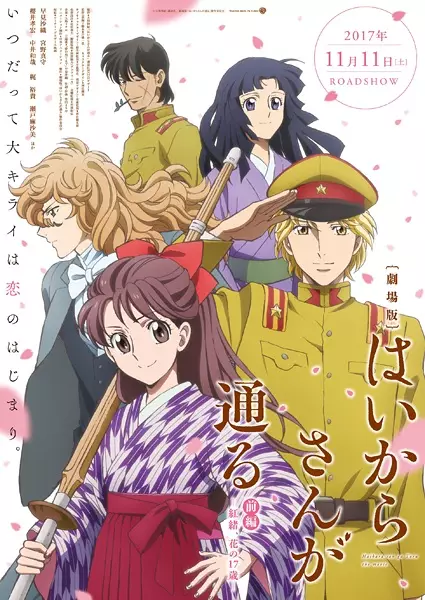

Haikara-san: Here Comes Miss Modern
劇場版 はいからさんが通る 前編 ~紅緒、花の17歳~
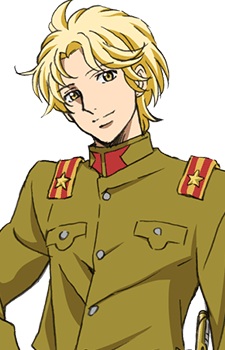
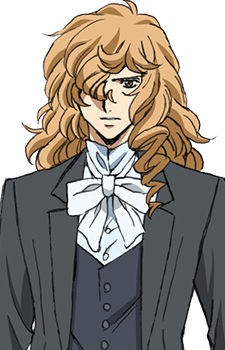
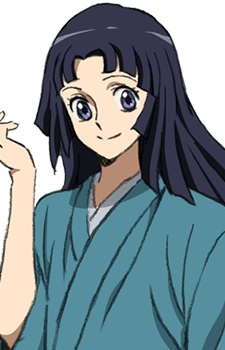
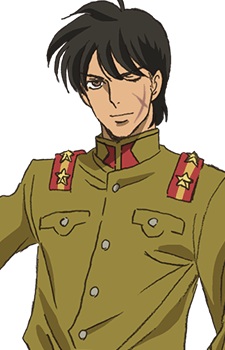
During the Taisho era of 1918, 17-year-old Benio Hanamura thrives on bucking tradition. As a boisterous and quarrelsome tomboy, Miss Hanamura leads a life of kendo and tree-climbing adventure with her best friends Tamaki and Ranmaru. Benio determines to find love on her own, though her family has other plans. Benio will encounter tests of love, independence, and friendship during wartime. (Source: Eleven Arts)
Главный
Главный
Второстепенный
Второстепенный
Второстепенный
Второстепенный
Второстепенный
Второстепенный
Второстепенный
Второстепенный
Flueckli
February 5, 2018
I watched this movie at the Akibapass Festival in Frankfurt, Germany. First of all, I have to say that I'm not familiar with the original source (published from 1975 to 1979) or the older anime series, which aired from 1978 to 1979. As it is I cannot compare it to these works and watched it completely unaffected and without any previous knowledge, besides the information which has been included in the trailer. Though as it is written on the manga source page, Haikara-san ga Tooru won the first Kodansha Manga Award for shoujo in 1977, so likely it has been very good as well. Thestory is put-together enjoyable and the art of storytelling has been made in a very lovely way. The transition between different scenes was often in such a smooth way that you just had to smile at how it was done. As the genre allocation of this anime says Comedy, Historical, Romance, and Shoujo, you get exactly that. I laughed or smiled a lot, while I was watching this movie and as I experienced it at the cinema I was surely not the only one with this expression aka impression of this movie. The historical aspects are also depicted quite well and one or the other scene reminded me of pictures I've seen before (in preparation for a presentation I made) about this era. Also, I haven't seen such a pure romance shoujo for a while, which means some scenes have been worked out almost unrealistically perfect or smooth. But still very enjoyable and sweet. For sure something recommendable for romanticists. The art was clean, consistent and very lovely. I wouldn't describe it as the most artistic outstanding work ever, but it really was enjoyable. As I've seen this movie only once yet, I cannot further go into detail with this point. The creators have taken great care of this production. The character design and composition also make it very enjoyable. As it is Part 1 out of two movies, the story is not yet concluded but the first movie is in its own a great work and is not only the introduction to a bigger following story. (Like some other multi-part movies have been created.)
Firechick12012
May 12, 2019
Let me ask you: Have you ever heard of an old manga called Haikara-san ga Tooru? Yeah, me either. Not until this, at least. Anyway, the original manga by Waki Yamato, which ran from 1975 to 1977, actually had a bit of a rough history with animation. It was adapted into a TV series from 1978 to 1979 and received 42 episodes. It was apparently supposed to be longer, but from what I've heard, it got cancelled due to low ratings, and as a result, the anime had to end in a different way than the manga. Ever since then, it just sort of fadedinto obscurity, as nobody ever really talked about it. The manga and the anime series were never licensed in the US, likely due to their old age and old school artstyle. Considering all of these things going against it, it seemed that Haikara-san ga Tooru would be left into the darkness forever, never to be seen again. OR WAS IT?! Apparently, someone decided this story deserved a second chance, rightfully so, and decided to make a bold move: Revive the series! But instead of making it into another TV series, they decided to adapt it into two movies. Not only that, they completely changed the art style to make it appeal to modern anime audiences, with a new look and coat of paint. Having seen the first movie myself now that I have the first Blu-Ray, I can wholeheartedly say that whoever decided this anime deserved a second chance did an awesome job of bringing it back to life, even with its flaws. Because this movie is awesome and I absolutely can't wait for the second movie to come out! The story takes place in the 1910s-1920s, during the Taisho era, focusing on Benio Hanamura, a happy-go-lucky, ambitious young woman and the daughter of a high ranking military officer in the Japanese Army. She lost her mother when she was young, and as a result, has become quite the stubborn, individualistic tomboy, in stark contrast to the strict idea of the "good wife, wise mother" ideal of womanhood. She studies kendo, drinks sake, dresses in Western clothes, and ardently believes that a woman should be free to choose who they themselves want to marry instead of being forced to accept arranged marriages. When she finds she's been betrothed to a man she knows nothing about, a handsome, sweet natured man named Shinobu Ijuuin, Benio tries everything she can to get out of it, from deliberately messing up her chores and housework (Which isn't hard, since she sucks at housework anyway) to trying to set him up with her best friend, who actually likes him. But things don't always go the way she wants them to, and circumstances might just make her realize that things might be better than she thinks. Now, the original manga is eight volumes long, so it can be hard to try and cram so much material into two movies, much less one. Many movies have tried this and failed miserably. As of this writing, I haven't seen the second movie yet (Though I do want to, and I'm definitely getting the Blu-Ray once it comes out!), so the review will focus solely on the first one for now. But even with the movie's overly condensed, compressed nature, there's a lot of things that it manages to do really well. One of those things is the animation and the character designs. As you can see, both the original manga and the anime from the 70s have VERY dated designs, with washed out colors, exaggerated sparkly eyes, huge lips, and some weird-looking, gonky faces sometimes. The producers for the new movies radically updated the character designs, making them sharper, cleaner, and more modern but still keeping it true to the shoujo aesthestic, with huge doe eyes, large eyelashes, and the men having some feminized features. The animation is beautiful, with smooth movement, lovely backgrounds and backdrops that really enhance the mood of various scenes, and it even has the characters make comedic, goofy faces like in the original Sailor Moon anime, and it works really well here. I'm kind of biased when it comes to the soundtrack, as it's done by one of my favorite anime composers, Michiru Oshima, who's worked on a lot of my favorite anime such as Nabari no Ou, My Sister Momoko, Fancy Lala, Snow White with the Red Hair, the live-action Sailor Moon series, and many others. But you probably know her for her work on the original Fullmetal Alchemist, Little Witch Academia, Tatami Galaxy, and more recently, Bloom Into You. Yet again, she hits a home run with the soundtrack here, with oboes and violins that perfectly fit the quaint, romantic feel of the movie, but never to the point of getting obnoxious or overbearing, something that few soundtracks can boast. I do have some mixed feelings about the characters, which is inevitable considering this manga tries to cram several volumes of manga into one/two movies. I will say that Benio is a relatively good lead character: She has a lot of character flaws, such as being a little too stubborn and argumentative, which can make her come across as bratty at first, but the movie never takes these traits too far to the point of making her come off as obnoxious or a bitch. Plus, while she does eventually fall in love with Shinobu, she still keeps her self-sufficient, independent personality, taking charge of her own fate. She's an intriguing, three-dimensional character with plenty of strengths, weaknesses, and perfectly carries the movie, something which is sorely needed in the anime industry as of right now. The other characters, on the other hand, aren't as lucky in this department. They're all decent enough, and I love the whole ensemble, but because the movie rushes through everything, they don't get fleshed out like Benio does, so every scene they're in lacks emotional impact. Shinobu in particular comes off as way too perfect. His patience for Benio is saintly, he's always nice and kind, never pressures Benio into doing anything she doesn't want to, supports her in everything, and there isn't a bad bone in his body. Now, don't get me wrong, normally I love these kinds of characters, and considering that most shoujo manga/anime tend to give those kinds of characters the shaft in favor of portraying people who IRL would be considered domestic abusers in a romantic, sympathetic light, we need more characters like Shinobu. But the problem with him here is that he doesn't have any flaws. You can't make a character that audiences will like if you don't give him any flaws or traits that he needs to deal with or overcome, and the only time we see him have to deal with a character flaw is at the very end, so it winds up coming way too late. Eh, maybe the next movie will rectify this. I hope it does, because as much as I like Shinobu, you can't deny that he's rather vanilla and too perfect for his own good. But none of these things detract from my enjoyment of the movie as a whole. Many scenes had me on the floor laughing a lot of the time, and in a really good way. The animation is luscious, the music is great, I love all the characters despite the movie being unable to develop them and flesh them out, and I'm really excited to see the next movie. I guess all of the movie's problems can be attributed to its format: Movies are typically better suited for standalone stories, and trying to cram 10 volumes of manga into two movies won't yield very good results if you want to tell a whole story. Scenes have to be cut out and you have to compress other parts in order to tell the story you want to tell. As far as Haikara-san is concerned, despite its initial missteps, I think the producers did extremely well with what they had and did the best they could to do what they needed to do here. It's a sweet, heartwarming romantic comedy that's sure to get a laugh out of you and take you to a time long past. All in all, while made missteps in its presentation, Haikara-san part one is definitely one of the better romances I've seen this year, and I normally tend to dislike romance. Now to (impatiently)eagerly wait for the next movie to come out on Blu-Ray!
Bobbylolhah5
October 7, 2020
The first time I heard of Haikara-san ga Tooru was when I saw a clip on youtube and realized I needed to watch the anime movie. I'm not sure why this is such an underrated anime movie but I hope if you give it a try, you enjoy it as much as I did. The story is about a "modern Japanese girl" with a tomboy-ish personality who discovers that she has an arranged marriage set up with a guy she met (and didn't like) prior. After this, she tries different things to get out of the arranged marriage and... ill let you watch the restto find out what happens after that. If you're looking for some comical (but not cheesy) romance with a beautifully portrayed historical background, you will love Haikara-san ga Tooru. Have a good day!
RESOLVING_POWER
October 3, 2023
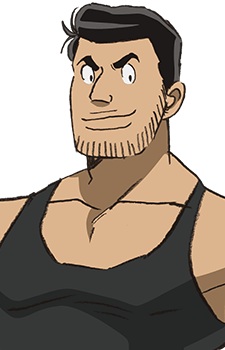
I watched both the Haikara-san ga Tooru movies, also known as Here Comes Miss Modern. Here are my thoughts: This anime is about a tomboy who is pressured into an arranged marriage with a half-jap soldier in the Japan army. The story takes place during the first couple decades of the 20th century and has a socio-historic flavour that some viewers may find appealing. It involves a lot of social issues in Taisho-era Japan, mainly involving female gender roles. It is somewhat interesting from a sociological perspective, although the plot velocity and runtime constraints limit the depth to which these themes could be explored. Even so,someone interested in historical Japanese society might appreciate this anime. These movies also incorporate the political nature of marriage in the writing – I found this to be refreshing, as the typically overly romanticized nature of marriage in fiction often doesn't reflect reality. I appreciated this lifelike treatment of marriage, and it meshed well with the other social themes. That said, romance is still a dominant motif in this anime, as is the relationship drama that comes along with it. This feels like a shoujo-demographic anime, albeit not exclusively so. As you might assume from the title, the story focuses very much on the female MC. The primary male love interest lacks character depth – he's really underdeveloped. In fact the entire cast is tropey in characterization, but I don't think that could have been avoided given the runtime. The story actually reminded me of theatrical works like Shakespeare in the sense that it involved themes such as love and loss, love polygons, tragedy and reunification; it was all quite reminiscent of theatrical writing. Haikara-san ga Tooru feels like it could be a stage play instead of movie anime. Ironically however, I found the scriptwriting itself poor – many scenes in this could have been enhanced by a better script. Similarly to theatrical writing, the story of Haikara-san ga Tooru demands a lot of suspension of disbelief. It is filled with convenient coincidences used to move the plot along and it felt crude and hamfisted as a result. The second movie in particular is quite bad in this regard and I enjoyed it less than the first. I also found the pacing of the first movie better calibrated than the second. There are a lot of scenes in which the boorish tomboy MC is placed into situations where elegance and sophistication are expected of her – these scenes are funny and I enjoyed watching them. The sidekick ruffian henchman character (Ushigorou) also has some funny moments. Unfortunately the other sidekick character (Ranmaru), a feminine-boy childhood friend, is kind of annoying. The visual art style and animation quality are rather lackluster. The visuals are on par with what I'd expect from a modest-budget TV anime – they're nothing special. The character designs are mildly retro shoujo-manga-like. In fact, overall this anime feels retro – if you told me it were 15 years older than its actual production year, I might have believed you. Regardless, the visuals overall feel low quality and fairly amateurish. However, the soundtrack does have some nice orchestral music. Conversely, the voice acting is consistently mediocre for the entire cast, in my opinion. My ratings for the Haikara-san ga Tooru movies are as follows: Movie 1 (Benio, Hana no 17-sai): 5/10 Movie 2 (Hana no Tokyo Dai Roman): 4/10 The writing of the second movie is worse than the first, mainly due to forced coincidences in the storyline. Furthermore, many scenes in these movies suffer from weak scriptwriting coupled with underwhelming voice acting. The visuals are lacking the quality I'd expect from movies made in the late 2010s, however the soundtrack is decent and worth checking out if you like classical/orchestral-type stuff. Some viewers may appreciate the socio-historic themes of these movies. I think that in general a female audience is more likely to enjoy these movies; they kind of felt like Taisho chick flicks. For the record, I have never seen the original anime adaptation released in the 70s. These movies reminded me of Kono Sekai no Katasumi ni, in that they are set in a similar time period and deal with similar social themes (i.e. female gender roles in historical militaristic Japan).
#2145
Популярность
#4430
Участники
32,891
В избранном
105
Эпизоды
1