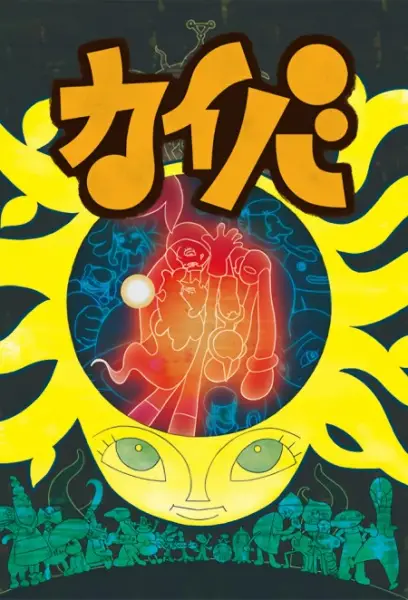

カイバ
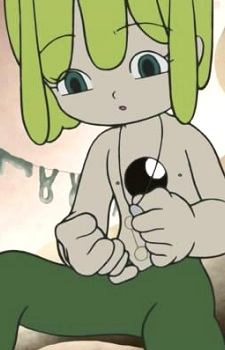
In a world where memories exist in memory chips separate from the body, death of the body no longer means death of the soul. It is possible for memories to be viewed, altered, and transferred between bodies. These memory chips are used by the rich to obtain eternal lives in carefully selected bodies, while for the poor, selling their own bodies and conserving their souls in the chips often become the only way to earn a living. An electrolytic cloud in the sky serves as a barrier between the heavens of the fortunate and the underworld of the destitute, making this social division impregnable. One day, a man named Kaiba wakes up in an empty room with no memories, a mysterious hole in his chest, and a locket holding the picture of an unknown woman. After escaping an attack and stumbling upon a decrepit village of underworld residents, he begins his adventure across the different planets of this strange universe to find out more about his own identity and the woman he once knew. Through a journey of self-discovery and acceptance, Kaiba weaves together tales of souls and spirits and explores the importance of memories. [Written by MAL Rewrite]
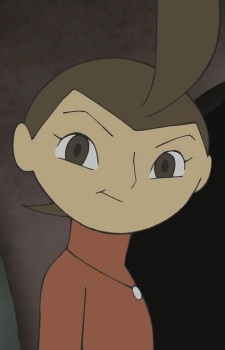
Главный
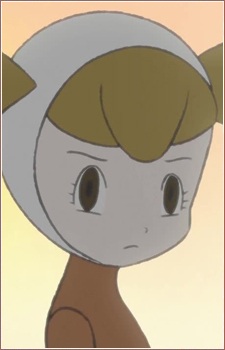
Главный
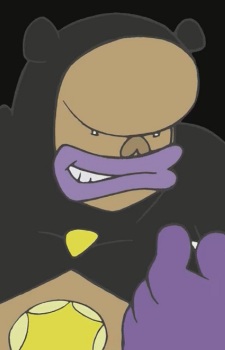
Главный
Второстепенный
Второстепенный
Второстепенный
Второстепенный
Второстепенный
Второстепенный
Второстепенный
Второстепенный
Ranivus
September 9, 2008
::QUICK REVIEW:: Story: 9 (Great amnesia story, love the sci-fi elements) Art: 10 ("I DO" yelled Sam, "I do like green eggs and ham!") Sound: 7 (overly silent at times, but dialog helps lot) Character: 9 (So simple yet very complex, a must see) Enjoyment: 10 (Felt like a 3-hour summer blockbuster movie) Overall: 45/50 = 9 (Everyone must experience this) ::FULL REVIEW:: People always try to be above others. It's because they can't be happy unless they have people below them. This show creates a whole universe around this concept and other unconventional ideals. From the anime description and genre choices for this show, and even the database picture the normalanime viewer might be a little turned off from this show. At first glance for me I quickly turned it away as I thought it was aimed toward children. Despite showing an R+ rating I also notice ratings are usually 20% correct in the MAL database. But after pushing it aside for about two weeks, I finally decided to give it a shot and boy will you be surprised. Right off the start, you're heart will start racing as you follow the story of the main character. A after waking up from a daze, blade runner-esque chase quickly follows. After the action, the main character appears to be very lost, which I'm sure most of you will feel the same way he does. This also starts a unique connection and experience between the viewer and the main character. This is where the show really starts. One thing I'm sure most people will notice is the art style. You will either love it or hate it but don't let the artwork turn you away from this show. After an episode or two you will most likely appreciate the level of originality this art style brings to the plate. After i have seen over 100+ series in a three month span, this was a very welcome change to the orthodox anime styles. Dont let the simple look fool you as well, there are more than enough small details to pay attention to throughout. From the tiny memory pellets to an overcrowded storage room. Everything looks very thought out and amazing. Often you'll probably think to yourself, how the hell does Misaaki and Nobutaka make this ***t up? Another false assumption was that the characters were mostly children since they have a simple child like look to them. But they are very much mature adults. The characters are are all so very likable and I owe a lot of that to the art style and the small details that they do or don't leave out. The even greater point is how Masaaki Yuasa goes to great depths to control the viewers emotions with the use of these characters. One minute, you'll hate a character, then the next you'll feel sorry for them, then you'll feel frustrated because this is almost an emotional roller coaster. Rest assured, this is a good kind of frustration (if there is such a thing). Defintiely don't judge this book by its cover. This point of view story was rather an interesting one and the science, technology, and hierarchy surrounding this universe was very captivating experience. There are quite a large number of allusions and ideals in every episode that got me reflecting on what I have just experienced (which I absolutely love). I can't really compare this to any other anime show. If i had to compare the story to something, it like a telling of a blade runner/ matrix story in the eyes of Dr. Seuss. A great way to close this epic show would be a quote from Dr. Seuss' Yertle the Turtle: "You hush your mouth!" Howled the Mighty King Yertle. "You have no right to talk to the world's highest turtle. "I rule from the clouds, over land, over sea! There is no nothing, NOTHING, that's higher than me!"
Rqt
February 11, 2015
Kaiba is a dystopian/cyberpunk anime. The atypical story telling and mesmerizing dystopias which are always complemented with vivid and unique artwork of the highest degree make for a highly enjoyable experience for myself. By no means do I consider these to be flawless genres but the amalgamation of the many tropes from these genres creates a captivating experience I personally can’t really find in other genre(s), so on that fact this review may be a little bias. One could argue that Kaiba itself is not a cyberpunk series but a dystopian fantasy and I could agree with that, and maybe that is why Iconsider it a cut above the rest of the cyberpunk (GitS and Texhnolyze for instance) I've watched. It is something fresh and has a totally different approach and perspective. However I do still feel it does share many similarities that cyberpunk does, so I will still refer to it as such. Like any other cyberpunk and dystopian anime it is apparent from the inception that it is a society that has been totally dehumanized. In this case, to handheld chips and yellow blobs. Bodies are thrown away like old clothing and replaced on mere whims. Human life and emotion is "seemingly" disregarded. Which is generally the most common criticism, and maybe even point, of these genres. They lack any real empathy and it is understandable that this can deter viewers from the genre. However, this is where Kaiba truly shines. Kaiba puts the futuristic technology into a more human context and is the reason why I emphasize the word seemingly. It is an empathetic cyberpunk, that is to say, that characters express true emotions and warmth. Which is something these series generally lack (for better or for worse? that’s each person's decision). It shows this empathy whilst at the same time, it is able to show the total loss of human value. To be able to show both polar opposites of this spectrum without one impacting the other is a true testament to how well done this series is. The empathy is shown in many cases throughout the series, such as maternal bonds, but most notably through the two main characters that, despite not remembering each other, and being in totally different bodies, they are still drawn together and attracted to one another. It also shows the sacrifices one is willing to take to stay with their loved ones and no amount of deceit and lies will stand between characters coming together. And at heart, this really is a series about human longing and romance. Similarly, the OST completely compliments and helps illustrate both the dystopian nature of the world in which Kaiba is set and also its warm empathetic side. Most notably two pieces: the Melody of Clonico and The Tree Song. The Melody of Clonico (episode 3) really serves to illustrate the empathetic side of the series. The Tree Song holds magnificent symbolism in both a literal and metaphorical sense, and it is no surprise why this song is teased throughout the entire series becoming its ‘staple’ piece. While this may not be relevant to some, it is something I can wholeheartedly appreciate. This song illustrates the entire series as a whole in more than one way. Kaiba's characters are fantastic for the most part. A large portion of the series can be considered episodic, meaning, Kaiba travels from one place to another and in doing so meets characters along the way that don't stay relevant for very long but they do what's required of them and are well developed enough in most cases that you genuinely care about them and what happens to them. Kaiba is a very interesting and mysterious character that at the beginning, the viewer knows as much (or as little) as Kaiba himself, who has lost his memories. As the series progresses Kaiba - and the viewer - learn more about his past which made it a very engaging experience as he slowly becomes more aware of the girl in his locket. That girl being Neiro. Neiro is also a very interesting character, who, without spoiling much, has issues of her own in regards to her memories. The most rewarding thing about the characters, namely Kaiba - but also others - is that his genuine interactions with other characters within the series brings a sense of warmth to an otherwise, overly cold and dark society. The art is a love or hate relationship. It is far from mainstream and maybe even pretentious. There's not much to say about that, the animation is still fluid, the characters are still well designed and the world they find themselves in is equally well designed. I personally found it to be one of the series greatest strengths and made it an even more rewarding watch. Kaiba is a bag of mixed emotions, on one hand it is incredibly sad to watch as human life is literally thrown away and treated like garbage, but on the other hand it is beautifully warm to see individuals stop at nothing to preserve this life and connect with their loved ones. It left me not knowing what to feel at times and I can only say that as absolute praise for the series. I am not saying this series is for everyone, it is totally understandable that if you’re not a fan of cyberpunk/dystopian anime this may not be for you, but if you don’t like these genres for the lack of empathy they portray, this may pleasantly surprise you. There are other reasons why this isn't for everyone, most notably, its art which as I said, is far from the mainstream. It may not be an easy watch for some, especially given the cyberpunk/dystopian tropes it has, but it is something I loved wholeheartedly. Thanks for taking the time to read.
GonzyChan
March 16, 2014
Where there is a body, there is a mind. A mind that is unquestionably a part of us and remains to be this way until our eventual passing. Throughout the centuries of philosophy and science, it is one of the most utterly fascinating aspects of human existence that has yet to be explored fully. Many stories have delved into the realm of consciousness as the primary plot device from the mid-20th-century science fiction authors, and anime has had its fair share of shows akin to this. One of which is Kaiba, a fascinating trip that shows no boundaries of animation and how it can usedifferent styles in anime that have primarily been redundant at the time. Indeed, this type of story has not been done before. One that deals with the concept of minds and how it's ourselves, but with Kaiba, it's like a journey you go through with our main hero, Kaiba. He meets different characters from his trip who all have distinct characteristics that make them stick out from the rest, who may or may not help him in his search to find the memories that have been lost after his long slumber. As we follow our likable hero, we discover how the world that Kaiba inhabits has begun to crumble under its dystopia. Although they portray the setting in a surrealist manner to give it a distinctive look, there's still a lack of depth to the world itself. In other words, there's not enough to go around from the lack of exposition it gives to the history of this world that Kaiba has to offer, and it only succeeds halfheartedly. With that said, even though the plot features some mind-bending, philosophical facets that incorporate Kaiba, the story-telling that helps guide them through the narrative is lacking. Nonetheless, when the show starts, it makes an excellent first impression by showing us first-hand what the world is like and how the other people who live in it go through the absolute turmoil that plagues their way of life. Some moments were even strong enough to invoke tears from my eyes. However, it doesn't take long until we cut away from the protagonist and then go into the character back story of another named Chroniko. To explain this clearly, Kaiba implants his memories into Chroniko, and from then on, we get to explore Chroniko's past and how she was brought up in the world. This plot point might seem admirable to make us know that there are, in fact, more than just Kaiba that might matter. I feel it wasn't even needed in the first place when we already have to follow Kaiba and his journey to get his memories back, even though technically, he's inside of Chroniko in these scenes. Furthermore, we follow other characters, such as the sheriff, named Vanilla, and his fascination with Chroniko, or in this case, the body that Kaiba inhabits. This story plays off more like a desperate attempt to make the show longer. After that, we discourage that whole moment involving those characters, and we follow Kaiba like nothing ever happened previously. One could say that those plot arcs were necessary for Kaiba to understand the meaning of human emotion and the human condition, but it comes across as a bit trite and forgettable once the next episode rolls in. Although with that said, the conclusion to the story felt incredibly fulfilling to experience after a brilliant romantic setup between Kaiba and Neiro, who play off each other very well. Their immediate feelings for each other might seem a little cliched, but how they direct the dialogue they say to each other comes off rather fluently and feels genuine. Near the very last frame of the previous episode, it felt like the best way to give Kaiba a sense of closure. The art and animation are fascinating aspects of Kaiba, making it somewhat of an indistinguishable show amongst the anime community. This man is directed by Masaaki Yuasa, who also produced the classic The Tatami Galaxy, directed the animation, and wrote Cat Soup's surrealist film. This man knows how to transform his visions into reality and make us clamor for more of his artistic creativity. Kaiba's hook from its animation relies not just on an unconventional art style but also on its seamless implementation of the story and tone it tries to convey to us. Once we see the art style that Yuasa executes in constructing Kaiba's world, the result is no less than jaw-dropping. It might seem even a little forceful in some areas to make things a little too wacky and cartoony. The moments where it shows how people can invade someone's memories look incredible at face value. The fluid motions that the characters exhibit in Kaiba's animation feel reminiscent of western-influence and the works of the great Osamu Tezuka. The abstract shapes of the buildings and vehicles give the show its unique identity and ultimately becomes very memorable in that aspect. There is about as much creativity as one could get from a studio named Madhouse, who's no stranger to producing shows similar in nature to Kaiba. On the overall quality of the sound production, the voice acting is serviceable, with the veteran voice actresses Romi Park and Mamiko Noto giving out terrific performances. Even with the limited dialogue that the character Kaiba has throughout the story, Houko Kuwashima plays out the amnesiac archetype rather convincingly. Her voice emotes perfectly as an unemotional character who has lost all sense of meaning in his life because memories play a massive role in him and how that was perpetually lost. One thing to note in music is the opening song for Kaiba, which is composed quite beautifully from the sublime electronic ambiance mixed with subtle orchestration. On top of that is the beautiful voice of Seira Kagami, giving a dazzling performance that sets a tone of pure melancholic loneliness, one of the main themes of the entirety of Kaiba. There's nothing quite like Kaiba's style in most anime shows. The animation is the only significant aspect of the show that makes it worth watching, but that's not to say that the story is bad. There's more to be seen in Kaiba than just the art and animation, but if it were only focused a little more tightly and given more world-building to be memorable, this would've been ranked higher. There is no doubt people will be looking at the art style and start thinking it's nothing like other anime they're used to and reject it immediately. These days, distinctive qualities are a rarity, and I'm okay with this. No doubt we need more creative measures put into the medium, but when one show comes out in that particular season that puts a lot of effort into its aesthetic qualities that challenge the norm, that makes that one show all the more special. Grade: B+
literaturenerd
September 27, 2019
Overview: Hot take! Kaiba is overrated as fuck! In all seriousness, Kaiba is actually a pretty good anime. The animation is stunning and the character designs are wonderfully unique. However, I wasn't a huge fan of the series from a writing standpoint and I don't believe it's one Yuasa's best works. Honestly, I liked Lu Over the Wall more than I liked Kaiba. I liked Kick-Heart more than I liked Kaiba. Cat Soup? Yep, it's still better than Kaiba. The story of Kaiba is told in an almost maddeningly confusing manner, but it's actually pretty simple. People are now able to store their memories in littleflash drives and switch from body to body. People can also erase bad memories and download happy memories that belonged to other people. The wealthy use this technology to keep switching bodies and live forever, while the poor sell their bodies for money. The poor are told that they will be stored on a flash drive and their families will one day be able to get them a robot body, but typically their memories are just erased and they're killed off. The poor live on shitty planets and the wealthy live on super ritzy planets that are inaccessible to everyone else. All of these are supposed to be mind blowing, incredible plot points, but everything in Kaiba is a well recycled Science Fiction trope. The story is basically just a shitty Metropolis, but doesn't say anything new about the evils of wealth inequality or social stratification. Hell, it says far less than Metropolis did 90 years ago! Evil rich guys switching bodies didn't start with Get Out. It was done in B-movies way back in the early 60s like "Frankenstein Must be Destroyed!" How about the part with downloading happy memories and deleting bad ones? That was done in Total Recall. Also known as Ah-nold und zee sree boobs! Back around 10 years ago there was a shitty action movie with Justin Timberlake called "In Time". In that movie, poor people have to sell years off their life to wealthy people, who accumulate time until they can live basically forever. It may have 30% on Rotten Tomatoes, but it was just as deep and profound as anything I personally found in fucking Kaiba. Maybe the problem is with me. Other people watched Kaiba and got something meaningful out of it. That's awesome! More power to those people. I've heard frequently that it's all about the importance of memories and how we should cherish all our memories including the bad ones. I mean...yeah. My grandmother has dementia. Of course I cherish my memories and fear losing them. I don't personally consider that a profound lesson, but that's just me. I've also read this series is a love letter to Osamu Tezuka. Seriously?! Of course I can't speak for Yuasa. Maybe he really said that in an interview. Personally , I have my doubts. Mr. Yuasa loves animation as a concept, but has never displayed a real love for "anime" as non-Japanese know it. I don't think there's an otaku bone in that man's body. There's a quote falsely attributed to Alan Moore that says "I don't make comics. Those are garbage for children. I make graphic novels". While Moore never said anything like this, I could absolutely picture Yuasa saying "anime is trash. I make artsy cartoons!" I'm supposed to believe that anime's greatest outlier, who spent his entire career being as un-anime as humanly possible decided to make a Tezuka tribute? I'm calling bullshit. The character designs are pretty awesome...mostly. Then there's this flying booger named Hyo-Hyo that never ceases to be obnoxious. Navi from Zelda would make up excuses not to hang out with Hyo-Hyo. Then we have this weird black caricature with fat, blue lips and a bulging tumor on his forehead. Oh and his name is Vanilla. God damn it Yuasa. What the fuck were you thinking? We all love Yuasa. However, I feel the man is much more comfortable as an artist than as a writer. His best works are Ping Pong, Tatami, and Night is Short, which were all adaptations. When Yuasa does the writing, we end up with stuff like Cat Soup. I was disappointed by Kaiba, but I'm glad other people love it. Now go and spread that love by fixing the fan wikia! As of the time of this review, the wikia is barren and has had zero effort put into it, as if nobody actually gives a shit about this series. The Wikipedia page is also a near stub and lacks basic episode summaries! There are 30,000 people just here on MAL who would say "I LOVE Kaiba! I don't just include it in my favorites to look smart!". One you guys please go fix this.
noteDhero
February 16, 2009
Art - 10 Kaiba is visually stunning and creative. Sometimes they trade in dynamic quality of images for free animation, and it’s not a bad thing. The art design is very Seussian, especially in architecture. There is a wonderful roundness to everything, with nary a straight line in sight. Despite the character design, there is an unexpected expressiveness in the facial animation. There is a thoughtfulness in each character’s appearance that is underscored by the fact that characters don’t look anything alike unless they are twins. The direction utilizes light and shadow brilliantly to keep the eye focused on theimportant, active pieces. Computer animation is good, and well integrated into the show, allowing a freedom of movement in both character and cameras that many should take note. Sound - 9 I don’t want to say perfect, but the music was so well done that I really can’t say enough about it. The ending and beginning themes really help to create this other-worldly, exploratory feeling that the viewer has while watching the show. The most amazing part of the sound track, though is “The Tree Song.” It’s a masterpiece. There are three versions of the song used throughout the show and it is always implemented beautifully. It’s varied enough that it gives meaning to many different scenes, and distinctive enough that you remember the song as a whole. Voice acting is good on the whole. I don’t think there was anytime that I question choices in the acting, but no one really left an impression besides Vanilla’s voice actor. The voice actor for Popo also does a good job, giving a certain amount of depth and quality to such a badly handled character. Some of the foley was very funny and charming. Much of the sounds of spaceships flying, guns firing, and hitting target were quirky and added character to the world Characters - 6 The characters are just ok. Unfortunately the viewer learns so much toward the end that it becomes very overwhelming to feel like you actually know and understand each of characters and their thought processes. Popo was interesting in the beginning, but once his motives are revealed, he is abrasively two dimensional and overexaggerated. Kaiba is quite empty. Part of this is necessary because of the role he plays in the beginning of the show, but after a while, it becomes clear that there is no real depth to anything that he does. While he is in Chroniko’s body he is astonishingly unconcerned with Vanilla’s feelings, and kind of mindlessly strings him along without a second thought. Vanilla, though, is easily the best character in the show. He is clearly conceived, and believably makes all of his decisions, no matter how vile or dumb the viewer may find them. Kichi isn’t a bad character, but again becomes important so late in the series that it’s a shame a lot of time was wasted on other, less important, subjects. Neiro just flat out wasn’t competently executed, bland, and a slave to the plot 90% of the time. The only thing notable with her was an encounter she had with Chroniko-Kaiba while she was in the body of another man. Story - 5 Had Kaiba been just a visual exploration of the world, rather than tethering itself down to an overall plot, then I think the creators would have had a better time with the story. It’s very clear that the show was bound by the main plot in the last half of the show. Kaiba is centered around the title character who has amnesia, the only notable thing is that he has is a hole in his chest and a locket of a girl. This story starts as an simple idea, then leaves that thought to explore worlds in a variety of vignettes, then coming back to the main plot cashing and burning in convolution. Characters who play an important role in the show are completely eschewed at the beginning, and are haplessly stuffed into the end leaving no room to breathe between character studies and plot twists. Enjoyment - 6 I was absolutely engaged with every moment of Kaiba in the first half of the show. The worlds were lush, beautiful and captivating, with the focus characters of each episode enticing and conflicted. I especially loved the dark mature tone and themes present in the series. However, after that first half, as well put together as everything was, it was equally off kilter in the latter half. Connections didn’t quite read on screen when they needed to, and the ending was honestly one of the worst in my opinion. I just finished Kaiba. I actively avoided this show last year, and after completion, I'm quite disappointed that I did. The discussion I would have had while watching it would have been fun. This is an exceptional show, yet very flawed, and I actually had to look back in the comments section after certain episodes to see if I was the only one confused with certain character/plot developments, and I wasn't. I don't think Kaiba is something you watch unless your taste level has reached a certain point, so enjoyment will definitely sway because of that. I'm torn between a 7 and an 8, but the story was just so terrible at the end that I can't give it an 8 in good conscience. Overall - 7
Ранг
#506
Популярность
#1519
Участники
179,380
В избранном
4,035
Эпизоды
12