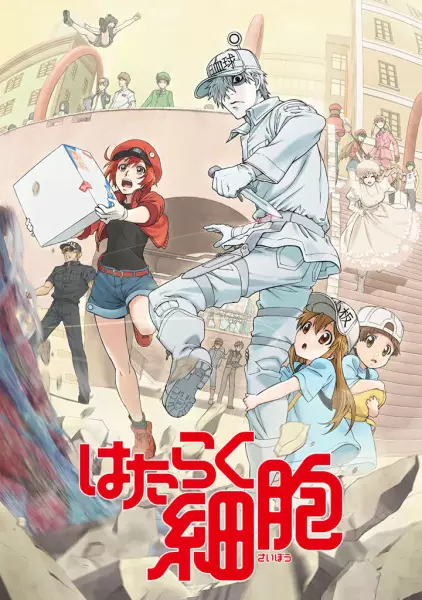


Cells at Work!
はたらく細胞
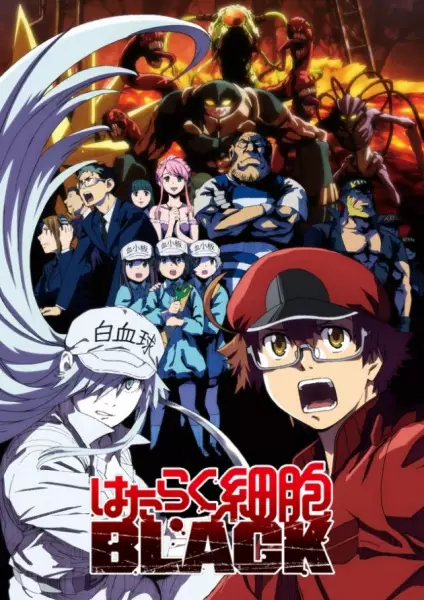
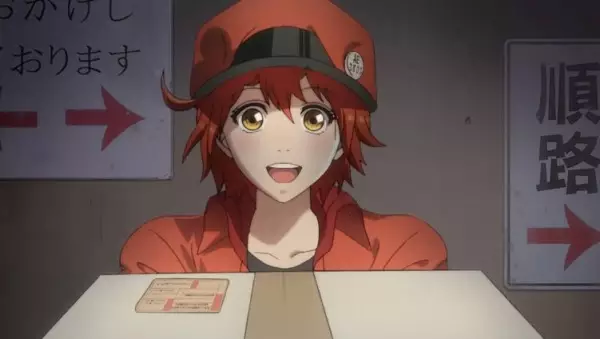
Inside the human body, roughly 37.2 trillion cells work energetically 24 hours a day and 365 days a year. Fresh out of training, the cheerful and somewhat airheaded Sekkekkyuu AE3803 is ready to take on the ever-so-important task of transporting oxygen. As usual, Hakkekkyuu U-1146 is hard at work patrolling and eliminating foreign bacteria seeking to make the body their new lair. Elsewhere, little platelets are lining up for a new construction project. Dealing with wounds and allergies, getting lost on the way to the lungs, and bickering with similar cell types, the daily lives of cells are always hectic as they work together to keep the body healthy! [Written by MAL Rewrite]
Главный
Главный
Второстепенный
Второстепенный
Второстепенный
Второстепенный
Второстепенный
Второстепенный
Второстепенный
Второстепенный
lemo_nemily
February 4, 2021
If you're going into this expecting it to be highly educational for older viewers, I personally believe you've missed the point. The show, while a little informative at times, focuses on entertainment, using the idea of cells to make an interesting narrative, and throwing in some basic biology afterward. This isn't a study guide, and I wouldn't expect it to be 100% accurate or informative. The story itself is sweet, and you'll most likely find yourself invested in the work of the red and white blood cells, as well as the multitude of other groups you'll be introduced to. The main characters are well-written and Ithoroughly enjoyed my time with them. While romantic attraction is hinted at throughout the series, don't expect much from this, as it quickly becomes clearly that this isn't going to be properly developed. The series tries it's hardest to remain fresh and interesting in each new episode, which is where it sometimes falls apart, though I would still recommend it for more casual viewing, as long as you don't go in with unrealistic expectations.
Zaber_san
September 29, 2018
"The human body is the best work of art." - Jess C. Scott Science is the study of everything around us. From the early stages of our universe, to the ancient civilizations in the past that leads us to our modern and technological society. Then we come to society. What makes a society even? The people. Humanity have transcended and evolved for generations and generations and will continue evolving like an endless cycle of life. What does a human compose of? Cells, organs, organ system, tissues, atoms, molecules, ions and so on and so forth. This things, particularly the cells, are the ones that keeps on givinghumanity life as we know it. From RBCs transporting oxygen throughout the body, to the WBCs fighting and defending our body against foreign invaders. Truly, the human body is indeed the best work of art. And then an anime based on this heroic beings finally aired this Summer 2018 as being one of the unique anime this season. Story: This anime "Cells At Work." doesn't have a chronological order in terms of the plot because, as we know it, the story of it is about the cells of our body. What they do against diseases, injuries and other life-threatening phenomenons that can happen to our body. Each character or cells of the story contributes on every episode because of their functionality. For example, the Blood Circulation episode which is of course mainly for Red Blood Cell, while the Thymocytes episode is about the childhood life of Killer, Regular, and Helper T Cell. We get to know on each episode how artistic, beautiful and smart the author of Cells At Work manga (which the anime based on) in plotting out different things about the cells different capabilities based on their real life counterpart. It is honestly very hard to make a manga or anime out of this characters as cells on our body are really hard to describe on, draw to different anime characters and have traits on them contributing to a anime world full of cells. For example, White Blood Cell (Neutrophil) is killing those bacteria, viruses or any type of foreign invaders with a knife and sprayin them afterwards. That is one of the smart moves I've seen that the author applied to be on an anime character because if they base it on the real WBC then it will just look.... weird and hideous as the WBC on our body actually engulfs and then digests the invader with enzymes, powerful enough to kill it (Phagocytosis). Another example of how the anime presented White Blood Cells' migration process to being like them passing through pipes and killing the enemy. Another smart move of the author is the settings and environment of the story. I love how each place whether it is the heart, lungs, or even the stomach have details that we viewers can understand and is accurate to the real life progression of this organs. From the heart being like a temple/shrine depicting how holy or important it is to the normal places where cells are on their apartment buildings, its easy to say the artist of the anime or manga really work so hard on this anime. We also cannot forget how the anime have some comedic elements revolving the adventures of the Red Blood Cell. This element is not that important but if you look at it, it does as it makes the show more entertaining not overall being a show to present only what cells are doing. It also have dramatic elements from the fight scenes and especially the Cancer episode. Who would've thought some of us audience gets pity on cancer just because how dramatic the scene was. Another great factor of Cells At Work is that it is an educational anime where everyone can watch it even though you have a failing grade in Biology or you just hate it. It provides small and summarized text about a certain cell, method, disease and pathogens which makes it very informative not only fun to watch. Overall, the story's accuracy comparing it to the real life cells and systems are just a masterpiece to look at as well as its representation of the cells on their role on any biological terms (or the episodes). Characters: In terms of characters, we get to see alot of characters here since this is literally about your body which comprimises of trillions of cells. Its diversity of characters, fitting them all together with no one being as important as any one because of their functions makes the show a worth to watch if you're interest is Biology. We have the RBC's who carry oxygen through our body, WBC that defends us from pathogens as well as Macrophages, T-Cells, B-Cell and NK-Cell. (there are alot more so I ain't going to list those cells). Then the pathogens either a virus, bacteria or even cancer have roles to the story depending on the episode where they shine to be the antagonist threatening our human body. What I like about the characters is that even though they all have different purposes, on some instances everyone needs to be there, working out together to counter either a scrape wound, virus attack or cancer. I can say as well that we humans are the hidden characters as well on the story. Why? Because if you take a look at the episodes of Cells At Work, on some instances, our cells cannot do anything on their own. For example, the heat stroke episode, where every cell in the body are already dying of heat and just praying for the heavens to rain and then suddenly a big tube coming from the heavens showed up to provide a solution to our body (Transfusion). Hence, characters in Cells At Work is literally just your heroic cells but turn into a more artistic view on TV. Art: Since the producer of this anime is David Production, which is the company that made Jojo's art phenomenal, I can see some instances that the art is reflected to Jojos'. For example is the faces of the Killer T-Cells and White Blood Cell, especially when Naive T-Cell turned into a bulky man. The visuals of the anime are really well-done and fits its theme. Who knew Platelets can be this cute?.. Aside from it being well-done, the art of the settings like I said earlier are a genius way to represent the human body systems in a manner that everyone can understand. Not like showing some microscopic things that we the audience that are not professionals on the field of Biology cannot understand at all. Its creativity on everything along with the character designs already a worth to watch anime. Sound: I cannot stress out how much I love the Opening and Ending of this show. The opening is really catchy. Having lyrics about the cells on how they work and work and we see them doing their functions on the opening is a great way to start or introduce the characters. The ending song is probably my most favorite by ClaRiS so far. It is a song where you can sing along (well you can try even if you don't know japanese) and it makes you feel really joyful. It is also a song to take away your stress. No issues at all on the background music as they all fit the sequence. Overall thoughts and Enjoyment: As a student who loves studying Biology, I totally enjoyed this show. The fact that anime can transcend even into our bloodstream is just amazing when you look at it. I always have the moment of excitement when I watch this because I can relate some of what's happening because of Biology class. It is very creative, very well-done and a masterpiece. This shows that anime can literally make everything good. Overall, I really really love this show and it is such a fine work of art as well as a masterpiece. I recommend you to watch this if you like a summarize version of what's happening on our human body everyday.
CordobezEverdeen
September 29, 2018
Hataraku Saibou or Cells at Work has been highly praised despite his lack of story and the lack of characters just because it's unique and innovative. If Hataraku Saibou can do something is to show that originality is not a guarantee of a good anime. The show lacks something that i still cannot precisely explain. After the initial shock you quickly realize that despite its originality this anime is incredibly generic (does that make sense? i dunno but thats how i felt while watching this). Story: There is no story, this is kind of a simpsons slice of life where at the end of the day everything isfine and dandy. Episode 12 and 13 were the most entertaining of all of them because the story felt real even if just a little. Sadly i personally felt that the ep 13 was the worst animated of all them so it took a little bit of the magic of the finale to this anime. Art: It's David Production. It's good. Sound: The VA's were perfect and both the opening and the ending are incredibly catchy. Characters: Probably the lowest point of the anime and the most cringy side of the anime fanbase stems from this part. Aside from probably the MC the rest of the characters hold no value. Yeah yeah platelet is cute but its a one trick pony that on my opinion exhausts its charm fairly quickly. White Blood Cell is interesting but we never get to know him at all so he ends up at being plain and it feels like he is just a secondary character that its there. In the last episode we barely see him a few seconds until the finale. Enjoyment: If you like gag mangas where nothing really matters then you might enjoy Hataraku Saibou. Overall: The show lacks value and intensity. If i were to be a weeb i still wouldnt like it because there is no waifu material fight me. If i were to treat Hataraku Saibou as a normal anime i wouldnt give it more than a 6.
Stark700
September 29, 2018
It’s almost impossible to ignore biology when it comes to the human body. Hataraku Saibou (Cells at Work!) has the confidence to be its own series. It’s like you take the cartoony Osmosis & Jones and turns it into an educational exploration. The human body is complex and that alone really made me wonder how this show could capture its magic. I’d say making this show takes a creative mind and the audience should feel connected when watching this anime. Right from the start, the show reveals the human body and what it’s made up of which is essentially red blood cells. It takes place inan anonymous person but one should presume that it’s healthy until it faces conflicts inside. This is where the meat of the show really comes in. The human body is vulnerable and we face consequences every day in our lives. But that’s not really the problem, is it? The main course of the anime is composed of human body anatomy. Main characters are composed of Red Blood Cells, in particular one girl voiced by Kana Hanazawa. There’s also a variety of others cells that includes white blood, Killer-T, Macrophage, Memory, and in general, the types that you’d find in any human body. Let’s face it, our human body is made up of trillion of cells. Every cell has its own role whether it’s providing oxygen, getting rid of carbon dioxide, or muscle strengthening. Manga creator Akane Shimizu made this work through innovative thoughts of the actions going on in our bodies. With 6+ volumes and counting, the show is only consists of 13 episodes. It became obvious that the story had to limit itself with exploring the full potential of what the human body can do. However, I will say right off the bat that this shouldn’t be something to overlook. Because the more I watched this show, the more I realized how informative it can be. Surprisingly enough, the details of the human body is explored with an accurate representation. There’s information that details with the context of the cells while also examining at the invaders that enters our body. This include germs, virus, and any foreign pathogen that threatens a person. From the first few episodes alone, we realize that our human body is very vulnerable if we don’t take care of it. God gave us our bodies but didn’t make us immortal. Hataraku Saibou definitely shows why. Naturally, anyone coming into this show should be wondering how the plot will be structured. While not following a direct linear plot, there’s common recurring themes with pathogens invading the human body. The major selling points of the show is examining how our body works with an innovative way of storytelling. Every action has a consequence and it’s easy to see why. The first few episodes shows this when a group of Pneumococus bacteria attacks a red blood cell before being recused by a white blood cell. The traditional concepts of the show is how characters deal with their problems like the way our human body does. As I mentioned before, our body is very vulnerable and is exposed every day. Even a simple wound opens opportunities for catastrophe if the body isn’t prepared enough. This almost happens in some of the earlier episodes. Other times, the body may not be ready in the first place such as against cases of allergies, heat waves, or food poisoning. When it comes down to it, I think the creator really looked at exploring our bodies’ problems in many ways. When the show deploys its character cast well, it’s definitely hard to take eyes off of them. From the variety of cells to the foreign pathogens, there’s colorful cinematography. It would be nice to live in a world where our body is perfect but accidents happen. When they do, your body has to fend them off or there could be disastrous consequences. This is where our cells comes in to take care of the problems and the action in this show wastes no time to showcase that. It’s thrown with an innovative style such as the White Blood Cells brutalizing pathogens or Macrophages showcasing their terrifying skills. Even the cute little platelets in this series has their own duties by reconstructing our body. Many other T-Cells (Helper, Regulatory, Effector) perform their own duties to make sure our body is healthy. I’m not going to lie though, watching this series reminds me to take care good of our own bodies. Realistically, more people die by diseases than any other causes in the world. You can blame that on heart disease, cancer, strokes, infections, etc. The big picture here is that the show also feels very real when we see what our body can do. Creative ideas take a creative mind. And I say this with the belief that we definitely needed a talented staff and studio to make this show believable. Thankfully, director Kenichi Suzuki applied his craft that made the show as stylish as it can be. His previous work with Jojo: Stardust Creators and Drifters can occasionally be noticeable with the amount of bizarreness going on. There’s personality injected into the various characters while cinematography is beautifully crafted. There’s also respect to be given to talented voice cast too especially for taking on the roles of these characters. Everyone in the show felt meaningful and there’s not one moment that should be discarded as meaningless. Similarly, the theme songs has a playful energy and atmosphere that never leaves the show. I won’t say this anime is easy to watch from first glance. It’s about the human body and in my many years of watching anime, there’s very few that took on this concept. (the closest one that came to mind is Moyashimon) As such, Hataraku Saibou is quite unique with how it manages its ideas, selling its craft, and making it into a reality.
KANLen09
September 29, 2018
This series was one of the most unique ones that most have been anticipating since the start of the year, and when it arrived in the lackluster Summer season, aside from the certainty that does not disappoint, it is entertaining to the mildest degree, while having a lot of *pokes* at the function of the most important system: us human beings. Now, I don't care that whether you have studied subjects that are close to this, but I'm fairly certain that no matter our background as people whom have learned about cells in one way or another, Hataraku Saibou, or Cells at Work!, will definitely pleaseyour senses that you are learning about yourself, and the cells that work hard to be able to sustain you in the long run and grow stronger. With that said, everyone, be it otaku or non-otaku, have at least witnessed this anime, and it really broke the conventional walls that this is something that speaks to everyone, as it did magnificently. The story is as clear-cut as it gets: Everything that you see within a microscope, are your daily drivers, the cells at work where every funcion is as important as the other. Now, I get it, it's a series that's worth the educational take, but thankfully it's not like a heavy plot pointer of info-dumped force-wrecker, and at least just demonstrates just about right and doesn't force it on us, which is a good thing. And as usual, the Black Clover aesthetics come back with the usual body-explaining capped-repeat to make sure that you understand what is going with your own body, and then addresses the episodic issue at hand. Honestly though? This is about as entertaining as it gets for anime to get very personal with its viewers, and it succeeds well in that regard. The host of characters, oh sorry I mean cells, are the strongest suit of the series. As with portraying the exact minute details of the cells right down to the extreme, I'd say this is a faithful adaptation of the human body. I mean sure, we all know what the Red (Erythrocyte) and White (Neutrophil) blood cells (voiced by the wonderful Kana Hanazawa and Tomoaki Maeno) do and their properties that keep our body safe from harm, but have we ever wondered: "What about the other cells, like the silent killers Macrophage, the disease-preventing killer and helper T cells, the body reconstructing Platelets (ravioli, ravoli, don't lewd loli platelets!), the weak-willed but strong Eosinophil, to name a few?" The monster designs were weird as hell, especially for the viruses like the mucus-grotesque cedar pollen ones that are easy to kill to the major ones that could cause a disease that could cause serious consequences like heat stroke, hemorrhagic shock and food poisoning. Overall, props to character designer Takahiko Yoshida for his pretty work here. David Production, the same studio behind Jojo's Bizarre Adventure, was a surprise pick for a studio to work on because their work of repertiore really varies from strength to strength, and adding to this, Hataraku Saibou becomes a fan favourite due to their quality of work done here. For example, the "sneeze" segment (that was meant to feel like an explosion) right at Episode 1 was hilarious and insanely funny, and right after that in Episode 2 we're introduced to the children-like loli platelets (which has become a favourite meme and the pivotal point of the "pressing the loli cheek" smiles), not to mention that to put the icing on the cake, the killer T cells in Episode 3 are the perfect reference to Jojo with the bastardized character figure and the single ponytail hair, that was anything but a fine reference. And in order to make our cells feel like they're at "real" work, the action scenes around the white blood cells in all types against the numerous viruses with the bloody scenes and over-the-top action. The reason for the drop in score is because some episodes had a minor drop in quality (but not by much), but it is still a visual treat nonetheless. With careful planning and perfect replication, this is a good series to boot its animation quality. The music is one where it might get on your nerves, but for what it is, I liked it a hell lot. The OP which is just a collaboration work between the character VAs for Red and White Blood, Killer T and Macrophage really sounded like the mission to keep the human body working, is mundane but the essence is what gives it a home-run strike. There was one episode where the OP was replaced with Killer T and Macrophage VAs, and people are wondering what was that, and that's just the 2nd cour of the song, which still is good to boot. And oh good god the ED, ClariS nails it once again (as is with every song that they made) with the happy visuals and tones. The background scenes were just as adequate to provide much needed movement for the overall setting, and it's A-OK! If there was that one definite show that will stand the test of time, it will be this one, much lauded for its "breaking the fourth wall" attention that aside from many casual anime watchers, EVEN the workers of true professions (doctors etc.) find that this anime is really a testament to how much knowledge it is given and took all of that into great consideration to keep it as linear as real life as possible. For the Summer 2018 season alone, this one could be many people's AOTS material and for excellent reasons. if you were skeptical of how the anime medium takes cells into consideration, I highly, HIGHLY plea you to watch this anime, it's definitely very responsive, reliant and relatable to all of us as imperfect human beings. Now, if you excuse me, I'm gonna take notes and learn as much as I can to regulate my body for the better! ...Or is it, waiting until the spin-off, Cells at Work! BLACK to be made???
Ранг
#1927
Популярность
#342
Участники
694,299
В избранном
2,421
Эпизоды
13