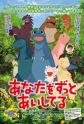

Aladdin and the Wonderful Lamp
アラジンと魔法のランプ
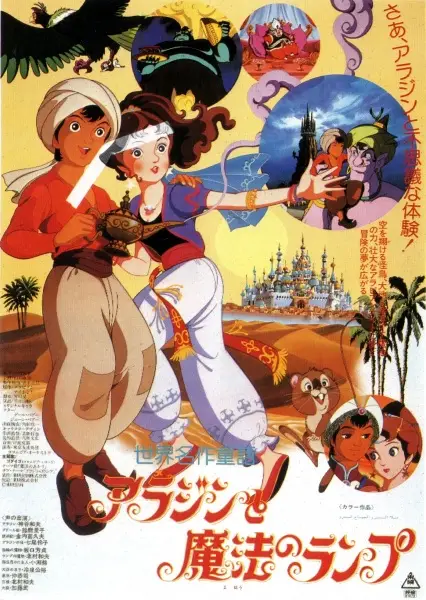
This film stays very faithful to the original down to the smallest details, save for the kangaroo-rat that suddenly appears twenty minutes into the movie and subsequently follows Aladdin around, serving no purpose in the story but fulfilling the role of token animal mascot. The screenwriter needs no introduction; Akira Miyazaki single-handedly wrote five of the classic WMT series, including Perrine and Rascal, and participated in two others. The only other name among the staff that rings a bell, though, is Yukihide Takekawa, who was responsible for the music in the magnificent and unknown Unico pilot film. The story takes some illogical and confusing jumps at the point where Aladdin begins to court the princess, and the extravagant animation that had characterised Toei films of the 60s, when Toei had the best animators around, had become a thing of the past long before this point; but this is still an above-average film, in large part because of the screenplay that stays so faithful to the original. The character designs are slightly more western-looking than one is accustomed to seeing in anime. (Source: pelleas.net)
Главный
Второстепенный
Второстепенный
Rubi-Jah
June 22, 2011
First of all, let me start off by saying that this was the first anime that I have ever watched. Though at the time, I didn't know it was an anime. I think I was 5 years old when this movie came on T.V. but I wasn't home to watch it and my mom seeing a commercial earlier for an Aladdin movie on T.V., she decided to record it. Unfortunately, the VHS that she had, only had room for about 30 minutes of taping. Even though I had only watched 30 minutes of this movie, the images would always stay in my mind. The movie wasmade in 1982 so keep in my mind the technology they had for graphics and sound. The movie stayed very true to the original Aladdin story in my opinion (much more so than the Disney version). Even the Japanese opening song was in an Arabic tune to make things seem more authentic. The Scenery and drawings in the movie were very well done for its time. The details in everything from the shining fruit in the underground gave to the Arabic city streets lined with pots and clothes and food stalls...everything was very well drawn. The effect the animation style had on me even as a child was something amazing because I remember being scared for Aladdin when the sorcerer trapped him in the cave. Overall, for its time, the animation was amazing. Now for the sound, I only watched the dub, however even with the dub, I felt like the characters were well portrayed and that their voices did not deter from enjoying the stories. The music was nothing special but it stayed true to the Arabic theme. The only thing I found annoying was maybe Princess Badral's voice and the fact that they recycled the "busy street people" sounds in the background, but again, this doesn't deter from enjoying the story. For those that have only watched the Disney version, be prepared...because this version seems more authentic (less modernized). This is not a bad thing though because the story is different and interesting and I felt like I was watching something new even though I knew the story of Aladdin. For example, Aladdin gets married to Badral even though he's only a kid. If you can keep an open mind, these concepts will intrigue you more than turn you away from the movie. The pacing of the story changes half way through the film, I don't know if it's because I'm biased because I only watched the second half recently, but I felt as though the first half took its time to let the watchers to introduce Aladdin and his life. The second half where he meets Badral, everything seems to go faster...even how fast him and Badral fall in love and get married and how soon the Sorcerer manages to steal Aladdin's lamp. The fast pacing near the end kind of threw me off but I still enjoyed the story none the less. This movie really was the epitome of my childhood and for those that don't mind a little outdated animation, I think it's definitely a good watch.
ktulu007
August 10, 2021
Up nest for this year's film festival week, we have a film from 1982 based on the story of Aladdin. For you youngsters out there, this has nothing to do with the Disney version aside from the fact that they both drew inspiration from the same public domain story. In fact, this came out a decade before Disney's version. You see, Disney loves to base their films off of public domain stories while hypocritically fucking over the concept of the public domain. But that's a conversation for another time. Let's jump into Toei's version of Aladdin. Story: Aladdin is a poor beggar boy who, along withhis friends, steals food to keep his belly full only going home to his poor old mother at night. One day, he's approached by a wizard who offers him a pouch of silver coins in exchange for doing a task for him. This task involves going into a mystical cavern that wizards can't enter and retrieving an old lamp. Which we all know turns out to be a magic lamp with a djinn in it. Aladdin uses the djinn's power to become a prince and woo the sultan's daughter which draws the ire of the wizard. Let's start with the problems with the film. The first thing that bothers me is that Aladdin steals so that he and his friends can have little treats to snack on but he never takes anything home to his poor mother Which makes him come across as a bit unlikeable. The second thing that bothers me is that the film leaves out a lot of the wizard's duplicity. In the original story, he gains Aladdin's trust by pretending to be a relative of his father's. In this he just shows up looking very suspicious and Aladdin just follows him with very little hesitation. Which does weaken the narrative a little bit. On the positive side, the film does get most of the original story's plot pretty much nailed. Including the exact trick the wizard uses to get the lamp and the lesser djinn of the ring. The film also has its fun moments, a lot of which revolve around a little desert rat that Aladdin picks up. I also kind of like the story arc about Aladdin trying to leave his former life behind and become more virtuous. Characters: The characters are pretty much the very basic, simplified variety that you get in old morality tales like Aladdin. They work perfectly fine but don't have much in terms of complexity. I will say, my favourite character was the little dessert rat, which doesn't have a name but I'm going to call Squeakers. It just has so much fun whenever its on screen and saves the day at least twice during the climax. Squeakers is the hero this story needed. Art: I will give this film credit in that it's not dated in a way that doesn't hold up that well, unlike some older works I've reviewed. That being said, there are a few things that bother me. The first is that Aladdin and the Princess are both drawn in such a way that they look to be around thirteen but then they get married and she's also being pursued by the old wizard and the grand vizier's son. I know that historically some young girls have been married off, including to much older men, but that's not a historical factoid that makes for good entertainment. The second thing that bothers me is that none of the major characters actually look like they're from that region. Both Aladdin and the princess have the brightest of bright blue eyes. The princess is also literally as pale as me and I'm a very pale white guy who barely goes outside. Aladdin has a slight tan, at least. Sound: The acting is pretty well done. Kimaya Kazuo, Suzuka Keiko & Kaneuchi Kikuo all perform well. The music is fine. It's not anything special that you'd listen to outside of the film, but it's fine. Ho-yay: There's none to be found. Areas of Improvement: 1. Include the part of the story where the antagonist actually tricks Aladdin. Look, this film is barely over an hour. You could take an extra five minutes to build the whole thing up a bit and have much better execution. 2. The characters could definitely use some depth. 3. Make the characters look less white and older. Final Thoughts: Sekai Meisaku Douwa: Aladdin to Mahou no Lamp isn't a bad adaptation of the classic tale. It's pretty faithful to the original but doesn't really add much aside from little Squeakers the desert rat. I'll give it a 6/10 because it does have some enjoyable moments but it's also not the best version of the story out there.
#8831
Популярность
#12149
Участники
2,295
В избранном
3
Эпизоды
1