

Keep Your Hands Off Eizouken!
映像研には手を出すな!
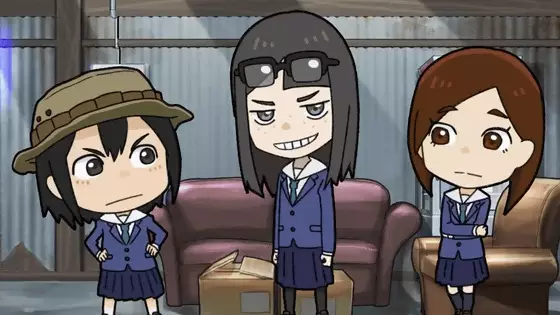
Midori Asakusa sees the world a bit differently. Always having her nose in a sketchbook, Asakusa draws detailed landscapes and backgrounds of both the world around her and the one within her boundless imagination. Even the simple act of doodling on a wall evolves into an emergency repair on the outer hull of her spaceship. She is only brought back to reality by her best friend Sayaka Kanamori. The pair are stark opposites, with Asakusa's childlike wonder contrasted by Kanamori's calculated approach to life. After a chance encounter where the two "save" the young model Tsubame Misuzaki from her overprotective bodyguard, a connection instantly sparks between Asakusa and Misuzaki, as both share an intense passion for art and animation. Whereas Asakusa is interested in backgrounds and settings, Misuzaki loves drawing the human form. Sensing a money-making opportunity, Kanamori suggests that they start an animation club, which they disguise as a motion picture club since the school already has an anime club. Thus begins the trio's journey of producing animation that will awe the world. From the brilliant mind of Masaaki Yuasa, Eizouken ni wa Te wo Dasu na! is a love letter to animation, wildly creative in its approach, and a testament to the potential of the medium. [Written by MAL Rewrite]
Главный
Главный
Главный
Второстепенный
Второстепенный
Второстепенный
Второстепенный
Второстепенный
Второстепенный
Второстепенный
Второстепенный
KiidCathedrale
August 9, 2023
Masaaki Yuasa is a genius, and everything he touches turns into heart-warming candy. His childlike soul, intact, is at the helm. Ideas rain down like asteroids, riddling the frame at an insane pace, and an entire universe comes to life under the Master's fanatical and amused pencil strokes. Ping Pong and The Tatami Galaxy are immense, indispensable works, and the latest, Keep Your Hands Off, Eizuken! is made of the same material. Three girls with diametrically opposed, and therefore complementary, personalities set out to create a video club in order to make an anime (each for a different reason, basically). The imagination constantly bubbling in the trio's heads overflowsand permeates every scene with its excesses. You forget everything, your heart lightens and your lips quiver. When it all comes to a halt, there's only one thing you want: to continue to see the world through the eyes of the kid inside you, a world that's less vain, more intrepid, a world that's sweet and sparkling, its nose always raised to the stars, its guts honed for adventure.
Stark700
March 22, 2020
Midori Asakusa sees the world a bit differently. Always having her nose in a sketchbook, Asakusa draws detailed landscapes and backgrounds of both the world around her and the one within her boundless imagination. Even the simple act of doodling on a wall evolves into an emergency repair on the outer hull of her spaceship. She is only brought back to reality by her best friend Sayaka Kanamori. The pair are stark opposites, with Asakusa's childlike wonder contrasted by Kanamori's calculated approach to life. After a chance encounter where the two "save" the young model Tsubame Misuzaki from her overprotective bodyguard, a connection instantly sparks between Asakusa and Misuzaki, as both share an intense passion for art and animation. Whereas Asakusa is interested in backgrounds and settings, Misuzaki loves drawing the human form. Sensing a money-making opportunity, Kanamori suggests that they start an animation club, which they disguise as a motion picture club since the school already has an anime club. Thus begins the trio's journey of producing animation that will awe the world. From the brilliant mind of Masaaki Yuasa, Eizouken ni wa Te wo Dasu na! is a love letter to animation, wildly creative in its approach, and a testament to the potential of the medium. [Written by MAL Rewrite]
Being an anime fan, the question of how animation is made is probably one I’m sure most people have asked themselves before. Before Eizouken debuted on TV, we have to remember that creating anime isn’t an easy task. It takes an immense level of commitment, passion, and expertise to make what we see on the screen. It’s not a program that follows a specific code as every anime is different, in shape, in form, and in seeking its ways to entertain the audience. Masaaki Yuasa is no stranger when it comes animating and storyboarding in his past projects. With decades of experience, he’s been progressively adaptingand evolving his techniques in the field of animation. From unique sports show Ping Pong: The Animation to the wildly space odyssey of Space Dandy, he’s here to show the world once again that animation has an unlimited realm of imagination. Starting off, we meet Midori Asakusa, a girl who is fascinated by how animation is made. It doesn’t take long for her to form a trio with Sayaka Kanamori and Tsubame Mizusaki, two high school students with similar interests. As a club together, they are united under the passion of making anime, a dream they hope to share with others. Despite the realistic idea of making anime, this show follows more of an artistic adventures together as the Eizouken Club. But know this, we are also introduced about the fundamentals of the anime industry. It’s something similar compared to P.A. Works’ Shirobako. However, Eizouken has enough confidence to be its own show. With our trio of and the right hands, they embark this journey to not just make anime but also learn about what it really takes to be an animator. It’s like following a boyhood dream together and see how far their journey takes them. Interestingly, the show’s setting offers a technological advanced setting, one that is believable but also not too farfetched to be unrealistic. What this means is the series can open many opportunities for the trio to experiment with whatever ideas they come up with. But for starters, we have to understand what making anime is not easy. It is a tedious job that takes expertise in the field, dedicated minds to create something unique, and knowing when mistakes are made. They’re humans after all and learning from mistakes is important so they can rise above them. The group makes mistakes early by setting expectations far beyond their standards. This creates tension in the club to the point where one of its members feels they may not be good enough. Plus, let’s not forget that making animation demands meeting timely deadlines so there’s no doubt the club runs into crunch time issues. Luckily, the club has support between themselves and this is thanks to Kanamori’s ability to compromise and create an environment where they can express ideas freely. And that’s the beauty of this show. It chooses to be free by using ideas of various genres and expressing them. Then, these ideas are created to become an anime project to showcase the world to see. But like most animation projects, the group faces challenges that they must overcome together. These include budget funding and securing the resources they need to make their dreams come true. And sometimes, the trio realizes their club needs more help than they realize. For instance, making an animated work isn’t enough if they can’t promote themselves. Marketing is a new field that the group wasn’t equipped to handle given their lack of experience. Luckily, they receive help from the school’s secretary. Later in the show, Eiozuken is also joined by Parker Doumeki, a girl interested in their audio files but takes a role to help their sound department. Together, this club grows more and more as we witness their transformation from a dream to a reality. Another important part of what makes this show special also refined to the close relationship between our three main leads. They start off as friends but by the end of this show, the trio looks more like a family. At the same time, each individual member has their own skills that are imperative for the club to succeed. This includes Kanamori’s business knowledge and negotiating, Asakusa’s talent for drawing, and Mizusaki’s skill of planning and observing. When you put these skills together, there’s immense potential to succeed with the right hands and tools. However, it’s also not to say to say that the trio does want to get some fame and fortune. A running gag in the show involves Kanamori’s love for money and hopes to make maximum profit. Other running gags in the show deals with how the trio runs into trouble with the law. If we talk about realism, this show sometimes negates that element as the problems the club runs into could’ve easily resulted in its destruction. But let’s get too far ahead of ourselves. This anime is designed to showcase the love of a club to fulfill their dreams rather than just showing the consequences of the anime industry. I’m sure the more fans watch this show, the more they’ll come to that realization. Like some of Yuasa’s other works, he likes to experiment and adapt this free style of animation. In this particular anime, we get simple character designs and animation that can be deceptively complex. This is easily told through the storytelling and brainstormed ideas from our main leads. In some segments, the animation tosses common logic out the window and transcends into daydreams. The audience will notice this by the stylish art shifts and occasional picture frames that seems out of reality. It’s one of the positive perks about this show as it allows art to be experimented beyond its usual structure. So bravo once again to Yuasa for gracing us with his brilliant designs. Speaking of designs, the main character cast are distinctive such as Midori’s short height, Mizusaki’s fiery hair, or Kanamori’s buck teeth. It’s also noticeable the producers gave each of them the school type look to show that they are in a stage of growing up. Being at school means to learn and together as a club, Eizouken is eager to show their potential. Finally, I really want to give props to the unique animation of the OP song. It’s something you don’t see often inspired by pop culture but translated into anime medium. I’m going to miss the weekends. I really am knowing that this show is over after gracing us with its fabulousness. When watching anime, you don’t often think too much about how it came together but every episode in this show convinced me a different story. And with 12 episodes, this is a type of anime that is inspirational as I’m sure there’s a little bit of Midori Asakusa inside all of us.
CodeBlazeFate
March 22, 2020
Animation is a wonderful medium, isn’t it? The way drawings get put into a consecutive illusion of motion, combining all sorts of aspects of art and color to create spectacles that inspire others to do the same. That’s the power of visual media: creative inspiration. You can look at all sorts of auteurs and visionaries such as Quentin Tarantino and Hideaki Anno, and they’ll tell you their inspirations: anime, movies, tokusatsu productions, etc. It’s the origin story of most in all creative industries. Creativity begets creativity, so it’s all the more wonderful to see works that celebrate it. 2014’s Shirobako was a charming and immersivelook into the anime industry from the perspective of 5 friends working in different aspects of that field. 2017’s Re:Creators brought all sorts of fictional creations to the real world to showcase the many sides of what writers and authors are capable of as well as what kinds of influences and intentions their works hold. Now that we’re in the year of our lord 2020, Keep Your Hands off Eizouken provides a charming look at 3 passionate high school girls in different production roles of animation, and how they work with each other to create their own anime. It’s gonna be difficult not to gush about this show on a level that most of its main characters do, so pardon me. The energy of this show radiates a level of autistic CBF energy I adore to no end as its passion and charm breathe life into me. The eccentric, high-energy nature of Midori Azakusa and Tsubame Mizukashi is precious with how they gush about the technical aspects of animation. Their chemistry with each other and resident penny-pincher and schemer Sayaka Kanamori is a sight to behold. Their no-chill energy might be a bit much for some people, but they alone could be fun in almost any scenario, as the anime shows us. The way they gush over animation techniques and still make it presentable, the way they come up with ideas like a moving logo akin to the Pixar lamp, the way the three casually interact with a mix of hyper and deadpan energy, all make my mind race at a thousand miles per hour! I love how they have to keep thinking about believability in their fantasy before making concessions. I love the theatric air they sometimes put on in their declarations. The show is just a joyous bundle of joy, one with a lot of comedic value such as them praying to the fallen comrade of 30K yen or what comes of filming Azakusa falling off guard rails on the second floor of a building. It also tackles a robot anime while having the characters balance the unrealistic nature of the genre in general with a level of plausibility, coolness, and internal logic in a way meant to harken back to the appeal of mecha in the first place. Needless to say, the mere concept of the arc excited me, and bias aside, the execution delivered! There are some problems with the show’s pacing. While the arc structure is generally solid, the episodes themselves can feel almost lackadaisical, as if we’re just flowing or cutting from one scene to another with little in the way of escalation. Episode 11 is probably the biggest offender of this, as it ends up feeling a lot longer than it actually is as a result. There are a few examples of episodes that also can’t figure out a good stopping point, either. It’s not the biggest issue in the world, and it being more of a slice of life title does help excuse it a little, but it’s still a problem that exists. One can argue that these characters aren’t especially layered or complex compared to some of other Yuasa titles such as Ping Pong: The Animation. As true as that is, it might be missing the point as a criticism of Eizouken’s writing. These characters are essentially vectors for this passion for animation that this somewhat dramatic slice of life-esque title presents. On top of that, while one can argue how similar Azakusa and Mizukashi are to the point of being as similar as Carole and Tuesday (from the eponymous disappointment of 2019) are in terms of characterization, they at least have incredible chemistry with one another and with Hinamori. Frankly, this dynamic of friendship is what sells the trio for me, as it’s fun to see them not just talk about the medium or about cash, but about anything else as they just have fun with whatever they’re doing. Azakusa’s definitely a ball of energy who gets too carried away with herself, but one who is otherwise laid-back and socially awkward. Mizukashi’s similarly energetic about a different part of animation --hence the two coming off as similar at times-- but she’s an incredibly sheltered girl at the end of the day, and one who just wants to follow her passions. Hinamori is the tough girl of the bunch, as she’s a schemer always on the hunt for money, and a deadpan hardass to boot. They’re not the most fleshed-out or interesting personalities in the world, but for what they are, the show takes advantage of them and explores their dynamics well. It’s also amusing to see all the little sound effects characters make and that Azakusa is capable of nitpicking and breaking down the believability of settings and ideas in anime, though that’s the aspie and reviewer in me talking, respectively. The show also takes advantage of how painful being an animator can be. The girls working for free is made for a morbidly humorous comparison to the low wages animators work for. Cuts take absolutely forever and require absurd lengths of time to complete as animators work for what feels like nonstop. Understanding realistic or plausible physics of whatever an animator is shooting for can be downright aggravating, like with smoke, sword movements, or hair movements. Several concessions often end up having to be made for the sake of getting a work of animation done in time, resulting in cost-cutting measures that can look cheap if desperate enough. An example of this is when the characters talk about how to convey the fast movement of a tank rolling around, and they discuss the idea of a background with moving highlights before Mizukashi rightfully calls out how much she hates the technique and they find a better solution. If Shirobako takes a somewhat lighthearted approach to what troubled production looks like, Eizouken does the same regarding the grueling nature of working as an animator, even on freelance projects not commissioned by anyone but themselves. I’m also intrigued by the strange, sci-fi school setting. We always see new bits being fleshed out with each episode like how clubs work or what getting lunch is like over there. Student council students are a level of hardass even Kanamori has trouble keeping up with, and club presentations can reach a level of violence where armored guards are forced to step in to protect club members with shitty presentations from getting trampled and beaten. The school itself is this strange hodgepodge of inconsistent elements in its design, as Azakusa points out in the first episode. It’s a chaotic mess that vaguely resembles the real world while having the grandiose and almost bloodthirsty attitude present in say, Kill la Kill’s Honnouji Academy. There’s also this semblance of reality and fiction melting together much like Satoshi Kon’s filmography, as the overactive imagination of characters physically transports them into whatever they’re visually brainstorming or whatever gets shown on-screen. The level of immersion characters reach gets to a point where they react and interact with what isn’t even there. Then again, with how great the visuals are, hard not to gush about and get immersed in them as much as the characters do. Masaaki Yuasa and his team at Science SARU do a beautiful job of taking the strange and creative world of the manga and bringing it to life. The absurd and extremely emotive facial expressions characters have all of the time are all amusing and ever-shifting. The character designs all feel distinct from one another with different head proportions that still feel grounded in the same world. The colors all pop while still feeling somewhat cool, almost akin to Tokyo Godfathers. This is most exemplified by the drawings the characters make, which radiate this endless, unbound youthful energy to them. Of course, where the show tries to flex its muscles the most outside of its character animation is when the characters immerse themselves in a setting. The beautifully unfinished setting models are just adorable, as pencil marks remain on models that haven’t been fully colored. It captures the setting and design sketching phase beautifully, and it does so while keeping the models consistent. It’s fun to see how the outfits our characters wear change in response to these scenes, and models such as the dragonfly plane sketch our characters envision themselves piloting in episode 1 make for the best use of 3D CGI in a 2D anime I have noted in years. Of course, the level of detail in the animation itself is impressive in terms of fluidity, about as much as when the show tries to recreate Future Boy Conan, one of Asakusa’s favorite shows. The way she gushes over the physicality of the characters’ movements and other aspects of animation are represented perfectly in this recreation of an anime classic. This is all just gushing about episode 1! I haven’t talked about a single thing about the rest of the show’s visuals, the stellar animation showcases that make up the climax of each arc, or about the vibrance present in the OP and ED. That should tell you just how visually stunning the show is, and I didn’t even talk about my favorite moment from the first episode. There are several gorgeous scenes thanks to Masaaki Yuasa’s directing as well as due to lovely art direction that works perfectly with the strange school setting our characters find themselves in. Perhaps nothing is quite as artsy as say, Berserk 1997’s shots, but there are still gorgeous moments such as the space scene at the end of the big imagination setpiece of episode 1. Sunsets are as warm as they can be without ever feeling plain like most other anime, and the CG water somehow looks both photorealistic and capable of usually blending in with the environment of the show. It doesn’t always work out and there are a few awkward CG moments, but this is still a joy to look at. There are other details, such as at the end of episode 2 when Azakusa and her family are shocked at a video of her falling that got filmed earlier in the episode. She’s so embarrassed that she’s literally malformed and shittily drawn compared to everyone else in the shot. A lot of the techniques and explanations this show employs get nice visual representations as well. I’m not entirely sure if this is my favorite Yuasa work from a visual perspective, but it is certainly one of the best in this regard. Not every episode quite lives up to episode 1, as there are a few CG problems and several moments that do admittedly look plain. This is to be expected from a contemporary anime production, and what they get away with on a regular basis is still vibrant and imaginative enough to properly convey and live up to the intricacies of the medium it puts on display. The series captures this overactive imagination that I envision every day given that I often think visually, and I love that. As you can tell, this show is hyper and that energy has rubbed off on me. If I had to find the weakest link, it would be the OST. This is the first anime OST done by Oorutaichi, and while it fits the setting and vibe of the show rather well, little of it is particularly memorable. The show also overuses certain tracks, as if there is one specific piece meant to be used every time the characters go into their visually-driven imagination setpieces. That said, I did notice how each arc of the show introduces new tracks, all of which are nice enough. I also like the brash and peppy energy presented by the OP, “Easy Breezy” by chelmico. The visuals of the OP have been memed to death thanks to the Drake-inspired dance moves the girls show off, but the song itself is still what I like most about it, though it isn’t especially remarkable. I’m less fond of the ED so that’s all I’ll say about it. It’s hard to avoid spilling everything I love about the show and what it tackles in detail. This review needs to maintain a level of coherence, after all. The show isn’t this 10/10 hype beast that I adore from beginning to end, but it resonates with me on a level that makes it difficult to get bored or find much to complain about. I didn’t even get to touch on the main conflicts much like with how beautifully and earnestly Mizukashi’s conflict with her actor parents concludes, or go into scenes like when the characters travel to a location for inspiration. The final arc involves the show’s understanding of social media marketing and how star-power gets many interested in a studio’s body of work so that the more invested can follow it thoroughly and deep-dive their catalog. I also never got to talk about the decent supporting cast and how interesting the scenes where they and our main trio come to an understanding are. Barring minor contrivances, everything feels natural rather than forced. All of the conflicts and interactions have this genuineness to their execution. There’s so much love and passion for the medium oozing out of Eizouken, and it’s hard not to get invested. Sure, the high-energy nature and how specialized it is in this field can turn some away, but it’s hard not to appreciate just how much about anime the series covers. Its heart isn’t just with animation, as the show has a few beautiful character moments and emotional climaxes of its own. The likable characters and wonderful visuals accentuate the joyful feeling of this show and how much it cares about what it covers. The show does not shy away from the darker and more complicated aspects of being an animator, even though it doesn’t dwell on the grim nature of it all. Eizouken’s simply a treat to watch, and certainly a contender for anime of the year moving forward. It understands, and that’s what allows it to shine so brightly.
ExemplarCayman
March 22, 2020
I really wanted to love this show, it’s just there is nothing to love, because there is nothing, period. It is entirely devoid of substance. The series is a monster-of-the-week about three aspiring anime creators, the “monster” being them imagining their various everyday happenstances as fantastical animated dream sequences. There is some glimpse of a plot about their anime-making school club, but that’s not the point, the point is a love letter to the medium, celebrating the creative power of animation. These imaginative scenarios are indeed creative and pleasant to look at. You know what else is creative and pleasant to look at? Actual anime, wherecool pictures have context and substance behind them. The very first episode of the show illustrates it already: it includes an entire meticulously recreated by hand sequence from Future Boy Conan, complete with the characters being awestruck by how cool it is. Ok, Future Boy Conan is cool, so why don’t I just watch Future Boy Conan? What’s the point of watching a fictional equivalent of a youtube reaction video? Recreating a scene from an old anime without adding anything transformative to it isn’t an artistic achievement, it’s just copy pasting. It’s a rather unorthodox case of failing the “show, don’t tell” principle - the show tries so hard to tell you how cool anime as a medium is, it fails to be an actual anime that is cool by itself. It also tries too hard to be artsy, coming off as artificial, insincere, and pretentious, because the “artsiness” is not supposed to be deliberately constructed. Just listen to Yuasa talking about how they’ve made the main girls ugly on purpose, “to subvert the moeblob trend” - nevermind that one of the girls is supposed to be a photo model - it just reeks of pretentiousness. And outside of the “I fucking love anime” the series offers nothing. The plot is an excuse for the sakuga moments and the main trio are one-note plot devices devoid of any actual character. There is nothing to care about, empathize with, or be invested into. Nothing to look forward to either, if you’ve seen the first episode, you’ve seen the entire show. There is Yuasa’s art and direction, but again - there is plenty of actual anime also directed by Yuasa, where stuff happens and things matter. The informational tidbits about the technical aspects of the animation process are theme-park level, you’d be better off watching Shirobako for that (and by “that” I mean wanking over how educated you are because you watched a cartoon, someone who genuinely wanted to learn about the real life process of creating animation should watch documentaries). Even the imagination sequences quickly get repetitive and boring because there is only so much fun in watching substanceless moving pictures. This is not the worst show in the universe, and it’s not like it does something monumentally awful. It’s just there are hundreds of better shows that are more deserving of your time being invested into them. 4/10 for “don’t watch anime reaction videos, watch actual anime.”
ChrissyKay
April 14, 2020
It feels wrong to swing the hammer at a show made by Masaki Yuasa. Everything the distinctive director has been responsible I've enjoyed immensely, and even his messier works like Kaiba and Kemonozume were full of heart and punch. Eizouken was different though. I had to drag myself to the finish line on this one, forcing myself through the final few episodes. It really shouldn't have been this way. Every PIECE of Eizouken is incredible: the animation is distinctive and evocative, switching styles with a grace that demonstrates great understanding of the medium. The central trio all have powerful, unique personalities not often found in anime--Asakusa,the imaginative gremiln, Kanamori, the stern pillar of willpower with a love for money, and Mizusaki, the bubbly, popular idol who really just wants to make anime. Their dialogue is well-written, their various strengths and weaknesses well-defined. And if you look at Eizouken at a glance, the story is completely functional, following our artistic trio as they embark on their maiden attempt to create their own anime. It's an informative and passionate tale of the many challenges faced by budding creators, and a lot of the specific aspects that go into making an anime. So what's the issue, you ask? Well, at first I wasn't sure. All I knew is that by the time I got about halfway through I was bored. Even though the quality of the show hadn't dipped, my interest had plummeted. After thinking about it a bit though, I noticed a pattern that hung through to the finale. Every conflict in this show has an immediate, easy resolution. There's no tension! The show throws a non-stop barrage of problems at our protagonists, but they shrug off every single one after a minute of deliberation. Eizouken sometimes starts an episode with the group being presented with a conflict: a lack of funds, a story idea that hasn't come together, censorship from the student council, whatever it may be. Then, Asakusa will go on a walk, or see something neat, have an idea, and that idea will fix the problem. Queue fifteen minutes of the main characters going to the baths, or wandering around looking at the town. Look, I have no problem with slice-of-life stuff, but even this show's fucking title is aggressive: Keep Your Hands of Eizouken, a bold challenge towards anyone who would meddle with our trio's project. I can only assume this title is supposed to be about the student council, who consistently attempt to stand in our protagonist's paths, but rather than building towards any sort of meaningful conflict where the practical nature of the administration clashes with the creative-driven soul of Asakusa and Mizusaki, the student council functions more like the show's Team Rocket, popping in to stir things up and then easily being bested, often off-screen. All throughout the show Eizouken provides signs that it wants to be about creative perseverance, not simple, easy living. The show brings up the financial viability of anime, the social taboos of being implicated in creating it, the restrictions imposed on the mobility of minors, the struggle of working for a deadline, and more. But rather than delve into these roadblocks the show seems content to wave them aside with ease. None of our main characters are forced to really grapple with anything difficult. Everything they do takes two sped-through tries, if not one. Asakusa is supposed to be lazy and easily distracted, a fatal flaw for the director of a production, but everything gets done on time anyways and she's never forced to face it. Mizusaki initially worries about how to not disappoint her high-society profile while working on anime, but then everyone just immediately accepts it and she moves on without having to make any difficult choices. Kanamori resolves financial problems by waving her hands. Where are the sparks? Where are the moments where the characters fail and face consequences, or have to take a real step back to dig deep and do some growth? We keep getting told that the club is always on the verge of being shut down, but they continue to do whatever they want and nothing comes of it. It's an ethereal threat, just like the rest of the threats in the show, one that has no weight, and as the show goes on and the audience starts to realize that none of the so-called conflicts have any bite behind them and the show gets boring. This is the A-grade Yuasa show equivalent of a maxed-out shonen hero who always wins easily. I could see an argument that the merits of this show outshine any issues with lacking tension: after all, it's a show about making anime first and foremost. But the fact that a show about the conflict of creation lacked any actual tension feels pretty damning to me, and the fact that it was straight-up a chore to watch by the end when it should have been magical and addicting... well, I can't really overlook that. I love Yuasa and even in this project you can see many of his countless strengths exemplified, but for Eizouken in particular... I guess it was just too goddamn Easy Breezy after all.
Ранг
#518
Популярность
#742
Участники
367,593
В избранном
4,527
Эпизоды
12