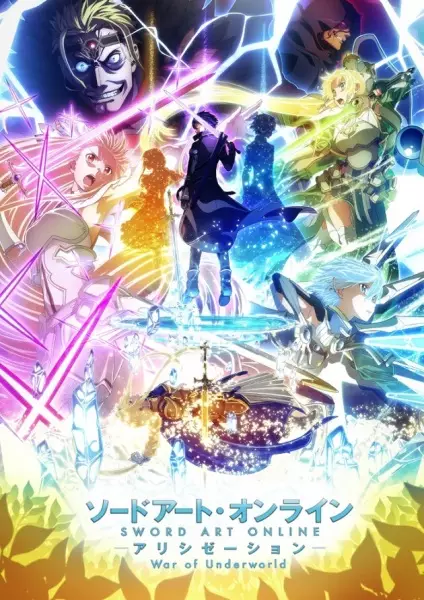


Sword Art Online: Alicization - War of Underworld Part 2
ソードアート・オンライン アリシゼーション War of Underworld
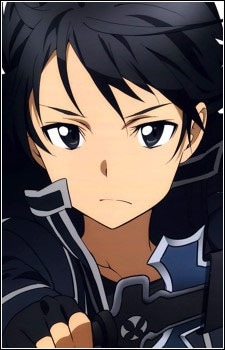
The final battle against the Dark Territory drags on, as players from all over the world flood the Underworld's servers and plunge the Human Empire into utter chaos. Asuna Yuuki and her friends defend their new allies with everything they have, but their numbers are falling. Meanwhile, Alice Zuberg heads toward the World's End Altar while Gabriel "Vecta" Miller relentlessly pursues her. Meanwhile, members of Rath strategize a plan in an attempt to restore Kirito's damaged fluctlight. However, the intruders occupying the main control room have other plans. Surrounded by death and despair, when all hope seems to be lost, one voice reaches out to Kirito—a familiar one saying, "I will always be by your side." Sword Art Online: Alicization - War of Underworld 2nd Season is the epic conclusion to Akihiko Kayaba's dream of creating artificial human intelligence. Now it is up to Kirito and his friends to protect this collapsing world from the people that still think it is just a game. [Written by MAL Rewrite]
Главный
Главный
Главный
Второстепенный
Второстепенный
Второстепенный
Второстепенный
Второстепенный
Второстепенный
Второстепенный
Второстепенный
Pipe
September 19, 2020
SAO's franchise has always been full of disapproval babbles between the anime fans, we can look that in the continue hate and rants that we can find in every place. However, even if it is hard to accept for several fans, the light novel is considered the best of Japan's decade, where it matters. One of the arcs from that light novel is titled Alicization that concludes with these eleven episodes and that for me, it is probable the best part of SAO's plot until this date leaving aside the new arc (Unital Ring) that is being published right now. The story follows thebasic template of the light novel; we have a Kirito in a coma waiting for his return as the underworld struggles to survive. The fight allows a large number of characters to participate in the story. The action sequences and some of the subplots are concluded (for example, Bercouli), so the development of the main character is completed. We can see tears, blood, gore, betrayal, fear, and many other feelings during these episodes. Maybe the screen gets saturated with action to the point that we can't process what's happening, or perhaps the events are too fantastic to be accepted. Furthermore, those awkward and useless scenes will lead us to wonder why several fans hate SAO, and it's not a problem with the adaptation that is a problem with the novels and the need to promote them with fan service. Albeit this silly impression, the show is able to offer a charming conclusion to Alicization's story arc, leaving the door open for future development. On the other hand, character development wasn't too impressive. I understand that various characters are introduced. However, I want to remind the audience that several of those characters have already had their development through other arcs of the story. Therefore, it is unnecessary to cover more details because the setting of the story will not allow it. They are just fillers that will help with the conclusion of the battle, and perhaps that is a negative aspect of this series. Asking for further character development when the climax was already set is not wise, but it could have enhanced the enjoyment. For example, giving Alice a bit more context would have been interesting. Still, this second season I feel like she is left behind as a supporting character, and all her development from the previous seasons froze. From art and technical aspect, the color palette is traditional but exciting nonetheless, the adaptation focuses more on the action sequences than the personal details that could have been expanded. Even if the action was well directed, you would feel like something is missing if you are not an avid SAO fan. I can't complain about the technical aspect of the series, it's good and I think the director and the studio made an excellent adaptation. On the sound, it's okay and it helps with the dynamics of the action, but it's not great. The songs are interesting, especially Anima by ReoNa; for some reason, I like the rhythm and the lyrics. Finally, the conclusion is acceptable, but sometimes the plot is useless and leads us to think that the story is garbage. However, I think the author is playing with some fictional elements that can give us great emotions and better development in future arcs. I can't recommend this series to all fans because you need to understand SAO's entire plot from the beginning to enjoy the full context, but I do enjoy it until the last episode. One last commentary, it was funny watching Alice coming out from a box lol.
Stark700
September 19, 2020
Sword Art Online’s Alicization arc has been one of the most complex and gratifying storytelling in its franchise history. From the depths of the underworld, we are thrown into a labyrinth of conspiracies. As a matter of fact, this arc has been so complex that it had to be told in multiple parts to explore its story at its full potential. From the first episode titled “The War of Underworld”, part 2 immediately jumps into the chaos with characters we were familiar with from the previous seasons. In this case, we are reintroduced to Sinon, Leafa, Klein, Lisbeth, Silica, and among others as they maketheir journey to the Underworld. Furthermore, Kirito still remains in a comatose state with viewers wandering if he can ever recover to normalcy. With the full weight of the ongoing war, characters such as Bercouli gets their triumphant yet sorrowful moments. It’s his moments of tragedy that is depicted not by fear but with a resolve, a way for this show to exemplify his character’s personality at its apex. And as I watched more and more of this season, I realized that every character has its importance, not like random fodder thrown away. For the sake of part 2, we are treated with 11 episodes with the ultimatum to conclude this saga. As the longest story arc to date, SAO Underworld wanted to fully capitalize its themes such as identity, loyalty, and love. When we realize what SAO Underworld has been selling to us, it makes sense to see how characters behave. It’s important to know that the war is much more about one side trying to gain dominance over the other, but rather why characters fight with their lives on the line. Bercouli, Alice, Sheyta, Iskahn, and Asuna are among a few of those who finds a reason to fight. And it is because of their reasons, they put everything on the line. For what’s worth, SAO Underworld isn’t afraid to also pull the trigger with character betrayals such as Yanai. With every action, there is a consequence as startling revelations are discovered. Meanwhile, fans will also have a lingering question on their mind. Will Kirito ever wake up from his coma? He’s the black swordsman that stepped foot into the virtual world of the franchise from the very beginning and make no mistake, he is an integral part of the Underworld arc. The memories grows to show his despair but somewhere within him, Kirito will find a way to become what he once was before. That is, during mid-season, he reawakens to battle against Vassago (Prince of Hell) and reunites with his friends. The moment between him and Asuna is imperative to show that despite them being apart for so long, they’ve never forgot about each other or their reason to exist. It’s a characterization element of the show that makes up their character roles this season. Furthermore, Kirito’s resolve to fight the good fight again shows that is able to conquer his personal demons and that anyone can overcome any obstacle in the SAO world. On the outside world, there’s also the threat of the government with the world at stake. This season shifts the balance between the virtual and real world to a surprisingly satisfying effect. The betrayal of Yanai is one such example to capitalize on how characters are motivated by their own morals. When you throw the government into this complex arc, the stakes are raised even higher. For what’s worth, you should expect SAO Underworld to deliver its best arc to date. It manages to woven together the multiple arcs together to meets its ends. This isn’t some half-baked game project like Sword Art Online Alicization Lycoris. It may not be perfect but certainly manages to evade a disastrous launch from the beginning. With every episode that progresses, we see more and more of the story unfold and why characters fight the way they do. SAO Underworld is the best for what this franchise has to offer and this one really hit the ball out of the park.
Neo_oeN
September 19, 2020
A little story on how Sword Art Online started. Reki Kawahara written SAO in Fall 2001 to participate in the 9th Dengeki Novel Prize, but he exceeded the page limit. According to him, he had no idea or will to trim it down, so he end up forfeiting and instead published it online. This manuscript he wanted to use to take part on the competition is the very known first arc "Aincrad arc", a death game story that take place in a floating castle inside a Virtual World, because of continues support from readers he wrote the sequels arcs and spinoffs. SAO was later publishedofficially into Light Novel around 2008 then adapted into anime on 2012, at the right time it exploded in popularity, with varying receptions to its fan, haters and critics. As well as at that time, the boom of isekai from light novels had begun. The author's wish to take part into a light novel competition was now unexpectedly adapted into anime continuously with new seasons and other media as well. Minor spoilers for first episode. Currently, here we are with the longest arc of SAO, started on Fall 2018 and span with almost 50 episodes, "Alicization arc" is animated completely. Alicization arc mostly sets in a Simulated Reality called "Underworld" created by Rath for the purpose of creating a True general-purpose Artificial Intelligence, where the characters are not NPCs but actual people copied from real world people's soul using the most advanced technology of SAO, the Soul TransLator. The first part of this arc "Human Realm sub-arc" is about Kirito and Eugeo on quest to reach the central city Centoria, with different goals, Eugeo is to save Alice, while Kirito is to find out how and why he was in sent to Underworld. Consequently, in the real world, while Asuna and Rath Staffs are waiting for Kirito's recovery and observing the state of Underworld, their facility Ocean Turtle is infiltrated by a Foreign Terrorists group. This lead to unfortunate events, with Kirito being comatose worsely, character deaths and the start of "Rath's Final Load test" or in Underworlders viewpoint, it is the start of war between Human Realm and the Dark Territory. This last season is part of the "War of Underworld sub-arc", the second part of Alicization arc, that covers the later 4 volumes, spanning with 24 Episodes. It started at were the "War of Underworld 1st Part" left off, with the Reinforcements coming from Real World, Asuna, along with the human army and a temporary truce to the Dark Territory had now a glint of hope. They can now fight back to the overwhelming number of the Red Knight Army, or so they thought, as a certain demon from the past takes the stage, and wants to settle the score with the SAO survivors, such as Kirito and Asuna. Meanwhile, Alice was captured by Vecta flying on his dragon to exit through the World End Alter, Bercouli, along with the 3 integrity knights dragon, continues to chase him. The adaptation is pretty faithful with slight alteration to join the elements from the movie Ordinal Scale. But because of most scenes lack explicit context, it will not be understood well by most viewers. Unless the viewer, perceives the scene using the past similar phenomenon or scenario that happen in previous season, as reference for its explanation or context, this is mostly the "Incarnation scenarios" in the anime. There are also overdid scene which got controversial receptions, which is to begin with, already questionable in the Light Novel, and just like on the first part of Alicization, this seasons controversial scene was adapted worse. But even though it did have those scenes, the anime did deliver heartfelt or emotional scenes, character moments, high production action battles and the storyline wrapped up well for this arc. The story elements that matter at start of this arc and from the other previous arcs were still used for this arc, such as the old characters coming back for this arc like the friends of Kirito and other players from other VR worlds; there is also old game/system mechanics at work such as the account-conversion system which made possible by The Seed program package, the common program used by all VRs in SAO. The Alicization arc until this last seasons arc is still directed by Manobu Ono, not a well known director, but has made quite experience with the popular very detailed scifi Light Novel, The Magic of Irregular High School. Did he do a better job at adapting the whole Alicization arc up to this point, instead of Tomohiko Ito who directed season 1-2 and the movie? My answer is not really, at most it's presentable, some directions being questionable leading to varying receptions. But thankfully, he did some good scenes that got a well reception like character interactions and relationships either among the main or supporting characters; and the most notable in SAO, of course the action scenes. But that is because of his other notable well-known great talent staffs such as Yoshihiro Kanno, Kentaro Waki, and Kajiura Yuki. They had produced high production values for this arc specifically in this second part of the War of Underworld. Yoshihiro Kanno is the SAO's main animator of major action battles, he came back for this arc's second part, after not animating the major battle scenes back in Alicization Part 1 Human Realm sub-arc. He did a great job, putting rough and weight on major action scenes, such as the most notable, Bercoulli vs Vecta fight. The Director of Photography(DoP) Kentaro Waki, known for being the DoP of God Eater and Mobile Suit Gundam Thunderbolt, made the final animated product refined. Blending the background and subjects with amazing visual effects. They produced the major action scenes captivating. Major action scenes indeed is sakugafest, although most of them lack the explicit context for it to understand. Also, we continuously have the notable great talent composer Kajiura Yuki, who's well-known for Ufotable Fate anime and Kara no Kyoukai. She had produced well-arranged pieces, ranging from heart warming to intense soundtracks. SAO is consistent and didn't shy away on presenting its themes, even though how ambitious it is. From earlier arcs back then we have Virtual Reality, VR machine for Medical Technology, now in this arc we have Artificial Intelligence, Time Accelerated and Simulated Reality, which is for myself the very reason I continue looking forward to SAO, are the themes it shows us, how our future technology might be. I wonder what more can SAO do with its themes, as the franchise is far from ending now. An announcement just made for another SAO anime. If you have watch this SAOs longest arc up to the previous season, why not finished it now with this last part, you might still find something to like.
SunlitSonata
September 19, 2020
(Note: This review covers both seasons of SAO War of Underworld, and also contains spoilers for Samurai Jack Season 5) The end of the nine volume “epic” Alicization, the end of SAO’s original web novel, and the last of the cringe phase origin. While SAO rants have been done to death on the problematic issues, including from me, I want to structure this review in a slightly different way. War of the Underworld positions itself as the end all be all of everything the series has culminated towards for nearly a decade, and it has the presentation to potentially make it an impressive achievement, but notwithout bizarrely problematic writing being a near constant, even by SAO standards. It has its moments, but it still has enthusiastic high schooler writing, equivalent to a runner having more than enough energy and support to run a full marathon, but choosing to bump into every person, car, sign and small animal on their way to the finish line. With that in mind I want to qualitatively explain how the show’s faults affect its story from three perspectives: the heroes, the villains, and the presentation. The Heroes If there’s one thing I can give War of the Underworld credit for, it’s that on principle, the cast on the hero side is the largest it’s ever been in the series, and they were even willing to kill off several characters for dramatic stakes. This works well for the named characters. The War of Underworld seasons consist of large-scale battles between the heroes and villains for virtual dominance. Nearly every character in the series is brought back for what feels like one last hurrah, in an almost Endgame-esque fashion. So, if there’s any alive character a fan may have liked from an earlier season, they’ll get to see them battle for a bit in this season, which is a nice, if basic way to pay off fans’ investment in the series. In particular, Klein has some small, but nonetheless genuine heartwarming moments. A brief almost self-contained story is one of the season’s highlights, mostly contained in the episode Sword and Fist. This story features Sheyta, a character taught to believe her power was a hindrance to ever form meaningful bonds, and her relationship with a more hotheaded, laid-back character on the other side of the war with the opposite personality. It’s nothing exceptional by the standards of most anime, but for being in an SAO story, it’s surprisingly alright and has some nice animation to back it up. On the downside, the show really wants to cultivate emotion with all of these characters, and many of these moments wind up ringing hollow because of their lack of focus. This isn’t to say they all suck. Asuna finally seeing Kirito again within the system is gratifyingly heartfelt, and any sacrifices on the hero side actually feel well-earned and theoretically interesting ways to have Alice grow as a person. Bercouli in particular has a surprisingly good arc of protecting Alice to the very end. His fight against the main villain’s first form is gorgeously animated, scored and resolved in a way only he was capable of doing. These moments in Episode 2 provide a genuine standout in for cast. But unfortunately, the rest of the series mostly flubs its emotional payoffs. For instance, at one point when defending her leader from an attack, one of Fanatio’s guards faces a brutal attack head on as their body gets torn to bloody pieces, and the audience is asked to care when they die from it. The previous season had the perfect opportunity to show Fanatio’s rapport with her guards during her introduction, but that was deemed unimportant in favor of needless exposition. It wastes half an episode trying to invest us in Renly, an Integrity Knight whom we only just know knew existed, and to be entirely irrelevant past this brief episode. The show tries to get weirdly sentimental about Alice killing random mooks with a spirit bomb, insisting they all have souls and that killing them is losing life, but with how little agency most of them have, it doesn’t land at all. The most desperate plea of emotional hollowness comes in Episode 11 of the first season. The speech is well-acted by Takagaki Ayahi and Sarah Williams, scored and animated, but what’s actually being said feels like hogwash. The writing in that scene is so sloppy and full of exposition that's only now relevant. What? You mean it WASN’T mentioned, let alone shown, how the school for SAO survivors was treating them poorly prior to Lisbeth mentioning it like it was always a thing? Who knew? God forbid we create an actual reason for all these background characters to care about throwing their Avatars away for a conflict that they have nothing to gain from. And then there’s Kirito......... Because of the events of last season, he’s spent most of this season wheelchaired around in a vegetive coma state. How exactly is Kirito in a double coma? Barely explained. But his state leads to a lot of very eyebrow-raising moments, like having entire scenes where characters do nothing but praise him, rolling him onto the battlefield where he could potentially be in danger or having a.............................................slumber party where four female characters all sleep together in a tent around his barely functioning body. Characters like Sinon and Leafa don’t even see him this season, but that doesn’t mean they won’t shut up about him or randomly inherit his clutch survival tools. Leafa in particular gets it incredibly tastelessly, constantly calling Kirito big brother over and over again (despite her initial arc being to shine on her own and get over her feelings for him) and doing nothing for the plot besides being killing a villain who had every reason to die earlier. But that’s not before Leafa gets raped by said villain in a scene shot like tentacle hentai for tasteless shock value! Because Kawahara just had put that in somehow and then it had to be animated with such gratuity. Near the end of the story, this is an actual dialogue. Lisbeth: I love Kirito, after all! Silica: So do I! SAO’s harem antics and wish fulfillment have been inherent to the series, but they’ve never dropped all pretenses to this degree before in something that was actively trying to be grandiose and gory. In previous arcs, Kirito had moments where he does stuff through ridiculous means because main character, but there’s enough driving motivation and the occasional arc, like his character arc in the first season of learning to be accepting to others, which was an idea, or the brief intentions to draw on his PTSD in Phantom Bullet. However, in this arc specifically, nothing progresses because Kirito isn’t active. Sure, characters appear and disappear, form armies in different places, or gain new forms, but the plot is still at a stalemate for 15+ episodes. And since everyone, even the Integrity Knights, talk about the off chance of Kirito coming into the fray to be all awesome, the self-importance is inflated to the nth degree, because it's all about Kirito's return. When elements start to move, it’s because they want Kirito back. War of the Underworld actively made him the black hole that sucks all the important stuff into and leaves little left for anyone. I mentioned earlier how Bercouli got a decent arc, but even then, his development is sidelined by events like the aforementioned slumber party, or Vassago trying to tip Kirito into waking up because he’s “the only one who can defeat him” and all that. The predictable result is that by the end, Kirito is going to godmode back to life and defeat Gabriel Miller, the main arc villain. This, by itself, is not bad, but the show majorly missed out on an opportunity to make this feel earned by exploring Kirito’s doubts, mentally. Samurai Jack Season 5 for instance, I think did this really well. We actually get to see Jack’s shattered, worry-worn state in action, while we also are shown in his mind, a twisted version of his previous self tormenting him, until Jack eventually overcame his past character (with the help of Ashi) to become the character fans knew and loved from the original four seasons, complete with his original sword. This occurs over multiple episodes and it felt like a genuine triumph. With Kirito, it takes 17 episodes into the arc to finally see his thoughts, and less than half of one to resolve them. As cliche as it would’ve been, imagine visages of Sachi, Asuna and Eugeo mocking him for his perpetual inability to protect those surrounding him from dying, and his propensity for constantly throwing himself into danger again and again with every new arc. Like he has this need to be some sort of paragon. Kirito overcoming those visages, and learning he’s more than what he gives, could actually be seen as a powerful character moment, worthy of people being excited for his return, and something to speak out against Gabe having learned this. But, no. In his headspace, Kirito, despite seemingly hating everything he went through, is validated for everything without it being by his own decision, and despite being in a double coma in a virtual system, the power of friendship prevails. Nothing important can happen or be resolved until Kirito returns, yet there isn’t anywhere close to enough time spent with him to make these moments feel earned in any way. You could lose at least half of the episodes in the first cour and most episodes of the second half and lose nothing. Did Eiji really need to stand up to Vassago just to lose and reset the status quo, when that time could’ve been spent better elaborating on Kirito’s mental trauma? No, I don’t think it did. Did we need to waste half an episode building up Renly? Not really. Did trying to bring politics into the mix with Chinese, Korean and US players pitted against Japanese heroes really mean something in the longrun? Not enough. Even the Sword and Fist story, which works decently well as a stand-alone tale, contributes nothing in the long run and wastes time that could’ve been spent either elaborating on Kirito’s mental state or building greater connection between him and the villains. This even causes moments that could’ve been other characters’ time to shine to fall entirely in Kirito’s lap. War of Underworld actually does a decent job giving Alice animosity with the main villain, Gabriel Miller. After all, it was because of his invasion that her apprentice Eldrie had to sacrifice himself, and he drove Bercouli to what was effectively a suicide just so Gabe could have another form on standby. There's an actual dramatic investment there. I mentioned in my previous SAO review that Alice was heading in the right direction for a female lead in SAO and that it was nice to see her stand up after learning her trust in supposed nobility was a lie. In this season, all she does is wheel Kirito around a bit, kill a bunch of mooks, sleep next to Kirito, get captured by Gabe for a bit, and then make her way to the tower like the plot device she is with no resistance because of an arbitrary time limit. So, Kirito defeats Gabe without her help, and she has no final words on the matter. Really spitting on all that potential there. Similarly, poor Asuna. She arrives into the world with a Goddess level power set, tries to help her side best she can, gets depowered through an offscreen time-jump, and just when through force of will and compassion she eviscerates Vassago in another ASTOUNDING cut of animation.......he gets to live just as strong while Asuna is near death. Like seriously? How much better would it be if she finally got a W against a major villain to prove herself as Kirito’s strong and capable battle partner, rather than being someone who needs her boyfriend to clean up for her? Or if Vassago, who constantly talked about wanting to finish things with Kirito, never got that chance because Kirito surrounded himself with people who care for him, rather than just people he could hold power over? They didn’t do that for, what? A fight that was passable at best? Where the fight animation is comparatively mediocre, and Kirito just wins by pulling numerous powers out of his ass to do whatever he wants because plot? This once again proves any stand against major antagonists by someone other than Kirito is pointless because plot. After all, who else besides Kirito can dual-wield, do the Gainax pose while flying through the air between two dragon wings, or straight up steal Goku’s Spirit Bomb? The heroes in this conflict have a couple standout moments, and it’s nice to see so many characters return, but nearly all of their previous effort evaporates once Kirito, the longest living person in human history, enters. No, killing random mooks/noob players and nothing else does not feel like it makes a difference in the grand scheme. But don’t worry, the villains will be waaaaaaaay better, right? The Villains If a story is only as good as its villains, then the score for the Story number here on MAL would enter the negatives. It’s no secret Sword Art Online hasn’t written very good villains; the series has become a standard-bearer for bad anime villains. With two exceptions that had vague characterization, they’re basically all the same character; some asshole who makes creepy faces at the camera, has obsessively rapey thoughts, and spends all their screentime making sure viewers know they’re as unambiguously evil as possible. Unfortunately, War of Underworld only worsens this aspect. There are four villains that hold plot prominence in War of Underworld, and none of them are written well for a variety of reasons. To get the two minor ones out of the way, Dee E El is just there to be the requisite femme fatale/baroness character for the villains and little else. She has an eye-catching design, but like most of the other female characters in SAO, gets sexualized incredibly hard with ahoge faces, groping herself and at least one shot of her ass. For how little she actually does, it seemed fair enough to kill her when her tactics backfire on her but nope, she needed to inexplicably come back, sport tentacles and graphically rape Leafa for tasteless shock value. It’s as if the anime screenwriters weren’t sure viewers thought she was evil enough yet, so she got brought back solely for hollow shock value. Yanai’s villainy is both hilarious and sad. He’s set up like a twist villain with incredibly poor foreshadowing, introduced and named out of nowhere in an episode to accompany an important character doing a plot-important task, before revealing himself at the next episode’s end. If the anime writers wanted to build up the shock value, they could’ve just had him be there with other scientists from the start and create conflict behind the scenes, but nope. The concept of his character, a programmer who took the form of the tentacle monster back in Season 1 to get Asuna all entangled, before becoming a virtual simp for Quinella, is so utterly dumb on principle I can’t imagine what Kawahara was thinking when writing him into this plot. But hey, how the narrative deals with him makes for great comedy. Still though, why? Then there’s the dastardly duo: Vassago and Gabriel Miller. To start with, the story barely implies how these two even know each other. How did they even meet in the first place? And no, I don’t care if the light novel answers. I’m judging the anime on its own merits. These two seem like they took some sort of bet for who could be more evil by the end of the run. Vassago has technically been built up since Episode 6 of Season 1, the former leader of Laughing Coffin and the one who as we find out, knowingly caused the PTSD incident that caused Kirito pain in Season 2. But what’s his deal? Oh, he has a hate boner with Kirito and is super obsessed with him, and entirely gets to realize that even despite losing. Yup, that’s it, more Kirito obsession. Plus, his backstory, which the anime presents as a choppily edited mess. Oftentimes, villain backstories tend to feel like either needlessly contrived excuses or too simple to buy into. However, somehow this is the worst of both worlds. There’s numerous leaps in logic and missing information to make how he became who he is needlessly irrational and confusing. Was he a soldier? Assassin for hire? School shooter? Anime viewers have no idea. The anime also widely overestimates his charisma. When convincing gamers from multiple countries that the Japanese heroes are villainous hackers, everyone instantly believes him, except for two people. This way Vassago can both piss of the heroes and make people from other countries look dumb in the process. He eats up the lion’s share of villain screentime in the second half, occasionally having fun chewing the scenery, but really just rubbing in viewers’ faces how flat he is, with random abilities to be a wall that only Kirito can break. Finally, there’s Gabriel Miller, somehow both the most and least important character in the story. He’s introduced with some bravado as the next big bad guy, having murdered an adorable girl as a child, taking control over the massive army, and repeatedly worfing Sinon. Perhaps there was some intention to make him a cold calculating sociopath as opposed to the wilder antagonists of previous seasons, but it backfires when the anime plays his expressions just as over-the-top as any other villain. Making him be hired by AMERICA also baffles. This heartless, irredeemable bastard was deemed the one America wanted to use for understanding mysterious technology? Really though, the most rookie mistake made was just how little attention he got proportional to his role in the story. He feels so poorly developed that by the final battle, there’s no connection between Gabe and Kirito other than taking opposite sides of the plot. Creating some sort of connection between a hero and their ultimate villain is basic writing 101, and even something previous arcs did. Kirito and Kayaba were foils to each other. Kirito and Sugou fought over Asuna. Kirito and Death Gun fought for Sinon and the (supposed) end to the legacy of Laughing Coffin. Kirito and Quinella had at least an attempt at some personal stakes such as Eugeo dying and avenging the Integrity Knights. Hell, even Vassago at least was built up since Aincrad and had history with Kirito despite it all being next to worthless in the end. But Kirito and Gabe? Nothing. His importance to the narrative ultimately just marks the guy as a footnote. The animators and sound designers do a great job giving the battle spectacle, but any substance is either straight up not there, or pulled with no buildup. To try and make these two seem threatening, the show opts to give them random arbitrary powers to pull out of their asses whenever they need to be a threat. Things like mass mind control, shadow cloning, force choking, or weapons that gain power from surrounding death frequently get pulled out of nowhere for the sake of false tension. This stuff isn’t even from the god-level accounts the system left open for them to obtain because plot contrivances; this is from GunGale Online accounts, where the abilities they use could not have existed. It’s annoying because these abilities tend to be used as an excuse for why no character has any chance against them without similar asspull powers. This is a problem Kirito and Asuna have as well, but it’s far worse when referring to Gabe and Vassago. It makes the establishment of a magic system, called Incarnation, seem pretentious, since all it really amounts to is the major characters pulling abilities out of nowhere to assert dominance and win fights. A major part of what makes action scenes, or tournament arcs enjoyable to people is thinking about what the combatants are capable of. War of Underworld actively denies that pleasure, particularly in the second half. What possibly makes this worse is that, as flat as these villains are, there was some potential present to make the focus on them more interesting. When they first enter the Underworld, they have a conflict of control with two characters that served as more civil leaders for the various armies. Seeing Gabe and Vassago navigate their way through the system to eventually overthrow them might’ve felt cruelly cathartic. But, nah, they die instantly just to show how evil the main villains are, and the evil army is mostly just drama fodder for one-dimensional bad guys. Presentation This refers to both the production value behind the show, and how the show itself choses to provide the audience a lens into its world. Visually, the show for the most part looks great, and while Swordland is still overused, the soundtrack can still hit at the right moments, like in Episode 2's battle, or A Tender Feeling at the end of Episode 9. Nearly every episode has some sakuga in it, and after mentioning how a lot of the battles in Alicization Part 1 didn’t seem to have as much passion as earlier parts, it was generally added back in Alicization Part 2, regardless of whether or not the writing supported it. The first half of War of Underworld does have some pretty dodgy CGI for ground battles, but that’s mostly done away with in Part 2. Bercouli’s battle against Gabe and Asuna’s battle against Vassago in particular have some astounding animation cuts. However, the sense of place conveyed with the animation when it comes to the war aspect is pretty poor. There’s no sense about what distance either side of the battle is from each other at any given point during almost the entire series. The Dark Territory is a whole lot of nothing scenery-wise: flat red canyon as far as the eye can see. Sure, they’ll be a crevice or a forest here or there, but they only exist as places for characters to walk through, not actual landmarks. Something as simple as giving either side forts would’ve done so much for stakes and establishment. In many war stories, or stories in general, the heroes managing to overtake a villain stronghold (or defend their own stronghold) after a desperate fight can be incredibly cathartic, and likewise, the villains managing to destroy or take over a hero base can be an effective moment of drama or tragedy. War of Underworld doesn’t concern itself with either possibility, instead thinking the best solution is to cut back and forth between numerous characters in numerous battle spots and camps that don’t have any relation to each other. Even something like showing a map of character locations during commercial breaks could’ve added. So much more gravitas could’ve been there if the anime illustrated where everyone is compared to everyone else. The series also could’ve benefitted from better editing. Jumps to the real world events can sometimes feel arbitrary, and editing in the battles themselves can be confusing at times (in one scene, the protagonist side will have a massive advantage against the clueless enemy, but in the next, they’re burned out and near death with no proper transition). When certain elements that are more pertinent to the story are sidelined, you’re left with Vassago’s confusing mess of a backstory and Kirito’s nightmare not having the time and space in the narrative it warranted for being so ultimately important. One improvement over the previous series is that the Star Wars prequel level exposition that tried to convey the show’s idea of “hey, digital souls are people too and they matter” has been reduced, but the utilization of the theme in the narrative too often undermines drama. Kirito thinking about Eugeo’s spirit once is fine, but it’s so comically overdone that it feels like a video game quick time event. Yuuki, who didn’t die within Underworld, pops out to provide Asuna with worlds of encouragement or bits of exposition because Asuna merely keeping her in mind wouldn’t be enough. And the most side-splitting scene in the season occurs when a virtual spirit manages to power a real-world robot to complete a task through strength of will alone. Really undermines the realness of digital souls when they have powers well above the plot. Conclusion Sword Art Online’s position is tragically precarious, or at least, the original SAO on its journey from web novel to light novel to anime. In light of everything it inspired within the industry, it cloaks itself in higher ambitions and always has strong production value on its belt, but it keeps stepping on rake after rake when it comes to the writing. Sometimes this season was enjoyable for the wrong reasons based on just how consistently the stupid decisions keep piling up in contrast to the production value, and how much of a teaching tool the series can be for up-and-coming writers. If you’re a fan of the series that can accept every dumb decision for the sake of seeing your favorite characters, you may be satisfied in some places and let down in others. For everyone else, it’s a well-produced but stupendously frustrating bellyflop that gets incredibly close to realizing something, only to fall short over and over again. At the very least, with Progressive as the next project, when SAO returns it’ll be closer to what everyone wanted out of it to begin with, and create ponderings for a timeline where it was the first big break for the anime.
YeeYeeAss
September 19, 2020
So, finally the Alicization arc has finished. It took some time but it was entertaining and way better than previous seasons also it was the longest. It took 3 seasons for gods sake. It had some pretty epic fights that gave me chills, some good animation and cool characters. Story: As a whole; It was okay, a lot of things happened after Kirito got poisoned but I don't understand how putting him in to a VR world fixes anything. Sure time moves faster but I don't know how it cures poison, that never got addressed or maybe I just missed something. Here we saw the endof the war and the return of the vegetated Kirito. Fights were pretty good but sadly there was some "questionable" scenes like there always is in SAO so that is nothing new. Characters: We had one from the Laughing Coffin; surprisingly they were still a thing and he had a big grudge towards Kirito but he is definitely out of the game, or in this case he is in the game (You'll get this joke after you have seen this show) Then we got Gabriel who is the leader of said private military company. He is known for his skills in GGO and previously he defeated Sinon. He is back and he is more messed up than ever before. He had a weird thing for dead bodies so he was certainly creepy. Kirito returned to save his friends from the Laughing Coffin man and oh boy it was brutal. Alice was the same as before and so is the rest of the cast. I don't think we got anybody new. OST: It was darn good. The opening was great in many ways. The background music was also nice. There was some very fitting themes and few not that good ones. Of course the classic SAO battle theme made a return which was also cool. In the end Alicization was cool and way better arc than GGO or Alfheim. There was better animation, better story, better characters and Kirito was a crippled fuck for +20 episodes. If you have seen only the first 2 seasons, I would recommend you checking out Alicization because it is actually better.
Ранг
#2072
Популярность
#352
Участники
681,886
В избранном
3,355
Эпизоды
11