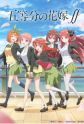
Megalobox 2: Nomad
NOMAD メガロボクス2
Megalo Box is an advanced form of boxing where competitors wear metal frames called Gear. When the first ever Megalonia tournament took place, "Gearless" Joe became its champion and known to all as a legendary fighter. However, soon after, he lost an exhibition match against the second champion and vanished from the public eye. Seven years later, Joe now goes by "Nomad" and keeps a low profile, occasionally fighting in a few underground matches to get by. He is haunted by hallucinations and relies on a set of painkillers to numb his mind. During a match, Joe wins against an opponent, Chief, who purposefully loses for some extra cash from gamblers. Subsequently, Joe discovers that Chief is from a community of immigrants called the Casa. Chief is gradually trying to make enough money to purchase the land where they live illegally. At first, Joe hesitates to get involved, but eventually decides to lend the Casa a helping hand. [Written by MAL Rewrite]
Главный
Второстепенный
Второстепенный
Второстепенный
Второстепенный
Второстепенный
Второстепенный
Второстепенный
Второстепенный
Chief_AJ
February 15, 2024
This is the best singular season of any "sports" anime I have ever watched, and the reason it's in captions is because this was more than a story about boxing. It was a beautiful depiction of a broken man, a man that was so successful but so shattered into pieces, it's a story of that man reinventing and reinserting himself into his past life with the help of amazingly written characters along the way. From his old companions from season 1 to newer characters that were introduced here. All of them played a huge significant part in Joe's story, and how he looks at theworld, which is all that you can ask for. This was more than a sports anime, this was a masterpiece that I would recommend for anyone to watch. To me I would give this 10 right hooks out of 10.
Atlos
June 28, 2021
(TLDR at the bottom, thanks for reading.) Nomad has no right to exist, but I am glad it does. You can almost consider nomad to be the other side of the meglobox coin, while s1 had a simple underdog story it derived its entertainment from the stellar visuals, soundtrack, and directing whereas nomad is much more focused on its story and characters, and less about the fight. Joe starts of this season back at the bottom, while he had achieved everything he set out to do in season 1 it doesn't make him happy. Nanbu's gone, Sachio's gone and while Joe is at the top he is allalone. "They don't make graves for stray dogs" but in the first episode, we see joe making a grave for a stray dog, combined with the constant imagery between Joe and stray dogs perfectly shows what's has happened to joe. We know Joe is dead, we only have nomad now. The first four episodes don't really concern themselves with the fight but the focus is laid squarely on Joe and the Casa. I mentioned earlier that one of the reasons for Joe's depression was the depression stemming from his loneliness. Joe and the Casa are complete opposites, you have joe, the successful but lonely and depressed megloboxer and then you have the Casa a persecuted but happy group and opposites attract. Joe slowly grows closer and closer to the Casa until this wondering nomad finally has a home. Mi casa es tu casa. And in episode 4 everything the Casa is aiming for is in their reach, they finally have the chance to be able to make the land the life on their home, and all it takes is for Chief to enter the ring once again. Then Chief does it, he secures the land for the Casa and then finally cements Joe as a part of the Casa by calling him, family. When Joe goes to offer Chief a handshake he refuses and hugs him instead, this scene is genuinely heartwarming after only 4 episodes we've seen Joe grow and develop as a character while this show builds some great characters of its own. But nomad isn't a 4 episode show and it needs something to hold up its other 9 episodes, the show stubbles between plot points until its final episodes and it drags down the experience, the first four episodes set the bar too high and the rest of the series just can't reach it. Episode 5 is a flashback episode, while it does kind of work since Joe is alone again one of the big emotional climax's of the previous episodes is Joes developing and becoming his old self again and then a sad backstory episode kind of feels that the series is regressing a bit. There is some more back story, some new characters get introduced, some fights happen, this mini-arc about a new character called Mac et cetera et cetera. Nothing that really pushes this show to new heights happens, it certainly has its moments but nothing more than the previous season had. There has been this feeling of melancholy throughout the series, while megalobox was all about the glitz and glamour of boxing nomad is what happens in the aftermath of it all, and the mac mini-arc perfectly encapsulates this. Mac, like joe and chief, is a boxer past his prime, He has fought with the gear and his age has come to pass, but because of the new technology offered to him by Sakuma he once more has a shot at the limelight. But all this has done is convinced Mac that he is ok when he clearly isn't. He keeps trying to achieve glory once again but he ends up pushing away what means the most to him, his family. There is this heartbreaking scene in episode 11 where Mac reaches to his son and he just screams "get away!" and everything from the accompanying ost to the hurt look on Mac's face these few seconds really sell this mini-arc. For a second nomad is showing that it can live up to its first 4 episodes. The only issue with this mini-arc is while it is great it doesn't have an emotional connection to Joe, while the Casa arc allowed Joes to grow and change as a character it is much harder to draw that comparison in the Mac arc which limits its potential. The visuals of this season are the same as the previous season, it still has the low-resolution cel-animated look and while I like the cel-animated look the lower resolution of certain scene can harm anime. But other than that the animation is spot on. The ost is great, nomad has a very Spanish feeling to its ost and to the Casa which helps it carve its own identity, it's a shame that most of the Spanish influences are mostly contained in the first 4 episodes though. TLDR: Nomad manages to be more than just an extra cour of megalobox but if you are only here for the fights to might not be too impressed.
k1080
February 1, 2022
I will certainly watch this again in the future since it was good. I loved s1 that was good but s2 was fire. bit disappointed with the last fight but the ending made up for it. I really like the metaphor too it was shoved down my throat since the start but i never got it until i read another review. Music was a banger too. Had some throwbacks to s1 music and that was fine. It showed some character growth. Had a tough time at the start because of his drug abuse though.LONG STORY SHORT: this shit absolutely fucking slaps
Inclemnc
April 6, 2022
This anime if any is deserving of the title " masterpiece" There is so much to discuss so I will try my best to express the beauty I witnessed within Megalo box, and why I think any fan of anime should experience this work of art. Story: As a fan of Megalo box I had love for this series already, and had never yearned for more, I was happy to see Joe's story end where it had left off. I could have never predicted such a raw and gritty, beautiful continuation of a story that already impressed and left me with a feeling of fulfilment, the directionNomad takes Megalo box is a breath of fresh air in an industry that often loses it's way over time with the pressure of meeting deadlines, rushing a story to completion, forcing filler and fanservice onto it's audience to appeal to a generation that is overly eager for action and promiscuity above all else. The experiences shown in Nomad are genuine and perfectly portrayed, the struggles of the hard working that immigrate, the resentment broadcast their way by the ignorant who were raised with hatred and lack a connection to culture, culture being something that connects people to one another when blood does not through love and acceptance, and furthermore Joe finding a place to call home within this culture because he is untainted by the generational ignorance. This is a breathtaking story, and every episode is a worthwhile addition delivering something new that has you sitting there enamoured by the masterful writing and story building. Characters: Time has passed since Megalo box, and this is reflected in every character you once knew, some have grown while others have recessed. This character development is reflective of the real world, people change a lot after taking heavy losses and this can leave you in a state of tragedy. As somebody who has experienced this kind of loss, I sought to escape by any means from the reality that was haunting me, I was a husk of who I once was and to see this portrayed so perfectly in Joe left me speechless, I felt like somebody out there understood me. This will stick with me for as long as I live, and I will forever praise Megalobox for showing that there is light at the end of the tunnel. Imagery: Subtle yet powerful, every scene has a meaning or a connecton of some kind, any scene that strays from the plot contributes in some way through the most intelligent and elegant imagery I have ever experienced. There are two scenes in particular that I feel convey my feeling perfectly, the first is a moment where Joe is travelling down the road on his motorcycle and along the way he encounters a lone wolf, in the heat of the moment said wolf turns and rears it's teeth at Joe standing it's ground which forces Joe to back down and turn away, sending himself sliding across the floor as his motorcycle collides with the roadside. Later on Joe encounters the very same wolf, this time it is laid out on the floor whimpering and injured. This imagery is open to interpretation, it could mean many things, but I'd like to share a few of my of my own interpretations so that you can understand how such a scene excited me. This wolf is symbolized as Joe, he has nobody and travels from city to city living a desolate nomadic life, much like the wolf he has no pack yet he is a fierce and capable creature, never backing down no matter the risk. In the scene where the wolf is injured this is representative of the Joe of today, he has fallen from his moment of glory in the first season, he pops pills and drinks himself silly to escape the pain of his losses. He is injured and vulnerable and is no longer the wolf that once reared it's teeth. The hummingbird in the logo, the title for this series being Nomad, everything is imagery in some way and once you understand the connections it is hard not to smile. Music: Season 1's outro is one of my favourites, to this day I still have Kakatte Koi Yo in my playlist and listen to it weekly, following in those footsteps Nomad has even more beautiful music that feels like it came directly from Chief's people, while also complementing Joe and his story perfectly, El Canto del Colibrí is the perfect outro song. Closing words: If you are yet to experience this anime for yourself, please take the time to listen to this story, really take the time. Sit down out of the way of distractions, in a nice comfortable quiet room. Watch this anime, take in all of the connections between our world and Joe's, and appreciate the talent that went into this underrated masterpiece, if you do that I am sure you will see Nomad Megalo Box from the same place as I.
KANLen09
June 27, 2021
"As the wind whirled by, a Hummingbird appeared before the Nomad as they made their way through the wasteland. Hummingbird: Will you listen to my song, Nomad? I'm in a hurry, ask someone else. But the Hummingbird just won't give up and pursued the Nomad. Hummingbird: Please, I must sing my song. Nomad: You're rather selfish. Sorry, but I' m just not in the mood. I'm on a journey to die. Hummingbird: But that's ridiculous. Who goes on a journey to die? Nomad: It's the truth. Why would I bother lying before I die?But the hummingbird refused to give up. Hummingbird: Then how about this? If I can make you lie, listen to my song. If I fail to do so, I will say no more. Wanting to be freed from the persistent pest, the Nomad agreed. Hummingbird: Why do you want to die? Nomad: Because I lost everything. Hummingbird: That's a lie. Nomad: But it's not a lie. I lost my home, my fortune...and my family died from illness. I've got nothing left. Hummingbird: No, you still have eyes to see me and ears to hear my song. You even have a mouth to speak to me. Nomad: Yes, you're right. Though they felt that they had been duped, the Nomad admitted defeat. Nomad: All right, I lose. The Nomad didn't want any more trouble, and stopped to hear the Hummingbird's song. The voice was so beautiful that it filled the Nomad's empty heart with a gentle warmth just for a moment. After it had finished its song, the Hummingbird flew towards the ray of sunlight that was peeking through the clouds." - The Hummingbird and the Nomad (Storybook) Redemption. The most successful and decorated Olympian of all time, Michael "Flying Fish" Phelps, sums the one word this way: "Perseverance, determination, commitment, and courage-those things are real. The desire for redemption drives you." Going back to Megalo Box, the prequel being a creation and a homage to the 50th anniversary of Ashita no Joe a.k.a Tomorrow's Joe, was a fun watch when the anime first debuted in Spring 2018, but quickly faded into obscurity for it being like a stereotypical Shounen anime where the underdog fights his way through all the underground boxing ring matches, to then rise up and be a formidable foe. Even I'll admit that going back to Season 1 now, just feels like the re-watch has made the experience much worse and a slog to finish this "boxing" anime. But the sequel here, dubbed Megalo Box 2: Nomad? NOW THIS IS A 100% GAME CHANGER of anything but everything that we haven't yet seen before. And apparently the production team behind the prequel also thought of it the exact same way with director You Moriyama, whom producer Minako Fujiyoshi had to convince him to do so, thinking that the prequel by itself is an open-and-shut case. Rather than make yet another season of staying with the whole "tribute to the past" thingie-a-bob (which was what attributed to the less-than-stellar feedback in both Japan and the West at the time), the staff team scrapped that idea, and went for a more mature theme that displays the post events of Gearless Joe in a long timeskip of 7 years, where everyone has matured and Joe's fall from grace as a depressed adult post-Megalonia. Instead of sticking to the same "Ashita no Joe" guns that bullets could crack for its own niche, the production staff team went for a more independent work which incoporates real-life societal issues, while still following Joe as he travels from place to place, while simultaneously not being able to move on from his past friends and rivals. AND BOY DOES IT SHOW, I'd say this change greatly increased the impact that boxing anime fans have been craving for the longest time. If anything, this Nomad sequel proves one crucial thing that is missing from the prequel: character development IS KING, neither the boxing matches (though since this is a boxing anime at its core, it has to be there) nor the impact of wins or losses. As such, Nomad starts out differently than your average sequel, giving it the vibe sense that the world of the past is present, but you cannot always look back to your glory days and make the same results again. And that's Gearless Joe's re-account of his mature life being the Nomad: the one who wanders around with no goal in sight. Need I mention that Nomad itself is more complex (as foreshadowed by the production team), but still reigniting the same flame of nostalgia? Because that is what it is: the Gearless Joe is not the same Gearless Joe 7 years later, and has largely kept to a low-profile state after losing out to Yuri's young successor Edison Liu, leading to his recluse life under painkiller drugs and earning money from his old ways of underground boxing matches. If you're wondering why I'd mention a "nonsensical" story in the beginning of this review, "The Nomad and the Hummingbird" is essentially the mature-but-depressed and delusional Joe's road from cradle to death, then riding the road to redemption, and it is a crucial pointer in the progression of the sequel. Through the same-old and new characters that are like character arcs in and of itself (and outstanding ones at that), these people will teach Joe the meaning of life, and what it meant by getting through all the trouble of being an outcast and making the most out of the new life, setting new goals, objectives and aspirations for the future. Seriously though, never have I been so captivated by a character-centric story so jarring, yet is intensely intriguing and hits at the heartstrings like a solemn foreign song played on the guitar. You can never find a better original story like this that is done through much of the production staff team's back-and-forth multiple discussions about the new Gearless Joe and his mature characterization, but fix as much as they can it did to give it an edge that I can say, is on a much higher pedestal than any typical "underdog to champion" fame kind of boxing show. Mature being the theme of Nomad, and of course, with such a huge timeskip, Joe and the kids of Team Nowhere have matured A WHOLE LOT. We all know what happened to Joe, but in the course of events, his manager-cum-coach Nanbu...shall I say, had some life complications to the point that Sachio and crew thought that Joe was solely at fault when he "abandoned" them for his own gain when going against the former No. 1's student successor (Edison Liu). Needless to say, all of that was a recipe for disaster, as the tables had drastically turned on Joe: the loss of his Megalonia "champion" status, and Sachio with the Team Nowhere kids exiting Joe's life thereafter. 7 years later, everyone obviously grows up, but Joe's fame got so much on his head that the loss subjected him to post-natal depression. Overtime, the new characters Chief (an Afro-Latino immigrant) and Mac "The Hero" Rosario (brought in as the new technological face of boxing Gear) encounters Joe, fights him, and teaches each other about what their human values are worth fighting for, hence the symbolism of "The Nomad and the Hummingbird", which explicitly interchanges the roles between the three Megaloboxers (once in each character arc), educating them and edifying the meaning of "coming home to the family". Even if all is lost, your family will still be right beside you, even through the course of life and death. And you know that I ABSOLUTELY LOVE symbolisms in shows, and Nomad does an outstanding job at reading between the lines when it comes to characterization of the tightly packed and immaculate kind. TMS Entertainment is back to produce this show (without the help of its subsidary 3xCube which also produced the classic Ashita no Joe), but this time, the old-school style animation is largely improved for the better. Even Joe's VA Yoshimasa Hosoya was surprised at the improved animation, and quote-unquote "was surprised by the improved animation which he felt to be more fit of a movie rather than a TV series". Season 1 wasn't bad, but the asinine tight production schedule, other than the tribute of sampling full HD to old 480p visuals, made it truly stand out in its time. Season 2 here is largely more of the same, though I'd guess that 3 years of production development is more than enough time to make this sequel work its legs to kick out wonders. It is an unique mold, all on its own. Even the music by famed composer mabanua is back with more of the same-old, old-school style instrumentals, but incorporating with Mexican-Spanish themes. Such as the OP "The theme of the Nomad" which is meant to sound like a glorification of Gearless Joe's better days in mono, to the Latin-American ED "El Canto del Colibrí" (translated as "The Hummingbird's Song") in full Spanish Tejano "folk" style music, meant as a song of the hummingbird, seen as a messenger of the gods used to convey good and peaceful thoughts to kin about their loved ones, dead or alive. And even as much as I miss LEO Imai's hyper OP "Bite" of the prequel, this narrative shift of a sequel does not need all the barking and biting hype, and settles for the comtemporaries to add the classic punch to the impact. Overall, it's insane to see a famed sequel like Megalo Box 2: Nomad, be so shunned by the community, because other than it being a vastly superior sequel, it can also be taken in as an independent work all by itself. Providing the fact that you have to bear through the decent prequel to get to this sequel, I can safely tell you that the wait is worth the trouble. Este es un Anime Excepcional Secuela! Realmenté excellenté.
Ранг
#461
Популярность
#1223
Участники
229,442
В избранном
2,253
Эпизоды
13