Cells at Work! CODE BLACK!
はたらく細胞BLACK
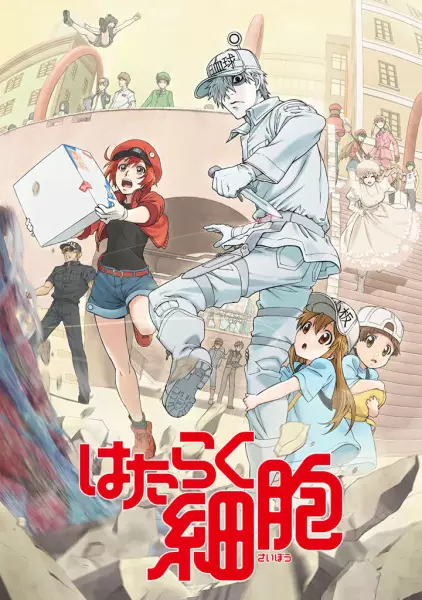
Due to poor lifestyle choices, a certain human's body is in constant turmoil. With germs, bacteria, and foreign substances abound, the jobs of various cells become increasingly difficult and dangerous. As some of the unfortunate ones who matured in this chaotic environment, Sekkekkyuu AA2153 and Hakkekkyuu U-1196 strive to fulfill their duties—even if it means seeing many of their fellow cells lose their lives in duty. Set in an environment vastly different from its parent story, Hataraku Saibou Black portrays the cells' struggles as they try to maintain the body's health. However, the human's condition continues to deteriorate, and whether or not these efforts will amount to something concrete depends on the cells! [Written by MAL Rewrite]
Главный
Главный
Второстепенный
Второстепенный
Второстепенный
Второстепенный
Второстепенный
Второстепенный
Второстепенный
Второстепенный
YeeYeeAss
March 18, 2021
Hell yeah Do you suffer from depression or do you want to fix your body? Well this is for you. Since you get to realize how much shit is going on in your body Story: Unlike the original Cells at Work this is depressing. This tackles more depressing things just as alcoholism, excessive smoking, liver failure, heart attack and more. It is just a fun and depressing watch Characters: Characters are pretty well done. Of course the waifu in this season is the white blood cell. Our main character himself is a hard worker which is respectable since the body is total shit Music: OSt is good and theopening and ending both are good but kinda unfitting for the show If you like Cells At Work or depression then this is for you
debochca
March 18, 2021
What happens when you put something as wholesome as Cells at Work with addictions and bad habits in a blender? Well, Cells at Work Black is what you get. Cells at Work Black is an anime that I refused to watch in a beginning. I thought it was going to be a blunder. When I first saw it would come out, I thought that it was going to be the same but with reversed roles. How wrong I was! If some people disliked Cells at Work because of the lack of characters as such, with this one there shouldn’t be many complaints. The story is Cells atWork but with a body of an stressed adult that smokes, drinks a lot and doesn’t have not one good habit. In consequence, everything is destroyed: the blood vessels are a mess, the defenses are pretty mediocre and the body is exposed to a big lot of germs and toxins, the white cells can’t have a break and let’s not get started with the red blood cells, that are so few that they have to double they job in order to survive in that hell of a world. They are exploted day by day, they are misstreated and don’t understand anything about their surroundings, and what’s most important, they are aware of themselves. They learn that they are disposable and that if they don’t work, they all will die. They are exposed to danger all the time and the main character sees a lot of fellows perish. And all this, my friend, is what you do to your cells when you get drunk and smoke like a chimney. What I love the most about this is how realistic this anime is. Not only because that’s how the body really reacts when the person has very bad habits and don’t care about themself, but because of the red blood cell that is our main character. He is the bare representation of the baby chick that gets out of the nest just to find out how rotten the world is. All the red blood cells madurate in the bone marrow and are educated in how they are going to work once they graduate. They show them tutorial videos, they give them guides in order to teach them that work is above everything, and these little red blood cells just want to get out as soon as posible so they could work and know that world that everybody is painting for them. But as soon as they do that, they realize that nothing is like the pictures, nothing in life can be solved with a written guide, and that even the people that appears in those videotypes are not what they seemed to be. They start working and waits for their superiors to teach them, but they just go like “you have to work, I have no time for you” and they are just left by their own. That’s what real world is once you grow up and you get to know the fact that you are on your own, and that there is no advice that can solve all your problems, and that school doesn’t prepare you to anything that comes beyond. A child dreams of growing up and living at their expectations, but when they are adults they realize that nothing is like they dreamed, and that sometimes, living to the expectations is a lot harder than imagined. That’s why Cells at Work Black finds a way of connecting two things that are as real as the day you live: the biology nature of the humans, and the dark nature of the humans. When we talk about dark or Black, I mean it. Different from the original Cells at Work, Black can give you just one or two laughs per episode, but a lot of sadness to carry during the episode. Letting the red blood cells aside, the rest of the cast is shookingly different from the original. The macrophagues are sick of killing in an infested body, raving and mumbering to themselves; Platelets, that are often the best and most cheerful part of Cells at Work, in Black are grumpy, sad and dull, frustrated by the state of the blood vessels that are full of shit and that are more and more unstable. In the first episode, in the first day and with his first colleague, the main character gets traumatized by his crudes words about “you just have to pretend you are okay and supress your emotions. That’s the only way to go on”, and then his death. Amazing. I cried a lot because I’m a pussy but that’s another story. The main character carries those words and his legacy for the rest of the series, getting him more and more frustrated. His emotions eat him alive, so he progressevely starts to supress his emotions and to live a shitty life. Just like that, a lot of other cells come to his life, leaves him some words and story to remember, and they disappear like that, making him more and more damaged and scared. Another realistic thing about it is how akin it is to some workers that are really exploted and that don’t have another options. It’s an anime that glorifies its name, because it’s all about the dark side of work; monotony, envy, workaholics. Everything represented in the same main cast, and treated with a subtlety that I enjoyed a lot. Their changes and growing are slow, are delicate, and so real. Is just great. In terms of visuals, this anime deserves a congratulation. Is a cheap art with low budget, but exactly that is what makes it so good, because it fits with the dark atmosphere, and is so loose and poor that envolves you even more in that world where everything crumbles. It’s a good example of a good use of what you have. And about sound… I hated the ending but now I just have it inside my head. In conclusion, I’m thankful for this anime. I needed this Code Black for Hataraku Saibou, and even if you don’t understand anything of biology, you need it too. It’s a crude anime in disguise, that will make you wonder why you make your cells suffer like that when you get stressed. Don’t be selfish, take care of them.
Valinis
March 21, 2021
Not a whole lot to say about this one. If you enjoyed the regular Hataraku Saibou you'll most likely enjoy this one as well. Follows much the same premise though focuses more on how bad habits can negatively affect the body. It remains a fairly interesting and informative insight into the human physiology. The main cast are essentially genderbent from the original which is an interesting touch. I did however find myself a little bored towards the end and didn't really care too much about the characters, but in fairness the setting kind of makes characters difficult to really get attached to.
Snapshot426
March 18, 2021
I think me watching a show about the human body and all the things that can go wrong with it while in the middle of a global pandemic probably wasn’t the smartest thing but I don’t think it really matters too much. I was looking forward to this series regardless since it essentially was the darker version of Cells at Work and Cells at Work season one was a solid anime back in 2018. But let’s not talk about its parent series and focus on the one right in front of us. A series that doesn’t require you to watch its parent series to jumpin as it is essentially a new body with new characters and new and bad problems. Many, many, many bad problems. Sit back, relax and make sure you manage your drinking and smoking habits as you get plenty of exercise as I present to you the anime review for Cells at Work! CODE BLACK! Let’s begin. Story: 10/10 Our story follows rookie blood cell Sekkekkyuu AA2153 (for the sake of this review, we will nickname him “Specs”) as he has just completed his training to help deliver Oxygen around the body. Enthusiastic and ready to go to deliver Oxygen, he soon realises that something is not right. There is built up plaque along the hallways, loads of cells are in a foul mood, the Platelets are back-talking and they are all being overworked. After seeing red blood cells die so easily and being saved from germs by white blood cell Hakkekkyuu U-1196 (Nickname: “Cleavage”), he realises that something is very wrong with this body. Drinking, smoking and lack of exercise has caused this body to deteriorate; making it a harsh environment to work in. The cells must work hard to maintain this body or the consequences could be catastrophic. What I liked about Code Black’s story was this underlying sense of inevitable doom but the determination to prevent it from happening. With each episode, there is a new problem that has to be prevented, often times just by avoiding death due to the harsh conditions. Whether it would be Kidney Stones or sexually transmitted diseases, they all culminate to this underlying sense that these cells, as well as the body itself, are going to die and it won’t be pretty in the slightest. But the show does a great job of showing that determination through its characters and wanting to see if they break through the wall and persevere. It makes you want to hope that these cells make it through to the end despite showing how easily cells die by the hundreds at a time. Much like its parent series, Code Black is as much as an educational show as it is a gripping Seinen series. Teaching us about the different cells, body parts and the many dangers that can happen to our body. Your learning as much as you are watching, which does help when some things need explaining to give better context to the situation. But it also tackles the stress of work and how you manage it. Throughout the series, we see our characters get stressed about the job and how they manage to wind down or sometimes the inability to wind down and having to feel that you must carry the burden. I’ve certainly been there when working so I can relate. The show does a good job to show that it is important to not only make sure you are determined and motivated to do your job, but also how to pace yourself to make sure that you aren’t overloaded and overstressed from work, regardless of the work environment. As well as doing a good job of iterating that you need to take care of your body. Characters: 7/10 The characters in this series definitely have their own quirks to make their role, no matter how small, pretty enjoyable to watch as they all have to work together to keep this body alive by fulfilling each of their roles. But it is mainly the main three trio that carry the cast of characters, Specs, Cleavage and Specs’ best friend and fellow red blood cell, Sekkekkyuu AC1677 (Nickname: Slacker) as they all carry their own burdens and need each other to persevere. Specs is the motivator, the cell that won’t give up and fulfil his task to the end to make sure the body stays afloat, but doing so causes him to carry the workload and overpush himself. Cleavage has to constantly deal with germs and bacteria but also cover ground more as the body deteriorates, more white blood cells are killed off and to be everyone’s shield. Slacker will help Specs when he needs him but struggles to muster the courage for himself and tries to avoid danger. Throughout the series though, we see them try to overcome their flaws by helping each other out to persevere and keep maintaining the body despite the overwhelming odds out of their control. It what makes them such likeable characters because they are rather inspiring and you want to see them succeed due to how the show conveys it, even if it’s practically suicide at times. You want them succeed and survive this, making each scene that has near death experiences more nerve-wracking as one slip up can kill you. Animation: 6/10 While David Production worked on the second season of Cells at Work, LINDENFILMS worked on Code Black which was alright. The animation itself really isn’t anything to write home about as it does contain quite a lot of still images, especially when the white blood cells are fighting the germs. There are moments where the animation is alright but again, there isn’t anything to write home about here. But what this show does have a very strong art direction. The grittiness and dark tone is well represented here with rust and grit, cracks along the walls and plaque just being everywhere. It goes along well with the very industrial look this show has which helps establish the setting that this isn’t some bright, happy to work here work environment, but rather a gritty, depressing work environment which enhances the message of being overworked and how you handle it. The character designs as well do a good job representing each cell and the black lines used on the characters to capture the dark tone and the fear in the characters is a nice touch. Sound: 6/10 For a show like this, you expect the ost to be moody, bleak and dramatic to strengthen the idea that this is a bad working environment and that is the case here. It does sound moody. It does sound bleak and it does sound dramatic. Is that a bad thing? Of course not. A good ost will always enhance a scene even if you don’t acknowledge it and Code Black does have a good ost. It was solid enough for it to stand out, especially the more slower pieces because of that ominous feel to it that makes the scene rather foreboding for what is to come. The opening, "Hashire! with Seiya Yamasaki" by Hiroyuki Hayashi is a rather lacklustre opening. I honestly don’t think it matches the tone of the show at all and is more akin to the tone of its parent series, in both song and visuals, barring a couple of scenes. Same goes with the ED as well "Ue wo Muite Hakobou with Sekkekkyuu & Hakkekkyuu" by Hiroyuki Hayashi. I’m no stranger to relaxing EDs but here, it’s more jarring than usual. With the show usually ending on a dark cliffhanger after each episode, the ED’s tone of it being all happy and upbeat doesn’t mesh with the show at all. I would’ve preferred a more calm ED than this because it can at least keep the vibe of the show after watching the episode. Conclusion Cells at Work! CODE BLACK! was a show that slowly grew on me over the course of the season to become one of my absolute favourites this season. The show’s message of managing stress at work and keeping healthy are only enhanced by the bleak and hostile conditions the cells have to work in. It even made me on the edge of my seat at times with each problem our cells have to face and if they are going to survive it. And in the meantime, it is also teaching us about the human body as well to make us learn some new things. But the best part about this is that it’s not a requirement for you to watch the original Cells at Work! You can watch this stand-alone and you will still get the same enjoyment out of it. The show is a well told, thematic story that can keep you on the edge of your seat, with likeable characters and a good, atmospheric ost to back it up. It’s ability to teach about the body while also having a gripping narrative just makes it even better. Again, you don’t need to watch the parent series to watch this one. Which is great because I do recommend that you check this one out for yourself if you haven’t seen it yet. My Personal Enjoyment: 9/10 Overall Score: 7.6/10 Recommendation: Watch It
RebelPanda
December 22, 2022
Through the overworked cells of a dying body, Cells at Work: Code Black tells to tell a relatable story about workers struggling to survive in a capitalist market. Unlike the original Cells at Work, Code Black doesn't simply teach you about human biology with kid gloves. It rips off the gloves, grabs you by the neck, and yells at you to be better. Every episode is a PSA: Why smoking is unsafe, unprotected sex, why overconsumption of caffeine weakens your bodily functions, too much alcohol over-saturates your liver, fast food will develop plaque and clog your arteries, causing a heart attack. These cells share stories ofsuffering and trauma they've endured from maintaining an irresponsible body. Witnessing coworkers die from exhaustion, being berated by abusive bosses, and mental breakdowns because of burnout. Although there are dozen of frightening monsters within the body, there's nothing scarier than watching personified cells get tortured. Imagine witnessing dozens of people choking to death because you smoked one cigarette. It's unforgettable. I've only smoked one cigarette in my life, and I still felt guilty and ashamed by watching this. There is always a sense of danger. Right from the minute the protagonist leaves the heart and enters the arteries, he sees problems with the body. Cholesterol plaque formed browned piles everywhere, rusted walls, cracked flooring, and everyone is frustrated. The first piece of advice given to him is, "If you suppress all of your emotions, you can keep smiling." The stakes are always high because he always has something to lose; his friends, colleagues, and fellow hard workers who he respects. Suppressing his emotions becomes his most helpful tool—the later episodes portray his descent into mental illness believably and in a relatable way. In Code Black, the nervous system cells figure out what is wrong with the body in real-time. They have an intelligence room where they give cells orders, rather than resorting to a narrator, like the original Cells at Work. Most of the time, the information gets naturally woven into the dialogue. Fight scenes were slow-paced because the action would pause so the narrator could explain the science behind what was going on, cue a slide show of information that I would immediately forget. It felt like I was sitting in a boring biology class. Code Black never gets bogged down. It is constant bloody thrills and psychological trauma. This show is nothing like the original, where everyone is happy because they have a utopian work environment. Initially, I wondered how this show makes us empathize with these characters if they continually suffer week after week with no reprieve? Empathy. The protagonist is pushed to the edge of insanity, working non-stop as a red blood cell delivering oxygen. While he travels around the arteries, he meets various people in the same situation. We get plenty of intriguing world-building throughout his journeys, but ultimately the lore isn't that deep because it is a vehicle for edutainment. It is abundantly clear every working cell gets exploited in some fashion: Overwork, no breaks, no retirement, no days off, discrimination based on age, penalties for taking a brief pause. Under capitalism, most people need to work after retirement because you need quite a lot of money to retire 64-62 years old on average since the government won't support you enough financially. One cell represents this to-the-tee—the sebaceous gland, represented by an elderly man, works until the moment he dies. He solemnly tells the protagonist, "I'm retiring today," with full knowledge of his imminent demise. Code Black is without a doubt a hyperbolic satirization of a workplace under capitalism—an economic system that couldn't give two shits working-class people. You can draw a dozen parallels to treating the red blood cells to honest delivery workers: High chance of injury, no time to take a break, literally being called disposable. That's how life is for real workers of all kinds, and that's how it is for red blood cells. They have a brief 120-day lifespan; then, new workers take their spot. It's a perfect metaphor for Amazon's worker turnover rate: 90% of the people who got a job there will quit or be fired within a year because the conditions are so dreadful, then new employees will replace them. All of this sounds depressing, and it is, but there are a few moments of reprieve. The main character's bond with his best friend provides plenty of levity. He is a diligent student, taking notes at the entrance ceremony, but his friend dozes off during their boss's speech. They support one another physically and emotionally when they're at the end of their rope due to overwork and witnessing traumatic violence. Their friendship feels believable. Over time, they help each other grow into multi-layered characters. I never expected to get so attached to these guys, but I genuinely cared about them. Under capitalism, the economy gets run by a small minority with the most power—they benefit from exploitation. Who is at the top of the hierarchy in this metaphor? The body. The human being indulges in vices for fleeting pleasure like cigarettes, alcohol, and junk food. It could do equal amounts of labor, by exercising and eating a proper diet, however it exploits the working class by paying them less than what they deserve. When the body over-utilizes organs (such as the liver, by consuming too much alcohol), it increases demand so the supplier has to work with no paid overtime. If they complain, no one cares. In the world nihilistic hellish world Code Black creates, the cells must work regardless of pay, which is known as a “market economy” rather than a “planned economy” that divides labor ethically. There are no unions, no democracy. A small group of apathetic men runs the organs, but even they are unhappy. They don't care if cells work themselves to death or are in unsafe work environments. When the protagonist realizes he's disposable, he questions the system. "Are our jobs really worth risking our lives?" He asks. No, of course, they aren't. If you have no other option but to work a dangerous job, you are getting cheated. Code Black simultaneously educates the audience on the dangers of an unhealthy lifestyle and tells a cautionary tale about working under the crushing boot of capitalism that is so successful I'm amazed it was allowed to air in Japan. The show doesn't simply tell us "Smoking is bad" and "The economy is exploiting you." That would be shallow. It tells us why the problems exist and how the final arc can solve them: A healthy person who respects their body by not overindulging in vices, eating healthy, and exercising. In this world, cells would take breaks and retire before they work themselves to death. Capitalism will constantly exploit workers—just like a lazy and unhealthy person will repeatedly exploit cells. The only way to break the cycle is a new framework. Within a work environment, every employee would get a say in running the business, rather than ignoring their pleas for better treatment. Of course, this analogy only tracks to non-disabled people who have a choice to be healthy or not. Someone living in poverty and doesn't have access to healthy food or clean water typically isn't going to have as healthy a body as an upper-middle-class person. We need to be careful not to blame the person for being unhealthy, but their environment. Code Black could've been empathetic to the actual working class by making the body an overworked salaryman. Instead, it is ambiguous as to why it is so unhealthy. The show works as a Public Service Announcement, too, because the body could be anyone. Though it is male, the problems the cells must resolve could happen to anyone—STDs, high blood pressure, bad circulation, blood clots, UTIs, cholesterol. The situations become increasingly severe as the body's health declines, sending the cells into a state of chaos and overwhelming pressure. There's so much valuable information Code Black has to offer. I'd even recommend showing it to biology students. Honestly, if I had this anime in high school, my biology grade would've been better. If you do show it to anyone, there's one part I suggest you skip. In the second half of episode four, gonococci tentacle monsters sexually assault the white blood cells, who are all women. The show made the mistake of framing it like fanservice, with boob shots and a voyeuristic camera. It's unfortunate because the show treats all of its characters with respect—as real people with turmoils. Otherwise, the fanservice didn't bother me. All of the white blood cells have giant bazongas and unzipped uniforms so you can see every inch of cleavage. But I'm an equal opportunities fanservice kind of guy. I'm happy they made the Killer T cells big muscular dudes with their shirts buttoned-down too. The art is fine. This production didn't have a super high budget compared to the original series. They frequently use CGI for the crowds of blood cells, but never too close to the camera. The monster designs are similar to the original Cells at Work, cartoony versions of germs, but with sharper edges and deeper shadows. Both the opening and ending were grand. As expected, there was a lot of suffering involved, and the actors gave convincing performances. I loved almost everything about this show. The body horror, the relatable characters, and on-the-nose anti-capitalist metaphors. Regardless of who you are, we’re all humans and your cells are worth taking care of because they take care of you. Even if you disliked the original Cells at Work, or skipped it altogether, this rises above being a spin-off and stands on its own. I would even say it surpasses the original. Within one season it tells a complete story with a compelling hero on a journey around the human body, as well as navigating adulthood in a working world that doesn’t treat him the way he deserves.
Ранг
#2054
Популярность
#1149
Участники
243,725
В избранном
470
Эпизоды
13