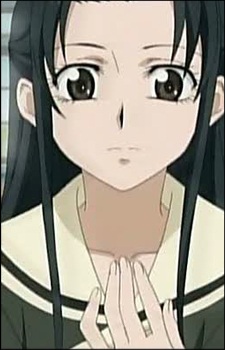
Maria Watches Over Us: Printemps
マリア様がみてる~春~
The spring term is beginning for the students at Lillian Girls' Academy. Friends are reunited, but for the Yamayuri Council, it's a bittersweet time. Yoko, Eriko, and Sei are busy preparing to depart Lillian while Sachiko, Rei, and Shimako are doing their best to ensure that their dear sisters receive a memorable commencement. Sei's departure will leave a sizable hole in the White Roses, and filling it won't be easy. But is there anyone who could appeal to Shimako enough to become the next Rosa Gigantea en bouton? (Source: RightStuf)
Главный
Главный
Главный
Главный
Главный
Главный
Главный
Главный
Второстепенный
Второстепенный
Второстепенный
jet2r0cks
July 6, 2007
All in all, I think this one exceeded my expectations. I was hoping that this season would be just as good as the first one, but it ended up to be much better. The storylines are much more interesting - for the first season I thought that the topics still had room for improvement, although I was already impressed. I liked the fact that more screen time was devoted to the third years. Back in the first season, they weren\'t given their share of the lime light, except maybe for Sei. Eriko even got an episode that was devoted to her life. Sadly though, we haveto say goodbye to the grande soeurs. There were new characters that were added, like Noriko and Touko. I\'m not so sure if I\'m happy with Touko being there. Shimako was also given a lot of chances to grace the scenes. There were many episodes about her. Thank goodness for that as well - I think she deserved a lot of screen time.I was also glad to see Sachiko in a different light. We see her family and how she is at home, we get to see her laugh for the first time (I think) and she is also able to reaffirm the relationship she has with Yumi. I was also able to get more laughs from this one compared to the first season. This was all due to Yoshino, who is both adorable and funny. The music was better this time around too. They finally added words to the opening theme, which made it more worthwhile, but I still find myself skipping it even with the words. It was still a bit boring. Same goes for the ending theme. I hadn\'t mentioned this in my review of the first season, but although the anime is considerably well drawn, the characters illustrations did have some problems sometimes. The characters, specially the really tall Rei, tend to look really long and stringy, almost like a stick drawing. There are also occassions when their faces change. Other than those, this anime is still very good. I was almost sad that I finished it too soon. I really didn\'t want it to end, and I hope there will be a third season.

Второстепенный
Jolon
July 22, 2011
It is a shame the decision was made to split the first 26 episodes of Maria-sama ga Miteru into two separate installments, because it is in the second season that Marimite really finds its stride. Although the second season is a bit late to be making the realization, it must be said that it was not until this arc that I properly realized Marimite for what it is, or rather, what it wasn't; This is not a yuri anime. The story here is one of intense and lasting friendships, although it draws upon an old idea in Japanese culture; class Srelationships and psuedo-romantic interludes between adolescent women are ideas that have had traction for awhile, and it is this rather than a direct lesbian theme that MariMite is shooting for. The characters of Marimite are well-developed and likeable, but as an entirely character-driven story your enjoyment of the plot rides heavily on your attachment to the members of the Yamayurikai. It was in the second season that this attachment came for me- through more exposure, but also the season's wise decision to give a closer look to characters other than Yumi and Sachiko. Shimako's arc in particular was beautiful and moving, and was an excellent expansion of a character who went through the first season comparatively underdeveloped. While characters are this show's strongest offering, they are not necessarily believable characters. Rather, they are idealized young ladies: conspicuously absent is sexual desire and romantic drama, cellphones, texting and malicious gossip, or a burning preoccupation with the opinions of their peers. Instead the viewer sees a refined and composed cast that have believable human traits and problems but at heart represent ideal maidens. Sachiko and Shimako in particular may not exist beyond the realms of fantasy, but this is ameliorated in part by choosing as a protagonist Yumi, a more relatable outsider to the world of refinement and grace that is Lillian Girls Academy. This is a show that begs for a cup of tea and a comfortable place to sit. It can be made into an experience, an isle of calm and quiet, and I found myself intentionally slowing the pace I finished the season to savour each episode and the feelings of well-being and tranquility it generated. The second season of Marimite was a couple notches more enjoyable for me than the first, and I would recommend as strongly as possible that anyone who enjoyed, or indeed finished, the first season watch the second. I would go so far as to recommend watching the first for the sole reason of setting up the second season, in fact; taken by itself, the second season of Maria-sama ga miteru is one of the most enjoyable anime I have seen.
zztl9
July 28, 2019
I feel this season is better than the season 1, but without the drama/whatnot all of the stuff happening in this season wouldn't be as nice, so I get it. In this season, we get more character development, and as the audience, we also get to learn more about the characters that were left in the previous season, which is really cool, especially with the Roses/3rd-year students in the council. And since they are in their last year/semester in this season in particular, if you are the type to easily cry, you are most likely to cry a lot when they are talking about graduation, letalone when they are at the graduation ceremony. And since there is no superpowers and stuff like that, I feel as that the studio/or the mangaka (Was this originally a manga or a novel?) tried their very best to have what the characters are going through as close to reality, and at least for me, it worked, cus I really felt for Yumi in some scenes lol As someone who watched a few episodes of the first season on Animax way back, I didn't expect myself to like it/lowkey addicted to the anime this much. Glad I have two more seasons to watch.
theDangerJack
June 25, 2020
The second season of MariMite might as well have been the second half of the first season. Which is not to say anything bad about this season, but story-wise, it is mostly a continuation of the main premise behind the first season; which is to say, it finishes out the story of the beginning of Yumi and Sachiko's budding relationship as "soeurs". The cons that I listed in my review of the first season remain the same for the second season: the animation isn't amazing and sometimes uses shortcuts (though none of that detracts from the story), and the story itself is character-driven with noaction to speak of (save for a brief glimpse of an expensive sports car being poorly mistreated by its driver). So, on to the good stuff: As always, the main plot of the series focuses on the relationship between Yumi and Sachiko and how they come to understand each other, appreciate their differences, and grow closer. Yumi is still terribly unsure of herself around Sachiko, who seems to come from a different planet compared to Yumi's normal, humble existence. The first episode of this season brings that message fully home when we finally get a view into Sachiko's home life, as the ladies of the Yamayuri council attend a New Year's party at Sachiko's palatial manor (it seriously looks like Bruce Wayne could live there). But while awed at how lavishly Sachiko lives, Yumi is also made aware of how fond Sachiko has become of Yumi, and her growing importance in Sachiko's life. Still, Yumi remains unsure of herself around Sachiko, and Sachiko is, as of yet, unable to express her affection (or any positive emotions, for that matter) to Yumi. This continues to cause issues between the two through to the season's climax. Matters are not made any easier with the introduction of my third favorite character in this series, Touko, who is a distant relative of Sachiko's. Touko has entered Lilian Academy's high school as a first year and immediately latches onto Sachiko to grab as much attention away from Yumi as she can. Touko is, within seconds of her first appearance, set up to be the main antagonist for this season (and indeed, often appears to be so through to the end of the series), and an invested viewer cannot help but feel immediate animosity towards her. She is a devious little girl, often appearing too smart for her own good. Her actions are bold and calculated; she reads people like a book, and seems to easily see what is going on behind the scenes. She becomes the perfect foil to the clumsy and unsure Yumi. I immediately liked Touko, and as the seasons progressed it became clearer that she was a complicated character, driven by motives and emotions that seem irrational or antagonistic until they are explained all the way at the end of the fourth season. Rei Kugimiya, the voice behind Touko, does an amazing job bringing this character to life, showing a broad range from willful strength to (later in the series) incredible vulnerability. As for the climax of the season, it all comes to a head in the final three-episode arc at the end. Yumi's world seems to crash down around her, as she and Sachiko manage to miscommunicate themselves into a sudden burst of melodrama that seems to bring them to the cusp of ending their sisterhood and friendship. And look, the drama is well-played and Yumi's redemption arc through growth in her own maturity, resolve and confidence, as well as acceptance of her independence apart from Sachiko, makes for a good story. BUT. After watching it, I couldn't help but think all of that drama could have been avoided with a 15 second conversation where Sachiko gave even a brief explanation of why she was acting the way she did instead of just assuming Yumi would get it. She should have known Yumi better than that by the time it all started to happen. That tugs at my brain every time I think about it. Still, the ending scene more than makes up for it, and there was a brief explanation as to why Sachiko didn't say anything that does make a sort of sense given Sachiko's character. Still bugs me a little, but I can live with it since the outcome was a more mature and confident Yumi and a stronger bond between the two soeurs. I don't think I'm spoiling anything there since there are two more seasons in the series. Other notable plots in this season: The graduation of the third years means Sei, Yoko and Eriko leave the story as regular characters (though they do tend to pop up throughout the rest of the series). Besides the emotional goodbyes and flashbacks to days gone by, the pinnacle of this story arc is an incredibly sweet moment between Yumi and Sei where you can see just how much the two meant to each other (and will continue to throughout the rest of the series). The other main subplot of note is Shimako taking over as the new White Rose and having to fulfill the responsibility of finding her own petite soeur, which she is reluctant to do. However, this introduces the second new character for the series; Noriko, who ultimately becomes Shimako's little sister. Now, in my review for the first season, I stated that Sei was the only confirmed lesbian character in the series, and that remains true. She's the only one shown openly in a relationship with another girl that involved anything physical (in this case, kissing and the ever lewd hand holding). However, while nothing is particularly shown to prove that Shimako and Noriko are "more than friends", whenever the two appear in a scene together, the show slaps the viewer in the face with imagery and implications that there is more going on behind the scenes. Even Yumi, who constantly hears the "whoosh" sound of concepts flying over her head, manages to be aware that there are times that she should maybe step out of the room when those two are together. You have to justify the yuri tag somehow. So, do I recommend the second season? Of course. If you enjoyed the first season, the second season only builds from there and does not dip in its storytelling. Nothing really felt like filler material, as story beats from the first season echo into this one, and consequences from actions taken during this season will resound through the rest of the series. It's the same good storytelling with a satisfying ending to a story arc that began in the first episode of the first season, and it left me ready to dig into the third season. You won't be disappointed.
martusf
March 21, 2008
This is the sequel of Maria-sama ga Miteru, about the all-girl-school Lillian academy and its students. Story It continues straight of from where the first season ended, with pretty much separate episodes about the different girls. This time even more of the girls get their back stories explained, and there is quite a bit drama in this as well. Every episode was good and the last three specially. The last episode is perhaps one of the best final episodes I’ve ever seen. The show really played on some of my heartstrings all the way, and it was really well made. Art Looked a little better than season one, butstill wasn’t super. Character designs were good, and the characters looked cute. The design for Yumi is just great. Still I felt something lacked. Sound OP and ED are the same as the first season, and they didn’t please me that much. Background music consisted of classical themes, and they contribute much to the general feel of the anime. It isn’t music I usually like, though. Voicing was good, with starring many good actors. Character Characters are the same as in season one, plus a few new ones. The old ones are great (many of who get episodes dedicated to them, many nice back stories). I also got my dose of Sachiko x Yumi, who got some nice moments. I liked the new characters, especially Noriko, and the characters remain as Maria-sama’s best field, and that’s good, since the show is pretty much a character drama. Enjoyment It was a nice watch, not as good as the first season though. The series still had plenty of humour and drama, and I liked it very much. But I didn’t quite enjoy it as much as I’d liked to. Overall I’d put this behind season one by a little margin, but it still was a really good show. The only major con is that it’s a little too alike too the first season, but I guess that was the intention, they aired relatively short after one another. If you have watched Maria-sama ga Miteru, pick this up, since it’s more of the same really.
Ранг
#1667
Популярность
#4589
Участники
30,452
В избранном
94
Эпизоды
13