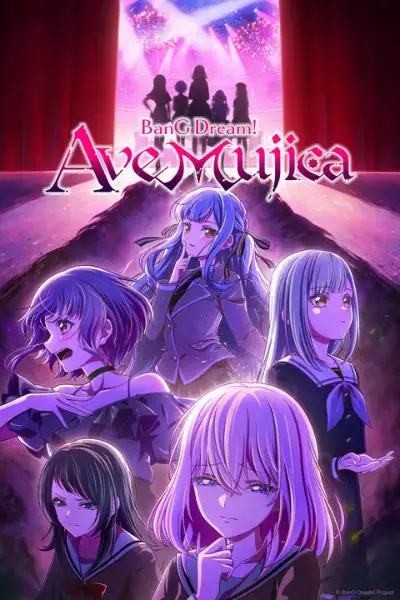
Ave Mujica: The Die is Cast
BanG Dream! Ave Mujica
The day Sakiko Togawa's privileged life crumbled, she painfully broke her vow to CRYCHIC and left the band behind—an act that tore her heart in two. As days fade into nights, she struggles to make ends meet until a certain cherished memory is tainted, pushing her to the edge. Driven by a fractured sense of purpose and the need to reclaim what she lost, Sakiko forms Ave Mujica, a masked symphonic metal band. Its members are bound not by a shared goal but by the fragile threads of their divergent desires. Together, they weave a haunting masquerade of loss and rebirth, captivating audiences with a gothic musical stage play. But as the girls' ideals collide, the scars of their pasts rear their ugly heads. The brittle facade the girls have built threatens to collapse beneath them, bringing Sakiko to the verge of falling apart. [Written by MAL Rewrite]
Главный
Главный
Главный
Главный
Главный
Второстепенный
Второстепенный
Второстепенный
Второстепенный
Sub Rosa.
Exitus Acta Probat.
Quid Faciam?
Acta Est Fabula.
Facta Fugis, Facienda Petis.
Animum Reges.
Quof
March 27, 2025
There's a lot to like about Ave Mujica: it's rather cool to see an anime sequel in this style coming off of MyGO, the aesthetics of the band have as much mass appeal as they are purported to have in-universe, and the whole concept of a 'darker' girl band has immediate appeal through the power of antithesis. I even came to like the 3DCG style quite a bit. So why do I rate the show so lowly? Well, the problem we face here is that Ave Mujica has one glaring problem: the writing. As is currently well-known, the scriptwriter for MyGO was removed from Ave Mujicaafter creative differences arose, and then their existing plot for Ave Mujica faced a series of rewrites and revisions that morphed it far from what it was originally conceived to be; I would not be one to criticize a work purely for external elements of that nature, but it's important to understand there is a real-life context when I say the writing of Ave Mujica feels misshapen and all over the place. The start of the show derails itself by bluntly infodumping to explain a key mystery behind arguably the most important character in both shows, rather than developing the narrative over time, and from there Ave Mujica feels like it never manages to get back on track. We know, factually, that the original conception of the show was going to center around Sakiko in what the seiyuu described as a sort of 'murder mystery' style to the show; however, due to the new scriptwriters (or production staff in general) wanting to introduce a totally new character that disrupted the intended flow of the story (simply due to the space a new character will need), there was no time for who was previously the main character. Their story is ingloriously shoved into the first episode, as mentioned, and then the bulk of the show starts almost schizophrenically focusing on one other character at a time almost as if there was no longer a cohesive story of the band Ave Mujica to tell, but rather the independent stories of the band members one at a time. I'm trying to focus so much on 'the facts' when criticizing Ave Mujica because online I frequently see more personal criticism ending up inspiring vicious arguments. It is a show that has an immense amount of "forced drama," bad-feeling arcs, unresolved tension, etc, but at the same time, as a "darker" anime it positions itself in such a way one can say 'and that was the point!" So normal criticism just leads to an endless back of forth of "I didn't enjoy this / I thought this felt bad" -> "You weren't meant to enjoy it / It's supposed to feel bad" etc. I don't want to inspire that kind of argument, or upset Ave Mujica fans. Instead, I just want to express: be warned, ye fan of band girl anime, Ave Mujica's script is all over the place. There's still a lot to like in the show: toxic yuri fans rejoice, grimdark girl band fans rejoice, drama fans rejoice, etc. The plot gets so insane at points it was regularly compared to being akin to watching Code Geass back in the day. I wouldn't deny that for the world, and I think at the end of the day, I may even call myself a fan of Ave Mujica overall. But in terms of the show... the script, the story, is just explosive, and I would say not in a good way. It is so explosive that for me, it's hard to overlook the damage it does to both its characters and MyGO. There were real-life problems going into the development of the show that lead directly into the original story and plan for the characters flipping completely around. For me, that's a dealbreaker, and I wouldn't like unsuspecting anime fans to hear the praise heaped onto the show then be surprised when the story is insane in a different way than they expected. This kitchen had too many cooks and some of them were particularly bad. That is all. Godspeed, girl band anime fans.
Второстепенный
Post Nubila Phoebus.
Belua Multorum Es Capitums.
Ne vivam si abis.
Odi et Amo.
SanaeK10
March 27, 2025
I find myself grappling with how much I ended up enjoying Ave Mujica even after the final episode. Throughout the weeks as this show was airing, I often found myself second guessing at the creative choices in its story, as well as coming to terms that the story I came up with in my head will never be the same story put to TV. There had been tremendous amounts of hype going into Ave Mujica, in part due to its very unconventional (especially by Bandori standards) ARG, portraying Ave Mujica as being this dark, cult-like underground band that kidnaps unsuspecting young girls. Not helping are allthe interviews and advertisements depicting the show as “The craziest band anime ever”. I had been through Revue Starlight and how that turned a wild premise into a boring conclusion, surely, I’d have learnt my lesson going into this, right? Well, I’d be lying if I said I was completely satisfied with the final package. The ARG and Live Intermissions painted a very different picture of the show for me, not helped by the exaggerated hype from the many interviews. Still, if Ave Mujica had aired immediately after MYGO, I’d have enjoyed it a lot more, although that still doesn’t discount the show from some questionable decisions when it came to its storytelling. Episode 12 was tipping point for me, as I was initially disappointed at how fast and rushed it all wrapped up with the main characters effectively telling the viewer to forget about it. It took me a long time to mull it over, but over time, I’ve came to accept the ending for what it is, and how it thematically connects to the overarching theme in Ave Mujica. That is to say, everything sucks and there is nothing you can really do about it, so forget about things and live happily. It’s surprisingly nihilistic especially for Bandori, it’s just wrapped up so cleanly and neatly that you really just wouldn’t notice on the first go around. Effectively nothing has been resolved, and there’s the sense that nothing really will be. The execution however, was lacking in almost every way. Interviews have described this as being a “horror” anime, and that’s just really not the case even in the most charitable definitions of the genre. Occasionally Ave Mujica does use the language of horror to construct some scenes, but horror is almost never the intent, and if it was, there is no scene in the entire show that comes across as even remotely frightening. Not to say that “Band” and “Horror” are mutually incompatible, look at Alan Wake for an example of something that manages to combine those two genres well for instance, it’s just that by calling Ave Mujica a “horror” or even “psychological” series, you’re setting up a series of expectations that the show can never quite reach. Credit where it’s due, Ave Mujica does go further than most similar shows in some aspects, I just hoped that they went a bit further than what we have in the show. There’s an underlying sense that the producers are too afraid to take just that little extra step in fear of losing revenue in regions with heavier censorship regulations. We have explorations of mental health, domestic violence, and lesbian romantic relationships that would make SayoHina look tame by comparison. Yet nothing too far out, punches get pulled at the last minute, there is no kiss, and most other things just get brushed off without much care or thought. Which brings us back to execution, which is where I find the show most flawed. The show is incredibly rushed. With MYGO, it was a simple story told very well, with the show paced so well it had room for an extended epilogue and even extra time to set up Ave Mujica. Ave Mujica on the other hand is juggling at least 3 different plot arcs which don’t mesh together well. You have: Mutsumi suffering from DID, Saki working out her issues with CRYCHIC, and Uika’s mad obsession over Saki. There are only the loosest plot threads connecting these three arcs together, and they all come at the cost of essentially ignoring the other two main characters, Nyamu, and especially Umiri. And not all arcs are created equal. Mutsumi’s arc got the most attention at about 8 episodes, CRYCHIC’s fallout took about 5 (5 times longer than it needed to be), and barely 3 episodes for Uika’s arc, which was hyped up to be the craziest thing ever, and it kind of is, but resolved in the most disappointing way imaginable. Sakiko is just not very likeable as a main protagonist. The show does occasionally (and correctly) call her out for being a spoiled rich girl callously toying with other people’s lives while pretending that she isn’t, but she never takes charge or responsibility for her actions until the very end. And even then, it’s less character growth and more “We’ve got to wrap everything up in one episode so let’s call back to the original themes in a rushed and haphazard manner”. Two of the three arcs just have her in an antagonistic position as Mutsumi or Tomori drive their arcs forward as Saki just reacts to the world around her passively. In spite of all this, I still thoroughly enjoyed Ave Mujica. For what it is, it has never been boring. Look no further to Bandori’s own S1-S3, which are the very definitions of safe, stale, and mediocre idol/idol-adjacent shows, being only slightly better than something like Cue or World Dai Star, yet completely outclassed by shows like Love Live or even Show By Rock. The reverence for the status quo is what kept Bandori in its rut, unwilling to explore any possibilities in its storytelling. MYGO was Bushiroad being willing to test the waters, even a little, and Ave Mujica is them diving head first into the Mariana. It’s strange, mesmerizing, and even a little uncomfortable at times. Sure it’s not as polished as it could have been, but the ambition is admirable, even if it fumbles along the way. What I can’t fault Bushiroad at the end of the day, is that they’ve tried doing something different. At the end, I suppose that may explain the final score you see in this review. Ultimately, I’ve enjoyed the show, but it is a very personal enjoyment and most of the enjoyment came from extrinsic factors unrelated to the show. I love the music, I love thinking about the show, and I certainly love the fanart and memes sprouted from this show. It’s better than Bushiroad’s previous attempts at something different, ie Revue Starlight. It’s just that I wish it could have been so much more. And maybe at the end of the day something simpler like MYGO may just be the peak of what’s possible within the confines of this genre and the 13-episode format. 9/10
Cr0ws
March 30, 2025
I have never had my mind occupied by something that I have arrived upon hating so much. There's things I do like. Watching episode by episode was fascinating. The BGM and sound design are a marvel. The voice acting is strong. The whole idea is great, and had so much potential. Sakiko's long-awaited (evil?/redemption?) arc! Mutsumi's getting real focus now, with a very interesting psychological angle to play off of! Starting the first episode with such a big play, where do they go from here? I had hoped. Anytime something that didn't particularly make sense happened, I would brush it off. It's something for the viewer toanalyze, and we will be rewarded for our attention later, you'd assume. But that continues to pile up. Episode by episode, there seems to be a lot to unpack and think about, but the real problem is how none of that is ever to be expanded upon. Looking back on it, it seems like so much wasted time for both the show and the viewer for these threads to be put out there to ponder only for them to mean nothing but shock value in retrospect. Not sugarcoating it- a lot of this comes down to a misusage of time. The pacing is staggeringly bad. So many times there'd be a sentiment of "They're rushing into this headfirst into this in the plot, so the episode feeling rushed isn't weird." No, that's not the issue. Things are being left out. Important things. Thirteen episodes can quite easily tell a coherent story. No, it doesn't "get continued in the BanG Dream mobile game" like some people may believe. MyGO!!!!! ended in a way that an anime-only could be satisfied with it, without straight up telling you you need to go and download a mobile game if you want a satisfying conclusion. You can't patch up and ignore plot holes and dredge up discarded plot lines like this with a the promise of some random in-game event down the line. There's many elephants in the room. Some of the elephants in that room are the members of MyGO!!!!!, and they are particularly quiet elephants, spectating silently for most of the time. Their involvement in the plot is watered down and cut out especially in the back half of the anime, which makes their very focused sections in particular all the more polarizing as the show treats it like they have been key players in the plot the whole time, and not just something for the plot to fall back on and tread over for fan (dis)service. MyGO!!!!!'s hindered involvement makes even less sense to me with the announcement of a sequel, featuring the two bands coming together for... something. Now it makes all those times where their reactions and conversations weren't shown even more frustrating, as that would have been a great way to actually build the dynamic between the two in a natural manner. That excuse I kept wanting to give the show that "It's Ave Mujica's anime, so focus on them, and they will solve the problem themselves" folds much harder hearing this whole setup, and the pacing starts to look even worse for it knowing that episode thirteen is not going to be the conclusion of the story. By the end of the show, I can't help but hate most of the characters more. Not in a flawed character way, in a non-believable character way. The inconsistent flip-flopping happens so often that it's not a "human thing" anymore. It just means the character is only making the decisions the plot needs at the time. Everyone, except maybe Umiri- despite her still having inconsistencies- has ended the show feeling like flatter characters than they began as and leaving a negative impression on me. But maybe it's because of how much the narrative likes to ignore Umiri's problems and use her only as comic relief in favor of whatever it was we received instead of exploring her many mentioned issues. Ave Mujica and its characters are a foil to MyGO!!!!!'s. Nearly every episode contrasts one from the previous entry in some way, hitting the same beats purposefully. It's commendable attention to detail, obviously, carefully constructed to be that way - but it honestly feels like they were more concerned with mirroring their praised predecessor and shocking the viewer rather than actually trying to tie this story together cohesively. These contrasts between the two shows and their character relationships are on full display so many times over. The biggest contrast, however, is the writing quality.
avemujica
March 30, 2025
i was hoping to love this series even more than mygo, but unfortunately, that didn’t happen. for me, the biggest issue was that i had too many expectations. if they could write such an impressive and charming story for a band as seemingly "ordinary" as mygo, i wondered what they could create for a band with a gothic and mysterious aesthetic. unfortunately, i ended up feeling a bit... disappointed. the story mainly revolves around mutsumi and sakiko. umiri and nyamu barely gets scenes...... ah. we got almost three episodes focused on mutsumi, one episode where umiri gets some attention, and the two episodes are abt *sign* uika.honestly, my biggest disappointment was uika. giving her such a background felt completely irrelevant to a band anime. mutsumi’s situation at least created conflicts between avemujica and crychic, adding tension to the story, so it didn’t bother me as much—but uika’s felt completely out of the blue. sorry but... whatever you say, it was literally unnecessary. the scene transitions, dialogue gaps… they’ve slowly started to get on my nerves. everything in this series felt incredibly rushed. i’m not even sure if the writers read through the script one last time before finalizing it, because there were way too many plot holes. did they write this while high or ????? it's as if they can't cope with the themes they put forward and are trying to escape...... the music... where's the music honestly? where's the passion? i'm not talking about the sudden performances. how and why was saki composing songs like this? how did uika write lyrics like that? the outspokenness found in mygo is completely absent here. i get that their stories are meant to be polar opposites—that’s what the writers were trying to convey—but you can’t do that by treating the audience like stupid asf. if a music anime doesn’t show a single scene of the vocalist and composer actually working on music, that’s... weird. the only moment i remember is uika looking at tomori’s lyrics in ep9 and then this got tied to fear of abandonment. uhm okay? cool, i guess. ugh. as an ave mujica fan, i ended up facing a lot of disappointment. i wanted a carefully crafted and deep story for my favorite band, but this ended up being one of the most underdeveloped and immature stories among bandori bands. it felt like, "we can write whatever we want, you’ll like it anyway, so we’ll just keep being ridiculous." even hello happy world, which is often seen as the most childish and unserious band, made more sense than ave mujica. sorry. the whole "forget everything and disappear under the moon" concept also felt bland because we only ever heard about it from saki. i mean… you had damn 13 episodes. not a single character showed any real connection with this concept. it probably seems like i’ve written an extremely negative and hateful review, but really, my only complaints are about the writing. to put it simply, i don’t hate the scenes—i hate the way they were put together. yeah like... they had so many great ideas but in the end they couldn't put them together. i feel so sorry. maybe instead of making a series, they should have just made yt shorts or something /j
ZNoteTaku
March 27, 2025
The end of *BanG Dream! It’s MyGO!!!!!* showed Togawa Saki appearing to move past her memories of CRYCHIC and work behind the scenes to get a new band started with the help of the shy and melancholic Mutsumi. Contrasted with the long performance debut in which the onstage cast are treated like dolls by the edgy script, Saki returned home to a small, dark apartment and a sorry excuse for a father full of beer, often finding himself escorted back from the police station, and going nowhere. The reason for Ave Mujica’s creation therefore seemed less like the whims of a rich girl who wasbothered by something as-yet unknown (though that was still quite true) and more as a coping mechanism for a life that was, by all accounts, horrid. As if exorcising her own demons in the only way she knew how, Saki’s vision for her new band was defined. Underneath the gothic costuming, stark lighting, and trying-way-too-hard-to-be-metaphorical attitude, Saki seeks an escape. That coping mechanism function the band provides transmogrifies for each member, and it becomes more obvious that as time goes on, not everyone within Ave Mujica’s group sees the band in the same way as Saki. Uika, Umiri, Mutsumi, and Nyamu need the band for their own selfishness, too. It is shortly after they perform for the first time that pushback against Saki’s perception of how the band should function begins to take shape, throwing the band’s idea of secret identities out the window in a gesture that leaves Nyamu smiling and most others shocked. The narrative takes what would on the surface appear to be its main concern, that of maintaining secret identities as stage personae, and throws it out the window. In so doing, it plays its hand early – the personae on stage are at odds(?) with the personae that wear the masks in the first place. It is a clash of dualities on multiple fronts, ego against ego, The Stage against The Real. With duality as a binding tether, just about every character in *BanG Dream! Ave Mujica* is split or tinkering with their own inner convictions. Even here, there is a duality between how the members perceive the band and how they use it accordingly. On one hand is the cold materialistic nature of the music industry and the success that Ave Mujica’s early theatrics bring. Nyamu, evident from her behavior at the end of *BanG Dream! It’s MyGO!!!!!*, is willing to do just about whatever it takes to become a viral sensation, and it’s her rashness that forces the band to reconcile their first real problems. Her materialistic approach with a “whatever happens, happens” treats the band as a thing to be used for her fame rather than a group to be lived in. How else to explain her enthusiastic adoration of Mutsumi’s famous mother, fawning over her with idolatry that we viewers see as shallow and vain? Umiri fails to recognize the band as anything more than a job, one of the many that she’s involved in (like a true session bass musician) and recognizes the group’s capacity to become a bigger splash. She’s dismayingly oblivious to what transpires around her as the threads come undone, doing what she’s “supposed to do” instead of stepping in proactively. On the opposite are Saki, Uika, and Mutsumi, all three of whom rely on Ave Mujica for some kind of mental grounding, therapy be damned. Either as a retreat from their ails or a putting off of what must be faced, they cling with broken nails to the precipice hoping it doesn’t give way under the weight. A crash is inevitable from the very start. The old adage may say that “opposites attract,” but that doesn’t mean they’ll get along. With Ave Mujica’s status as a band that also does short dramatic plays, arguments both onstage and backstage are played out in vivid detail, replicated for audience members who may be none the wiser to the actual venom being laced. It’s all too real, but under the veneer of the theatre. By the time a few episodes are complete, it becomes clear that all potential stage markers have been replaced with metaphorical chalk outlines instead, the world of The Stage and the world of The Real intermixing with, at times, barely any distinctions. It’s through these disparate parts coming together and colliding that poses its own duality between this series and its prequel. In my original review of *It’s MyGO!!!!!*, I stressed that that series separated itself both tonally and in the construction of its band from nearly everything that had come before in a bid to be new. Despite all those changes, it still seemed at least somewhat concerned with the real world rather than masquerading as a particularly heightened version of reality. It seldom opted for abstraction if it could help it. Almost like a counter, *Ave Mujica* commits the full dive into its melodramatics, often abandoning logic for the most-deranged idol soap opera imaginable. Given the bombast and superpolymegadeathcorehellmaidens quality of its theatrics both in-universe and as representation of character psychology, to expect anything less would be to uphold a standard of *BanG Dream!* that was cast aside more than a year ago for this newer take. If *It’s MyGO!!!!!* wandered into the ocean, *Ave Mujica* deliberately drew in its breath before surfacing, basking in the sensation of water filling its lungs, and loving every second of it. As such, *BanG Dream! Ave Mujica* treats many of its events as earthshaking and monolithic, pulling back layer after layer of defenses for its characters until the only thing left is the empty melancholia and how to deal with it. Every character, often violently, is in a new place from where they started, and even if it cannot give the fullest time and attention to everyone, it rarely misses. Director Kakimoto Koudai, main series writer Ayano Yuniko, and music director Fudanotsugi Taiki knew that in order to sell *Ave Mujica’s* central ideas, it needed to give every scene a heavy and focused intensity that constantly flirts with toppling over. The result is anxiety within the viewing experience through wondering whether it will fumble, within the text itself through things and imagery only getting more abjectly horrifying, and paratextually through a series made by people loving what they’re doing and abandoning the old standard that tied them down before. By performing as a *BanG Dream!*, they have moved into a new realm altogether. It is precisely because they love *BanG Dream!* that they have “killed it.” Lovedeath. We cannot pretend that this series (and the franchise as a whole) is not made for the purposes of making Bushiroad a truckload of money. Most entertainment, especially of gacha properties, acts in this way. *BanG Dream! Ave Mujica* is a reminder that even if the everlasting hunt for the bottom line looms overhead, you can still create something new and truly distinct within yourself and show that it can succeed after all. Flirting with disaster every step of the way, it dared, it committed, and I adored the ride through and through. As Uika proclaims, “Welcome to Ave Mujica’s world!” What a welcome—and what a world—it was!
Ранг
#605
Популярность
#4300
Участники
35,026
В избранном
839
Эпизоды
13
Links may contain affiliate references