
Rascal Does Not Dream of Santa Claus
青春ブタ野郎はサンタクロースの夢を見ない
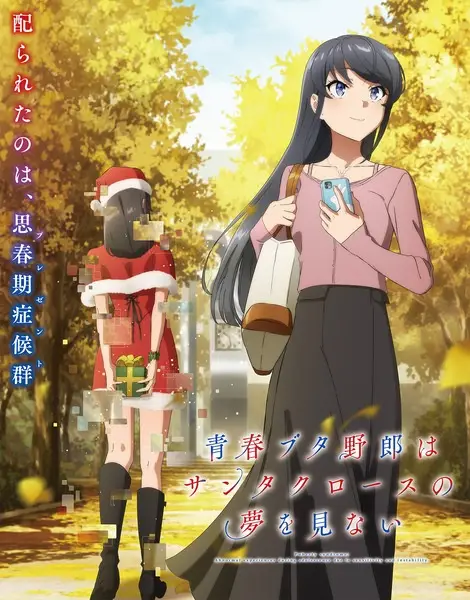
After surviving the entrance exams, Sakuta Azusagawa has finally enrolled in the same university as his girlfriend, Mai Sakurajima. He is gradually getting used to the unfamiliar environment as he attends student gatherings and makes new acquaintances. Everything seems to be going smoothly until Sakuta's friend and Sweet Bullet idol group member Uzuki Hirokawa begins acting out. With fellow Sweet Bullet member Nodoka Toyohama pleading for his help, Sakuta realizes that he has stumbled upon another case of the inexplicable Puberty Syndrome—Uzuki is feeling pressured by the sudden surge of popularity and rumors of a potential solo career. While Sakuta searches for a solution, another occurrence of Puberty Syndrome gradually emerges from the shadows. [Written by MAL Rewrite]
Главный
Главный
Главный
Второстепенный
Второстепенный
Второстепенный
Второстепенный
Второстепенный
Второстепенный
Второстепенный
Второстепенный
Chuy_diazz
September 27, 2025
Just when you think the story can't be more self-inserted, this second season comes along to prove it can. A somewhat unnecessary second season, in my opinion. If the story had ended with the movies, no one would have complained. Why is that? Because in the second season, the girls experiencing puberty syndrome don't have a direct relationship with Sakuta. Everything in the protagonist's life after the last movie seems to be resolved. He has a girlfriend, his sister is doing well, and he managed to save the life of his first love. Up until then, there wasn't much more to explore about the character; he'dalready had his closure; there was no reason to give him a second closure. For this reason, this second season had the opportunity to give secondary characters a spotlight and give them their own closure. We have characters we met this season who have always magically been linked to Sakuta, and if they were girls, they always ended up falling in love with the protagonist. At some point, it seems like you're watching a teenage fantasy about having a girlfriend but being able to flirt with other girls without any problems. Sakuta's disloyalty is disguised with a weak excuse like "it's all for Mai's sake." Sakuta is a terrible boyfriend, who ditches dates to go on dates with other girls. He accepts confessions instead of rejecting them and makes his girlfriend waste money because he has to meet with a student at Christmas. The introduction of the miniskirted Santa Claus is just a rehash of the first arc. An invisible girl that only Sakuta can see, so original. On top of that, they're screwing up what they presented in the first season because now puberty syndromes are no longer about quantum physics, but about an entity that distributes them. Since Rio Futaba's character no longer appears as often and she was in charge of the convoluted explanations of quantum physics, they had to fill that gap with a rather flimsy explanation. Puberty syndromes this season are incomprehensible because there's no visual representation on screen. The first syndrome seen this season is "being able to read the room." This isn't a supernatural power; it's a social skill that any adult should have; they call it empathy. Since it's just an idol drama, you don't feel anything at all because it all seems more like a whim than a real syndrome. In the end, they resort to the same trick: Mai is in mortal danger because they don't know how to move the story forward. The first death sentence works, the second loses its impact. On top of that, since Sakuta doesn't have a direct relationship with those affected by the syndrome, he ends up feeling more like a busybody than a savior. An anime that, unlike its fandom, didn't grow up and remain stuck in a teenage fantasy. All so that teenagers of this generation could immerse themselves in a story where they could be the worst person and still be loved.
dontttt
September 27, 2025
If we’re being honest, season 1 is just better in every way. Bunny Girl Senpai lost its allure after that, and I think it comes down to three major problems in season 2. First, season 2 basically pushed the romance aside. The relationship between Mai and Sakuta was the main reason a lot of people loved the show, and some even went into the sequel movies specifically to keep up with their relationship. So when the show decided to put that aspect on the backburner, it really needed to make up for it by nailing the supernatural and mystery side while still giving us small sliceof life moments between the couple to keep the romance fans happy. This leads into the second issue, which is that Puberty Syndrome has always been kind of stupid and illogical. It only really works when you look at it from the emotional side of things, since it’s more of a metaphor for what the characters are going through rather than something that makes sense in-universe. The problem is that this emotional explanation makes the whole thing vague, and that vagueness is exactly why it gets so confusing. Certain events end up feeling like complete mysteries, especially to anime-only viewers who don’t have the extra context from the light novels. In season 1, that wasn’t as big of a problem because it was new, fresh, and had some strong implementations, plus the cast was smaller and easier to care about. But by season 2, it turned into a chore of trying to follow an LN adaptation that leaves anime-only viewers in the dark when it comes to the details, which is very important for a show trying to make a deep and complex story. Third, the arcs start focusing on characters I have no reason to care about. Compare that to Kaede, who is one of the best characters in the show and proved that Puberty Syndrome could actually work in a meaningful way. But in season 2, the spotlight shifts to characters who barely had any presence before. We are suddenly expected to care about someone who showed up for maybe 30 seconds in the previous movie, and the reasoning behind her depression and regret feels childish and forced. It is hard to take seriously when the entire conflict comes from one random and almost meaningless event. Instead of adding real depth, it just makes the story feel shallow. Lastly, I don’t want to make it sound like I completely hate everything about this show, and that’s reflected in the rating I gave it. I still enjoy the dialogue between Sakuta and the other characters, and I think his relationship with Mai is wholesome and even pretty realistic in certain aspects. On top of that, I genuinely like the OP and ED. But none of that changes the fact that season 2 just isn’t as solid as season 1, and many people will not enjoy the experience to the same extent.
Otaku329
September 27, 2025
“Love isn’t about logic. If it made sense, it wouldn’t be love.” That’s exactly how I feel about the absolute rollercoaster that is Bunny Girl Senpai. It has everything you could ask for, emotions, romance, wholesome moments, character growth, story depth, you name it. You can tell it was written with love. That said, I get that it’s not for everyone. Some might find it “weird” or even “repetitive,” but for me, that’s missing the point. To truly see its beauty, you can’t just look at the surface, you have to dive into the depth of the storytelling. Rascal Does Not Dream of a Santa Claus reallyhit the spot. Coming in right after Knapsack Kid with a one year time skip, I wasn’t sure what to expect. But the moment Sakuta got dragged back into the mess of Puberty Syndrome, I felt right at home. The mix of heartfelt drama, strange supernatural twists, and touching character growth is exactly why I fell in love with this series in the first place. For me, this was an easy 10/10 experience. Story 8/10 The story keeps the series’ trademark formula: a grounded, emotional core wrapped in supernatural metaphors. It feels more mature now that Sakuta and Mai are in college, but the essence hasn’t changed. From the sudden appearance of “Santa” to the emotional struggles of friends caught up in Puberty Syndrome, the narrative balances mystery, heart, and humor perfectly. It’s the kind of storytelling that sneaks up on you and hits harder the more you think about it. However, it doesn’t really try to reinvent itself. The formula is the same as season 1, someone gets hit with Puberty Syndrome, Sakuta steps in to help, and of course, Mai-san ends up in trouble and needs saving. On paper, that might sound repetitive, and I did had issues with it. But honestly? For us Bunny Girl fans, that’s exactly what we signed up for. It’s the comfort of familiarity, and I can’t really complain about that. Art 9/10 The visuals aren’t showy, but they fit the tone. Character expressions carry the emotional weight beautifully, and certain scenes really stick in your head. It may not be the flashiest anime visually, but the art style is consistent and helps deliver the story’s atmosphere. Soundtracks 8/10 The soundtrack was spot-on. The opening theme sets the mood right away, while the background music knows when to stay soft and when to swell with emotion. Voice acting is top-tier as always—Sakuta and Mai’s performances carry so much weight that you can feel every little shift in their emotions. Characters 10/10 This series has always been character-driven, and this season is no exception. Sakuta continues to shine as the grounded, sincere heart of the story. Mai’s presence feels even more significant now, and their relationship growth is a highlight. New characters like the “Santa” bring intrigue and depth, while the supporting cast gets moments that remind you how much you’ve come to care about them. Enjoyment 10/10 Honestly, I loved every second. The pacing may be slow compared to action-heavy shows, but that’s the charm. The emotional highs and lows felt genuine, and the mix of romance, drama, and mystery kept me hooked throughout. I found myself smiling, tearing up, and just fully immersed in the world again. Conclusion Rascal Does Not Dream of a Santa Claus was everything I wanted and more. It captures the magic of the original series while pushing the characters into new, meaningful territory. With heartfelt storytelling, subtle but effective visuals, and characters that feel real, this season reminded me why Bunny Girl Senpai is one of my favorites. A perfect 10/10 from me. TL;DR: A heartfelt continuation that nails the emotional beats, delivers meaningful character growth, and reminds you why Bunny Girl Senpai is special. For me, this was an easy 10/10.
BRO_7
September 27, 2025
Honestly, this entry in the Rascal series lived far beyond my expectations. The story is unique in how it balances supernatural elements with raw, real emotions. Even if you think you can predict where it’s going, the execution hits in a way only this series can. It’s less about “what happens” and more about how the characters grow through it. The art style fits perfectly—it’s calm, detailed, and brings out both the emotional weight and the lighter moments. Nothing flashy, but always just right for the mood. The characters remain the strongest part of this series. Sakuta especially feels real because of his flaws, dry humor,and the way he reacts to heavy situations with both vulnerability and strength. Mai continues to shine as one of the best-written heroines in anime—confident, caring, but never unrealistically perfect. Every character, even side ones, has depth and purpose. The way they react to the events feels natural. You never get that “forced drama” feeling—everything flows in a way that makes you believe these people exist. Do I think others will enjoy it? 100%. If you’ve followed the Rascal series up to this point, this installment is a must-watch. It delivers the emotional depth, romance, and closure fans expect, while still leaving you excited for the finale to come. If you’re new, you have to start from Bunny Girl Senpai to really understand the weight of these moments. Overall, this movie proves again why Rascal is peak—strong writing, real characters, and a story that sticks with you long after it ends.
krokodil4iki
December 14, 2025
For me, this season is not bad at all — it’s solid and emotional. But if I’m being completely honest, it’s definitely weaker than the first season and all the movies, even the spin-offs That doesn’t mean it’s disappointing. The atmosphere is still there, the dialogue still hits sometimes, and the themes are familiar in a comforting way. But it doesn’t reach the same emotional peak or impact that the original story had. The first season felt sharper, more painful, more unforgettable. This one feels softer, safer, and less memorable overall Still, I gave it a 9/10 — and yes, that’s mostly because I love Mai Sakurajima.She’s still my favorite ever, and every moment with her automatically makes the experience better. I took 1 point off, honestly, just because… it didn’t hit me the same. Not because it’s bad, but because something is missing. I can’t fully explain it — it’s just that feeling. The magic is still there, but it’s not as strong as before. In the end, even a weaker Seishun Buta Yarou is still something I enjoy deeply. I may criticize it, but I still love this series — and I probably always will. Score: 9/10
Ранг
#481
Популярность
#1359
Участники
203,121
В избранном
1,098
Эпизоды
13