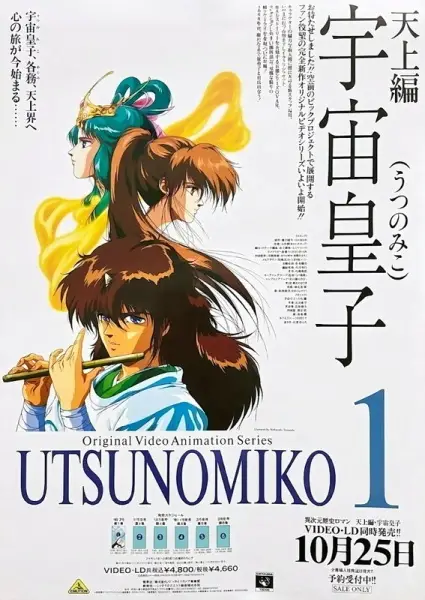

宇宙皇子 天上篇
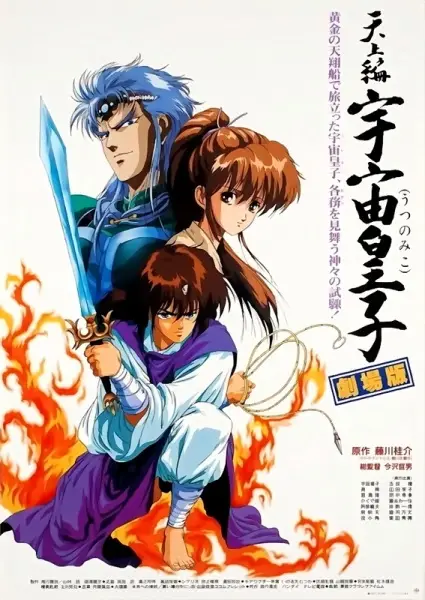
Delving into the humans' spiritual journey to the Celestial Realm of Buddha, UTSU NO MIKO follows five friends on their quest to bring peace to a corrupt and chaotic Earth. Born with a horn, Utsu no Miko found refuge on Mt. Kongo where he studies to become a God. But when the ruling imperial government seems to bring only devastation to the people, Miko and his friends venture on a 33-year quest to reach the Celestial Realm and meet the almighty Father of the North Star. Yet, the way is filled with danger, for the five humans intrude upon the world of immortals where the gods reign supreme. And, in order to reach their goal, Miko must first challenge them to battle. However, they soon realize that the gods too are not without flaws and earthly desires. And for Miko, the hope of rescuing his love (Kagami) leads to the realization that the world cannot exist without the balance of gods' tumultuous soul, and the humans' will to survive and to love. For, as one life ceases, another takes its place. And only when there is true peace can people finally see the face of God. (Source: AniDB)
Главный
Главный
Второстепенный
sorcery
June 3, 2019
Among the prolific lineage of Light Novel Adaptations, there is a before and after "Shakugan no Shana". This title dramatically modeled the modern scenery of this medium, from 2005 to onwards... But what about its lesser known debuts? The most cultured elements of the community would answer that there is "Slayers" in the 90s, but they would be only half right. Although it is true that this light-hearted 'sword and sorcery' is the first of its kind to be popular in the West, a long running Light Novel was already well established in Japan: that, is Utsunomiko. Spanning to 52 volumes under the pen of thehonorable Keisuke Fujikawa, his brain child started in 1984, only to be concluded in 1998. A prequel movie (which is still untranslated) premiered in march 1989. Even though it was far to be a smashing hit of "Delivery Girl Kiki" scale, it garnered enough success at the box-office to warrant the creation of the present OAV series. The franchise is, at core, a Fantasy Jidaigeki Epic. Themes in relation to piety and chivalry being dear to Fujikawa, his creation sort of comes off as an oriental equivalent of the Arthurian cycle. Replace the Camelot era by the Jinshin-no-Ran civil war of 762, the knights of the round by Shugenja monks, Christianity by Shugendo, the dazzling charger by a celestial boat and you may notice they share like-minded topoi. Furthermore, they both blend a Historical base with a more Fantastic component. The big difference is that Utsunomiko, the main character, is a champion of the people instead of a lord. As its name indicates, Utsunomiko: Heaven Chapter, merely adapts the second arc of the Light Novel. As such, there is this latent impression to jump on it In Media Res, as the intrigue was defined previously. Indeed, upon completion, the spectator is left with many questions on his mind: How the little goddess Kijimuna joined the Shugenja? What were the events driving the prince Kawashima to betray his entourage? Why was Ootsu no Miko executed? What lead the valiant thief Uokai to meet the same fate? Fortunately, the focused storytelling of this OAV series alleviates the confusion. It is largely due to its protagonist, Utsunomiko, who is a proactive leader. There is no beating around the bush, because he is straightforward in what he aims for. Not even the idealistic romance between Utsunomiko and Kagami, which is particularly elevated, is disruptive. It intersects neatly with the plot, rather than shunting it through unnecessary digressions. In essence, U:HC is as anti Isekai as it gets: it starts with the small Terran crew departing to Heaven as fleshly VISITORS. That is all the subtlety, as the main protagonist and his companions are not perceived as chosen ones by their hosts... On the contrary, they are seen as intruders who might be up to no good. Moreover, they initially come to seek enlightenment, not meddle with otherwordly affairs. The ascetic outfits of the monks is indicative of their humility, in contrast with the pomp of the Touriden Gods. The tense conflict between the two parties is emotionally involving, as it stems up from a dramatic double truth. Art Direction has a pivotal importance as its mission is to convince the spectator that the title is not a fraud. Anyone who owned the Laserdisc of the series at the time, was certainly blown away by the gracious ballet of Yukata-clad angels flying in the sky, the frolicking winged horses or the floating lagoons enfolding at screen. The supreme God's castle is itself a imposing structure, harmonizing a rough Chinese style with the exuberance of Art Nouveau. The Chara-design in itself goes for practicality. The distinctive Toei Douga touch, strays somewhat from Mutsumi Inohata's chara-design, who illustrated the source. This matter of fact is further evidenced by the appearance of certain characters; master Ozunu looks like Toki whereas Taishakuten has a vague likeliness with Rei. It would not be surprising if Toei enlisted the help of key animators who worked on "Hokuto no Ken". Thankfully, the mecha design of Katsumi Itabashi adds enough of an extra to avoid it looking derivative. As for Saki Makihiro's score, it is captivating. The background musics are solemn, yet are neither ponderous nor stuffy. Synth backs up more traditional instrumentation as they pulse at every turn of phrase with epic breadth. A less vibrant contribution would have undermined the show's atmosphere, but a shortcoming the soundtrack is not... All the Seiyuu provide an inspired performance; Toei went as far as casting the voice of Seiya for Utsunomiko, as to associate in the spectator's mind the mythological backdrop of two different series. Personal favorite being Banjou Ginga as Taishakuten, exuding with godly self confidence as his blaring, deep voice echoes like a war horn. Half extrospective and introspective, half spiritual and grounded, U:HC is a metaphysical Odyssey into Mystery, Enchantment and Danger. Whereas it does not innovate in any way, it extracts a Nekketsu motif and translates it in a near flawless way. It is a most recommended addition, to anyone willing to watch a Fantasy Epic balancing aptly the fun, the tense and the ethereal together. If it were not for the flaws listed on the colophon, this unfairly overlooked entry would have been rewarded with a perfect 10... ~Praise be unto Sacred Geometry ..| Colophon |.. This section is dedicated to content indication in order to inform audience in a practical way. On the next paragraph, the buzzwords offer hints about the title's strong suits and drawbacks. Ketchup meter: Nothing too objectionable. There is no gore or blood shed to be seen. Most of the violence results from Utsunomiko intensely suffering his passion, as he learns to concile his dual nature. xXx meter: What do you think this is? Ore no Imouto ga Konnani Kawaii Wake ga Nai? Fishing scene(s): Oddly enough, in the second episode, it features the only existing instance of a ship hooked and dragged below the sea level. It is a clever way to introduce the heroes to an exiled deity's plea. POSITIVE aspects: + The timeless fairytale art direction, going for a classicist approach + The Laserdisc worthy animation + The stakes being adjusted in consequence, as the protagonist is a demi-god. Is there a more fearsome obstacle than a Supreme God, after all? + An excellent balance, between the didactic subplot, the romance and the main conflict + No cringy Isekai tropes to ruin the premise + The limpid narration, helping to immerse into the big-scaled epic NEGATIVE aspects: - The esoteric Buddhist flavoring, which may deter a casual western spectator. - A regrettably necessary In Media Res start - The concept of physical and spiritual death, not tackled properly - The recurrent tendency to utilize master Ozunu's appearances as an almighty plot device. - The cliffhanger ending making one wish for more (even though the Heaven arc was at least fully finalized)
#9880
Популярность
#12844
Участники
1,845
В избранном
3
Эпизоды
13