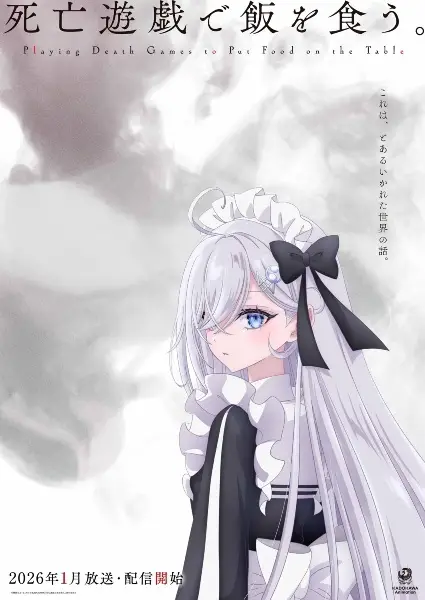
Shiboyugi: Playing Death Games to Put Food on the Table
死亡遊戯で飯を食う。
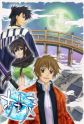
Yuuki wakes up to find herself in an unfamiliar manor, wearing a maid uniform and lying on a luxurious bed. Soon, she discovers five more girls, all dressed the same as her. This is the Ghost House, and the only way they can survive is to make it through the traps that lie in wait—deadly games full of blowguns, buzz saws, locked rooms, and weapons. It's a hopeless, terrifying situation for everyone there...well, everyone except Yuuki. After all, this is her career at seventeen. Do you think that's odd? She would agree. But that's how some people are—they earn their living playing death games. (Source: Yen Press)
Главный
Второстепенный
Второстепенный
Второстепенный
Второстепенный
Второстепенный
Второстепенный
Второстепенный
Второстепенный
BurtRocks
March 18, 2026
Shiboyugi feels more like an art project than an actual story. There’s a strong, creative vision behind it that is obvious from simply watching it. The art style is uniquely minimalistic, the music choices are purposefully empty, and the characters are written to feel mysterious. In theory, this sounds interesting, but in practice, it shows that Shiboyugi’s issues are not the result of poor execution but of deliberate choices. Everything the studio chose to do was executed perfectly, but followed through on a plan flawed from the beginning. I also suspect the source material didn’t help much with the characters and plot, but I can’tspeak on that since I haven’t read it. Starting with the visuals, the anime alternates between two very different styles. For long, mostly still shots, it generally uses a soft art style and draws its characters with strikingly gorgeous eyes. During action scenes or less important dialogue moments, the characters are drawn in a minimalistic style that lacks all facial features. The result is animation that frequently looks well below-average, but contains the occasional well-composed still image. Additionally, the aspect ratio constantly shifts, often becoming wider (or shorter) than the normal ratio. If done right, this trick can build tension or look cinematic, but here, it happens so often that it’s jarring. By the end, it almost feels like they did this simply to reduce the amount of space that had to be utilized. Shiboyugi also implements completely black title cards between segments, similar to the Monogatari series. In Monogatari, these add to the rhythm and personality of the storytelling. Here, the chapter number is presented as a fraction, making the purpose seem like it’s to tell the audience how far through a light novel they are, or to pad time, not as a meaningful stylistic choice. The final aspect of the visuals to critique is the character designs, which are uninteresting and mostly all the same, especially in the minimalist style. In these moments, when characters have the same hair color, it becomes nearly impossible to distinguish them from each other. Unfortunately, the premise itself doesn’t fare much better, with the death games lacking all intrigue and rarely generating any real tension. There are two main reasons for this. First, the nonlinear narrative removes any feeling of suspense for the main character, Yuki, since we already know she survives. Second, the other characters are so uninteresting that their survival or death carries almost no emotional weight. It doesn’t help that Yuki’s dialogue is short, bland, and never reveals anything meaningful about her. We rarely learn how she actually feels, and when we do, it’s through third-person narration, leaving a feeling that we are told how she feels, and not shown it. Again, this is on purpose; she’s supposed to feel detached from the world, but this detachment makes her terribly uninteresting to watch or become invested in. The games themselves are at least varied in structure. The smaller games generally involve a group of girls working together, and ultimately, some must be sacrificed. These are more focused and had potential to explore the characters, but the show rarely takes advantage of this. If it does, it’s done through third-person narration, which feels drawn out and needlessly complicated to follow, and ultimately doesn’t make me any more invested in the characters. The other games are almost like large brawls, where a ton of girls separate into two groups and then kill each other. These games don’t get decent explanations of what is going on, so they just feel like a bunch of girls killing each other for kicks and giggles, devoid of any real strategy or emotions, which ultimately undermines some of the characterization the show tries to do. By the end, I felt like I had learned almost nothing about the settings or characters aside from a few surface-level details, and there was no buildup to something exciting that may or may not occur in a possible second season. Shiboyugi had potential. There were interesting elements to the series that, unfortunately, were not chosen to be focused on. Instead, we get a story that doesn’t actually have a lot to say, with characters that seemingly only exist to be allies or enemies for Yuki. Any attempts at characterization are fumbled through dull, third-person narration for a backstory that doesn’t usually make a whole lot of sense. The visuals could have been striking; like I said, the static shots are pretty, but the directorial choices hold it back, causing jarring shifts between the two art styles. The music successfully invokes a feeling of emptiness and, from that, dread, but honestly, I’m not sure I would have noticed a difference if it were completely absent. In the end, Shiboyugi tries to distance itself from other high-stakes games by attempting to be contemplative and artsy, but ends up losing what makes the genre engaging in the first place. Instead of tension, mystery, or emotional investment, it delivers an experience that ultimately feels empty and plain boring. Because of this, despite some interesting stylistic choices, I cannot recommend Shiboyugi.
Ionliosite2
March 18, 2026
The most confusing part about Shibou Yuugi is trying to find out exactly what people find confusing about it. Ever since the first episode premiered, this series has been referred as “pretentious”, “artsy fartsy” and people constantly asking questions about the things that happened in the episode, and I cannot comprehend what is supposed to be pretentious about this show or what exactly is confusing about it, this series is very simple and mostly straightforward. I know, the word “pretentious” is basically a buzzword at this point used to point out things that look “weird”, it can be because the series goes from an arthousedirecting or because the art style the characters are drawn in is weird, it’s not like I haven’t been confused before as to why some shows are referred as pretentious, if you ask me, this show is as pretentious as Tatami Galaxy, as in, it isn’t pretentious at all. The reason of why it’s called that way is because of Ueno’s directing, he clearly is trying to use some unconventional techniques instead of doing it in a generic style, this makes him standout as some weirdo, this is clearly an attempt at giving the series he directs more personality and to make a style distinct to himself. Sure, it’s not like other directors don’t have a similar style to his, the most common comparison I’ve seen is that he is a discount Shinbou, and I would very much agree with that sentiment, as while Shinbou is a genius who gives a very unique and almost incomparable style to any series he directs independently of their content, Ueno, while I appreciate his efforts, is definitely much rougher around the edges. I mean, at some point you have to stop and think with what studio and staff he is working, I’m not expecting high quality animation (or any kind of actually competent quality) from Studio DEEN, and this is clearly why they brought him, he is capable of working with the little resources available and do something different, clearly low quality things like the characters looking like MS Paint in multiple scenes across every episode could be intentional due to his style, but I really don’t think this is something the series would be doing so much if he had a better studio at his disposal. In general, this series suffers a lot from the quality of animation even if it has an interesting aesthetic thanks to Ueno’s style, but when the characters are actually drawn, they look pretty good, and the author clearly wanted to have these girls in as many fetishistic outfits that he wanted, which I completely approve. The writing of this series is actually quite simple, which is the reason I don’t understand why some people are so confused about it, a lot of things are just explicitly spelled out to you, what am I supposed to be confused about? The rules of the games? They are clearly explained, the only game that doesn’t have the rules spelled out to you is Golden Bath. Am I supposed to be confused about the characters? Their way of thinking? Their backstories? All of the backstories we see are pretty clear, Mishiro’s backstory is extremely clear despite the presentation, she attacked her sister because she was jealous of her, things like Moegi’s backstory is even more explicit, everything about he reasoning of participating in these games, even Yuuki’s character gets explained across the series and the last arc basically explains how she got to how we see her in previous arcs. Am I supposed to be confused about the arcs not being in chronological order? You aren’t losing anything, except for Yuuki’s reason as to why she wants to participate in 99 games, which is told to you anyway. Am I supposed to be confused by the metaphors? “What will happened to me if I don’t become a swan when I grow up and stay as a duck?” is the most basic Ugly Duck metaphor you can possibly make, is this supposed to be confusing? Is it pretentious for saying stuff like that or because it repeats lines of dialogue multiple times when a character is thinking? All of these things are explicitly spelled out to you. There ARE some parts that aren’t explained, but they are still easily inferable, in one death game Yuuki clashes with a locker, from that locker, boots fall out, the girl that was fighting with Yuuki is also wearing the same kind of boots, there’s a floor that nobody touches without the boots and instead climb on furniture to not touch it, and when Yuuki touches the floor, she uses the boots that were clearly shown on screen before; they don’t explain anything or why you need the boots, but it is easily inferable that you need those boots to be protected from that floor, which is the reason why Yuuki didn’t walk on it before, it’s a good showcase of something that doesn’t need explanation but you’ll know what’s happening as long as you pay attention to your screen. If anything, the problem with Shibouyugi is that it is too simple, it really is a series about young girls wearing fetishistic outfits chosen by 1% rich ojisans to play death games (without blood, because blood is yucky) and get money from it. I’m sorry, I just cannot see what’s supposed to be confusing about it, let alone how it is supposed to be pretentious when it is so simple, this isn’t a problem with the series, it’s a problem with the person watching it just not actually paying attention, things like this is why Evangelion is considered difficult to get despite the fact that its episodes 25 and 26 explicitly spell out to you what’s happening, the characters’ state of mind, their problems and the themes of the show. The complain I’ve seen repeated the most aside from being confusing or pretentious is that it is a bad adaptation, I cannot speak about it, as I’m a filthy secondary who hasn’t read the manga or novel but I will do so later, if it is true then I can see it as a valid complaint, but as it stands, the anime seems like a very solid product with a very clear and simple story and an interesting directing style, so I will take it as such. Thank you for reading.
emolano
March 18, 2026
Shiboyugi is a show that takes an introspective aproach in death games. This is reflected in the way the anime looks (as if it's an painting), in its music and also in its pacing. The show deliberate slows itself as a way to make the watcher reflect upon what's happening on screen. But the artistic direction also works as a way to mask its shortcomings. Most of the shots are distant ones, with porly drawned characters. But it does have fluid animation when it needs to, like in fights or traumatizing deaths. The worst thing about this anime is the pacing. It's too slow. Sometimes you willkeep watching a static frame for seconds. And other times they will repeat the same sequence in a loop. As I said before, that's a deliberate artistic choise, as well as a cost saving method. But a lot of times it makes the watch boring. But there's one thing to praise, which is the sound direction. Not only the music creates the exactly vibe the show wants, but the VAs did a great work. Their cries, both the sad and painful ones really transfers the weight of what's happening on screen. Overall, it's wroth to watch the first episode, which is 50 minutes long and depicts one game fully. How you feel about it is a good indication about how much you will enjoy the rest of the show.
Chuy_diazz
March 18, 2026
Playing death games to put food on the table? More like "Playing boring games with no clear rules to put my viewers to sleep." Shiboyugi arrived in the winter season as one of the most promising, thanks to its visual style. Unfortunately, it failed spectacularly in telling its story. If we were to count all the creative decisions that went wrong, we wouldn't finish in time to calmly welcome the spring season. So, we'll go step by step, highlighting the most relevant points that made Shiboyugi the best remedy for insomnia. 1. The Death Games: Call me crazy, but if you have "Death games" in your title,well, that's the least I expect. I think the worst genre for philosophical musings is precisely this one. The girls waste a lot of time with introspective monologues that, frankly, don't matter. The games are scenarios designed more to make the girls look good than to be a real challenge. The games lack clear rules. In none of the four games shown do you understand how to win or what you have to do to survive. Only in the last one do they make an effort, but given the outcome, it's as if they might as well hit me over the head with a hammer and put me to sleep instantly. There's no clear enemy. Although they mention an organization that forces girls to play these games, it's only a superficial element. Sure, they try to play with the cliché of the protagonist taking down this organization, but they don't know how to handle it. This causes the idea to fall apart far too quickly. The protagonist is constantly protected by plot armor. From the first game, you understand that nothing can happen to her. They don't let us worry or feel tension because one way or another, she's saved by the script. The protagonist is nothing special. She's not manipulative, she's not a liar, she has nothing that would characterize her as a good protagonist of the genre. She's just a girl who doesn't even understand why she plays what she plays. 2. The story's chronology: I don't know who the genius was who decided the story would look much better with time jumps. The anime starts with game 20, then goes back to 10, jumps forward to 30, and ends around game 7. Or something like that; I don't know the exact numbers, but you get the idea. It creates a very unstable rhythm because the ideas presented in one game don't exist in the next. The introduction of characters feels strange. In one game, you defeat the current villain, but in the next, you meet them for the first time. In one game, Yuki has a mental breakdown, but in the next, she's like John Wick. You go from one place to another, up and down, so that by the final episode, you're kind of dizzy from all the twists and turns the story has taken. The story jumps back and forth, so much so that in the end, you're left with a feeling of disorientation. 3. Ueno as director: I know I'm treading on thin ice because of the affection people have for him. I acknowledge his great work on "Gimai Seikatsu," demonstrating how much he can do with a small budget. In Shiboyugi, he demonstrates the opposite, how little he can do with a large budget. The entire first game is visually and aesthetically stunning. As the chapters progress, you can see how the budget shrinks. They opt for a faceless style to avoid expressions, leaving dialogues, fights, and voice acting a bit strange because there's no face to accompany them. The shots start to become distant. Suddenly, the camera moves several meters away from the characters, giving us little view of them. At other times, only half the screen is used, leaving black bars on the screen. I understand the affection for the director, but there's nothing wrong with talking about direction without direction. 4. Pretentiousness: Most people defend this point by saying things like, "How can it seem pretentious if everything is perfectly clear?" The problem arises when you ask simple questions like, "If everything is so clear, tell me what the numbers in the middle of the screen mean?" That's when they offer a thousand theories but no answers. That kind of thing is what makes the work feel pretentious. The fact that instead of blood, the girls sprout plush from their bodies. These are things done solely to seem different, so we see them as not following the "traditional" path. Except that in the midst of experimentation, the story's identity gets somewhat lost, making all the explanations seem correct. If you don't find it pretentious, it's simply because your thoughts have been molded by the story. Let me just say that every thought is molded to a formless figure. Shiboyugi arrived as a promise and left as a mere illusion. An illusion of something that could have been but preferred to be "unique and different".
KoraxCatalyst
March 18, 2026
In 2024, mostly to troll, I asserted to my friend that we were going to watch the ostensibly trashy Days with my Stepsister. An anime that, on the surface—had no pretensions about what kind of show it would be, breathtakingly ludacris. To our surprise, before we began proper in October of that year, we discovered that Gimai Seikatsu had received considerable acclaim, consistently topping polls from various online anime-related journalistic outfits. And, in a rare turn of events, we both found the series to at least somewhat live up to a shred of the hype. I wouldn’t say Days with my Stepsister is the best showof all time, not even the best show of that year, but it’s good. It’s a work created by artists passionate about exploring aspects of the human condition through salacious tongue-in-cheek anime incest motifs as advanced level marketing. More importantly, I felt—and still do feel, that Days with my Stepsister is one of the best directed anime of the decade. With its solemn, still sense of atmosphere, using the severe limitations at the often-derided Studio Deen to its advantage, Days with my Stepsister curates its own unique visual language through the medium of anime in a way unlike anything I’ve seen outside of Shaft and its many copycats, and even that’s only in its usage of the lens than the entire project being some kind of elaborate pastiche. So, when I began watching 2026’s Shibou Yuugi de Meshi wo Kuu. Or Shiboyugi, you bet my jaw dropped when I figured out the director was Souta Ueno, the same guy as Days with my Stepsister. Shiboyugi: Playing Death Games to Put Food on the Table, is the most recent addition to Japan’s long history of death game series, being practically the inventors of the genre. In Shiboyugi’s case, this is a show wherein girls participate in intricately crafted death game scenarios professionally, even if by accident or by deception, with a main character that desires to complete a seemingly obscene number of games. Shiboyugi is a show that wants you to analyze the “artistic intent” of its various artificial scenarios. A unique endeavor, that explicitly rejects death of the author, to foster intrigue in regards to the in-show authors of these various death traps. There is a clear intent to highlight its artistic meta, in that the games are constructed to be as entertaining to its audience as possible, basically outright saying that the viewers are the people who directly fund the games, much like how real life audience members financially contribute to an artistic piece’s creation. Furthermore, Shiboyugi leans into an alternative approach to its storytelling, focusing on the suspenseful and dramatic aspects of its death games in comparison to strategy. Logically, when you couple this with one of the most ingenious directors working in animation today, you’d expect something exceptional, right? Well, there’s a reason why this review exists. To begin, I want to say that death games have never been a genre I’ve resonated with. I like Fate, so I can’t entirely write off battle royales, but death games suffer from a consistent thematic crutch of endlessly stating the fucking point and rarely deviating from it. Death game shows love to emphasize over and over again the futility of human connection in the face of immediate crisis, bitter resentment bred from self-interested and short-sighted decision making, the stomach churning horror in psychopathy revealed, the sheer agony in betrayal from people you thought were “good,” they’re all like this. Man, aren’t people just TERRIBLE? Aren’t they AWFUL? Doesn’t it SUCK when they BETRAY YOU? Yes, yes it does. But I know this already, why do you say nothing else? People like Squid Game because it has other things to say outside of “people bad.” Admittedly, Shiboyugi somewhat avoids swimming the same cynical nihilistic toilet bowl that every other death game show does but only in the last 18 minutes or so, and mostly by further meta-commentary instead of providing a specific takeaway. It’s not that nothing interesting is happening, it’s that little is being said with what is interesting. Nevertheless, Shiboyugi is also plagued with a number of other problems. Shiboyugi is one of the few shows I can declare, without a shadow of a doubt, to be pretentious. Pretentious in literary criticism has basically become a feckless term. Realistically, it’s usually lobbed against works that are just really artsy, to the point where one might assume the author’s sneering at them if the audience doesn’t understand their work. For anime, it’s often levied against pieces like Texhnolyze, Ergo Proxy, basically anything Mamoru Oshii has ever made that isn’t a comedy, works that I would say actually have the depth they are trying to convey, but it might communicate its message in such a way as to come off self-absorbed. Since Shiboyugi has very little thematic depth beyond its final episode, all of the elaborate aesthetics and Souta’s Ueno’s direction feel superfluous. Ironically, having such an auteur creator can be a detriment, where there’s noticeable discordance between the base and the rest of the superstructure. But this isn’t Shiboyugi’s only issue. Sometimes, Shiboyugi’s dialogue is just kind of clunky and bad. It’s not consistently odd, but there were a number of times while watching where I had to do a double take because it seemed as though characters were fumbling through what should be pretty or poetic sentences. But, more broadly, the structure and pacing of Shiboyugi actively undercuts the thematic points the series might be trying to make. The series’ story arcs were moved around to put book two in the middle and have both ends be covered by book one. However, this creates a case where what should be one of the most powerful episodes in the show falling completely flat. Because it ends up following an arc that has nothing to do with the emotions being discussed, instead of what actually does, leading to the episode, and its preceding arc feeling emotionally disjointed for seemingly no benefit. Doubly frustrating because this adaptation does feel endowed to change the source as they like, for better and for worse. The first episode, certainly what put the series on most people’s radars this season, clearly cuts out substantial portions of characterization for certain side characters because they were inevitably going to die in 15 minutes anyway. However, one of the key points the series tries to make is despite dying horribly, these girl’s lives are carried on through Yuuki surviving, and us the viewers by witnessing her journey. And this happens consistently in most of the arcs where entire characters are watered down or butchered, and then it expects me to care when they die. Shit like this is why I don’t like death game shows. NO, I’m not going to care about random pathetic moe girl with blue hair #68 because the mc talked to her OFF SCREEN and her death was gruesome and tragic. Furthermore, there’s character exposition that feels sorely missed. Like apparently there’s a girl who’s cyborg for seemingly no reason outside of making her comically strong, and it’s only mentioned in passing. Now, the characters’ bodies are repaired even when taking ostensibly permanently debilitating injuries, but that’s fundamentally different than becoming a FUCKING CYBORG. It’s ironically one of the issues Days with my Stepsister was encountering near its end, where it became clear Ueno was jumping through like an entire book’s worth of content just to reach its conclusion so the season finale was actually worth your time. Instead, for Shiboyugi, it’s actively detrimental to what the series is trying to do. Now in general, Souta Ueno was more of a boon to this series than not. It felt like one of those circumstances where you found the right guy whose creative vision aligned seamlessly with the author of the original source material. Honestly, it jelled so well that basically all of the anime original changes to the light novel were SUBSTANTIALLY better than the original books, providing more depth and nuance when there may not have been before. Though this does imbue in me more confidence when I say Shiboyugi has so little depth. You have no idea how frustrated I was to learn that the most thematically interesting scene in the series was entirely anime original, and that its equivalent scene in the novels was corny light novel crap. It does go to show how much Ueno’s vision heavily carried this show to the finish line. And it’s evidenced even more in the show’s visuals. Consistently interesting and unorthodox framing, electrifying representations of character pathology, absolutely stellar sound design (except for the action scenes), and a killer soundtrack. I never figured out why the aspect ratios kept changing, I’m sure it’s super deep or something. But that goes to show how disinterested I became in the show’s narrative to no longer even care about the plethora of visual motifs sprinkled throughout the series. It’s not visually perfect, there are melting character models in the middle episodes, and the action sequences all look sluggish and bad. However, there is one core problem, and that is the broad visual aesthetic. I don’t have any contentions against the aesthetic itself; the show’s main influence was Edgar Degas and I’m always open to having non-anime influence in anime. But Souta Ueno decided to hinge his approach on adding a thousand filters onto every shot on the compositing end of production. Which, due to the encoding that’s done on streaming services, looks like hot ASS. Some of the crunchiest shots I’ve ever seen in a piece of media, entire cuts looking completely inscrutable. It’s just terrible, and I can’t make any excuses beyond the producers not screening the show on different streamers in case any corrections were necessary. The entire show’s aesthetic basically rests on these filters being there, and for my viewing, it actively hindered my experience. I could delineate into excessive detail about all of my contentions with Shiboyugi, but it’s frankly not worth it. It’s a series I only watched due to recommendation, and I only finished because it was the show this season, I felt the most compelled to write about. I even dropped Shiboyugi for about a month only to come back in a vain attempt to get this creative endeavor out of my system. It’s a case where, ironically, something being good actively made my role harder. Where I was ready to really dig in on this thing, but I liked the last episode so much that it sapped all the frustrated energy out of me. I’m only left with a bundle of mixed feelings, formulated from an experience I was probably fine to do without. And isn’t that the greatest shame of all? Have a nice day.
Ранг
#2033
Популярность
#2671
Участники
82,586
В избранном
344
Эпизоды
11