

荒川アンダー ザ ブリッジ
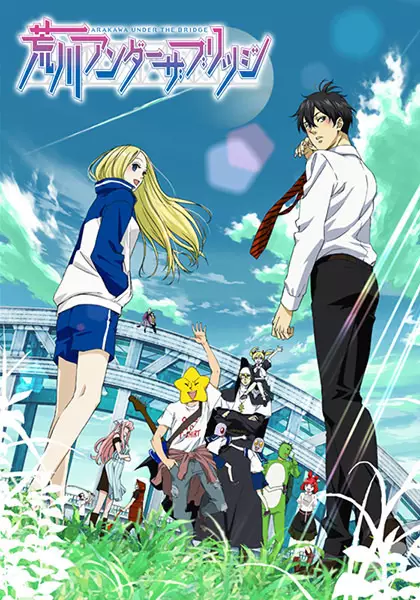
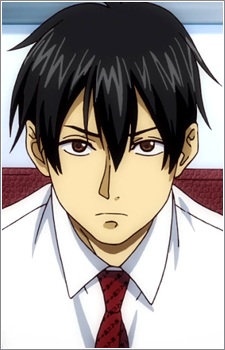
Kou Ichinomiya is the son of a wealthy businessman who holds a firm belief in his elite status. As such, he is determined to avoid becoming indebted to anyone; but one day, after a run-in with some mischievous kids on Arakawa Bridge, he ends up falling into the river running underneath. Luckily for him, a passerby is there to save him—but now, he owes his life to this stranger! Angered by this, Kou insists on paying her back, but this may just be the worst deal the arrogant businessman has ever made. The stranger—a stoic, tracksuit-wearing homeless girl known only as Nino—lives in a cardboard box under the bridge and wants only one thing: to fall in love. Asking Kou to be her boyfriend, he has no choice but to accept, forcing him to move out of his comfortable home and start a new life under the bridge! [Written by MAL Rewrite]
Главный
Главный
Второстепенный
Второстепенный
Второстепенный
Второстепенный
Второстепенный
Второстепенный
Второстепенный
Второстепенный
Fulan
August 7, 2010
At first, I thought this anime is like a normal love story. But when I watch the first episode, the story was totally ridiculous. But in the fun way. There's a lot of weird people under the bridge. Although, some of them looked normal. You'll totally laugh after watching this anime. Their stupidity is the best! All the charcters are well create. Their attitude is somewhat unique.All their past life is a mystery. Don't know where they come from, who are they, what's their background, and why did they live under the bridge?!
Manglex
July 30, 2013
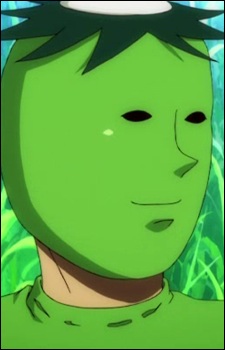
Often times people like to think of themselves as “the normal one.” At least this is the case for Kou, a self-proclaimed part of the “elite.” From the day he was born Kou was taught to never be indebted to someone. For the most part Kou does a pretty good job of it too, that is until he loses his pants and falls into the Arakawa River. Now we have one indebted Kou, and a savior named Nino that wants Kou to help her experience love. He accepts, and begins living under the Arakawa Bridge with a group of bizarre social misfits. It sounds abit absurd I know; but this absurdity is what makes it so great. Arakawa Under the Bridge uses a unique mix of absurdism and slapstick humor with a few deeper messages added along the way to bring you a really nice comedic experience overall. The story itself is lacking as show isn't episodic but can appear to be that way at times because of the absurd things happening. The story really takes the backseat and suffers to let everything shine through in this anime. As for the artwork found throughout this series... well, this is SHAFT we are talking about here. They are a studio known for their odd visuals and cinematography. You know, the people that brought you Bakemonogatari and Mahou Shoujo Madoka Magica. Although it is less experimental in art style than the previously mentioned series, it is still up to standard with any of their works and at times can even make for some really nice scenery porn. The Arakawa Bridge is called home by a village chief that thinks he is a Kappa, a killer nun, a literal rock-star, a Martian, two runaway guinea pigs from a laboratory, and of course the main character Kou. All of the characters are as absurd as they sound and maybe even more. They are the focal point in which many, if not all of the jokes in Arakawa come from. As you can tell the cast of characters found throughout Arakawa are not your average run of the mill people, and although they lack depth they are definitely the highlight of the show. The sound in Arakawa Under the Bridge is suiting. The soundtrack wasn’t mind-bogglingly amazing but it was still good. The background music enhanced the comedic moments so they did their job quite nicely. The opening of Arakawa Under the Bridge is definitely more satisfying visually than musically and I felt the same way about the ending too. As far as sound goes the voice acting was definitely the highlight, the voice actors did an absolutely incredible job making the jokes told in the show that much more memorable. It is true that people often think of themselves as “the normal one.” But after watching Arakawa Under the Bridge I think it is safe to say that normality is relative. It constantly wears this theme on its sleeve while presenting is odd, yet surprisingly pleasant form of absurdist comedy. Don’t get me wrong, I’ll be the first to say that I don’t like absurdist comedies. I have just never found them that funny, but Arakawa Under the Bridge was a pleasant surprise. I found myself laughing from the beginning of one episode to the end, which is a huge win in my book. I strongly believe this anime is a must watch for all comedy lovers. ------------------------------------------------------------------------------------- Story- 4 Art- 8 Characters- 8 Sound- 8 Enjoyment- 9 Overall- 7.4
Ezekiel_01
June 7, 2020
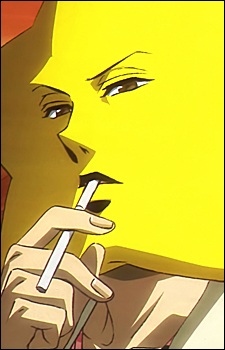
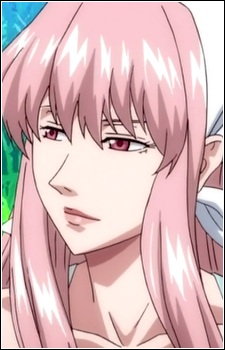
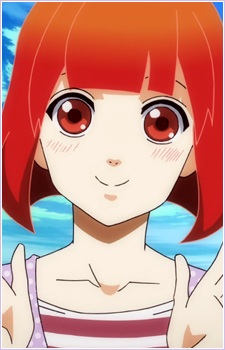
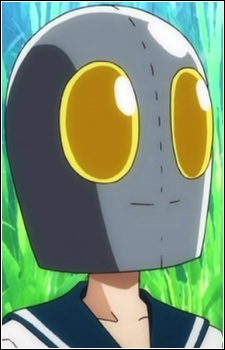
Arakawa Under the Bridge Review Part 1 [STORY ELEMENT PRESENTATION 7/10] [GOOD FOR A ROM COM] Arakawa Under the Bridge from the title itself is the main setting of the story, almost all major chain of events and interactions take place here. A strange setting to circle a romance comedy. The joke has somewhat a modern take in the presentation, for it uses a combination of interchanging camera angle views, a wholesome amount of different color pallets to intensify emotional symbolism, and continued with a constant stream of jokes that built upon a major punch line. Put all this recipe together, you would have a very charmingand engaging style of comedy from start to finish. For the most part, the comedy itself is more of a satire commentary on criticizing societal norms, it ranges from simple discrimination, public indecency, what society thinks is acceptable, and many more but in a shallow sense to make the humor light-hearted than offensive. Traditionally the show presents drama via internal monologues and dialogues to relay the main point towards the audience to think through. There was never a right or wrong on both sides of the argument. It was always left for the audience to decide whether to agree or disagree. I like how they put a decent amount of pacing between the comedy and drama, they don’t overlap on each other and thus it enforces the main point of the narrative in a much clearer to understand manner. It is nice to have something to learn after a good laugh and this Arakawa selling point in making its humor memorable. [SOUND & MUSIC INTERPRETATION 8/10] [MEMORABLE] For the technical stuff, I say the OP song Venus to Jesus is a wonderful opening sang by Etsuko Yakushimaru. Its wacky demonstration of absurdity that transcendence beyond belief. An interesting way in introducing the audience what kind of anime they are about to watch, it’s unique and I love it. While ED song Sakasama Bridge by Suneohair has a natural and relaxing atmospheric vibe to it. Both songs are completely opposite of each other but to be brief, the OP represents the bizarre premise while the ED constitute to the in-depth look of the characters The voice acting of Sugita, Tomokazu, playing Hoshi, is a plus. It’s fun to hear. He reminds me of Gintoki's ironic shenanigans in Gintama. OST is enjoyable and good to listen to. There times you the atmosphere of easy-going comedy and there are times when the narrative is serious in a meaningful way, it catches that mood accurately, making the show well pace between humor and short character moments. [AESTHETICS 8/10] [CREATIVE AND INNOVATIVE] The settings design and attention to small details are impressive. I can make desktop wallpaper in every cutout scene the show has. It has a lot of good camera shots on natural scenery around the bridge. Arakawa has some interesting symbolism and Easter eggs, especially when it comes to character design. The character here is not defined by the color eyes or the size of the hair. Their overall design defines their personality and interest. For example, Hoshi wears a star shape mask not because he’s a weirdo but indicates that he is a “rock star!” that he always plays music to enforce his character trait. Similar things can be said to other residents of the bridge. The cut transition scenes of Arakawa under the bridged doesn’t appear to be meaningless cut-outs to save some animation budget but a sense of insight in understanding what is the current tone of the situation is. This creates a mundane scene, like a simple conversation, more engaging, and entertaining. It doesn’t stray away from the audience in comprehending a particular scene. [CHARACTERS 8/10] [ENJOYABLE AND LIKABLE FOR A ROM COM] Arakawa has a specialty in introducing and fleshing out its weird set of characters. Characters in this show are at first glance seems like forgettable gag fillers, but as the story progresses there are a certain amount of depth and meaning about their motives and behavior, though if they got a moment of serious monologues and dialogues, the outcomes resulted in looking a bit pretentious because of the irony of the narrative being a comedy but still I was able to always deliver its messages in the right moment coming out as pay-off in every day to day every interaction. The encounters of each character are dynamic. Character in the show has a sense of purpose and place to belong in the setting. They each share a good amount of life lessons to influence in the development of our main protagonist character growth. Every encounter comes out different, there is always something new and completely unexpected development happens. Thus making it very enjoyable to watch. [CHARACTER ANALYSIS] [WARNING!!! SPOILER DETECTED AT THIS POINT][YOU CAN SKIP THIS PART IF YOU HAVEN'T SEEN THE ANIME YET] [CONTINUE TO THE FINAL THOUGHTS] Kou Ichinomiya, in the Arakawa Bridge Resident, nickname as Recruit because of his corporate attire. Looking at the surface, “Never be indebted to anyone” is Kou Ichinomiya's motto in life, a motto that his family embedded with him since childhood. This motto made him become independent and self-sufficient. He’s the model elite of the current society. He has an impressive track record and achievements that everybody should dream to be like him and adore him for it. He has complete pride in his capabilities that the entire world is within the palm of his hands. But even all the prestige, intelligence, and power, He still a flawed character. He lacks some common sense and basic communication skills to other people outside his corporate profession, which ultimately became his biggest weakness. This is further supported by the fact of how easily his pants was stolen by a bunch of hooligans and how awkward his interactions with the residents living near the bridge. Once his family motto was broken by his own arrogance, he goes overboard to pay-off the favors which nobody asked him to do so. Because of his stubborn ego, Kou experience negative predicaments towards the bridge residents. He also has a prejudiced mentality, the unfair feeling of dislike for someone or something like race, sex, religion, etc., because it is not reasonable or logical. Because of his high confidence of himself, he even admits that he is special, blessed with innate intelligence and privileged upbringing not only in capabilities but physical experience having a nice body and attractive face. He’s totally arrogant and a jerk on the people around him. He thinks he's the chosen one. His first impression is always the outside appearance that resulted in misjudgments that will result in him to reap what he sows. Every time he goes with an argument base on shallow assumptions, he never wins. An innocent satire of human discrimination will always result in negative consequences on how people perceive you. Despite his bad personality, He is actually a nice person deep inside. He is straightforward, sincere, and caring for others, once you got know him. He knows how to adapt and learn his flaws. He already made a helping hand compensate for his lack of etiquette to the local bridge residents. Going Deeper Kou is a genius in the business world but when it comes to the mutual relationship he’s barely a middle schooler. There is a psychological reason for this and it is all linked to his childhood; Kou’s complicated relationship with his father. He idolizes and admires his father for being the top of the corporate ladder. At such a young age Kou is already been taught an iron hand about the business world that ultimately distance his relationship with his father. The cold parental love drives him to become an elitist that will someday make him as his father’s successor. Even with a bright future ahead of him, he was lonely and empty inside. Kou only wanted to earn back his Father’s love and affection. In the end, Kou’s and his Father's relationship reached the conclusion that both father and son are just too embarrass and prideful to admit each other’s inner feelings to one another. Kou’s father is not the cold person that he was made out to be but it just Kou’s being too intimidated to approach his father. Where in fact both wanted to talk and bond with each other as father and son. For it’s pretty a nice way to bring up family issues without being one-sided. The conflict was concluded quite nicely; in the end, both father and son are just too prideful in admitting each other’s inner feelings. Characters in this show are not what they look in the surface. Kou developed his character over the course of the series. After meeting Nino and the residents of the Arakawa bridge, he no longer needs desperate attention for love. He already had it while spending his time with Nino and others. From being a try-hard elitist jerk to being a humble and respectful person. He knows what he wanted. He eventually breaks the curse of his family motto, by being able to ask favors that totally surprise the people around him. Indeed a positive character development, even the supporting cast has a decent amount of growth over Kou adventures; they don’t remain as jerks in the remainder of the series but became one of the friendliest neighbors that you can share your life with. Nino-san, a surreal character at the surface. She is the sole reason for Kou’s character growth but pretty much a hair head at times but has a heart of gold that is adored by the residents living under the bridge. Her intentions are pure and selfless where she almost symbolizes as a goddess of sorts, though she not perfect and has little knowledge when it comes to the outside world. She is Venusian apparently so I may buy that as an excuse of her being an alien because of her awkward behavior. She doesn’t know what is a date or other fancy stuff common for girls, giving Kou a very hard time deal with her but she has a right sense when it comes to critical moments, her decision and action is on the right place for the people she loves and cared for, that even Kou agrees with her without a doubt. When it comes to Kou and Nino’s Relationship, they both have good chemistry, which most of the time is comfortable and adorable. There is a harmonious atmosphere between them. Their simple conversations made way to better understanding each other's strengths and weaknesses. Overtime their emotional connections grow stronger which is a lovely sight for a romance. For honorable character mention, Personally, P-ko is the Best Girl for me. She is a dangerously clumsy, a bit naïve at times but aside from Nino, P-ko is one of the lovable girls in the series based on my reference. Her motives in providing the bridge residents with freshly farmed crops with love is admirable. She is adorable and naturally innocent. I will surely help her out to look for seeds in the winter. She reminds me of Little My and Snufkin's personality from the Muumins. [FINAL THOUGHTS] [ENJOYMENT 9/10] [GLAD THERE IS A 2ND SEASON] Arakawa Under the Bridge for me is a special romance comedy. It’s an unconventional setting for a romance with a nice set of bizarre characters. The cinematography is well-crafted on maximizing the aesthetics and it blends well with music and sound. It matches the theme of its absurd premise, definitely amazing for me. I love the moral values it showcases in valuing mutual relationship, it informs us to stop being a judgmental person. We should not be seeing a person outside appearance but through their actions and inner quality. We must see a person who he is and not what he achieves. Respect people’s choices in life and never discriminate them just because it against your own principles in life. Be tactful on people living a simple life and don’t brag achievements that have no meaning to them. It will only destroy your character. Arakawa Under the bridge is enjoyable to experience. It has plenty of feel-good moments that is both relaxing and soothing at times. It’s more of a slice of life than drama. But sometimes I wish there are more character development in the show but because the characters are a great addition to the comedy to work, I’ll give a pass in flying colors. It rare for me to like all the side characters in a romantic comedy given how eccentric the supporting cast in the first place. The anime humor is not for everybody, its alienating nature could be an uncanny valley for some. But if you are tired of the same troupe on romantic comedies, It wouldn’t hurt to try Arakawa Under the Bridge. You might love it. I know I do. Looking Forward Watching the 2nd Season [OVERALL 7.7/10][A UNIQUE TITLE]
Artrill
December 28, 2017
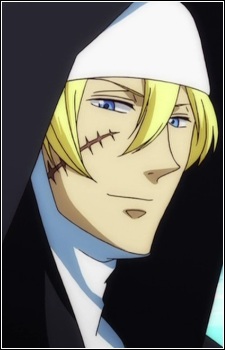
5.0/10 _____________________________________________________________________________________________________ There are certain tropes that exist within the realm of anime, well, less obviously, comedy anime. Said tropes seem to inhabit the majority of these programs and, to my dismay, negatively influence my enjoyment of these products. Tropes are not inherently bad, as they are a kind of backbone for every piece of entertainment. However, certain tropes you, as a viewer, can grow to harbor an inner disdain for. Comedy anime, especially of the romantic nature, tends to exude and indulge in these tropes to the point where they instantly put me off of a show. One of said tropes is the idea that ourprotagonist needs to have some kind of moral or ethical restriction or rule imposed upon them by nothing but their own will or experience, which often rings hollow since it is such a preposterous idea, to begin with. This trope, I'll agree, is present in a lot of anime, especially Shounen action, but it also persists in comedy for no reason other than to create over-the-top situations, naturally. This is just one of those tropes that always rubs me the wrong way because it never breeds situations that I believe or find funny, and while comedy is generally unbelievable, there does need to be an air of verisimilitude that inhabits the scene for it to work in context. With this knowledge, we enter "Arakawa Under the Bridge". _____________________________________________________________________________________________________ [Character, Delivery, Execution] The trope here is utilized of course. Our protagonist, Kou Ichinomiya, kindly nick-named "Rec" or "Recruit" early on in the series, is a rich business elite who grew up with a tough, no-frills father that seemed to not care much about him at all. He taught him one lesson, to never take favors from anyone as you never want to be indebted. So here stands Rec, on a bridge, pantsless, and wondering what he did to deserve to be stripped by a group of schoolboys. Here comes Nino, fishing his pants up from a hanging railing and handing them over to him. At first he rejects her assistance but then comes around to accepting her favor and is therefore forced to become indebted to her. She asks him to be her lover and well... you can probably guess where this goes. He is forced to be the lover of this surprisingly attractive strange girl who lives under the bridge. Woe is Rec. Under the bridge, Rec meets a group of equally strange and zany characters that have all kinds of odd interests and hobbies. Ranging from a man in a Kappa costume who believes he's actually a Kappa, serving as the chieftain of this little group, to a man who is perpetually in love with Nino whilst also wearing a star-mask and making bad music. The designs here are all distinct and quite good, actually, specifically the gun-toting nun and peppy, yet clumsy farmer girl. This group of somewhat loveable and oafish characters don't get much development, as the series' thirteen episode stretch is more oriented around sketch comedy. Unrelated skits backend each episode. These episodes are split up into multiple "chapters", each one signifying a different theme or concept and play out in one to ten-minute sketches that don't correlate with one another until the main psuedo-arc of the series comes into play. It's a cute format that is in-line with something like Nichijou, a favorite of mine. Unlike Nichijou, "Under the Bridge" doesn't have as much diversity or prowess in its execution, and unfortunately, a lot of the comedy falls flat. More on that later. Ultimately, these colorful characters are not at all detailed enough, in my opinion. It's not like they have to be since there are plenty of comedy series' out there that don't have three-dimensional characters, but they make up for that in pure wit and amazing comedic chops. With "Under the Bridge", there is a specific effort for emotional moments and moments of actual romance, and unfortunately, they all fall flat. Which is sad because the series is definitely at its best when it is being funny. Even if it isn't always funny. The first episode, also, doesn't feel like anything else in the series because it is substantially better paced and entertaining than anything else in this series, which is somewhat low on highlights and more just showing blips of inspiration a few moments of joy every episode. _____________________________________________________________________________________________________ [Comedy in Anime] Since I don't have too much to say about this series apart from "it's okay" and "occasionally funny" and "somewhat unremarkable", I rather focus on the broad experience I've had with comedy anime and the "style" is is often off-putting for me. I don't even think it is a cultural thing since there are plenty of anime that have had me laugh and there are plenty of Japanese films that are equally hilarious as some of the better productions coming out of Hollywood. No, it's something more. It feels like so much comedy in this series, as well as a lot of the comedy anime I've seen hits the same way, with the same delivery, and the same kinds of shots and effects and even voice acting. Honestly, a lot of it seems very repetitive to an almost ludicrous level. The same can be said for the way humor is handled at all. Jokes seem to go on for far too long, their punchlines run their course and instead of cutting, they either repeat the punchline or exposit the punchline, which makes it far too obvious and very clunky to sit through. It happens a lot. For example, a scene would lead up to a pretty decent punchline, and then, for no reason other than to explain to the viewer what is happening, the main character or whoever else would just yell out exactly what the punchline was. This is what I call 'reactionary humor', where the writers try to add another moment of comedic timing and delivery through a character's reaction to the piece of comedy, however, it is so rarely funny. Especially since it is delivered the same way every damn time. It's always yelled loudly with a multi-colored background and action lines. It doesn't look good, it doesn't sound good, and quite honestly, it ruins the joke. This problem persists throughout this series and throughout a lot of comedy anime because I guess a wacky face that I've seen a hundred times in a hundred different anime is enough to be a punchline now? So there's the problem, this odd, clashing style really detracts from the punchlines. I suppose it works for many, this very abrasive, loud, and reaction-based style of comedy. However, for me, it really doesn't do anything and "Under the Bridge" was brimming with it. _____________________________________________________________________________________________________ [Aesthetic and Sound] This is all solid. The SHAFT style is ever present. It feels a bit too much like Monogatari at times, but I suppose that style is what defines studio SHAFT at this point. It is especially jarring when the protagonist, Rec, is voiced by the same VA as Araragi from Monogatari. The style here, while visually solid, isn't really necessary. I never felt the indulgent need for it, similar to Monogatari, and it very rarely actually affected the core of the show, which is the comedy. There are some pretty scenes, but in general, the entire show takes place in one, very green, very bridge-oriented location that isn't all too interesting after the first couple episodes. The OP and ED are both solid, providing something that wasn't outstanding, but definitely is worth noting as a positive for this show's sound. Then again opening and endings in anime tend to blend together for me, so who am I to judge. _____________________________________________________________________________________________________ [Conclusion] It's okay. That's the best thing I can say about this series. There were stretches where I was bored and genuinely uninspired by what's happening on screen. There were moments where I enjoyed seeing these characters interact and seeing their little world grow, and there were, very rare moments of actual, laugh-out-loud comedy that was delivered well. Unfortunately, this makes for an unremarkable package that I don't see myself recommending to people who aren't already fans of anime-style reactionary comedy. Describing this series, one of my friends called it "Monogatari-lite", and in a way, it is. The style is not as interesting, neither are the characters, or the setting, or anything, really, but the presentation is in line with what SHAFT has done with Monogatari and I, for the life of me, can't figure out why. There is no reason to include this kind of aesthetic in a show like this, and SHAFT shouldn't be pigeon-holed into over-relying on their developed style, which was pioneered by Shinbou. They are perfectly capable of utilizing something different like with Madoka Magica. The music is solid, and the voice acting is generally really unremarkable. The most impressive voice work has to come from Chiwa Saito, who plays the cute young kid, Stella. Thi character is a brat and often changes metaphoric forms, which prompt the VA to have quite a few different inflections for this character that are not only endearing but are bordering on funny, too. "Arakawa Under the Bridge" is a fairly unremarkable series wrapped up in the guise of something better. The style doesn't seem to fit, although it is visually pleasing, and everything from the story to the characters tends to flatline more so than anything else. Even if the characters themselves are well-designed. The attempts at romance fall completely flat due to the totally ridiculous premise, which fits the show's comedic tone but doesn't actually make for a believable romance or likable romantic prospects. The father/son relationship is a bit more interesting but honestly isn't explored enough to call well-done. Overall, it's "just there" as a series that I think doesn't do enough to actually maintain interest through the meat of its execution, which is the humor and characters. The presentation is fine, although ill-fitting, and the music is decent, too. But ultimately, there's a dissonance between what works and what doesn't, and I will always find myself wishing that this series portrayed a more captivating world.
Ston3_FreeN7
May 26, 2011
Comedy is a tough aspect to grade, since it is largely subjective in nature. Just because I find Kramer and Jerry arguing about the trajectory of someones spit on Seinfeld hilarious, doesn't mean others will. Likewise, just because someone else finds a guy walking into a woman's bath by incident and getting knocked into the stratosphere for it amusing, certainly doesn't mean I do. But, and I think most other people will agree, some of the best comedy is stuff that actually has an underlying message to it. When humor can actively facilitate an overall message that the work in question has, then it allworks on multiple fronts. And, well, this is something that Arakawa Under The Bridge does well. Arakawa starts with the protagonist, Ichinomiya Kou, standing on a bridge completely pants-less. It is here when he meets a rather strange girl known as Nino and it is also here where we learn of his fear of owing anything, and I mean ANYTHING, to anyone what so ever. It is readily apparent from the on set that Kou has some rather deep sitting issues with his father, almost a sort of phobia if you will. Now, don't get me wrong. Arakawa is most definitely a comedy first and foremost, but themes such as running away from problems, parental issues, and so on are lightly, and rather effectively, touched upon during the course of the series. But, it certainly never becomes heavy handed in this matter at all. Visually, Arakawa is a treat with very well done character design, particularly Nino and the other female characters, and just overall interesting visual touches here and there. Shaft has the usual visual touch, but not quite as heavily as Sayanora Sensei, EF, or their other works. Sound wise, the musics generally pretty good. But, the voice work in particular is striking with some very big names in the series particularly Sugita Tomokazu (Haruhi, Gintama), Fujiwara Keiji (Baccano, FMA), and many more. The characters are very likable, with pretty much every one of them having some sort of..personality quirk. Whether you have the cross dressing "Sister", The Kappa costume wearing Village Chief, The rockstar wanna be Star shaped mask wearing Hoshi, the insult throwing Maria, and so on..it's almost guaranteed that you'll find something to amuse you in some form. Which brings me to my biggest issue with the series, the characters don't change and we just don't learn anything at all about the vast majority of them. Not that Kou doesn't try to learn, it's just that the other characters either avoid his questions or outright lie to him. It's arguable, of course, whether or not this is an actual fault or not...it's just the way these people live their lives and it effectively ties into the central plot point. But, it still hurt my enjoyment a little bit. Story: 7 At it's heart Arakawa Under The Bridge is a sort of coming of age story in which Kou tries to come out from under his fathers shadow and live his own life under the bridge. Some of the comedy is random in nature, but most of it seems to hit on the underlying message. It isn't deep stuff, but this series did very effectively what it intended to. Art: 9 Well done character designs, good background art, and very consistent animation. The Shaft "style" isn't quite as glaringly obvious as most of the shows from the company, except for the OP, ED, and a few other instances. It has to be said that Nino is probably one of the most obviously beautiful female characters I've seen. The other female characters are well designed as well. Sound: 7 Solid music, with well know voice actors doing the same great work they always do. Not much to complain about here. Though, there also isn't anything particularly amazing in this compartment, either. Character: 8 The characters are likable, memorable, funny, and just overall well done. Unfortunately, they go out of their way not to talk about themselves and Kou is pretty much the only character to go through some form of change. Still, nothing to complain about. Enjoyment: 9 Consistently funny unlike most comedy series I've seen and the characters are very likable. I enjoyed the message this series brought to the table as well. An easy series to marathon. Overall: 8 Memorable, funny, and many other things. Arakawa is a great comedy series up there with stuff such as FMP: Fumofu, Minami-ke, and a few others. Definitely recommended for those looking for a good time.
Ранг
#1832
Популярность
#729
Участники
372,379
В избранном
2,476
Эпизоды
13