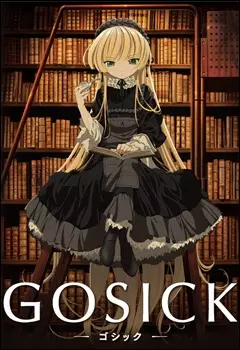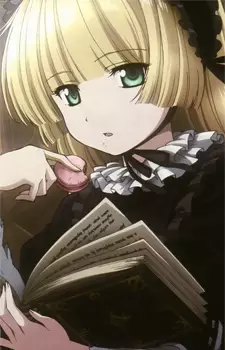



GOSICK -ゴシック-
Kazuya Kujou is a foreign student at Saint Marguerite Academy, a luxurious boarding school in the Southern European country of Sauville. Originally from Japan, his jet-black hair and dark brown eyes cause his peers to shun him and give him the nickname "Black Reaper," based on a popular urban legend about the traveler who brings death in the spring. On a day like any other, Kujou visits the school's extravagant library in search of ghost stories. However, his focus soon changes as he becomes curious about a golden strand of hair on the stairs. The steps lead him to a large garden and a beautiful doll-like girl known as Victorique de Blois, whose complex and imaginative foresight allows her to predict their futures, now intertwined. With more mysteries quickly developing—including the appearance of a ghost ship and an alchemist with the power of transmutation—Victorique and Kujou, bound by fate and their unique skills, have no choice but to rely on each other. [Written by MAL Rewrite]
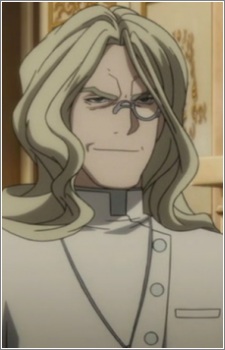
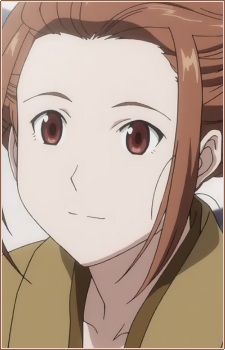
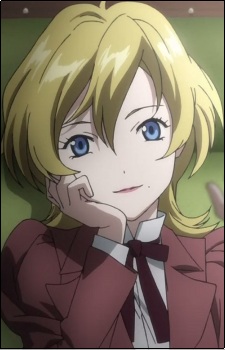
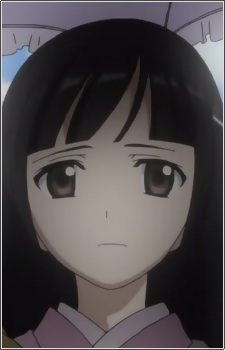
Главный
Главный
Второстепенный
Второстепенный
Второстепенный
Второстепенный
Второстепенный
Второстепенный
Второстепенный
Второстепенный
Archaeon
July 6, 2011
Detective stories never go out of fashion, but finding a way to make them interesting is another matter entirely. Some leave things open to interpretation, whilst others rely on convoluted mysteries that are more difficult to follow than a city street map. There are also whole bodies of work dedicated to the exploits of well known sleuths like Sherlock Holmes, Hercule Poirot, Miss Marple, Inspector Morse and more. So what was the great innovation brought forth by the anime industry? Why loli detectives of course! Originally a light novel series by Sakuraba Kazuki, Gosick (which may be a play on the word "Gothic"), is set in thefictional European country of Sauville where Kujo Kazuya, the third son of a high ranking officer in the Japanese Imperial Army, begins attending the prestigious St. Marguerite Academy. He quickly discovers that almost everybody in the country is enamoured with tales of the supernatural, and one of the strangest tells of a golden fairy who lives at the top of a tower ... The plot is generally well constructed and the basic premise is actually quite interesting, so it's unfortunate that the narrative is a bit too linear for the majority of the series. In addition to this there are several rather blatant attempts at moving the story forward by inserting some obvious tokens into specific episodes, many of which could have been handled in a far more subtle manner. A major issue when adapting a written work into a visual form is that it will undoubtedly lose something in the process, and that seems to be the case here. Part of the problem stems from the fact that certain aspects of a given story will lose a degree of mystery once they're converted into an image, and this is even more prevalent in animation. While experienced authors are able to hide certain clues or foreshadowing elements in a body of text, once the story is adapted for anime the differentiation between foreground and background becomes far more pronounced. This has the effect of "highlighting" the more important parts of certain scenes, and when taken in conjunction with the linear plot, it makes several of the seemingly impossible to solve mysteries relatively easy to deduce. That said, there is quite a bit of sleuthing going on, and the variety of cases on offer should tickle the fancy of many a mystery buff. Because the series is set in 1920's Europe, Gosick has a very continental look to it that's reflected in the clothing, buildings, and even modes of transportation, and the majority of the background artwork is implemented rather well. There has also been a decent attempt at giving the majority of the characters a vaguely European caste to their features, and this can sometimes contrast nicely with the somewhat stereotypical design used for Kujo. The one oddity is Victorique as everything from her height to her clothing is very different to that of everyone around her, which raises an interesting thought. Gosick is, at heart, a detective drama, and in the spirit of tradition the leading sleuth must have something that visibly sets them apart from everyone else. In this case, it's a loli wearing ruffles, lace, and a charming array of bonnets. The animation is pretty decent for the most part, and the majority of character movements have been implemented rather well. Unfortunately Bones haven't really pushed the boat out with this anime so there are a few telltale signs of inattention here and there. Gosick features a variety of classically themed background music, and while the majority of the tracks reflect the serious tone of the show, there are a few lighthearted pieces scattered here and there. The opening theme, Destin Histoire by Yoshiki☆Lisa, is a J-pop/rock song that seems a bit too action oriented for a series that relies more on utilising the character's brains instead of their brawn. In addition to this the stylised montage that accompanies it drops a few too many hints about events that occur in the story, which is unfortunate as otherwise it's a well made and choreographed piece of work. As for the two ending themes by Komine Lisa, Resuscitated Hope (episodes 1 to 12), is a pop ballad that seems to fit better with the tone of Gosick, both musically and in terms of the visuals used for the end sequence. The second song, Unity, is the one that stands out the most as it's far more melancholy and dramatic than the other two tracks, and the accompanying imagery reflects the darker turn the series takes after the halfway point. The acting is pretty decent for the most part, with Yuuki Aoi and Eguchi Takuya performing rather well in the roles of Victorique and Kujo (and it's actually surprising to find a tsundere loli that isn't being played by Kugumiya Rie). The rest of the cast also handle their roles passing well, but like so many other titles out there, the script could have been done better. The dialogue is sometimes childish or stunted, and there's a lack of cohesiveness that appears during several conversations which can make the characters seem ... lacking. Possibly the biggest surprise in Gosick is that there's actually a fair degree of justification for Victorique being not only a loli, but also tsundere. Kujo is the typical "blank canvas" used in so many anime to highlight just how much he develops by the end of the series, but in all honesty neither of the leads is anything really special. The fun actually starts when one looks at the supporting characters as there's literally a wealth of personalities and ambitions on display. While there is some growth to be found for both Victorique and Kujo, it's the amount of characterisation that has gone into the minor roles that makes this series interesting to watch. That said, the show does sometimes play fast and loose with certain events, and there are several occasions where the situation has clearly been contrived to develop a particular character in a certain way. Gosick may have its flaws, but that doesn't mean it's a terrible show. There's a decent amount of detective work in the series that raises it above the likes of Tantei Opera Milky Holmes and Hidan No Aria, and while the mysteries on offer can sometimes be easy to deduce, there are also a few that contains some interesting twists on the stories that they've inspired. That said, this isn't an anime for everyone, mainly because it relies more on the characters using their heads rather than the usual shounen tactic of solving problems by hitting them until they've gone away. In addition to this the element of romance in the story can often feel more like an afterthought, something added to give the characters a bit of added dimension. Somewhat surprisingly, I found that I enjoyed this anime a lot more than I thought I would. The idea of loli detectives is no more laughable than that of a little old lady, an author of crime fiction, or even a mouse, and once I got over my initial aversion I found a show that was interesting at the very least. That doesn't mean I'm sold on the idea though, but that's mainly because of shows like Milky Holmes and Hidan No Aria, which really haven't done the concept any favours. If nothing else, at least Gosick tries to redress the balance.
Detective
July 6, 2011
Review contains possible spoilers. I find that GOSICK is flawed and weak in every way, and to summon up a commonly used cliche to describe an undesirable mystery,"it's like watching Scooby-Doo." So my first comparison will be how Scooby-Doo is, in fact, superior to GOSICK in terms of mystery. Scooby-Doo is an episodic mystery show (similar to GOSICK in this regard) in which a cast of bumbling characters winds up with a mysterious case on their hands, that is always solved (similar to GOSICK). Unlike GOSICK though, Scooby-Doo always introduces it's culprits prior to the solution, and presents CLUES as to HOW the mystery is solved alongthe way. GOSICK has no development in regards to it's mysteries. They are solved *magically* and I mean, without any clues or evidence nearly every time by a "Fifteen" YEAR OLD GIRL. She can spot who the cuplrit is by the way he or she holds a gun, for example. She knew that the culprit of murder must be blonde because it was sunny out, for another. Or how about the ever so flattering "the culprit is black because it was dark out." Are you kidding!? So in short, Scooby-Doo is a better mystery because GOSICK is not a mystery. GOSICK is a fantasy anime in which little girls can outwit their older brothers who have detective's licenses. As every review has said, Kujo is a garbage character. Even the reviews attempting to explain how wonderful GOSICK is mention that Kujo was a generic protagonist. The story is that he is a highly intelligent Japanese student who is transferred to an imaginary European country. So we have the Japanese highschool student cliche with legs as our lead. How creative. This cliche would have worked if the setting was Japan in the 1920s. I am not willing to embrace this cliche if the setting is supposed to be in Europe though. Just so the teenage Japanese audience could relate to the story, they forcibly needed to add a poorly written Japanese boy as the lead? Kujo is so pointless as a character and shows so little development that I doubt he was necessary to any point of the story except to add a filter for the audience to see through and to stir some "romantic scenes" with Victorique. Except GOSICK is not a romance. There's twenty-two episodes of light banter between two archetypal characters, and then two episodes of reversal, and we're supposed to believe GOSICK is a romance? Unless you are easily deceived by crying and enormously blatant drama then you might. This kind of finish can be termed as "wrap up drama," in which the story lacks development for eleven episodes or so and then in the final two or so episodes a dramatic plot is concocted to give the show lasting appeal, a technique commonly used in slice of life anime as a way to finish a show. My favorite (sarcasm incoming) part of said ending though, was when about half way through the series a "super serious ultra scary dramatic prophecy of great mysteriousness" was directly told (in a supernatural manner, once again GOSICK would've sat far better as a fantasy) to Kujo by an old dude that he and Victorique would travel far apart and that they would face grave misfortune for the rest of their lives. [[[[SPOILER:]]]] Of course, GOSICK has a happy end. There's no point in introducing this concept of great loss and permanent misfortune if it /does not happen/. Adding in uselessly "epic" scenarios and scenes into an anime does not actually make it an epic. Now a lot of reviews criticize Kujo, but not Victorique. Victorique is a by the book tsundere character. That's about the level of depth she has other than (once again, unrealistically) her incredibly mature voice. The show actually tried to explain her mannerisms in one episode by delving into her "dark and mysterious and emotional and begrudged" past. Oh my goodness, laugh out loud for real. Oh sure, a little girl can change the tone and pitch of her voice as well as the way she acts by being locked in a prison... her whole life. Is that scientific? No. Is that possible? Well without any facts, statistics, charts, studies, or maybe even imaginary facts, statistics, charts, and studies I would have to say, no! There is no logic behind her behavior other than "uh well she was alone for a while and then she completely changed forever." Reasonable logic, I think not. Beyond that her character is loved by many for doing pointlessly childish things and puffing out her cheeks much like every tsundere. And she isn't even voiced by Rie, so like, what the point is, I don't know. She's just another piece of bait to attract fans. What GOSICK really attracts people with is though, is it's Victorian setting (well, and having a small blonde girl as it's cover piece). A few anime share a similar setting in a similar time period - Chrno Crusade, Victorian Romance Emma, and Kuroshitsuji to name a few. The mysteries in this series are so convoluted that this setting isn't even necessary. It's definitely not needed for the mystery, because there is nothing Victorique can't solve, essentially making her solutions as inconceivable as having a futuristic computer solve the mysteries. It also isn't needed for the "romance" because it could have been set in any wartime period (or more exact inter-wartime period, or post-wartime period, or whenever more exactly). So what's it needed for? It's needed for an audience is what I draw from this. It's needed so it can be slightly different, but exactly the same. Anime has only scratched the surface of the Victorian setting, and people are highly interested in such a time, so it draws in viewers. I'm not trying to be a cynic here and tell you that it did all this to draw in fanbase but... I actually think that's why GOSICK has the Victorian setting as it's time period because I logically can't think of any other reason. Now if you're still reading, I must thank you, because I'm about to get into the muckiest part of this piece - the side characters. To begin unfurling this mess, I have to bring out the ditzy teacher. She does nothing except comic relief and drool over the other comic relief guy (whose hair is a drill, ha ha). The second comic relief character, Grevil, Victorique's older brother earlier in the series is portrayed in every episode as an ignoramus. Yet he's the detective and his little sister solves all his mysteries. (What a fantastical fantasy anime this is!) Then in the final arc, much like the two main characters, instead of getting development throughout this 24 episode series, his character suddenly goes grim and serious. This is not character development. This is a re-write. There is no character development in GOSICK, there is only a re-writing of the whole cast in the last few episodes, that is just too unbelievable even for my willing suspension of disbelief to hold. Another character is Avril, a classic dope supplying comic relief (but like the aforementioned two isn't funny either). So the recurring cast are all dopes with the exception of supercomputer Victorique. Single arc characters are the tritest of the bunch though. The antagonists have their flimsy motive or mysterious prophecy (most arcs tend to center more around supernatural beliefs and occurances, despite the mystery tag) and all the side characters are one-dimension at best. Victorique's mom and the Roscoe twins are actually hilarious though, because they create such a crudely dramatic and painfully bad allusion to Alice in Wonderland. I didn't even know that the whole cast was essentially a poor parody until the ending when Kujo was holding a book with a white rabbit and little girl together. So apparently, their obnoxious roles as characters was to simply imply a better work! How classic! GOSICK wishes it could be Heart no kuni no Alice, which is already a fangirl's rendition and (somewhat of an enjoyable butcher) of the original Lewis Caroll staple, forget Alice in Wonderland itself! Touching on music is almost always subjective in a way, but I just wasn't impressed. There were no tracks that caught my interest, the openings weren't particularly enjoyable, nor were the endings. The voicing as I mentioned earlier felt unbelievable, too, because Victorique has the voice of a forty-year-old woman. So I can't really complain about the sound beyond how average I found it to be. I'll end with the art and animation. BONES I've seen better from you. The background art was actually pretty nice, but was far too often engulfed by the ridiculous character designs. The animation in my opinion, was rather poor by BONES standards and the awkward positions characters managed to wind up in often amazed me, as well as the messy looking faces of the side characters. I did not find any character enjoyable to look at, and I feel that Bones just had way too much fun with the bold line tool. Also Victorique has a mishapen and malformed Uguu~ face. So yeah, I didn't like GOSICK. It was a waste of time to anyone who pays attention to detail and/or wants a mystery anime. And yes, I can say that going into GOSICK I expected a mystery and in every way I was let down. Because this is not a mystery anime, it is a fantasy anime, and I am quite upset that the database won't let me fix this misnomer.
cyrilkhan
July 2, 2011
--The review contains spoilers-- Overall - 9 If you are looking for a good detective series, this is not the show you are looking for. Gosick is not a detective show. It is a historical fiction that tells the story of Ministry of the Occult’s attempt to maintain political power against the rise of science. Victorique, the heroine, solves minor mysteries in a Sherlock Holmes manner throughout the show. As Ridiculous as they may seem at first, the resolutions of these mysteries foreshadow events crucial to the actual plot. Although the conflict is not obvious until the second half of the season, it is present from thefirst episode. Another important note to mention is that the show is also a romance. I would put it akin to Toradora. The romantic plot is important to the overarching plot, but it does not take priority over it. If you don’t like romance, you can still like this show. If you want a good love story, you still get that. Gosick gets very dark towards the end, as the overarching plot becomes noticeable. There are scenes filled with action, especially towards the end. Every episode build suspense and questions; as the show comes to a close, it does not disappoint. The staff of Gosick takes the unimportant details seriously. Minor characters have a lot of personality and perform their roles decently. The background art is among the best of any show I have seen. Every little thing was given time and effort by the staff, and that is one of the best parts of the show. If you love music, this show doesn’t have the world’s greatest soundtrack. However, the music is still very good, especially in the opening and ending themes. As a warning, endings change at episode 13. Being a huge fan of the first ending, the second was a shock, as it is not nearly as good. It is still a very good song, once you’ve hear it a few times. The in show music could be better. --- Characters - 10 The lead role of the show is a Japanese exchange student Kazuya Kujou. Kujou is an intelligent, albeit naïve, student. He trusts the myths of his host country, Sauville, but does not become entranced by them like the students of that land. In his home country, he is considered a pansy; in many ways he is, but there are times when he has plenty of courage. He is not a toughened warrior at all times, but when other people’s lives are in danger, he steps in the path of bullets. Although Gosick is not narrated, Kujou seems to take that role. Whenever the viewer is left in the dark, so is he. Whenever the view would be confused, so is he. When the show journeys into the supernatural, even Kujou keeps it tied to reality. Victorique is the character that causes people to label Gosick as a detective series. People present her with cases, sometimes unintentionally, and she solves them within moments. She constantly acts bored and rarely shows any emotions at the beginning. Her history is a mystery that is uncovered bit by bit after each case she solves. The only thing that is obvious in the first few episodes is that Kujou causes Victorique to change. She becomes more social and emotional. Her character changes so much over the course of the show that she looks dramatically different at the end than at the beginning (literally and figuratively – although the literal change is to emphasize the figurative). The changes make sense with the story, and do not distract the viewer at all. Each supporting character has a clear cut personality. Even one shot characters have histories explained briefly without distracting from the plot. This is one of the best aspects of the show. The minor characters fulfill their roles well. Grevil de Blois, the only real detective in the series, plays a complex part. He often becomes an obstacle to the main characters, but sometimes he aides them by following or ignoring his superior’s orders. He changes as much as Victorique as the show progresses. Although Grevil is the strongest support, almost none of the others can be done without. I’m not as picky on grading characters as I am with other sections. I am willing to give 10’s to multiple shows, not just the best. There are requirements to get this score. The cast must be well developed, have purpose in the plot, and fulfill their roles properly. Gosick is one of few shows where I could not find a character I did not like. That being said, there are characters I wouldn’t want anything to do with if they existed. In fact, that is the reason I’d give this show such a good score here. I think that every single one of these characters could exist, because they are developed enough to have realistic personalities. Story - 9 The first half of the Gosick has lots of little mysteries that seem to have little relevance to the entire plot. Also, for someone expecting a detective show, these mysteries are a bit disappointing. Very little work is done in the actual investigative fields, and Victorique solves these mysteries quickly. While many people would find her evidence a bit farfetched, it is fitting for the overall plot of the show. Victorique claims that she puts together the chaos around her using a “wellspring of wisdom.” This is a horrible way to end any mystery arc, if you want a show like Columbo, Monk, or Law and Order. However, this does not hurt Gosick at all. After all, this show is not a detective series; it is a historical fiction. The first few mysteries help develop the characters and foreshadow the important plot points that come later on in the show. Each minor event has relevance to the story, but it does not become noticeable until the second half. Like the first half, the last episodes are full of minor mysteries. At this point in the show, these mysteries are no longer random. The cases from the first half have gained relevance to the overarching plot. The new mysteries reveal the most important details of the history within the show. Victorique’s past is revealed. The conflict becomes overt. This is an important point in the show; the viewer can see that the conflict has always been present, but no one knows exactly what it is until Kujou discovers it. Also, it proves that the show is not a detective story. Although the heroine is treated as a detective, she does not change the show. The conflict of a detective show is always the same; the leads must discover how an event happened, and who caused it to happen. In the case of Gosick, the conflict present in the overarching plot is completely different: the Ministry of the Occult’s final attempts to maintain political power against the Academy of Science. The presence of the supernatural is important for the plot of Gosick. Myths and superstitions help keep the Ministry of the Occult in power. The ignorant populace responds to mystical evidence before the scientific. Victorique offers scientific theories to cases, but she creates them through unlikely means. These theories also make sense when she says them, but they seem mythical as well. This makes Victorique the focal character; she contains elements of the Occult and science in her. She represents both sides equally. The ending of the show feels rushed. The last episode is forced to switch between several characters, locations and times that it is hard to understand what is going on. While it isn’t the smoothest finish ever, it still ends the story well. The conflict between the Occult and science is resolved properly without anything being rushed. The resolutions of all the characters, however, are rushed. As the Second World War passes, viewers get to see where each of the characters are and what they are doing. Perhaps the chaotic ending was intended, since everything that happened during that war was chaotic. Very few questions are left when the screen reads “Fin,” and most of those are philosophical. As mentioned in the characters section, this show is also a romance. The relationship between Kujou and Victorique is very important throughout the entire show. The conflict between science and magic still takes priority over it, but the conflict of the romance plot is directly related to the other. Although they are not the same, the events that occur affect both plots. When the main conflict is resolved, so is the romantic one (albeit a romantic sub plot remains unresolved until the very end). In many ways I want to give the story a 10, but I will not for one reason. The show that gets a 10 in this field must be, without a doubt, the best story I have encountered. While I haven’t seen such an interesting storyline executed in such decent way, I cannot say it is the best. That being said, I cannot say that about anything else I have seen. I’m picky that way. So go ahead and put a 10 in that spot, since it would have one if I wasn’t stubborn. Art -10 The character art in Gosick is basic. It does not distract the viewer by being too flashy or by being of poor quality. The faces of the characters do not have the details they could have, and my art styles surpass the one used in this show for that reason. However, plenty of detail went into the clothing of each character. Not only were Victorique’s dresses given plenty of time and effort, but even the supporting characters had well thought out clothes. Luigi, who appears only a few times, first appears wearing a ratty set of clothes. The detail put into making his simple set of clothes look like he slept in the streets took effort that many shows don’t put in. The quintessence of art in Gosick is its back grounds. From the insides of homes and libraries, to greenhouses and full landscapes, the artists of this show worked hard on every detail. The scenery of the city near Kujou’s academy is splendid; the cobblestone street and European style homes look realistic. Several landscapes are shown when the characters travel, and they are never reused images. Every time one appears, they look like places worth visiting. This is why I gave Gosick a 10 in art. I would want to visit every place the characters travel if they really existed: from the lush green countryside to the snowy Alps (granted I could visit Italy for that). The scenery was never ignored or rushed, and I have seen very few shows that compare in the slightest. As for character design, the show does not lose any points from that. Although it is not the best way to draw characters in my opinion, it fits the rest of art well. Because the art does not take any time to get used to (unless you’ve never seen anime before), with the combination of its simplistic style and mixing well with the background art, the character designs do not distract from the show. As a note, art is one aspect that I’m extremely picky about. Art alone can decide whether or not a complete show. Music - 8 The in show soundtrack is very good, but it does not change much as the show continues. Nakagawa Koutarou does not ruin the show with her music. In fact, many of the scenes are made much more dramatic due to her works. However, she is no Yuki Kajiura. A show of such high quality seems deserving of an amazing soundtrack, but it is left with an above average one at best. The opening and endings of the show are among the best music the show provides. Yoshiki Lisa created an amazing opening for the show. Destin Histoire puts the viewer in the right mood for the show. It is an upbeat song, but it is not so happy that it deceives the viewer (as the show gets dark from time to time). It is not dark enough to scare away people looking for a good story. Komine Lisa made the first ending, Resuscitated Hope. This song was a perfect ending for each episode. Since the show often ended on a cliff hanger, this song only intensified the suspense. Also, appropriate for a show title in the engrish version of “Gothic,” this ending has plenty of Nightwish vibes. Of all the themes for the show, this fit the very best. Unity was the second ending of the show. Also created by Komine Lisa, this song is drastically different from Resuscitated Hope. It is not unfitting for an ending for the show, and it accomplishes everything the first ending did nearly as well. However, this song drops the score dramatically. It is so different from the first ending, that it is a shock to the viewer when it appears. It is not as good as the first, so it seems quite worse than it actually is. This should be unexpected when you go from a Finnish rock style to a folk style suddenly. For those willing to ignore the change, the song becomes attractive over time. However, it is an immediate distraction, and unfortunately is the absolute worst part of the show. I give Gosick a generous 8 in music. I generally don’t pay attention to in show soundtracks, and if I don’t notice it, it deserves about an 8. I noticed this soundtrack from time to time, always in a good way. All of the openings and ends are songs I can listen to over and over again. This show deserves a 10 for its work. I will not give that score, because the music causes what I believe to be the biggest flaw in the show. If the endings had not changed, I would not be as harsh as I have to be.
Darkmoq
February 5, 2013
This is a really great anime if you go in with the right mindset and expectations. Story: 8/10 The story was very good and enjoyable. The storyline can be divided into micro-scale and macro-scale subplots. On the micro-scale we have Victorique and Kujo’s adventures/mysteries. These are initially little, stand-alone mysteries that revolve around the legends of the academy where they study. As the series progresses the mysteries become interlinked with more important and far-reaching issues. I think the mini-mysteries were the weakest part of the storyline, as they were waaay too easy for both victorique and the viewer to solve. Fortunately the dud mysteriesdon’t destroy the series and it picks up. I enjoyed their attempt at a ‘historical’ macro-scale plot. They rewrite/rearrange a good portion of history but they do reference actual historical events. As the series progresses we see the eerie rise of powerful, unstoppable forces and how the characters get swept up by some of these events. I’ll just stress that this is NOT a Death Note style deductive reasoning game of cat and mouse. There are big and small mysteries that are developed throughout the 24 episodes but the main focus is on the character relationships. Art: 10/10. I thought the landscapes were very beautiful and the characters drawn perfectly. Sound: No problems…can’t say much more than that. Characters: 10/10. The anime is very character-driven and many of the smaller mysteries are used as plot devices to allow Kujo and Victorique to interact and bond. I liked the chemistry between Kujo and Victorique as partners too. They complemented each other very nicely and made a great team. I thought Victorique’s character development and balance of brattiness, quirkiness and warmth was a real strength of the series. Interestingly, Victorique’s personality allowed the relationship between her and Kujo to bypass an annoying cliché that I see in many other tsundere anime characters. This involves the “cold” character displaying a gesture of affection or warmth at the end of an episode, and then inexplicably acting like it never happened by the beginning of the next episode. This strategy allows the series to drag out that “warming up” process by the tsundere character at the cost of making the character seem fickle and inconsistent. I thought that Victorique’s odd, demanding and, at times, innocently sadistic personality naturally lent believability to that ‘two steps forward, one step back’ approach. The “romance” angle storyline is integral to the plot and arguably the main focus of the series. I would go as far as to say that this is more of a romance/relationship anime than a true detective series. Enjoyment: 10/10. If you know what you’re getting yourself into this is one of the most enjoyable animes I’ve ever watched. It has enough plot to make it interesting and engaging while not going overboard with the dark/twisted themes. I had just come off of Phantom: Requiem for the Phantom and I was looking for a satisfying and heartwarming anime…which I got with Gosick. Overall: 9/10. I think they could have spiced up some of the earlier mysteries, developed the side characters a bit more, and made Victorique struggle a bit more with the detective work but overall it was exactly what I wanted to see when I watched it. Save this anime for a rainy day. Misc: Love/Romance: I would say high. It's not a typical high school drama but you definitely feel it. Sex/Nudity: Thankfully none as 15 year old Victorique looks like she's 11 years old. Blood/Gore: Light. Most of the violence happens in flashbacks or in reconstructions of events. They show blood splatters and a few deaths but that's about it. There's not really any glorified or stylized anime violence.
TheArchangel
July 1, 2011
1924. A mere 6 years after WWI, the fictional European country of Saubure is the location of the prestigious Saint Marguerite Academy, where "The Golden Fairy" spends her days in chronic boredom eating sweets and reading in the tower library. One student that attends this school, "The Black Reaper," ventures to the very top of this tower library to see this legendary student literally rolling around, and so, an unusual bond forms between the two. Gosick follows the story between Kazuya Kujou and Victorique de Blois, as they either dive headfirst into the various ghost stories or legends that frequent their school and try to unravelthe mysteries surrounding each, or these troubles find them. These mysteries however, are rather mediocre and can be solved by the viewer with a little common sense. Victorique's flawless explanations at the end of these short mysteries (usually 3-4 episodes) really only make others look rather lacking in intelligence, mostly Kujou. However, I do not believe the main appeal of Gosick is the mysteries themselves, but rather the superb character interactions. Many times, I found myself watching an episode of Gosick to watch more of the very entertaining interactions between Kujou and Victorique rather than learn more about the mysteries they found themselves in. Victorique, who was ever charming and typically tsundere, displayed cute antics with Kujou passively sighing and laughing. They had excellent chemistry with one another. Their friendship deepens quite a bit in the course of the show, and that was what made the ending and overall experience quite enjoyable. There are some particular moments which were heartwarming and quite emotional, after they realize the importance their presence has for the other. Clutching a small necklace in times of desperation, after all, is sometimes all one needs to keep on living, to see another day, for the sake of the other. To make a comparison, this is also particularly one of the reasons I enjoyed Spice and Wolf so much, not for the rather confusing economic and business sense, but the interactions between the two main characters. Art in Gosick was very well done and detailed. Saubure was rich and colorful, and characters were animated wonderfully. There are many settings to enjoy, such as the tower library, the town itself, theaters and the rich countryside. It's always nice to see the artist giving viewers a pleasurable viewing experience and diversifying things. There was a plot weaved in carefully at around the middle of the series, involving a particularly despicable Marquis and his own self centered plans. Though somewhat unnoticeable in the beginning, the final few episodes of Gosick manage to explode this plot into a hotpot of emotions, ranging from completely despicable to heartfelt. After a great wind has descended on the world and splits nations apart, comes the time when the relationship between Kujou and Victorique becomes most difficult. Even so, they live for the sake of the other. Sound is minimal, but I felt this helped to enhance the atmosphere of Gosick. What little music is present was fitting for the situation, whether on a speeding train or a platform addressing the country itself. The opening is "Destin Histoire" by yoshiki lisa, a catchy pop-rock song with quite the nice animation to go with it. The opening utilizes a pleasant and unique water color style of art, giving even more diversity to the already beautiful art style Gosick utilizes. There are two pieces of ending music, "Resuscitated Hope" by Komine Lisa and "Unity" by the same artist. They were appropriate for the mood that followed the ending of an episode. I want to especially applaud Victorique's seiyuu, Aoi Yuuki, for an excellent and laudable performance. She gave a great range of voice for her character, from the bored, sarcastic tones of Victorique to her emotional tones especially as the "wind" approaches, with particular mention to Victorique's despair. I do believe the end of episode 22 will tug at quite a few people. Gosick is an overall enjoyable anime that tells the story of two very different people as they tackle fables, legends, stories, and their own shortcomings. Gosick should be viewed not with the mysteries themselves as the focal point, but as the story of Kujou's and Victorique's slow friendship that keeps them together, even with the tragic "wind" that will inevitably separate the two. Holding hands, the petite Fairy looks over the shoulder of the reliable and forgiving Reaper, as they face the world.
Ранг
#655
Популярность
#412
Участники
600,308
В избранном
8,932
Эпизоды
24