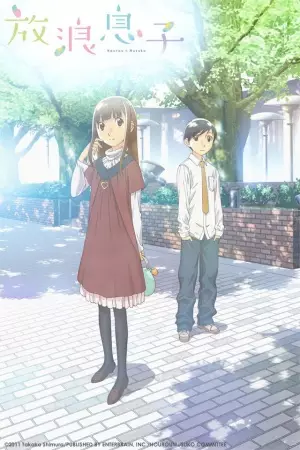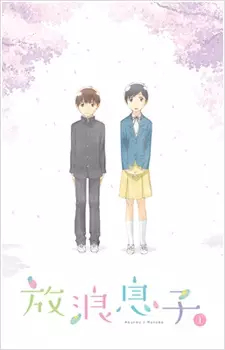

Wandering Son
放浪息子
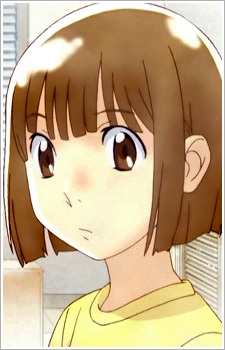
Effeminate fifth grader Shuuichi Nitori is considered by most to be one of the prettiest girls in school, but much to her dismay, she is actually biologically male. Fortunately, Shuuichi has a childhood friend who has similar feelings of discomfort related to gender identity: the lanky tomboy Yoshino Takatsuki, who, though biologically female, does not identify as a girl. These two friends share a similar secret and find solace in one another; however, their lives become even more complicated when they must tread the unfamiliar waters of a new school, attempt to make new friends, and struggle to maintain old ones. Faced with nearly insurmountable odds, they must learn to deal with the harsh realities of growing up, being transgender, relationships, and acceptance. Lauded as a decidedly serious take on gender identity and LGBT struggles, Takako Shimura's Hourou Musuko is about Shuuichi and Yoshino's attempts to discover their true selves as they enter puberty, make friends, fall in love, and face some very real and difficult choices.
Главный
Главный
Главный
Второстепенный
Второстепенный
Второстепенный
Второстепенный
Второстепенный
Второстепенный
Второстепенный
Второстепенный
Artrill
January 4, 2018
[9.0/10] _____________________________________________________________________________________________________ Wandering Son blew me away. A series that could've easily harbored so many of the negative qualities I associate romance anime with, such as an overabundance of melodrama, love triangles, and boring characterization was utterly subverted throughout this short, eleven episode run-time. So much so that I honestly felt surprised throughout most of my watch-through. While there is a love triangle, while there is melodrama, although thankfully it is reigned in, the characterization is far from boring and the writer(s) do an impeccable job with keeping you on your toes. This series doesn't go where I thought it would, as it spends it's run-time makingsure you experience a believable story, rather than a concise, palatable one. Relying on some beautiful, warm, watercolor art with expressive and shockingly exceptional animation, Wandering Son doesn't even skimp on its visuals, setting its tone immediately. This is further emphasized with slow, methodical editing that works symbiotically with equally slow and thoughtful direction. What initially looked somewhat generic slowly sprouted into visually acute, as the director cuts all music and lets scenes breath on their own, with a fair share of intentionally awkward pauses that emphasize the youth and confusion these characters are going through. What Wandering Son succeeds so vigorously at is the ability to tell a lose-fitting story in this confined, semi-contrived environment. A school, where we pull back layers behind characters and everyone in this expansive cast gets their moments of humanization. The bullies aren't bullies, the goofballs aren't goofy, and even the quietest characters get to roar every once in a while. _____________________________________________________________________________________________________ [Characters & Narrative] Wandering Son follows Shuuichi Nitori, a boy with a knack for cross-dressing, and Yoshino Takatsuki, a girl with a similar interest. What begins as a fascination with the other gender's aesthetic blossoms into curiosity, love, and eventually inner turmoil that there really isn't an answer to. Nitori struggles with the idea of being a boy, what it means to want to be a girl, and how he'd go about being accepted. This is as much as a study on the idea of cross-dressing as it is the concept of being transgender, and that's equally surprising. Color me cynical, but I was simply not expecting this kind of detail to be present in an anime. Especially not a television anime, a medium that I've constantly spoken against as pandering, sexist, and having an over-reliance on creating objects to sell rather than characters. Yet here I sit, in a medium that has a plethora of television shows all mocking the idea of cross-dressers, transgenders, or simply not even bothering to delve into it at all, letting them be and making them the butt of jokes. "Traps" and the like, being a huge cultural meme at this point. It was refreshing to see a take on it that not only examined the idea of being transgender, but doing it in literally the least exploitative way imaginable. That was, perhaps, the biggest subversion of all. Nitori and Takatsuki meet a whole cast of different characters, a cast that is honestly somewhat confusing and vast at first. The first episode, while quite good, left me with a lot of questions and confusion simply due to how many people there were on screen and how different each one was. Each character felt well-placed, too, from the dramatic, soft-spoken, and vicious Chiba, to the totally love-able and goofy Sarashina and her almost parasitically latched-on friend, Shirai. What was so refreshing about this expansive cast is that each one had their list of flaws and positives, even the newer characters introduced at the mid-way point of the series after the new school year starts. For example, Sarashina, a total goof and completely "open", in the best possible way, is initially incredibly divisive amongst this already established groups of friends as her abrasive and talkative nature lands her in hot water with Saori, who understandably doesn't appreciate hearing everything this girl has to say. But even Saori, who is, quite frankly, painted a lot like a villain at first in the show, is totally vicious and rude, yet that teen angst feels earned and actually well-established enough for you to see her side of things. Especially with the background we end up realizing she has with Takatsuki. If i'm confusing you, then you know how I felt after the first few episodes, and this is only a fraction of the characters. Surprisingly, it all ends up falling in place. What first started as a somewhat obnoxious love-triangle between Nitori, Saori, and Takatsuki, where Nitori is in love with Takatsuki, Saori is in love with Nitori, and Takatsuki is just not romantically interested, ends up completely disintegrating into something significantly more interesting. Character and narrative-wise, the writer(s) take more than that extra needed step to make something as contrived and cliche as a love-triangle palatable, going so far as to totally subvert the notion and we end up in a position that is less romantic and more engaging on a narrative level. As the venerable Dan Harmon said when asked on the concept of romance as a genre, "Romance isn't a genre, it is a topping. Watching the romance genre is like going to a 'salt' restaurant." I agree, romance struggles to be compelling all the way through, which is why it is often paired with comedy and other genres to make it more palatable. Here, what initially feels like a romance is at the backdrop of the more important narrative, the identity crisis that a lot of these characters end up going through. Sure, it is somewhat contrived to have one character be gay, two be transgender, and so on. Yet it works here because each one has a different approach. Each one is faces their own demons, and in some cases, no demons at all, as Nitori's good friend hardly struggles with the concept of being attracted to other men, which is so poignant to me as someone who is critical and often expecting every ounce of melodrama to be wrung out of an anime like this. Yet that never happens. In a way, Wandering son is very much like the anti-Your Lie in April, where I relentlessly criticized that series for having every single moment be this obnoxiously over-the-top emotional breakdown with sappy music and utterly incoherent philosophical babbling from supposed fourteen year olds. Wandering Son tones that down, instead of having kids remark on the nature of their situation with fake nuance, they instead speak to themselves bluntly, and you gain that nuance through the situations they are placed in and the way they react. Which is infinitely more clever and appealing to me. There are no huge, swelling musical pieces as the characters break down crying and confessing to one another. No. Wandering Son cuts the music, it lets you live in the moment as the characters are and experience what they are. Quite frankly, it's fucking awesome. Even the romance in Wandering Son is often treated like a kind of puppy-love, and while puppy love is real for the puppy, it is what it is. It isn't the end-all of the series because it is tackling a significantly more nuanced idea. Ultimately, the characters shine the brightest in Wandering Son, and while i'm sure there is much more story to tell, what with the looming threat of puberty changing the field once again, as slightly examined towards the end of this series, the way Wandering Son ended felt great in its own way. _____________________________________________________________________________________________________ [Aesthetic] So this show is pretty much perfect in its aesthetic, there is very little I would change. Apart from a few moments towards the middle that felt rushed through animation, Wandering Son actually had pretty exceptional animation throughout for a small-budget television anime. In fact, it looked much better than it had any right to. There was a warm watercolor aesthetic, where the background was blown-out and the sides of the screen were constantly foggy and white, almost dreamy, it looked great. There were moments of great animation, too, especially with subtle character-driven movements. Animation in general can't nearly be as subtly expressive as live-action, as you often have to resort to tactics such as narration or overblown reactions, yet in this case they really do portray some genuinely subtle moments through only animation. The director, Ei Aoki, is outstanding in this series, too. I initially thought the endless loop of piano melodies backing the majority of early episodes was somewhat frustrating, but that loop eventually mellowed out and the director cut a lot of the sound from certain moments, letting them be punctuated by silence, which is a great aesthetic choice as a director. Some scenes were only music, others were only dialogue with no backing track. This made all the difference with these potentially melodramatic scenes ringing incredibly true for these children. _____________________________________________________________________________________________________ [Conclusion] I think it is needless to say that I really loved this series. It is one of my favorites and it came out of nowhere for me. There are flaws, such as the contrived nature of the plot at first, as well as the initial groan-worthy love-triangle that thankfully blossoms into something engaging. It is also blunt with its symbolism on many occasions, as there are some subtle, nuanced, symbolic moments that are unfortunately back-ended by unneeded characters explaining exactly what just happened. Where Wandering Son shines is in its believable characterization of its kids. Sure they address these heady topics perhaps ahead of their age, but the way they do so is so natural and impressive that I can't help but commend this series. It doesn't rely on stringing emotions along or even trying its best to make you cry, because that's not what Wandering Son wants to examine. Unlike something like Your Lie in April, where it constantly tries its best to shove melodramatic bullshit down your throat until you choke some tears out, Wandering Son reigns these emotions in and instead tells a character-driven story about finding yourself and truly accepting who you view yourself as. Characters aren't what they seem to be. As I said, bullies aren't bullies, even Nitori's sister, who is perhaps the most unlike-able character in this series due to her being "the bratty sister", gets some much needed, and surprisingly subtle characterization that made her believable. Not every character has to be someone you like or sympathize with, but as long as they fit the series and further establish your verisimilitude, you should appreciate their existence. Love doesn't go as planned. Not everything works out perfectly. That is shown constantly throughout Wandering Son. There is no perfect ending where everyone ends up happily together with the people they have crushes on, in fact, the show effortlessly skirts that idea by refraining from focusing on it. Nitori and Takatsuki's similar yet separate struggles are at the forefront here, not any kind of romance you might expect this a series as emotionally in-tune as this to focus on. Wandering Son is exactly what I want from my emotionally powerful anime. Characters make the story, not the other way around, and this series succeeds in that regard with flying colors. Beautiful execution on almost all levels. If you are looking for an anime that is willfully detached from the character-driven cliches of so much romance and school-drama-oriented series', then Wandering Son is perfect for you. If you want anime that is daring, ambitious, well-directed, and ultimately, subtly rewarding, then Wandering Son is undoubtedly for you.
Aegair
January 22, 2014
I, like most people on this planet like things. Things that I like come in many shapes and forms, one of which being anime and manga. One such anime / manga I like is Wandering Son. A character driven narrative that follows the lives of a handful of middle school children as they grow through puberty and the issues that they come up against. All in all this is a pretty standard setting and premise for an anime or manga, all it really needs is me adding on the words ‘fan service’ and ‘fighting power’ and really this description could be about 90% of any animeout there. In actuality, the themes and overall feel of Wandering Son is something that I’ve found to be pretty unique in the medium. The series, and manga, may differ but some things that are shared between them, given that I have read the first four volumes of the manga and watched the entire anime twice, is that they both gently deal with issues of transgenderism, relationships, and gender roles. I say gently because there is really nothing forceful about what is shown. Every character is treated as a human, as a person. There is no ‘role’. For any single character in the show I would have to use multiple archetypes and at least one or two paragraphs of extra text to even get close to summarising them. I can’t just say “There’s the tsundere bad ass pilot” or “She’s the naïve gold hearted moe.”. Instead I’m forced to describe them as people, though of course their relationships towards one and other is another way to point out who is who to those who struggle to tell the characters apart. The art style of the manga is very minimalistic, a childish aesthetic without actually being badly drawn. This is no Oyasumi Pun-Pun when it comes to art. But, from my aesthetically inclined perspective, the art style matches the feel of the manga perfectly. Utterly capturing childish innocence with maturity. But, the characters can be hard to make out. I haven’t really had that issue except in panels showing the classroom, but Shimura Takako has had letters about that issue from fans of the manga so us Westerners aren’t just being stupid. The anime has this to a greater effect, in that in your first viewing you probably won’t know who is who half the time until around episode four. But, you get gorgeous looking water colours and pretty fluid animation. So it isn’t bad at all, and probably could be argued is due to the nature of most anime to have very distinctive characters aka: Pink haired girl, brown haired guy, that dude with the eye patch, rather than the more authentic colourings and hair styles of Wandering Son. There is no real over arching storyline in either the anime or manga, at least up to volume four of the manga. And that isn’t a bad thing. Given that this is a mature journey like narrative. These are real fictional people. And you care about them. There is no villain, sure Nitori’s sister may bully him at times, but she genuinely cares for him. The bully at school has much more going on for him in a non-antagonistic way than bully characters normally do. Anna on her introduction is initially shown to be strict and cold hearted, even though she’s a really conscientious and caring character. This narrative is about, driven by, and made beautiful by the characters, and as I’ve already expressed about them they are amazing. Now, as amazing as I find this series, as much love and affection I may lather onto it, that might mean absolutely nothing to you. You ain’t me? So why should or shouldn’t you watch or read this? If you’re looking for some brain dead, happy go lucky, or witty moe, this ain’t what you’re looking for. If you’re after brutal murder, nope. If you really want to stay away from shows that delve into issues with gender and sexuality in a meaningful fashion, you probably should watch this, but I say that in a “Everyone should experience this.” way, as opposed to “This show doesn’t do that.” when it clearly does. If on the otherhand you want a gentle, meaningful, and thought provoking look at growing up ‘the wrong sex’ or just growing up in the real world with real personal development issues. This could be for you. I have never felt such horror for someone having a wet dream before reading this. Understandably that didn’t get into the anime. And this was a thing I liked.
Yukariki
February 19, 2012
There is no doubt in anyone’s mind that a poorly researched work on a touchy subject can frustrate people off. The anime medium is infamous for blatantly using offensive stereotypes; One Piece is one of the weirdest examples out there for attacking racism and then, using racial stereotypes. Then, there’s the animes that deal with the LGBT community. Stereotyped as flamboyant creatures, the LGBT community suffers through insulting stereotypes and invectives. One of the least prominent group of the LGBT body is transgender community; there is so little focus on them. As far as most ignorant people are concerned, they are crossdressers. Nothing more. Hourou Musuko, or WanderingSon, is a work, based on the bestselling manga, that focuses on crossdressers, puberty, and transgender issues. It serves to educate -- and entertain -- viewers about gender identity. What does it mean to be a boy or a girl? Why do people have so many problems with guys dressing up as girls? Are crossdressers “weird”? The work tackles these questions through the eyes of Nitori Shuichi. He never like being a boy; he always feels he should have been a girl. Takatsuki Yoshino, a girl, wishes she is born as a boy. She hates wearing girly clothing. Both these main characters feel strangled over societal norms on gender issues and this anime adaptation does great justice in focusing their struggles. Because this work starts in medias res, the drama immediately starts and that is one of its greatest strengths. It doesn’t waddle on setting the work; the work has an inviting introduction that explains most of the events explained in the manga in the first episode. Personally, the first episode is one of my favorite first episodes out there; it is so impressive that I said, “Wow.” While it rests on the familiar tropes and archetypes, there is an engaging twist on everything. If you think love triangles are the most boring trope out there, Hourou Musuko will flabbergast you. Chiba Saori, a straight female character, falls in love with Nitori as a girl while Nitori has a crush on Takatsuki. The love triangle situation grows even more complex and captures the viewers’ imagination. Dramatic and slice-of-life situations are there for a reason: to characterize. There is nothing redundant about them and everything feels well-placed. Interestingly enough, the work climaxes on the silly anime cliche: a play in a cultural festival; however, it is one of the best endings out there in anime. Everything about the characters feels realistic. Nitori and Takatsuki are definitely two of the best written LGBT characters out there; they act like people in real life facing actual dramatic situations. Except they have problems identifying themselves. Saori, while being a more unconventional -- and almost insane -- character, has a degree of believability. Ariga Makoto, Suehiro Anna, and Doi Shinpei -- despite their labels as supporting characters -- are strong characters that complement the drama in the work; it seems bizarre to call them supporting characters. While Sarashina Chizuru may vex viewers, her placement is a necessary evil. The minimalist watercolor palette for its art is powerful. Bright colors and thin outlines almost feel like you are viewing a moving watercolor painting. Lush backgrounds have never been this interesting. The character designs look fantastic and dynamic. What can I say? Hourou Musuko’s art style is unbelievably incredible. “Itsudatte” by Daisuke is a charming acoustic piece for an OP: clear vocals, catchy acoustic pieces, fantastic lyrics. While I find it hilarious that the OP focuses on furniture and symbols, its symbolism is worthy of praise. It introduces the serious yet enchanting elements of this work. The ED, “For You” by Rie Fu, is a soothing pop music, but loses its memorability quickly. Fans argue that its noitaminA’s position creates problems with this work. Its 11 episode structure has condensed the work quite significantly. Despite that, it is an excellent way to introduce viewers to the manga; its easygoingness gives little problems. So how does Hourou Musuko compare to the likes of other slice-of-life works? Excellent. Its pleasant nature does not scare off viewers; rather, it educates them about the issues. The animation staff did not back off from the issues, no matter the consequences. That, to me, is admirable.
mahoganycow
May 2, 2013
It's strange to think about the roles that we fall into based on our inborn qualities and the societies in which we live. The very existence of the term “cross-dressing” seems to rely on the assumption that there's a “right” way to anoint ourselves with clothes to wear based on our sex, and to do otherwise is to risk social exile. But what if a boy doesn't want to look like or act like a boy, and what if a girl doesn't want to develop into a woman? Do we have any freedom in this regard, or are we slaves to birth and societal convention?Wandering Son is a series which looks at the implications of these and other ideas by taking a peek into the life of a middle school student: The feminine boy, Nitori, who privately cross-dresses and begins to identify as a girl. Sometimes at odds with others, and always at odds with himself, he walks through some confusing years searching for the answers to countless complicated questions. “Simple, but effective” is a phrase that could describe Wandering Son on a couple of levels, but it's most immediately noticeable in the artwork. The color scheme is warm, consisting mostly of pastel pinks and yellows. Backgrounds are reasonably detailed, and they fade into a sea of off-white around the edges, like a drawing on canvas. At the most basic level, you could call the character designs generic, but they're drawn with the same light, rounded watercolor touch that's applied to the backgrounds, and the result is a world that's appealing to the eyes, as inviting and agreeable as it is distinctive. Each scene looks like a moving painting, remarkably fluid, with no out-of-place elements or sharp contrasts to break the sense of consistency. The music and sound share many of those same qualities. Short of some obligatory “light and cheerful” music for the more upbeat school scenes, the series mostly relies on a seemingly limitless series of piano melodies. Dramas can sometimes be guilty of leaning too heavily on the sound of the piano, but in this case there are a surprisingly large variety of tracks, and they run the tonal gamut from soft and somber to soaring and hopeful, so it didn't bother me in the least. What's more interesting is the show's willingness to use atmospheric noise in place of music. The soft ticking of a clock during a lull in conversation can become harsh and accusing, as can that normally-harmless loop of muzak playing in the karaoke place. In one heart-stopping scene, the shrill cry of cicadas and the beat of slow footsteps are all we can hear as an antagonistic classmate approaches the vulnerable main character behind a closed door, his motives unclear. In this regard, the series can produce an immense amount of tension and audience involvement from practically nothing. The characters are both a blessing and a curse. Get ready to be completely and utterly lost as early as three minutes into the first episode: The cast is huge, and with the exception of two leads, Nitori and Takatsuki, none of the characters are explicitly introduced in any sort of depth. To make matters worse, in addition to their given name, every character is also referred to by several nicknames, so you can definitely expect to play a little who's-who early in the series. Many of the characters knew each other in past years, but this is touched on very briefly, and the series seems to take it for granted that we'll be able to grasp everyone's histories. To be fair, if you're paying close attention, you can do just that, but it's definitely a tasking introduction that might be a little more complicated than it needed to be. The series also falters a little when it comes to making the lead roles feel believable. It's difficult to write children with true accuracy, but this is an extreme case; within this series, there are at least three middle schoolers who, by all indications, are more mature and intelligent than most adults. Nitori and Takatsuki are both unflinchingly honest and up-front about their motivations and desires, and Saori, the third lead, is a little girl who has the steely composure and resolve of a professional hitman. In one scene, Saori's mother asks her what she plans to do with her life, and Saori sullenly responds that, if all else fails, she could “just be somebody's mistress.” You'll pardon me for thinking that seems like an unlikely response from an eleven-year-old, and it's a drop in the bucket of unrealistic behavior exhibited by children throughout the course of the series. That's not to say the characters are a flop, though. Nitori is a character in a state of internal turmoil, trying his best to make sense of himself and work through confusion that most people could only imagine. It all shows through in his tepid behavior, his shyness, his inability to truly feel comfortable amongst others. He's complex, and believable as a person, just not as a child. By and large, the supporting characters are put to good use—as mentioned, they're many in number, so I can't dig into everyone, but some standouts include: Sarashina, a brazen and upbeat girl whose positive attitude and strong sense of identity make her a good role model for Nitori; Ariga, Nitori's friend and confidant who also has the desire to cross-dress; and Maho, Nitori's sister who, like true family, can somehow manage to be simultaneously spiteful and kind. The sense of realism isn't quite up to par, but there's definitely a lot of good chemistry between the characters. Even by slice-of-life/drama standards, there really isn't much in the way of a conventional story here. Each episode is just a day or two in the life of Nitori as he faces numerous problems. In many ways, Nitori is the story—numerous subplots raise meaningful inquiries about him and the way that he is going to live his life. He starts to undergo puberty, he finds himself attracted to his sister's friend, he is conflicted about whether or not he should cross-dress at school. These beg some questions; how will he handle it when he is too “boyish” to convincingly cross-dress? Will he be able to have a meaningful relationship with the opposite sex despite his own confused state? Will he live in secrecy, or be open about his desire to be a girl? The series is good at provoking these sorts of thoughts without ever being too explicit about them. In that same vein, Wandering Son really does have something that's absent from most dramas, and that is a sense of emotional understatement. It generates tension the same way that tension is generated in real life. Awkward silences; sometimes words unspoken are worse than those that are. Simultaneous sidelong glances in which both parties drop their eyes; just returning the gaze of a person you no longer call “friend” can be disquieting. A white flag offered by someone who has wronged you in the past; you want to let bygones be bygones, but you never can tell who's genuine and who isn't. Over time, Wandering Son collects all of these realities and more, hones them to their most disconcerting and incisive forms, and then uses them to great effect. The scene that I would consider to be the show's climax is so soft and unassuming, yet so full of visceral impact, that it's tough to even describe. Bad dramas default to artificially emotional screaming and crying. The good dramas are the ones that are built on the understanding that sometimes life is just so damn cold, silent, and uncomfortable that screaming and crying become a welcome change of pace, the finish line of an emotional gauntlet rather than the start. To that end, this series passes with flying colors. What ultimately ends up marring Wandering Son more than anything is its treatment of its themes. Don't think for a second that I won't commend the show for taking an idea that's often denigrated to the rank of a joke and bringing it up to center stage, because I will. It's daring, original, and respectful, and I respect that to no end. The series is great at presenting insightful questions. But it cheapens itself a little bit when attempting to provide the answers. For all of the inner toiling, the complexity of the problems faced by the characters, the series ultimately ends up being permeated and diluted by the same overly simplistic “just be yourself and everything is gonna be okey-dokey” message that seems to be omnipresent in all forms of media. My own cynicism notwithstanding, there's nothing terribly wrong with that message in and of itself, but in this context, it's little more than a cop-out, a juvenile thematic resolution crudely tacked onto an otherwise mature and involving experience. It turns Wandering Son into an inarticulate meditation on the topic at hand rather than a full-blown attempt to embrace it, and for lack of a better phrase, it's a crying shame. Nonetheless, there's plenty to appreciate here, and if you lean at all towards the slice-of-life/drama genres, or if you're just intrigued by the idea but sitting on the fence about whether or not it's worth your time, this is an easy enough recommendation. It doesn't carry nearly as much weight as it might have, but it's still the kind of uniquely artistic and effective series that I wish was a little more prevalent in the entertainment landscape.
Wilio
March 31, 2011
Let me get this straight, I usually don’t watch gender-bender series or anything that is related to the genre. Actually, I don’t recall one anime that I saw that the focus was with cross-dressing of any sort. That said, Wandering Son would actually be the first anime that I have seen that made usage of this trope. And to be honest, it came to be one of the best series of the winter 2011. Wandering Son is a short and calm anime that was enjoyable for its simple, but thoughtful story. Wandering Son starts off with an interesting structure. Instead of starting from an extremity,the beginning or the ending, the anime begins somewhere in the middle of the original story. Of course, it is assuming that either the viewer is familiar with the manga or is watching the series seriously. I’m saying this because it is easy to get lost in the anime as it refers a lot to pass events and it is mostly through dialogue than flashbacks. Actually, I applaud the director for using such a direction, simply because that the story works on already constructed and broken relations rather than focusing on making some. However, where the story keeps its real strength is in the problematic itself. Of course, our main characters have an idea of cross-dressing and wanting to be the opposite sex, but such dilemma is never blatantly exposed in the anime, nor does it make it over-dramatic. Instead, Wandering Son almost works as a slice of life. And by that I do not mean IT IS a slice of life, since it is absolutely not, but the story is found between the lines, between the dialogues and the actions of the characters. This way, the anime is helped by a correct blend between light moments and drama. While it is mostly a serious show, the happy moments are never actually forced and it sometimes it is not really sure if a scene was to be happy or sad. Ironically, the lack of focus in the story can also be a weak point for some, as it may get hard to get into a story that doesn’t really shows itself. From this point, it is really a matter of preference. Personally, I think the calm development is the best way to go, since a direct focus would make it too dramatic for nothing. Of course, the story wouldn’t matter without its cast, which exactly knows what it has to do. Wandering Son has a relatively large cast. Only, it is clear that the anime only focus on the main characters rather than the supportive cast. This way, the small amount of 11 episodes is enough for the viewer to learn about the characters that are really important to the show. As for the others, they play their supportive role very well and that is a big plus point in the series. What is really fascinating about the cast is really the way they are used as whole rather than individually. More precisely, the representation of the classroom can almost be taken as one big character. The chemistry of the students is something I’ve rarely seen in the medium. Individually, the characters aren’t bad at all, but there is a tad annoyance. Looking at characters such as Nitori, Takatsuki and Chiba, they are certainly well written characters. However, especially for Chiba, their way of thinking can often look too far away from the physical age. It’s always hard to represent children or prepubescent teen correctly and realistically in anime and Wandering Son certainly doesn’t have the best one of them all. Of course, I might be wrong on this one, but the characters really were too mature for their age. Though, I wouldn’t say it’s a problem since it works greatly with the story and the feeling of the anime. Childish characters wouldn’t go well with subjects such as gender crisis and the fear of puberty. The anime is accompanied by a wonderful soundtrack. While the opening song might be debatable, (I for myself wasn’t a big fan of it) the series itself is helped by wonderful melodramatic piano compositions. A prime example is in the first episode where Claire de Lune is played at the end. Not only I respect them for the use of a very popular composition, but it was also completely fitting with the situation. The music is never poignant in Wandering Son. Instead, it is played gently and calmly in the background. You don’t really pay attention, but you know it is well there. As for the voice acting, glad to know that it wasn’t a typical high pitched voice you would often see with children. For most of them, they did a really good job, and while Nitori had mostly a monotone voice, it went very well with its personality. Another point that is easy to notice in Wandering Son is the artwork which is very similar to book art. I don’t know the reason behind this, but I found it to be relieving. In contrast to the melancholy feeling of the series, the light pastel colors help the viewer to go through the whole series and take it as a lighter anime. The character design is meant to be normal in this show, and so it’s usual for them to look like typical children. However, the artwork is enough to make them look different from the mass. I just can’t say it enough; I simply fell in love with the artwork. To fill it up completely, Wandering Son is simply a good anime that blends dramatics elements with lighter ones in the best way possible. Even though the style might not be your cup of tea, which is a valid point, I still recommend it to everyone who wants to try something serious once in a while. Really, it shows how the anime industry is still trying to give us original titles rather than the same formula over and over again.
Ранг
#1438
Популярность
#1895
Участники
136,934
В избранном
1,103
Эпизоды
11