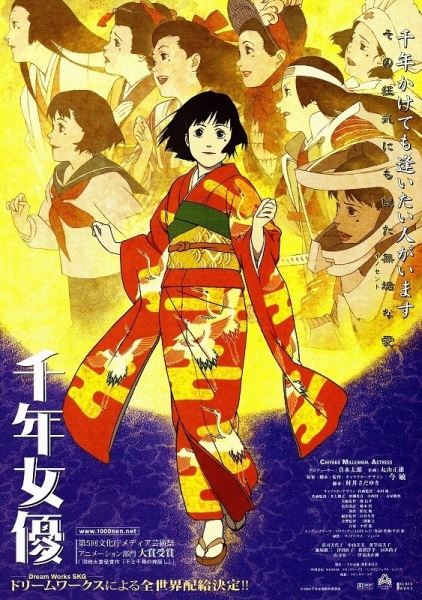

Millennium Actress
千年女優
At the turn of the millennium, Ginei Studio's dilapidated buildings are set to be demolished. Ex-employee and filmmaker Genya Tachibana decides to honor this occasion with a commemorative documentary about the company's star actress: Chiyoko Fujiwara, the reclusive sweetheart of Shouwa Era cinema. Having finally obtained permission to interview the retired starlet, an enamored Genya drags along cynical cameraman Kyouji Ida to meet her, ready to put his lifelong idol back in the spotlight once more. Hidden in this secluded mountain retreat is a thousand years of history condensed into one lifetime, waiting to be narrated. Chiyoko's recollections take them on an illusionary journey through Japanese cinematic history that transcends the boundaries of reality; the saga of her acting career intertwines with her filmography, the actors in her life blend seamlessly with the characters on screen, and the present melds with the past. Though the actress may have retired at the height of her career 30 years ago, the curtain on her life's stage has yet to fall. [Written by MAL Rewrite]
Main
Main
Main
Supporting
Supporting
Supporting
Supporting
Supporting
Supporting
Supporting
Supporting
Skadi
March 21, 2009
Millennium Actress is a wonderfully crafted story about a fateful encounter of a young girl and how it shaped the rest of her life. Though I am always a little hesitant about awarding such high marks to anything, this movie was one of the most riveting and unique anime experiences I have had. The story follows a pair of filmmakers who are interviewing a famous actress who has been retired for many years to celebrate the studio's 70th anniversary. Millennium Actress features one of the most original story telling methods I have seen. We see the majority of the movie told through theactresses various movie roles. We shift from feudal Japan, World War 2, and a futuristic moon base, amongst others. You are never actually sure what is real and what is the movie all the time. I also found it interesting that the two filmmakers were always observers during the entire process. Their presence provided an interesting way of narrating the story and kept the viewer from getting confused by the constantly changing scenery. Though many will perhaps not be able to relate to Chiyoko's devotion to a man that she hardly knew anything about, I still never felt as though it was too farfetched. Whether or not she truly loved him the way one might feel for a lover is beside the point. Her love is what shaped the remainder of her life and allowed her to accomplish the things she had. I think this is summed up best by her last lines from the film when she comments that finding him was not that important, because it was the chase that she loved the most. The two filmmakers Genya and Kyoji provide a nice anchor for the viewer. Of the two Genya is the most important and as the story unfolds we learn about his past and why he idolizes Chiyoko. As for the object of Chiyoko's devotion we really learn little about him other than has ultimate fate. I think it was a good decision from a storytelling standpoint because his mysterious nature was what kept her looking for him. The art was really exceptional. There were sometimes that some of the backgrounds looked like actual photographs and perhaps they were but they seamlessly fit in with the rest of the animation. The film as does a wonderful job at portraying many different settings. Everything feels so authentic from the prewar Japan costumes and architecture to the 50s styling and fashions. Overall I really can’t recommend this movie enough. I don’t think its appeal is limited to just shoujo and romance fans. Give this movie an hour and a half, you will be glad you did!
kiriska
June 10, 2008
"What does this key open?" "The most important thing in the world." STORY - Millennium Actress's story is very simplistic and very sweet. I'm not usually a fan of unquestioning, devotional love, especially to such a crazed, obsessive extent, but the way this movie presents things makes it very easy to like. Just the extent of everything, the lengths to which Chiyoko had been willing to go; all of it was incredible. Even better still, was the idea that we in the audience could not know just how much of it was real and just how much of it was fantasy. The lines seem permanently blurredand any one scene might have just as easily been a memory or a dream, especially since all of the recollections are coming at an age where forgetfulness is common, making everything all the more tragic. The use of movies to convey a fantasy was brilliant, especially considering the story's form as a movie. The way people in the present are thrown into the past (or fantasy) was also a wonderfully creative way to tie the two times together, and there's even a bit of tongue-in-cheek self-commentary on this way of handling things. Really, it's Satoshi Kon's phenomenal storytelling that transforms Millennium Actress's exceedingly simple plotline into a masterpiece. CHARACTERS - I have mixed feelings about the characters in this movie. I've said before that I'm not a fan of sudden, unquestioning love; thus, I definitely wasn't a fan of the fact that Chiyoko essentially fell into eternal love with a man she'd met once, briefly, for several short hours. At the same time, the extent to which she took this infatuation seemed strangely realistic, despite how incredible it was. Indeed, people obsess over little things all the time, irrelevant people, incidental meetings; there are short moments that they will remember for the rest of their lives, so perhaps it isn't so strange that Chiyoko should cling onto something like that. Besides, it wasn't as if she had thrown her entire life away for the man, even if she did build up everything she had in order for him to see her. Aside from the obsession, I really enjoyed the way the elder Chiyoko was portrayed. It was very believable that she would become a recluse, and the way she told her story, the small revelations that came along with it -- all of it was wonderfully interesting to watch and very touching in the end. The other characters in the movie are all relatively minor and their characters subsequently less complex. Mostly, their personalities are sculpted so that they contribute directly to moving Chiyoko's story along, whether by acting as antagonists or by wanting to discover more. In the end, I find them more to be tools to help Chiyoko along more than being characters of their own, but in a movie like this, I think that's fine. ARTSTYLE & ANIMATION - Millennium Actress has some absolutely gorgeous animation. The art style is rather typical of Satoshi Kon, and you'll easily notice that many of his middle-aged and older male characters look startlingly similar across the movies and series he's directed, but the same can be said with a number of other prominant artists and directors. What I loved about the animation itself was how smoothly scene transitions were handled, especially considering that we moved back and forth between present day and past recollection and between reality and movie fantasy constantly. The inclusion of the present day interviewers within flashbacks is one of my favorite touches and really helps weld everything together in the end. It was especially nice too, to see so many different kinds of scenes animated since they were just scenes within Chiyoko's movies. MUSIC - Maybe I was too wrapped up in the pretty animation and storytelling, but I didn't note very astounding music, though nor did I note anything bad. VOICE ACTING - I saw this movie subbed. The voices were pretty average for the most part, though I didn't rather enjoy elder Chiyoko's performance for some reason. Her emotion, especially near the end of the movie, was just very touching. :3 OVERALL - I really enjoyed this movie, though if I had just been given a synopsis, I probably wouldn't have been very interested in the first place. Having Satoshi Kon's name attached to it did help though, and I think this is one of the better examples of his works. The way the story was told just changed everything, including the fact that the plot itself was very simple.
Fleure
July 16, 2017
The camera zooms towards a slowly-expanding earth from the eyes of the outer Celestials; it glides closer and closer until finally reaching stasis on a face bidding goodbye to her present domain. As liftoff begins, the heroine speaks her last lines as the shot fades from the heart-clenching scene to a cluttered office, where one man watches the same scene on his little desk-television. Interrupted by the call of his coworker, he rewinds the tape and the one scene changes into a montage of the actress’s life - in reverse. These scenes and the actress in them, the man watching the actress, and the co-worker beckoning theman ultimately become the driving force of one of Satoshi Kon’s cinematic masterpieces titled Sennen Joyuu (or Millennium Actress). ——————————————————————————————————– Cast for the lead star of this intricate narrative is Chiyoko Fujiwara: a fictional actress of the past whose name once rested on every citizen’s breath, who has now surrendered fame for a private and reclusive life. Yet, her isolation hasn’t left her forgotten; as the film moves with the aforesaid ‘man’ named Genya Tachibana (a producer), and his somewhat aloof camera-man, Ida Kyoji, who set out to interview and document the now-aged Fujiwara. The film wastes no time in frivolity as the seekers find the sought and meekly, in their own star-struck daze, ask for a humble interview. The demure, soft-spoken actress – eyes filled with nostalgic wonder– surprisingly accepts and begins to iterate her story. The scene fades from the present-day home of Fujiwara where the three are sitting cozily, blanketed by the serenity of her presence, to a snowy day many decades in the past where both Genya and Kyoji physically walk through the memories of Fujiwara’s youth as she remembers…her past as a girl and as a woman as she recalls her the path to stardom. As her memories solidify, Fujiwara begins to recount the personal and historical events with supplementary and insightful commentary from her interviewers. This is all set on a grand stage by Kon who ingeniously parallels the reality of Fujiwara’s fading memories and the fantastical culmination of it all relating to her pursuit of one man. Her chance encounter with a revolutionary and the love he transpires within her becomes the foundation of the film. It is a sublime, subtle achievement that actualizes the passion of one’s woman’s love, as she chases her beloved throughout time and place. Unbounded by reality, her motives and actions may initially seem unfathomable and even, foolish, but that is the essence of love in all its power to will absurdity. Still, many may find her character unappealing or even trope-y of the tragic romance queen or yet-another-empty-vessel-of-a-woman-only-to-exist-for-a-man. However, all qualms will be gracefully dispelled as the film cannot be solely undermined by gender complaints of a shallow characterization, because what the film aims to be, what Fujiwara ultimately becomes and shows us, is far grander than reducing the film to a superficial love story. Furthermore, Kon’s films are never about complex characterization, but using unremarkably simple characters to tell a grand story with deeply-rooted themes; a marriage of style and substance, where style irrefutably becomes substance. Even then, there is a subtle familiarity to be found in her obscure romance which is illuminated by its ambiguity, beautified by its innocence, and engaging due to its complete grasp on the psyche of both Fujiwara and the events that follow: the events that define a millennium of history and the actress who defines a millennium. Fujiwara’s love is the driving point for her, but not the entire focus of the film as Kon paints pictures-a-many, and with each progressive frame, the romance falls back into the periphery and something more [un]real, more ubiquitous, more opaque takes the reigns. With the passage of time, Kon reveals to us the transitory nature of love, the dissipating and ever-changing landscape of society, the dichotomy of fantasy and reality, the evolution of cultural trends and cinematic progressivism, the sanctity of memories, and lastly, the history that brought it all together, during one place, spaced out in centuries through numerous films, with Fujiwara as our first-person guide. Essentially, what Kon presents to us is an extremely imaginative work that can be viewed from multiple perspectives, but what it can be seen from one angle as is a tale of impassioned human will - lost in its own irrationality and driven by its incongruity - with no threshold or limitation, which provides to be the perfect base for a tale drenched in fantasy just as much as it is in reality. As she tumbles through many roles, she fuses her own desires to find love, and her passion becomes engrained in every role that she plays. Yet the bewildering success she garners from this never satisfies her. The thrill ‘was’ really in the chase, and though something unattainable was the product of that chase, it never stops her: and that is the essence of Fujiwara’s story and the canvass on which Kon paints his masterpiece of epic proportions. One caveat of this film that has been argued is its homogenized appeal said to be geared only for the Japanese viewer. The reason being is because this film may feel uninviting and be stifling at times, especially with the historical contextualization or the character dynamic between Tachibana and Fujiwara which is somewhat reminiscent of a romanticized otaku-idol dynamic, or even the overall sentiments and feel of the film which is very much rooted in Japanese culture and iconography. However, as a non-Japanese viewer I can confidently assert that there is still much to be loved. From the extravagant homages to various directors, films, and icons to the sympathetic characters to the artistic-directorial skill; there is something extremely universal about this film that extends beyond the scope of any one nation and thus debilitates any claim of a homogeneous appeal. It’s a work with unfathomable scope and ambition that will resonate on multiple levels, whether it be absorbed as a film of impassioned love, or coming to terms with one’s ghosts from the past, or a technical production of the highest cinematic caliber, or just an entertaining mélange of myth and history told through reels. Regardless of how one approaches it, it is hard to deny the merit and absolute talent that constitutes this film, no matter where one hails from. ——————————————————————————————————– The focus reverts to the initial frame: of Fujiwara staring into the camera, dressed in her astronautic gear. It pans out as her rocket blasts off as she takes her final odyssey into space. The camera rescinds into the background, with the lights coming to a stand-still, and the reel finally stops. The cosmos is silent… Yet the legacy of Chiyoko Fujiwara in Millennium Actress continues to shine not in just its world, but also ours.
Preachee
February 15, 2020
Minor spoilers ahead. Millennium Actress is a film that can easily be called great. It is outwardly audacious and seemingly gorgeous in nature. Though in reality, Millennium Actress seems like it would be praised as long as the aesthetics are nice, the plot is not straightforward and that it is directed by Satoshi Kon. Not only are the fans often completely oblivious of any criticisms, but their belief that this movie is a magnum opus also won't change because of what was mentioned (as ridiculous as it sounded). About it being a faultless masterpiece, I beg to differ. The story is downright average and uninspiring. That said, thestory has a heart, with an intention that remains clear and consistent. Unfortunately, this is also one of my biggest gripes - the movie is rather 'static' for what is essentially labyrinth of a narrative, which is totally incongruous (and more on that later), and has virtually nothing to anticipate other than “does the actress meet her love?”, which is kind of a dull two-sides-of-a-coin. Nevertheless, the movie still manages to feel complete because of its 'heart'. Also, paying homage to Japanese cinema is no good excuse for an average story, though it's nice and somewhat exciting to feel such radiated, genuine affection of Kon towards the rich cinema history. As briefly stated, the execution is poor. As thin and uninspiring as the story was, the execution did not do much to embrace it. To regurgitate what I said, it's not brilliant to have an abstruse narrative for a story so simple, quixotic even, hence the incongruity. Much of what Kon does was dragging the weak storyline for an hour and a half. For a story with barely any philosophical weight nor plot development, the messy confusing narrative didn't make it more "complex", only pretentious. “But it merges reality with memories...”, sure. I understand that by the end of the actress’ life, she can recall the events so vividly and can’t differentiate what’s real and what isn't; yet forasmuch as this whole sequence solely focuses on that concept alone without even bother to have a wider, or deeper reach, it gives the audience no insights or depth other than the actress' very simplistically discernible state of mind. Perhaps, this would've been so much more effective had the emergence not just taken up such a big chunk from the movie. When an idea so superficial being told this grandiosely, it will inevitably give the impression of self-indulgence. And to make matters worse, dragging it out wears out any novelty. The narrative, while somewhat impressive, not only lacks depth, but precisely because it lacks depth that it also comes off as pretentious. The characters, I guess, are fine. They're fun and likable enough to lead the audience till the end, but none of them are really remarkable. Some parts of the scripts are honestly so corny though. I could forgive everything these hombres say throughout the movie, but even the very last line? It’s a corny melodrama kick in the gut. It literally just goes to prove my view on how the movie is as shallow as it could get, and yet with sprinkles of striking but empty visual storytelling, Kon manages to make it seem perplexing, yet not actually so. That said, the tone did make the experience somewhat endearing. It's difficult to fully criticize Kon because the man was such a talented romanticist in this film. Kon knows exactly how and when to utilize comedic relief, or to build our expectations up for an emotional impact. So thanks to that, the story flows quite seamlessly. Still, this is insufficient as a saving grace for an overall poorly-written and executed movie. But, if we really stop bothering about Kon's excuse of a story, we are left with what is probably Kon's true intention - a heartfelt love letter to Japanese cinema, elevated and, without reservedness, expressed via the exercise of exhibiting grand, unbounded audiovisuals. The animation is flawless and the attention given to the art is nothing short of stellar. The music is pretty good and generally well used. I have no real complaint about the production value and perhaps would even more than enthusiastically sing praises to the aesthetics alone. Again, though, this movie is subpar in almost every other way. Satoshi Kon is definitely not a hack, however refutably overrated, for he has demonstrated his genuine competence in composing his own coups such as Perfect Blue and Tokyo Godfathers, and even glimpses of greatness here and there in Millennium Actress. Nevertheless, the self-indulgent and bafflingly convoluted narrative has made Millennium Actress his weakest work that I’ve experienced so far. Mind you, this movie used to hold a 10 on my list for quite some time, so I do understand all the worshipping. Yet have I verily changed my mind to thus give my sincere final verdict upon this movie: How corny.
awerture
May 10, 2015
Satoshi Kon's "Millennium actress" is a breathtakingly brilliant film. It was so breathtaking that I'm still in awe and I feel forced to write my life's first unconditionally positive review. What primarily needs to be noted here is that it is brilliant as a work of art, and not only as a piece of entertainment. It is clearly a traditional cinema movie, not an "anime" of the type Westerner is accustomed to. As such you shouldn't expect almost any typical elements you learned to adore in the works you treasure in your anime list. It's also not advisable to judge the movie by classical MALcategories, especially in "Story" and "Character" sections. "Sennen Joyuu" doesn't tell any substantial story. Ok, it does, to a degree, it can be potentially described as simplistic yet gripping romance melodrama. And I saw the movie advertised that way by many people. But it is doing the movie a great injustice, because simplistic story is certainly not its main goal. The movie is rather an unusually skillful meta-narrative, it is the story about stories, tropes and plot devices, about what role they play in each individual's life and how powerful driving force they can be, despite being simplistic. And it focuses on very specific types of stories - on these told using cinema as a medium, thus on numerous different cinema genres at once. As such film "Millennium actress" pays homage to many (mostly Japanese, but not only) movies. While it is not necessary to pick up references to these films, if one is able to pick at least some of them (fortunately some will be rather obvious) it enhances the viewers' enjoyment. On a side note - Japanese cinematic references notwithstanding, it's probably the most culturally Western anime I've ever watched, second being, by peculiar coincidence, Paprika by the same director. The movie doesn't indulge itself in character portrayal much either - you shouldn't expect captivating protagonists or antagonists or development thereof. Or again, to an extent you should, because, as I noted before, on the surface level it's the story about the journey in search of love. But as a meta-movie it's more about how the character is created (or how she creates herself) in act of being portrayed. "Millennium actress" is also kind of an ironic proof that anime is sort of ghetto medium. The movie is apparently in love with "cinema" as a whole, even more with "live action cinema" than specifically with "animation", yet it itself is animation. And I'm afraid it's the main reason it's not as notable as it could be. But what it's so great about "Millenium actress" that it should be so notable? What comes to mind immediately - It is told by using intertwining layers of different narratives coming from different movies thrown together into individual scenes in an exceptionally masterful way. Every passage from scene to scene, from layer to layer and simultaneously from style to style is smooth and barely noticeable, yet with every turn it creates entirely different reality. And through different turns the story remains coherent and never looses itself on anything unneeded. What's interesting, these ever-changing sceneries gave the creators chance to make the movie even casually entertaining - it contains for example genuine action sequences and even comedic reliefs. That combined with all these setting changes practically excludes possibility of boredom. Art style closely follows every turn of the scenery - it recreates all different movie genres in their own unique style, often adding some distinctive touch. It's creative and pure pleasure to watch. The soundtrack of "Millennium actress" may be not as infinitely exceptional as the whole movie but still it is pretty much perfect. It resonates with the viewer, it fits the mood of the scenes and it stays in the head after ending. The movie has also the trait of being simple yet complex. My analysis of the movie is not necessarily the single correct one, the movie stays open to many others. The film provokes the viewer to come up with her own interpretation, without forcing anything on her. Yet it's not vaguely about everything and it gives the viewer strong sense of fulfillment. The only flaw one could find in the movie is that its unrestricted love for cinema results in film being in love with itself and becoming self-absorbed in playing with different settings and references to other famous works. The movie is by no means bombastic in it, so I didn't find it pretentious. But still, someone could complain about it. And one can possibly call such type of film parasitic or even fundamentally empty - it's not great on its own, its greatness manifests when it plays with genres and conventions, when it builds its world, its story and its moral from borrowed pieces. Although I'd understand such objections I personally don't regard such flaws as diminishing my final reception. I think that they are inevitable consequences of creator's choices, of what this movie intends to be. I find such movies important and I cherish them immensely. I mention these para-flaws as a warning for people who don't particularly like post-modern self-obsessed meta-narratives - they definitely won't find in "Millenium Actress" anything worth special acclaim. For all the others - it's truly magnificent. Check it out ASAP.
#381
Popularity
#1323
Members
208,988
Favorites
2,982
Episodes
1