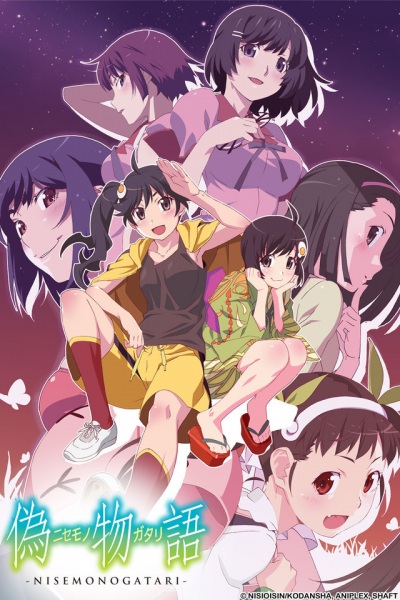

偽物語
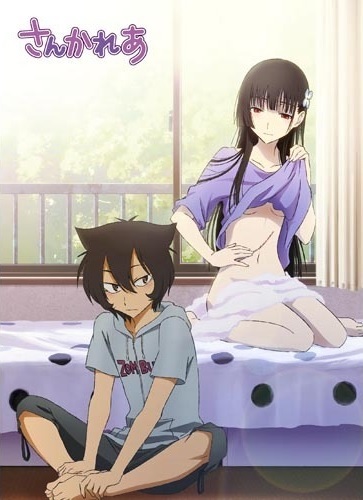
Koyomi Araragi has recently survived a vampire attack and met several girls plagued by supernatural entities. On top of all this, he wakes up one morning to find himself kidnapped and tied up by his girlfriend Hitagi Senjougahara. Araragi's sister Karen has run afoul of Deishuu Kaiki, a swindler who once conned Senjougahara's family. As a result, Senjougahara has imprisoned Araragi to keep him safe from the devious Kaiki. But when Araragi receives a frantic message from Karen, he sets out to rescue her. Along with Karen's troubles, Tsukihi, Araragi's other sister, faces issues of her own. And when two mysterious women step into their lives, not even Araragi can anticipate their true goals, nor the catastrophic truths about his family soon to be revealed. [Written by MAL Rewrite]
Main
Main
Main
Main
Supporting
Supporting
Supporting
Supporting
Supporting
Supporting
Supporting
OdysseusUlysses
March 29, 2012
Nisemonogatari is the most disappointing thing since Barack Obama. I mean what the hell was that, this wasn’t a sequel, for the most part it felt like a really long OVA that you’d get for buying a special edition of Bakemonogatari, because nothing happens in this series at all, except we are introduced to Araragis sisters but that’s all, there is virtually no character development for the sisters at all in a series that is almost entirely about characters.Now Bakemonogatari was good, i didn't love it or anything but for the most part i enjoyed it, the visuals were a pleasure to watch, the music was good, the dialogue was sharp as a blade and the characters were mostly interesting because it was a pleasure to see them interact with each other and see what happens. But if you’ll recall Bakemonogatari also had something that called a story, you know things happen in it, characters are introduced and develop and grow, problems arise and our characters try overcoming them and maybe learning something along the way you know shit like that. But Nisemonogatari has nothing, the characters are boring cardboard cut outs and the most shocking thing of all is that nothing happens in this series at all unless you include implied incest as something but if you do then you need take your brain medicine and get back in your toll booth. Okay so let’s get into this shit and start with what’s wrong with the story, as if I even need to say it because it so obvious Ray Charles could see it, and he doesn’t even know anything about anime. Okay so I’ll be brief there is no story, it’s just a bunch of stuff that happens to give us an excuse to see girls in compromising situations and yes I know Bakemonogatari is a harem but we still need something or else we don’t care about the characters and it gets boring. And thats what Nisemonogatari was, boring, uneventful and ultimately pointless you could watch the episodes in any order and it wouldn’t make a lick of difference because there’s no story. The whole series just comes off a sequence of colourful crisp images played in a sequence to trick people into thinking there watching an anime when in fact they’re just being scammed. That’s right I said Nisemonogatari is just a big scam to trick idiots who liked Bakemonogatari into thinking there watching the same thing when in fact they be better off watching a strobe light while listen to music from Bakemonogatari because that’s basically what this was. I mean I know Bakemonogatari was no Citizen Kane but it was fun to watch, the show struck a great balance between comedy, fan service characters and story and even threw in some nice visuals and music to boot while Nisemonogatari is like its retarded little brother which fucked up everything from pacing to character development to my brain, ahhh it hurts, make it stop! Anyway, another glaring problem with this faecal matter was the characters, much of the original characters return but they feel like shadows of their former selves and don’t do anything to the point where I wonder if the people who made Nisemonogatari even watched Bakemonogatari or have any idea of what made it good. They come off as cardboard cut-outs just there to further the illusion that what we`re watching is a sequel to Bakemonogatari and not crap. So anyway the whole point of this I think was to introduce us to Araragi`s sisters and then have something involving them happen or whatever but does that happen…… no! Jack shit happens except scene after scene after scene of Karen and whatever the other sister was called in provocative positions and some half assed plot about some guy who’s doing something to people at their school but it goes nowhere and the bad guy just leaves when confronted. Jesus Christ are they trying to bore the audience to death, I think the people that made this thought that as long as it looked like Bakemonogatari then they put whatever the hell they wanted into it and get away because idiots can’t tell when their being scammed. So anyway there’s about a million other things wrong with this series but I’ve wasted enough of my time on this shit, when you’re 147 years old like I am you can’t waste your time so, you know, watch it, don’t watch, I don’t really give a flying fuck but if you’ve got like cancer or something that’s like killing or something then you then you probably shouldn’t watch this because it sucks balls and is just a big time wasting scam.
Supporting
SteelMaverick
March 17, 2012
Better than the real thing. Fake, unreal, an impostor. Story. With even more of a play on words than its predecessor, Bakemonogatari. Nisemonogatari is everything you can believe or disbelieve in when it comes to being a good anime. Directed by the avant-garde-ish Akiyuki Shinbo, Nisemonogatari pushes the boundaries of conventionality in anime and even in our own perceptions in more than a few ways. Like Bakemonogatari, Nisemonogatari splits itself into two character-centric arcs, focusing on Araragi Koyomi's sisters, Araragi Karen and Araragi Tsukihi. As a show Nisemonogatari carries surrealist presentation, strong dialogue interactions, characterisation, story, tenets of philosophy and seamlessly integrated 'fanservice'. It is thatfinal point which I believe draws the greatest strength of Nisemonogatari, not as an anime or show, but in the name itself. The seamless integration of the fanservice in this show brings about discussion whether or not Nisemonogatari delivers a story at all, or whether it is just simply a conduit for the release of morally questionable content, which is a valid point for many viewers and indeed the polarising point. If the latter being the case, then Nisemonogatari has already sold itself strongly as not being a story at all, that the Impostory has always simply been telling us the truth and we refused to believe it wasn't a story and that it was always intent on showcasing various fetishes. However if it is truly a story, then we can say it is a story about various impostors and believe the falsity or fanservice in some aspects of its presentation as being integral towards it. Either way in this discussion, the great power in the name of Nisemonogatari has already demonstrated what I believe to be an excellent show which will leave you reeling one way or the other as a viewer. The six elements of this show as mentioned above are seamless in their integration together which is primarily why I feel Nisemonogatari succeeds well in encapsulating the viewer in its mysterious world. As a show driven strongly by its dialogue, it is well backed up by the developed personalities and quirks of its various characters. The opening episode helps us reminisce the sharp personality of Senjougahara, her borderline sadism and her 'tender' love for Araragi Koyomi and hammers in what this show is all about, the powerful dialogue and serious yet occasionally comedic exchanges between the often powerful personalities in play. Within this scene, viewers are also treated with the surrealist presentation, the quick scene cuts, the magnified close ups which delivers a powerful intimacy, an almost voyeuristic, teasing approach to observing the relationship between Koyomi and Senjougahara. In terms of the story, this opening exchange would not have seemed significant at all, however the proceeding scenes and the effectiveness of their dialogue allows for seamless transition as the story is revealed to the viewer, bit by bit. Nisemonogatari continues in this vein albeit after this scene, exchanges grow even more unconventional, including the make or break element of fanservice. Combined with the surrealist approach and voyeuristic directing, the exchanges between Koyomi and various female characters have put many viewers on edge and an amount on high. However because these scenes generally carry some story significance or at least are serving as a transitional point, the fanservice slips itself in as a strange necessity almost. It is also important to note that these scenes serve as the intimate observation point of the developing feelings of many of the girls have for Koyomi. When I discuss fanservice, Nisemonogatari also strays far from the typical conventional ecchi like scenes found in various harem shows. That is to say that the fanservice in Nisemonogatari is different in terms of impact, presentation, time, location and case. One of the first things I should mention is how normalised the fanservice is in some cases. The character Kanbaru Suruga is an example of where her flirtatious personality results in her being intimately nude in her own room. The setting of her room is different to say more traditional fanservice locations such as the beach of hot springs and this also brings me to another point. As is with Shinbo's directing, Nisemonogatari's fanservice brings about this intimacy which is only exemplified by the surroundings and the scene cuts and close-ups. In some cases, the fanservice occurs in the room of the girl, or in one case Koyomi's own room which adds additional characterisation elements and heightens parts of the dialogue. Additionally, the fanservice brings forth extra dialogue which helps to proceed to the next element of the story. Some say you could compare it to Phoenix Wright, with a little more intimate action from examining witnesses in attempting to unveil the mystery. Also unlike other shows with fanservice, I feel that the fanservice here is not forced per se, but as mentioned integrated well into the story. Because the fanservice was done with story intent in many cases, and done seamlessly I feel that this element contributes to the success of Nisemonogatari as a show and to itself as a name. There is also the impact of a certain scene in Episode 8 which will not be forgotten any time soon. Regarding the core of Nisemono (The Impostor), Nisemonogatari brings forth various intelligent exchanges regarding that topic. Whether it be fake love, fake feelings, lies, families, justice, relationships, Nisemonogatari has excelled at keeping towards its particular core topic. Some of the best exchanges are a result of discussions between Koyomi/Senjougahara and a self described villain and a self described good guy and they have raised interesting philosophical points of things we perceive in society such as good and evil and the power of lies. This is partly due to the excellence of the source material written by Nsio Isin, whose manipulation of language has proven to create powerful dialogue. Regarding some of the more technical aspects such as music, voice acting and animation, this is probably one of SHAFT's better works in terms of animation. Many will recall how horrible and non-existent the animation for Bakemonogatari was and will notice that Nisemonogatari relies far less on full screen cuts and has much more fluid animation. The voice acting for Nisemonogatari has also been excellent, in particular the voice of Kaiki Deishu, voiced by the experienced Miki Shinichiro. His deliverance of lines which were lies and compliments with sarcasm and scorn enhanced the many scenes he was in and certainly heightened the personality traits of his character. Kamiya Hiroshi also remains excellent as Koyomi Araragi, delivering comedic, serious lines along his character. I felt the OST remained a little under the radar, but proved to be good enough for the situations they were played in. Nisemonogatari presents a mature, comedic, intimate, emotional rollercoaster of a show with its avant-garde methods of presentation, backed up by its powerful characters and their exchanges and dialogues. As a sequel, it will prove more difficult to watch without watching Bakemonogatari, and as what I would deem a seinen show, difficult for newcomers to anime, especially those unaccustomed to degrees of fanservice. If you enjoyed Bakemonogatari, Nisemonogatari will be familiar to you and I would recommend you continue even if you don't enjoy fanservice. Fans of SHAFT shows should also explore the Gatari series and watch up to Nisemonogatari. Mystery, Fantasy and Comedy fans should also try watching Nisemonogatari, through watching through Bakemonogatari first. Nisemonogatari for me has few weaknesses as a show aside from it being a sequel and I'd rate it a 9 for enjoyment. Critically, Nisemonogatari also fares very well as a show, I think of it as the smooth, silky tapestry located in an art museum with all the statues and nude pictures, it's captivating, flowing and intricate, yet you don't stare at it for all the naughty bits. It scores a critical score of 8.
Evil_Mousou
June 4, 2013
I really, really wanted to review Bakemonogatari way back when it aired, since the show seemed to captivate the anisphere but because of the fact I only just joined, that was of course wasn't possible. Here’s the thing though: I was never quite sure what I watched. To me, the show was overly complex when it didn't need to be, a continual tease, and only “intelligent” in the way two teenagers up late talking about life can be. But I held my tongue. I could never form a set of arguments that satisfied me. Nisemonogatari, on the other hand, I understand and was prepared for.This time, I get it, because if the prequel was everything people said of it, the Spring 2012 show is definitely worse. Story (5/10) - Nisemonogatari’s TV run picks up shortly after the end of its prequel series and sees Koyomi Araragi spending time shirking his studies and visiting his various friends. While the anime starts off touching base with its characters and serving up the meandering conversations for which Bakemonogatari gets so much praise, eventually a pair of incidents surrounding Araragi’s “Fire Sisters” become the show a semblance of a plot. Sadly, Shinbo gets in the way more in this season than the last. He turns the fanservice meter up to to eleven, exchanging the clever banter for lovingly crafted shots of his underage beauties. Sure, the first season had its awkward moments of lingering on jailbait, but this time, we spend significant portions of the plot watching Araragi oggle, fondle, and play twister with teenage girls with very little story-related payoff. The infamous toothbrush scene--during which Koyomi and Karen play a punishment game in pretty explicit imitation of a sex act--in particular drags on for an uncomfortable amount of time and doesn't do much more than provide cognitive dissonance with Araragi’s later explanations of filial relationships. Animation (10/10) - In contrast to the scattered storytelling bringing down the anime, the visuals deliver precisely what the audience has come to expect from Shinbo at the top of his game. While the direction remains avant garde at times, the animations ensure that the characters and settings appear as lovingly rendered as possible, and the juxtaposition works. The constant cuts work better in the more intimate setting of this series and either work to intensify the action (the few times when it does come up) or create an almost tactile understanding of a scene in his viewers (see: the pencil or toothbrush scenes). The character designs help Shinbo in his quest to provide the best visual experience. Each character can flow between eerie, moe, and attractive almost at will without damaging the coherence of a scene, and again the disjointed direction helps ease the transition between the silly and the serious. The mercurial and flexible portrayals work best with Koyomi, Kanbaru, and Kagenui who work hard at hiding multiple sides to their personalities and identities. But it also helps to add surprising depth to Hachikuji whom the script treats strangely. Sound (8/10) - For all that Renai Circulation should still be banging around in some of your heads, Platinum Disco manages to raise the bar. Its combination of traditional sounds, upbeat vocals, and a pop baseline makes it one of the best offerings of the year. Once again, Hiroshi Kamiya gives us a super-plastic Araragi who really saves the show. Since he’s in just about every scene and spends a good portion of the time wandering all over the emotional spectrum, this performance determines whether the narrative holds together at all. That he succeeds frees the rest of the cast to stick to caricature. Of these, my personal favorites are Maaya Sakamoto’s Shinobu, Emiri Katou as Hachikuji, and the delightfully petulant Tsuhiki played by Yuka Iguchi, although my preference for those characters clouds my judgement. Fans of aloof tsundere should still find Chiwa Saito’s Senjogahara easy on the ears and the newcomers playing Kagenui and her familiar provide excellent ‘otherness’ so needed for the roles. Characters (7/10) - Bakemonogatari and Nisemonogatari play with the shifting space between characters as tropes or ideas and characters as interesting, layered personalities. The earlier show’s meatier conversations create a wide-open space for exploring each characters’ quirks as he or she (mostly she) banters with Araragi. Here, however, something seems off. Araragi spends too much of his time alone in the first half of the show or beating around the bush as the first conflict winds up. Moreover, Suruga and Nadeko, who had displayed their personal conflicts and quirks prominently before, flatten into their single defining traits for their brief appearances which feels disappointing after their humorous arcs in the first season. Even so, some characters shine through the odd direction choices. First and foremost, Hitagi’s moments near the end of the Karen Bee arc show a vulnerability and depth of emotion to her that works well at complementing the sensitivity shown near the end of the first season. Retreading her weakness provides some much-needed cracks in her cool tsundere. Shinobu gets a similar treatment that has her bounding between violent legendary vampire and lonely little girl. Isin binds the two personalities together using her condescension as glue, which allows her to be aloof, ironic, and earnestly concerned about Araragi without stretching the limits of her characterization. Overall (8/10) - Its prequel straddles the line between self-importance and brilliance. Nisemonogatari, however, distorts the formula sufficiently to lose some of its shine. The top-notch visuals and exceptional sound direction don’t entirely excuse Shinbo’s explosions of fanservice and stuttering plotting, but fans of the first series should still find lines of character development worth following and many of the same themes on display. If you liked Nisio Isin’s first installment, you should take this second bite, just don’t expect it to blow your mind.
Chocosword
June 14, 2013
Shaft... just words can't describe their magnificence. If you have seen Shaft's works, they are truly amazing and one of the best animation studio. Bakemonogatari was the first anime I've watched when I came back to watching anime in December 2012. I've got to say that Bakemonogatari was a genuine work of literature and it was my favorite. The monogatari series focuses on mysteries of each character and explains them in a beautiful way. I kept telling myself that this series isn't the best, but I was sadly lying to myself. Nisemonogatari is a continuation of Bakemonogatari and focuses on the sisters. Araragi-Kun has twosisters: Karen and Tsukihi. As we already know, Araragi is a vampire and he has to the decency to help other people with weird problems. Who knows that the sisters even had supernatural problems? The plot was creative and wasn't cliche. Give a hand of applause to Isin Nisio, the author of the Monogatari series. I couldn't tell what this intelligent man was thinking, but I had to agree that his literature was one of my favorite. Nisemonogatari shows the relationship Araragi has with his sisters since it wasn't focused much on Bakemonogatari. There has to be some background knowledge if you introduced a character into an anime. It would be vague if the sisters weren't explained, but introduced in Bakemonogatari. The art is absolutely amazing. I loved the way Shaft animated it. It is truly convey the cinematic. I'm glad that Shaft is going to animate Monogatari: Season 2 in the summer. To add more, their going to animate the movie, Kizumonogatari! The head tilt is what Shaft was known for and it was unique in its own way. The characters were well drawn and the background was good. There was a bit of action in Nisemonogatari and it was amazing. It was just the literature which makes Monogatari series stand out. Since this anime focuses on the sisters, there are only 3 opening. The beginning is Senjougahara, but the rest focuses on Karen and Tsukihi. The music for Shaft is amazing and I love the way they animate each one. I have to say that Tuskihi's opening was my favorite. It was cute and it reminded me classical music. The ending was made by ClariS and it was pretty good. Other than that, Nise was well made. The huge change I've seen was that Nisemonogatari added too much fanservice. I can say that it was hilarious cause I believe it was intentional and it has a significance in the anime. It isn't those ecchi anime without any meaning. I mean I can just sit here and watch oppais bouncing around, but the ecchi here is creative and symbolic. It is also to approach siscons and brocons. The monogatari series have a broad genre that it appeals to most viewers. You don't have to be a mystery lover to enjoy this anime, nor a ecchi fan to enjoy it too. At the end of the day, I just want Shaft to take my wallet and my car and my clothes and my computer and yadda yadda. This is one of the anime I was interested in buying figurines and stuff to support the author and the company. The story was great, the art is superb, the music was soothing, and characters were likeable and I enjoyed the anime throughout. It touched the goal where Araragi wants to save everyone who he cared deeply for. "It is impossible for someone to replace someone else." - Araragi Koyomi
Veronin
August 17, 2012
Fanservice has always been a bit of a controversial issue. Some love it, some hate all instances of it. There's really no feasible way to please everybody when the reaction can often be likened to a dichotomy, split between 'too much' and 'not enough'. While Bakemonogatari is a series known by most for its unique art direction and character interaction, to say that it's removed itself entirely from sexual themes would be a flat-out lie. It's not much of a surprise then, that these elements are even more prolific in Nisemonogatari, for both better and for worse. The first thing that should be recognizedbefore watching Nisemonogatari is this very change and shift in focus. It wouldn't be much an exaggeration to say that at times it can feel like a different series, and certainly not all fans are going to approve of the change in tone and theme. Despite this though, things are not all that unlike either. Being that this is the sequel to one of SHAFT's most successful anime, it would be incomprehensible for them to suddenly remove the unique style and flavor that the series became so known for in the first place. Head tilts are still prominent, the scenery is highly stylized, the characters will frequently engage in a playful diatribe and critique of Araragi, and surrealism remains a pervasive aspect in the presentation and overall experience. This is Bakemonogatari in much of its glory, but with the story itself becoming something of less importance than the characters and their interaction with each other. Probably the largest addition to Nisemonogatari is the new role of Araragi's two younger sisters, Karen and Tsukihi. Both of them form a group known as the 'Fire Sisters', and together they create the main focus of the entire show. Tsukihi is a sharply sarcastic and disapproving sister while Karen, voiced by the beloved Kitamura Eri, behaves as a bit of a tomboy and energetic character who strives to fight for justice and what she feels is the right thing. These ideals of justice create an interesting problem for Karen as she comes into contact with the antagonist, Kaiki, a con artist exploiting teenage girls out of their money which quickly escalates into a conflict between the two, with Karen focusing on protecting the innocent and Kaiki on using them for his own avaricious goals. Kaiki as a character is quite unique and interesting as he never falls into a generic and stereotyped 'bad guy' persona, instead adopting a very grey morality where neither good nor bad exists. He cares for little else than money, and money is something he aims to attain regardless of who loses out for it. Surprisingly, he doesn't antagonize the main characters very much outside of their first few encounters with each other. As long as they don't complicate matters for him, he generally has no issue. The way his departure is handled is also very surprising and refreshing when compared to the usual conventions in storytelling. It's just disappointing that he loses his role as a main character in the second half and falls much to the side, since his scenes are without a doubt the most memorable and engaging in the entire show. Being a character that stands out so much in a series full of unique characters is a very hard feat to achieve but Kaiki managed to pull it off. Of course, Nisemonogatari wouldn't be the same without the cast from the previous season playing a prominent role in the story. All of the main characters from Bakemonogatari retain a large role in Nisemonogatari each with their own unique scenes, though unfortunately most of them don't appear anywhere near as much as they did in Bakemonogatari. Senjougahara in particular is largely missing from the first half of the series until becoming a large focus of the story again, which may be a bit disappointing at first for fans of her character. Thankfully, the episodes before that focus on an excellent blend of new and old characters and concepts, bringing just enough to the table to make the series fresh again while maintaining enough of the old that fans will still feel mostly at home when watching. Focusing on the aforementioned Kaiki as the antagonist, the story itself is largely about his exploits and the characters' resulting intervention for the first half of the story. It picks up further towards the end into a galvanizing climax and battle between Araragi and the two new antagonists, one of which being a character from the previous season. Fans of Bakemonogatari will find something enjoyable in that respect once things start to pick up, but the story itself is not so much the focus of Nisemonogatari as it is what gives a way for the audience to see the characters interact in a variety of new and different situations. This brings us to the main problem — fanservice. Do you like fanservice? Do you want fanservice? If not, you probably won't enjoy Nisemonogatari too much. It's not nearly as oppressive or prominent as some screenshots would lead to believe but it's very easily a defining and inherent part of the experience. Characters will frequently try to seduce Araragi which leads to some amusing scenes with him on the verge of cheating on his beloved girlfriend and paying dearly for it. There's also fanservice for the female viewers, with long shots gawking deeply at Araragi's chest. Nude scenes are not too uncommon and the series often plays more with sexual feelings than it does with its witty dialogue and stylized presentation. Though these common elements still do remain a large part of the experience, all one needs to do is take a look at the infamous toothbrush scene to have a good understanding of how Nisemonogatari is often presented. Whether or not the viewer will approve of these changes comes down to personal taste and what they primarily enjoy the series for. It would be a lie to say that I didn't enjoy the frequent fanservice and sexual themes at least somewhat, but it's just that, perhaps, Nisio Isin and SHAFT went slightly overboard and forgot a little bit about what made the series so highly respected in the first place. It's enjoyable in smaller and occasional doses but being that it's the forefront of the entire experience, it sometimes detract from what is an otherwise very engaging and unique story. Subtle or even suggestive fanservice would have been preferable to the ubiquitous butt-shots and nude scenes. It doesn't help matters much when the pacing of the anime is negatively impacted by the fanservice as well. As a result of much of the screentime being spent on trying to make the viewer erect, it often feels like the main conflict surrounding Kaiki and the later two antagonists is a bit rushed. Certainly, more time could have been spent developing those characters and the main plotline. Things often shift haphazardly between fanservice and important story events and it feels a bit unwieldy and awkward for that reason. It's hard to appreciate the fanservice much when there's a serious and interesting story going on in the background, and conversely it's also hard to fully appreciate the story when the next scene will transition into more of the fanservice and silly interaction. Had SHAFT and Nisio Isin focused primarily on the story instead of these sexual themes, the main story could easily have been something equal to or even greater than Bakemonogatari. Which is a real shame. Fortunately, thanks to the success of Bakemonogatari from a few years earlier, a large budget increase is very evident with the quality of animation. This really is one of the best-looking TV anime on the market and the fluidity in each frame is something truly stunning at times. The way the characters move and jump around so freely is something unique to the series when compared to the previous season which relied primarily on transitions and stills. While some complained about the lack of animation and movement in Bakemonogatari -- often comparisons to a slideshow -- this is definitely not the case with Nisemonogatari. This is just as much a visual presentation as it is a verbal one Nisemonogatari can often verge on the surreal with its artwork. SHAFT loves to play with their scenery in highly creative and interesting ways which serves to immerse the viewer and give personality to the artwork and the area that the characters live and interact in. It wouldn't be strange to see a colorless cityscape with a bright blue-green sky looming above, a room filled with mountains upon mountains of same-colored books, a sudden letterbox effect in the image, a home bathroom with stained-glass windows reminiscent of a medieval church, or a gloomy thicket dyed beneath a red sunset. It's this stylized presentation which creates much of the atmosphere of Nisemonogatari and what makes the viewer feel like they're in a very different place. There's really nothing out there that looks or feels the same way. And with more effort spent on the series, positive improvement comes to the music and soundtrack as well. The usage of songs and music is a perfect fit for the scenes they are used in, especially those involving Kaiki. They may not all be songs that will stick in your mind and be reminisced for long after, but when used in the anime itself they are an excellent fit. And much like Bakemonogatari, a variety of unique opening sequences are performed by the seiyuu and each styled with their own unique theme. While there's nothing quite on the same level as 'Renai Circulation' here, all three of the openings are very catchy and memorable. In particular, the second opening 'Marshmallow Justice' was something that I felt perfectly represented the series as a whole and its theme. Disregarding my own love towards Kitamura Eri as a seiyuu, it's quite a pleasant song that mixes the quirkiness of the series with the energy of the characters. In the end it becomes very easy to see where the complaints and negativity surrounding Nisemonogatari come from. While there is truth to be found in the complaints of there being too much fanservice, it's also evident that some are focusing too much on this one aspect instead of fully seeing what it accomplished and did well. It's not quite as good as its predecessor, but Nisemonogatari still manages to be a solid entry to the series and one that paints its own unique character as well. It's certainly different, and different in a way that will be either a bad or a good thing depending on the feelings and tastes of the individual. Hopefully, with the next animated installment of the Monogatari series these fanservice elements will be toned down a bit. We (well, some of us) have had our fun, and now it's time for the series to go back to its roots. Small change can often be beneficial but in cases like these it's best to know when to leave well enough alone.
Rank
#540
Popularity
#296
Members
771,059
Favorites
3,954
Episodes
11