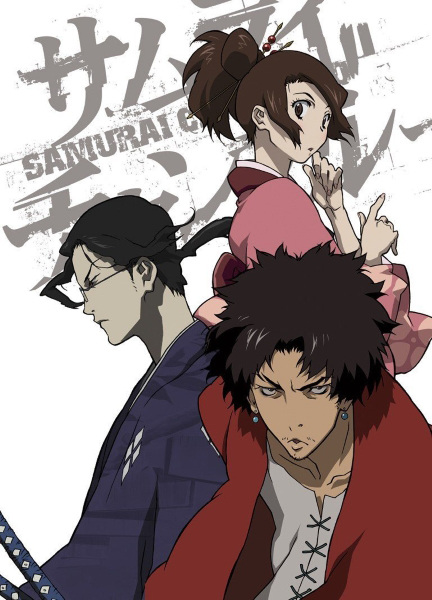

サムライチャンプルー
Fuu Kasumi is a young and clumsy waitress who spends her days peacefully working in a small teahouse. That is, until she accidentally spills a drink all over one of her customers! With a group of samurai now incessantly harassing her, Fuu desperately calls upon another samurai in the shop, Mugen, who quickly defeats them with his wild fighting technique, utilizing movements reminiscent to that of breakdancing. Unfortunately, Mugen decides to pick a fight with the unwilling ronin Jin, who wields a more precise and traditional style of swordfighting, and the latter proves to be a formidable opponent. The only problem is, they end up destroying the entire shop as well as accidentally killing the local magistrate's son. For their crime, the two samurai are captured and set to be executed. However, they are rescued by Fuu, who hires the duo as her bodyguards. Though she no longer has a place to return to, the former waitress wishes to find a certain samurai who smells of sunflowers and enlists the help of the now exonerated pair to do so. Despite initially disapproving of this idea, the two eventually agree to assist the girl in her quest; thus, the trio embark upon an adventure to find this mysterious warrior—that is, if Fuu can keep Mugen and Jin from killing each other. Set in an alternate Edo Period of Japan, Samurai Champloo follows the journey of these three eccentric individuals in an epic quest full of action, comedy, and dynamic sword fighting, all set to the beat of a unique hip-hop infused soundtrack. [Written by MAL Rewrite]
zenoslime
April 21, 2010
"Samurai Champloo" may not have the same ring to it as "Cowboy Bebop," yet it is a title that has a similar function: to illustrate a combination of multicultural pulp fiction sensibility. Where Cowboy Bebop was a past + future fusion of jazz, rock, and blues, spaghetti western, kung fu, and noir cinema genres, and a setting equating outer space to the great frontier, Samurai Champloo is a more wildly anachronistic mélange of Edo-period history and contemporary hip-hop and bohemian culture. "Champloo" itself comes from the word "chanpurū," Okinawan for "something mixed," and a source of Okinawa's pride in multicultural acceptance. CowboyBebop was a trend-setting marriage of anime traditions and Tarantino-inspired cultural hodgepodge — it could be said that Pulp Fiction influenced Cowboy Bebop as much as Cowboy Bebop influenced Kill Bill — and Samurai Champloo continues in this meta style, taking it even further. Of course, Cowboy Bebop was not Shinichiro Watanabe's first foray into resonant crossover in anime: Macross Plus was a monolithic amalgamation of Top Gun's hot-headed romantic drama and sci-fi tropes including a pop-idol hologram version of 2001: A Space Odyssey's HAL, in turn influencing the famous cyberpunk writer William Gibson to write Idoru, a novel about a Japanese virtual idol and her marriage to a real-life rock star. Of course, all of this was before the invention of the Vocaloid, though I suppose the future imagined by Watanabe and Gibson was, in a way, not so far off. Anyhow, now that I've finished my little history lesson — which I feel is relevant, as having such a perspective may deepen your enjoyment of Samurai Champloo as much as it did for me — let's continue on to the review. In light of all the prescient futurism found in Watanabe's other works, it's rather interesting that he decided to shift his focus to the past and present. Of course, the world's future is always in its past... and what we have here is, in a nutshell, Edo-period Japan: the remix. Baseball, tagging/graffiti, Van Gogh, zombies, and Catholicism are tossed into the "chanpurū" with a whole lot of revised Japanese pseudo-history. As such the medley of influences and tangential tale-spinning occasionally smacks of filler, but one would do well to understand that this show is simply all /about/ the filler — and this is all for the better, because Samurai Champloo is at its freshest and most hilarious when it's veering off the rails. It even has the single most entertaining recap episode I've ever seen. Even with all this episodic improv, Fuu's journey in search of a "samurai who smells like sunflowers" provides a compelling core to the story, much like a steady hip-hop beat giving structure to the mix of samples and freestyle verses. Her ronin traveling companions Mugen and Jin mingle like oil and water, and there we have the perfect cast for hilarity and drama. Samurai Champloo is one good-looking show, with its thick linework giving an impression of manga blended with graffiti style. One episode even takes a quick trip into the psychedelic, with a sudden burst of colorful hallucination, Mind Game style — courtesy of episode key animator Masaaki Yuasa, of course. A wide variety of such notable animators were brought on board and thus the style occasionally varies slightly from episode to episode or even scene to scene, but it's always pleasing and completely in tune with the show's theme. Rural Japan has never looked so urban; almost any given scene in Samurai Champloo would be right at home spray-painted on the side of a city building or underpass. The music, likewise, blends hip-hop, rhythm & blues, and traditional Japanese shamisen. Music often plays second fiddle to the look and quality of the animation when it comes to my enjoyment of anime, but in some cases it becomes just as important. This is one such anime, where the music contributes so greatly to the feel of it that it defines it and sets it apart from other anime — much like the soundtrack by Yoko Kanno and the Seatbelts did for Cowboy Bebop. It's also worth mentioning that rap and beatboxing sometimes enter the dialogue, and it's always amusing. Admittedly, most younger people these days are far more familiar with hip-hop than they are with the jazz, blues, and big band genres; nonetheless, in the realm of anime this feels a bit groundbreaking, especially with the theme songs featuring Japanese rap lyrics. The world is getting bigger and smaller every day. Samurai Champloo is a show for everyone. Plenty of great sword-slashing action, clever comedy, and a good share of moments that will tug at your heartstrings — often all at once. If you enjoy anime, this is one you can't miss.

Gintama
Beatnik
April 3, 2013
I caught Samurai Champloo as it aired back in 2004, and though I liked it enough, it didn’t impact me as much as I hoped it would. Though maybe that’s not entirely true, as the soundtrack did indirectly change my life, thanks to the composer Nujabes introducing me to instrumental hip hop and providing a soundtrack to my life for the next few years. I recently re-watched the show and felt compelled to write a retrospective/review of the series. While watching Jin, Mugen and Fuu traipse around 19th century Japan getting into ridiculous adventures, I realised Shinichirô Watanabe’s follow up to Cowboy Bebop is one ofthe most subversive animes ever made. Taking a staple genre, dressing it up in anachronism, but continually tackling subjects often avoided by the medium. It takes 25 episodes until a character literally says “I was born in the wrong era.” Champloo is basically saying Japan’s lofty samurai era was actually a shit place to live for common people like us actually thank you very much. It’s a divisive show that tested the patience of many viewers, drove others away entirely after a few episodes, and frustrated people who were too used to watching a plot move characters forward for 26 episodes. Champloo doesn’t even have characters who move the plot forward. The hook of how the three disparate characters end up travelling together through Edo period Japan is just that, it’s a hook to draw you in. Samurai Champloo is about, and also not about, three characters hunting a samurai who smells of sunflowers. There’s an episode late into the series which features two street gangs having a graffiti battle across town, and though somewhat amusing also served no benefit towards the journey of the three characters. So if you hop into any forum thread you’ll see a multitude of complaints about it. However, the point of the episode is the same as the theme running throughout the entire show: people from a bygone era rebelling against authority and social norms in a way 21st century people do: through counter-culture. I’ve gained a new appreciation for this show. It’s been so so long since I saw it, but rewatching it I realise how the story is about how incompatible Tokugawa era Japan is with our way of life; all the things we take for granted were rare luxuries back then. This is an obvious fact for anyone with a remote understanding of Japanese history, but still, the show rams it home with stark contrasts. Each episode highlights a 21st century aspect of our lives, a form of freedom (creative, sexual, geographical, etc) that characters in the 19th century yearned for despite the odds. It’s set in an era ruled by rigid order, social rules and hierarchies. Stifling to the point of causing grief among the downtrodden populace. Yet a populace we should not treat as foreign aliens. The show asks us to empathise with them; they were just like us. Some of them had our modern spirit and ultimately struggled to exist in such a society as a result. Our heroes are a ronin, vagabond, and an orphan. Fighting against their era’s rules with a modern spirit. One of the things I love about this show is how the three characters hate each other for the majority of the 26 episodes, but their hatred gives away inch by inch. They initially try to break apart, to run away from each other, but situations conspire to brig them back together, until a turning point where they actively make a choice to stick together, grudgingly recognising that they are of the same fiery rebellious soul. This is infinitely more satisfying than characters who automatically stick together from the outset. Another theme of Champloo is that travelling a journey with strangers can bring you together like family. Champloo is more known for its scenes that are juxtaposed with modern quirks such as people beatboxing to humorous and surreal effect, and scene transitions that look like a DJ playing with their deck. Episode topics try to cover every area that is barely explored by other samurai-era anime that are more concerned with traditional ‘fight evil’ plots (or even movies for that matter) from the prevalence of the yakuza co-existing with samurai, the tragedy of women forced into prostitution to pay off their husbands’ debts, human trafficking in the art world, existence of homosexuality, persecution of Christians and Ainu, and graffiti gangs with too much time on their hands. There’s even a hilarious baseball game with members of an American expedition that predates Commodore Perry’s by a few years. Champloo features one of the best soundtracks ever, brought to you by Nujabes, whose life was tragically cut short in 2010. Instrumental hip hop might bring to your mind a certain perception of what to expect, but the soundtrack is a mixture of traditional beats with Japanese influence, floating ephemeral sounds constantly conjure a feeling of melancholy, or ‘mono no aware’, the fleeting transience of things. The appeal of the show is ‘style over substance’, however that is a great discredit to what Champloo accomplishes. All the modern quirks in historical context are not just there to make the show stand out visually. The show is about entertaining this idea, this hope, that even back in Edo era Japan there were open-minded people fighting for creativity, individuality and basic human rights. Sure, most of them didn’t last long, but they didn’t die without a fight. Banzai!
Jin--
December 16, 2006
Samurai Champloo is the latest work from Writer/Director Shinichiro Watanabe, who is most recognized for his work on Cowboy Bebop. One of the very few things Champloo and Bebop have in common is their great scores. Champloo mixes two subjects which would never be put in one sentence together, western hip-hop and eastern samurai swordplay. Yet the mixture comes out with a brilliant result. The fights scenes are hyped up with the speed and flow from the music and come out magnificent. But Champloo isn't all about fighting. Many things happen along the road for thethree main characters: Mugen, a rough mouth vagrant with a fighting style similar to capoeira with a sword. Jin, a quite and intelligent ronin who fights with deadly lightning speeds. And Fuu, the ditsy waitress that brings these two together in search of a samurai who smells of sunflowers. Between these three we see many moments of humorous antics, whether it's Mugen poking insults at her flat chest or Mugen and Jin’s constant attempts on each others life. Samurai Champloo is fueled by Action, Comedy, and Drama. Together with an original story Samurai Champloo has a unique spin on the old samurai era making it a great find for any fan of anime. Story The story of Champloo is an original work from Shinichiro Watanabe. The story centers on Fuu’s search for a samurai who smells of sunflowers. As the wanders continue on their travel they encounter many problems, mostly dealing with how to make money for their various expenses some times causing trouble for the three. In the travels many humorous things occur like Mugen entering a beetle type cock fight, Jin and Mugen’s adventure in to the red-light district, or the three entering an eating contest. As the three get closer to the samurai who smells of sunflowers, things begin to unravel leading the three to the most trouble they have ever seen. Animation Champloo has crisp clean stylistic animation. Characters are draw clean and clear with many details. The landscapes of Champloo are filled with beautiful shots of Japan’s country side. There are even a few scenes were the animation becomes only black and white and seem as they where draw straight from sketches to add to the scene. There is also one part were the colors and animation becomes so lively that it gives the impression of a whacked out hallucination. Sound The score of Champloo is what sets its self apart from any other anime in its genre. The background music is filled with urban hip-hop to give it a loose free flowing fill to it. A big portion of Champloo is focused on its original sound and it shows. For action scenes we get a fast flowing sound that gives the sword fights a more stylistic feel to them. For the more dramatic scenes we get deeper sounding background music. There are even moments during some flash back scenes were the music that we get to hear a rich Japanese sound to give a deeper feeling to it. Characters Samurai Champloo focuses around 3 core characters. Mugen is a straight loud mouth anti-hero. Mugen is the wild one of the group, always flying by the seat of his pants. Mugen also seems to have a problem with authority. Mugen is the first to draw and the last to leave a fight. Jin is a noble ronin in the search of a purpose. Jin although quite and wise, he too has some distaste with authority like Mugen, although with different reason mainly because he sees the one’s in charge as waste. Fuu is a young girl in the search of a samurai who smells of sunflowers, she keeps these reasons to herself for some reason. Fuu is clumsy and some times naive. Fuu is constantly being kidnapped even though she has two strong bodyguards. And for some reason she keeps a flying squirrel with her to help out sometimes. Enjoyment Any one who is a fan of samurai action will surely like Champloo. Filled with enough action to keep those hard core action fans at bay, Champloo sprinkles some comedy and drama on top. If you are someone who doesn't like the hip-hop aspect of Champloo, then at least give it a try, you may be surprised.
kiriska
June 10, 2008
Historical anime don't usually interest me, but when it's as tongue-in-cheek and as full of anachronisms as this, I'm not sure it really counts as a historical anime anymore. STORY - Like its predecessor Cowboy Bebop, Samurai Champloo is a very episodic series, and it's perfectly safe to miss a few episodes here or there. Even the overarching story remains incredibly vague for almost the entirety of the series and the audience is sometimes left to wonder if there really is a point to all of that searching when they knew virtually nothing to begin with. There's something about the lack of details that makes thisstory appealing though -- it never seems that important, so you just continue along, but deep in the back of your head, you remain curious about it. So it's the perfect situation; there's immediate gratification within each mostly-standalone episode, but there's also the thread that ties all of those little adventures together, and in the end, there is an ending. CHARACTER - As with many other slice-of-life or episodic series, much of the entertainment relies on the characters, and herein is a very strong point for the series. All three of our protagonists are rich, interesting characters with backstories that don't seem to clash with their general personalities. As strangers that all met coincidentally in the first episode, their histories are gradually revealed throughout the course of the series in a perfectly paced, even casual way. Though this involves a bunch of chance encounters with figures from their respective pasts, none of them ever really seem to intrude upon the story for the sole purpose of explaining things, which is great. And their stories all actually do contribute to their personalities as a whole, making them all fully-rounded characters with an enjoyable amount of depth to them. The characters also really contribute to the sometimes satirical nature of the series. Jin could be, at first glance, your stereotypical samurai. Or maybe he really just is, but the fact that they poke fun at him for it makes his whole stance all the more questionable. Mugen is just ridiculous; after all, his fighting technique is rooted in break dancing. And Fuu... well, I suppose Fuu is the least notable of them all, though I sort of feel like I can conclude her a mockery of typical women in samurai anime if I'd seen more samurai anime. Even given the normalcy of her character, she has enough emotion and perseverance to keep her from being called flat. ARTSTYLE & ARTWORK - Given the time period of the series and all the anachronistic elements, Champloo's art style is very fun and unique. The opening and ending sequences are a great example already. The blending of modern ideas with such a traditional setting is brilliant and very interesting to see. One of the best examples within the series would probably be the graffiti episodes, where yes, there's totally a town in feudal Japan with a street graffiti problem and two rival gangs that won't stop tagging everything. The animation itself is of good quality throughout and it's definitely an aesthetically pleasing series. MUSIC - The music in Champloo suits it perfectly with its clash of ancient and modern, traditional Japanese folk music and present-day hip hop. The opening and ending themes are also wonderfully appropriate to many aspects of the series. VOICE ACTING - I've seen both the sub and dub, and I must say, both are quite excellent. While I wouldn't necessarily venture to say that the dub is better than the sub (as was certainly the case with Bebop), it definitely stands on at least the same level. Dub-wise, it might have been the easy choice to cast Steve Blum as Mugen, considering Spike Spiegel and Mugen not only had similar personalities, but also looked similar, but damn, the man sure does the job well. (Admission of bias: I love Steve Blum's voice.) Jin's and Fuu's English voices were also quite awesome and actually sounded rather similar to their Japanese counterparts. The characters introduced in each episode also maintained above average voices for the most part, with appropriately sinister voices for the sinister and bumbling voices for the bumbling. All expressed emotion well and were generally convincing all around. OVERALL - Samurai Champloo was a very fun series. Almost all the episodes were excellent in themselves with a great story, as well as great technical aspects. But the overarching story, when it finally did come together in the end, was actually really nice too. And simple as the ending was, I liked it, was satisfied, and thought it was worth it.
YoungVagabond
October 18, 2009
For anyone who has watched Cowboy Bebop, they know that director Shinichiro Watanabe loves blending completely disparate elements together, be it science fiction, physical comedy, spaghetti Western, bebop jazz, or space epic, all into the same story. As diverse as "Cowboy Bebop" was, it has nothing on the sheer schizophrenia of "Samurai Champloo", Watanabe's most recent effort. On the surface, it's a mixture of comedy and samurai epic about Japan in the mid 1600s. However, that doesn't do the series any more justice than calling "Cowboy Bebop" a space western. One episode is a Shaolin Soccer-esque comedy about a baseball game. Another is a zombie horror storywhich doubles as an allegory for World War 2. The series presents historically accurate facts about the spread of Christianity in Japan side-by-side with rocket launchers, talks about Edo-style painting and Vincent Van Gogh in the same episode as punks with switchblades and green mohawks. There are young street gangs painting graffiti, near-invincible blind warriors modeled upon Zaotichi, honorable samurai warriors, arrogant fashion designers, mid 17th century Japanese beat boxing rappers, and eating competitions. Hip-hop and rap music is as prominent as traditional Japanese and Aina-style music. Most directors attempting such a crazy mix would be met with failure and ridicule. However, Shinichiro Watanabe manages to succeed, and he does so thanks to several different elements; 1. Comedy- Samurai Champloo might well be the funniest anime series I've ever seen. Whether it be over-the-top action scenes, great situational comedy, or the absurdity of so many different elements in the same time period and place, there are certain moments in the series that will have one gasping for air. 2. A hard, brutal, uncompromising story- The above works especially well because of how gritty, bloody, and tragic the majority of the story is. Most of the characters die. There is rarely a happy ending. Even in the instances when the good guys "win", it's not clear whether they're better off than they were originally. 3. Misdirection- In every series or movie, a director can leave lots of minor hints and clues about what's going to happen. Most of the time they are fulfilled. In this series, though, Watanabe does the exact opposite of what one is expecting. A small example of this is when an old man is giving one of the samurai protagonists, Jin, a lecture about going with the current to catch a fish. The man is clearly wise, the music becomes serious, and like lightning, his hands dart through the pristine, blue river. His hands rise above his head, clenched hard, golden in the light of the sun. Suddenly, the record scratches, the man opens his hand, and it turns out there's no fish. "Well, sometimes they get away, anyhow!" the man exclaims with a laugh. There are dozens of such examples throughout the series. The ending is probably the best case of misdirection, being the complete opposite of what I expected. 4. Memorable characters- While the former pirate and violent vagrant Mugen is probably the star of the show, and the source of most of the laughs, he does not completely outshine straightman, and traditional, honorable samurai Jin, who is every bit as interesting of a character, and provides plenty laughs of his own. Even Fuu, the girl guiding them, isn't the typical annoying Japanese anime heroine, and is a great set-up and comedic foil for the two mismatched warriors. This series is an absolute classic, my favorite anime ever.
Rank
#152
Popularity
#112
Members
1,341,872
Favorites
40,909
Episodes
26