
どろろ
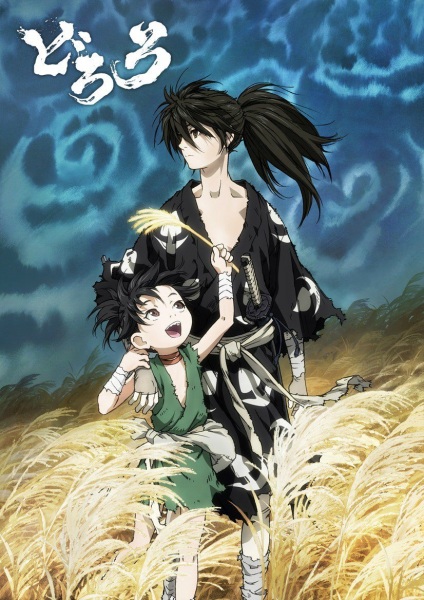
The greedy samurai lord Daigo Kagemitsu's land is dying, and he would do anything for power, even renounce Buddha and make a pact with demons. His prayers are answered by 12 demons who grant him the power he desires by aiding his prefecture's growth, but at a price. When Kagemitsu's first son is born, the boy has no limbs, no nose, no eyes, no ears, nor even skin—yet still, he lives. This child is disposed of in a river and forgotten. But as luck would have it, he is saved by a medicine man who provides him with prosthetics and weapons, allowing for him to survive and fend for himself. The boy lives and grows, and although he cannot see, hear, or feel anything, he must defeat the demons that took him as sacrifice. With the death of each one, he regains a part of himself that is rightfully his. For many years he wanders alone, until one day an orphan boy, Dororo, befriends him. The unlikely pair of castaways now fight for their survival and humanity in an unforgiving, demon-infested world. [Written by MAL Rewrite]
Main
Main
Supporting
Supporting
Supporting
Supporting
Supporting
Supporting
Supporting
Supporting
Stark700
June 24, 2019
Older classics from the history books getting back to modern times seems to be one of MAPPA’s hobbies in recent years. We’ve had Ushio to Tora from Summer 2015 and more recently Banana Fish from Summer 2018. Dororo’s remake under MAPPA’s umbrella made an outstanding impression and gives more reasons to bring old classics back. What a time to be alive in this timeline. The original series aired some 50 years ago in the late 1960s. Most of us probably weren’t alive back then to see this older timer. Manga with content revolving around demons seemed like a popular trend among children those days. The brainchildbehind this work is Osamu Tezuka, who is regarded as a “the father of manga”. With famous franchises like Black Jack and Astro Boy, he goes down in history is a legendary figure. Dororo is a dark fantasy adventurous tale with supernatural elements and dealing with characters’ emotional journey of discovery. From its very few episodes, I noticed an old school feeling that blends with modern quality productions. The original series had a much simpler animation style with cartoony character designs and black and white quality. MAPPA and Tezuka Productions decided to take their style to bring these characters to modern standards. Immediately, I felt as if the show had a credible outline for its artwork. Consisting of 24 episodes, the roadmap of the show also gives an easy pacing for new viewers. Do note that I have not read the manga but jumping into this anime isn’t much of a problem. We have two main characters – Hyakkimaru and Dororo traveling together during the Sengoku period. Hyakkimaru is the limbless ronin due to circumstances of his birth while Dororo is the thief who joins as his partner during their journey. The two forges a unique bond despite their contrasting differences. And throughout their journey, they face many obstacles ranging from powerful demons, saving people, and overcoming their own personal struggles. At the heart of the show, Dororo is known for its moody and dark tones. There’s the theme of revenge born from the beginning. The episodic structure (as some fans dubs it as ‘monster of the week’) is a typical style of storytelling for this show. However, Dororo’s intriguing content comes from character development. This is especially true for Hyakkimaru as he begins to develop human characteristics, feelings, and becoming more of himself. Being accompanied by Dororo, they begin to understand each more and more with each progressing episode. At some point, we even see Hyakkimaru laughing, which is something he’d probably never expected from himself. Dororo is also a character that injects a dose of playful energy into the show. Let’s face it, Dororo is a kid but sometimes shows the mature personality of an adult. As a show about survival in a dark and grim world, the duo relies on each other every step of the way. In the latter half of the show, Hyakkimaru’s mentality contains both of a human and demon. His desire to protect Dororo may also be his greatest weakness as he is forced to rely on his demonic side. It makes the overall show very thrilling as viewers will anticipate the consequences of his actions. In Dororo, notice how almost every character our duo encounter faces some sort of challenge in their lives. Whether it’s about personal relationships or just to survive, this anime makes it clear that it’s not an easy world to be in. There’s carnage with gory content as the show establishes itself as a dark fantasy. The monsters are characterized with a fusion between classic and modern designs while taking ideas from folklore. There’s also a question to be addressed – what really makes a monster? Is human another word for monster? There’s a sense of grey morality explored in later episodes that will no doubt be controversial. This includes the actions of Kagemitsu Daigo and Tahomaru. For their motives and actions that greatly influenced the show’s plot, they can be viewed as monsters. In other words, if we behave like beasts, we are no better than the beasts themselves. Nonetheless, I don’t see Dororo as a complicated storyteller. The episodic nature and dark fantasy elements brings together a classic adventure. It holds itself together as a visual masterpiece with its aesthetics. Particularly, I find some episodes with the black and white coloring to fit perfectly. What also amazes me is how Dororo doesn’t make battles feel pointless. There’s action to follow, behaviors to observe, and see how each fight progresses change for characters. Hell, such a show with all this despair even has its happy moments. The show’s humor comes off naturally thanks to Dororo’s personality. It doesn’t play out forcefully with questionable dialogues and character interactions. Instead, the character chemistry between our two main leads is what does the talking. The more you watch this anime, the more you’ll feel attached to our duo. It’s not a question of how but the way they develop together in their journey. For being an iconic classic, Dororo’s modern adaptation will easily get people into the mood for those who has a taste for dark fantasy. Even if you don’t belong in that category, that’s alright because it’s a chance to experience the artistic creativity of Osamu Tezuka. And I’m so glad to be alive in this timeline to experience it.
TakaCode
June 24, 2019
In this day and age we have been presented with remakes of classic anime from various decades. From Magical Circle Guruguru, Fruits Basket, Legend of the Galactic Heroes and Bogglepop Phantom. With the few exceptions that shall not be named theses remakes have been well received by fans and critics. This leads me to on of the more recent anime remakes Dororo. Unlike any other remake minus Fruits Basket 2019 I had high expectations as this being done one of my favourite directors Kazuhiro Furuhashi the same director that gave us the underrated cop drama Your Under Arrest, the flawed but highly enjoyable Rurouni Kenshin adaptations and theatmospheric Hunter x Hunter 1999. Fortunately the series managed to almost perfectly deliver my high expectations as this is easily one of the best anime remake I have seen period. The story follows a ronin named Hyakkimaru who is born malformed and is required to kill demons to obtain his missing body parts. He is accompanied by a troublesome orphan thief called Dororo during his travel. From there the duo roamed around various countries, hunting for ghouls and demons. There a lot of things to like about Dororo. For starters this show is very dark both visually and narratively. It's Sengoku-era of Japan after all. The most darkest period for Japan. The dark nature of Dororo is only enchanted with the show asking us the viewer various deep questions what makes us human and what defines a machine and what makes a monster. Hyakkimaru character arc is a brilliant case study of this. From the first episode he has a personality of a machine where he hunts down demons without breaking a sweat. As he gains more body parts he starts to becomes more human where he starts to understand the world that he is in but at the same time Hyakkimaru's journey of collecting body part's is slowly breaking him mentally. Not only the harsh reality of the world starts to mentally creep him he also has to face the fact that he has killed various people along he's journey hunt and as a result it makes Hyakkimaru less of an actual human. This is Dororo biggest strengths by a long shot as it makes you the viewer think about all the actions that Hyakkimaru has done thought he's body part journey. This is the main reason why it was hard for me to call Dororo a full out episodic series. Similar to Cowboy Bebop and to a less extant Ouran High School Host Club the series has all the elements of a standard episodic series yet the characters are developing along with the plot. When the series starts taking the overarching plot approach towards the end it's feels natural thanks to the series strong direction and build up. It didn't pull it's overarching plot from its ass as every single episode of Dororo had a purpose despite it being mostly episodic. The second best thing about Dororo is how brilliant the world-building is. The series is set in Sengoku-era of one of the most darkest periods for japan yet it does a splendid job of making the world of Dororo feels alive thanks to the spectacular attention to detail towards various locations and races. Unfortunately Dororo does have some minor faults. To say that at times Dororo doesn't have enough substance at times is an understatement. Granted that compared to any other MAPPA series excluding Banana Fish. Dororo has the most substance thanks to it's setting, characters writing and thematic exploration but at same time Dororo clearly had its fair share style over substance moments where the writing was put in a bus in favour of visual presentation at times. This also leads to my second and final problem with Dororo the inconsistent quality of the episodic episodes. Granted there was not an episode in Dororo that I consider to be bad or even average but I still felt like some episodes had clearly better written than others. The weakest episodes of Dororo went for the more typical approach by featuring less memorable one off characters and stories. Regardless theses two flaws did not shut down the adventurous party that was Dororo. A silent protagonist in any fictional work is very hard to pull off as can easily becomes blank stake for that particular work. Fortunately Hyakkimaru doesn't fall into the same traps of other silent protagonists he is an interesting character from start to finish. His character arc was well-handled thanks to great writing, and he's just a sympathetic character overall despite him being mostly silent. Similar to a silent protagonist a child protagonist in any fictional work is very hard because they can easily be the most annoying thing in your story. Fortunately the character Dororo doesn't fall into the same traps as most other child protagonists as he's a great and enjoyable character. She's the perfect companion for Hyakkimaru as she tries to best to help Hyakkimaru succeeds of his journey of getting his body parts back. Her personality is full of life and humanity despite being a child living in a harsh world. The best part about these two protagonist is their strong character chemistry with each other. I really loved the dynamic duo of Dororo and Hyakkimaru as they have a strong and unbreakable bond. Both Dororo and Hyakkimaru would do anything to ensure that their partner is safe from danger. The rest of the characters were good. Some of them are better than others, but they all served they roles and purpose in the story. If, I had two words to describe the visuals of Dororo it would be atmospheric and gorgeous. MAPPA did a fantastic job of bring this classic series to life with its beautiful soft colour palette, well-drawn characters designs and splendid background secretly that is filled with attention to detail. This is only enchanted with the fantastic visual direction. When the show decides to have a flashback the entire show minus the blood goes to black and white which homages the visual presentation of the original series. The animation was for the most part is beautifully choreographed and well-animated. It does dip at times notably episode 14-15 but it never dipped to a point of being ugly. The soundtrack is outstanding. The series uses a mixture of Melancholic and Japanese folk music pieces only enhances the plot and setting. The same thing can be said for all the opening and ending themes that Dororo has to offer. The voice acting is strange in a good way. The Seiyuus that did the voices for Dororo and especially Hyakkimaru were newcomers. With this in mind you would think that the voice acting would be bad because of this but no. In fact, they were amazing as they fitted with they respective roles perfectly. My favourite Seiyuu out of the two is Rio Suzuki as Dororo as she did an outstanding job at being the cheeky Dororo to life. There is currently no English Dub as from June 2019 then again the show has gained a big following from both vintages and casuals watching meaning the series will someday get a quality dub and I hope Bangzoom will be the ones that will dub it. Dororo is what an anime remake should be. It takes everything that was great about the original series from 1960s and expanded it to new heights with its beautiful presentation, smooth soundtrack, strong characters and intriguing plot that has a purpose. It did have a few faults along the way but the faults didn't shut down the grim and fascinating party. Amazing job MAPPA. You finally made a modern anime classic.
CodeBlazeFate
June 24, 2019
*Given the nature of the series itself, it’s hard for me to discuss it without at least mentioning mild spoilers. Also, there’s a RWBY spoiler in here. Proceed with caution.* With the exception of One Punch Man Season 2, Dororo is probably the most deflating anime I’ve seen so far in 2019. That’s honestly a real shame cuz on top of being a popular retelling of an anime from the ’60s, it's a 2000s samurai anime displaced in time. Furthermore, one of the main protagonists fights demons and samurai with swords for limbs! That sounds pretty cool, doesn’t it? Then halfway through the show, you realizethe cool moments are rendered moot and surrounded by mediocrity. Even worse, the show lost a lot of stream after peaking early on, causing the second half to become especially bothersome given the lackluster writing that permeates it. If nothing else, Dororo makes for a generally well-produced spectacle of samurai battles and bloodbaths. Even outside of the fight scenes, there are some incredibly well-animated sequences, like whenever demonic lightning would flash or when people or demons were burnt to ashes. At their best, the battles are crisp, fluid, and decently choreographed, with lots of sakuga moments where characters clash blades and get hacked to pieces. At their worst, they’re short, barely animated, and often replaced by animation shortcuts like static character portraits flashing in one after another, or slash marks on a black screen being followed up by a lack of anything satisfying, juicy, or vivid. The production values also worsen throughout the third quarter of the show in general, with bad CGI water, unriveting choreography and barely-animated fight scenes, several awkward shots and animation cuts, and overall inferior character models and animation throughout. None of this is horrible, not even the infamous episode 15 barring a few terrible sequences, but it does show that the production is a tad uneven. As for the character designs, at least for most of the main duo, they’re fairly attractive and mostly on-model barring a few stylistic changes throughout episodes and fight scenes (which are as hit or miss as the episodes themselves). Most of the secondary and tertiary characters are not very distinct or interesting and suffer from off-model syndrome a tad more, but it’s never anything heinous. As for the designs of the demons that are slain throughout the show, the only interesting ones were the ghost foxes that appeared halfway into the show, as well as a possessed horse near the end of the show. I also like the monochrome aesthetic, as it complements the atmosphere and designs of the show, especially when the animation kicks into high gear. It’s probably one of MAPPA’s more well-produced titles, even if nothing here is especially exciting. That’s where most of the compliments end, as the writing leaves a lot to be desired. I like the idea they were going with. It would have been interesting to see how the episodic stories impact Dororo and especially Hyakkimaru in their journey to slay demons and regain the latter’s humanity and body parts, which were robbed from him at birth. Having their escapades intertwine with the story of a falling kingdom and a family whose secrets unravel as specific members learn of Hyakkimaru’s survival could have been exciting. An overarching narrative where the characters often deal with episodic occurrences is certainly nothing bad, nor anything groundbreaking. One-off episodes are a great way of allowing for action spectacles and powerful moments that could impact character arcs tremendously. They also allow for more diverse narratives and world-building. Series such as Ghost in the Shell: Stand Alone Complex, and Moribito are excellent examples of this. Dororo fails in all regards here, as most of the stories follow the exact same narrative beats and character archetypes, causing the side stories to lose any identity and worth by the second half. The show has a disconcerting number of one-off femme fatales, ridiculous psychopaths working with demons, and rambunctious kids wandering around to find a mother or sister figure they care about, both in the main story and the one-off episodes and arcs. If the one-off characters were more interesting and varied, or if the protagonists were more engaging, this wouldn’t be a big deal. Another major issue is how none of the side stories leave any real impact on our main duo. The only thing of note in most of these is how Hyakkimaru gets his body parts back. They did have an arc where Hyakkimaru had to deal with the shock of having ears again, forcing him to slowly and painfully adjust to the act of hearing. Had the series explored that concept with his other body parts and spaced them out better to allow for said exploration, I likely would have cared about Hyakkimaru a lot more. Sadly, at most, we get one-off lines about the differences in what he can do with his swords, only for him to still do the same things he always did, but with one less sword limb or with longer reach. Even worse, most of his developments after that point feel less gradual or tactile, and more “start and stop”. The worst examples are when in between episodes 12 and 13, he goes from barely uttering words to forming a complete sentence, or when in episode 20, he flips out due to a demon not granting him a body part back (an occurrence that has happened a few times by this point) and becomes a raging beast who wants his body and Dororo back during the final arc of the show before arbitrarily becoming more level-headed again in the finale. Backtracking to the non-impact issue, in the fifth episode, Hyakkimaru finds himself being taken care of by someone who he ends up having an affection towards. Meanwhile, Dororo interacts with her and the kids she’s taking care of, all while giving Hyakkimaru time to recover. At the end of episode 6, everyone who took care of them there dies, and Hyakkimaru goes on a rampage, killing almost everyone who murdered them. You’d think such an event would leave an impact on both of them, especially Hyakkimaru who finally found someone else he cared about that could help him. Apart from minor flashbacks in the middle of Dororo getting angry at someone, and a scene of another secondary character comforting Dororo, it means absolutely nothing and doesn’t get referenced in any meaningful way. I’m left with flashbacks to RWBY, when in Volume 3 Ruby watches Roman Torchwick get eaten after beating her up and challenging her heroic idealism with talk of how cold and nihilistic reality is. This scene comes between the death of two of her friends for an added gut punch. This is prime real estate for her to develop as a character (the main one at that) before Volume 4 completely has her going nowhere with this outside of two scenes of her feeling scared and horrible for what happened, causing her to completely abandon this idea outside of one scene in Volume 5 where she brings up the deaths of her friends. Hell, even that had more of an impact than what happened in this arc, which is still the most emotionally resonant arc in the series! None of this would matter too much if the characters were dynamic and colorful, cuz that would make it so even if an episode is only there for variety, it’s still engaging. Unfortunately, Dororo’s characters barely go beyond their character archetypes, and the ones who aren’t stock characters often leave a lot to be desired. I already discussed how poorly they handled Hyakkimaru’s development, which is a real shame since there are moments where he comes off as fun, even adorable with how he has to learn to really socialize with others on a level beyond that of a toddler. Dororo, by contrast, is far more lighthearted, sometimes even naive regarding “right and wrong”, as she’s a child. She’s an orphan that has watched her parents die and seen villages burn, and that completely clashes with how naive she is and how horrifying such violence seems to her in the first leg of the show, but she’s still a child. Speaking of clashing, her character trait of being a street rat who regularly attempts to swindle people or make a quick buck makes some of her more gullible actions in later episodes (15) seem entirely out of place. She has two sides to her that are fundamentally at odds with one another at times, resulting in a character that feels weak, on top of feeling shallow. That shallowness is compounded by the lack of development, a trait which only Hyakkimaru and one of the antagonists have any kind of access to (as dodgy as their development is). I know that a lack of character development is one of the tackiest, most misused complaints thrown at an anime, but when the characters are this shallow, and none of the side stories leave any kind of impact on a pair of characters consisting of a child and a person slowly gaining back and developing his humanity, I'm left begging for something, anything to change before completely checking out by episode 18. I’m barely gonna touch on the side characters, even Hyakkimaru’s family and the people that serve them, as they’re mostly just boring character archetypes like the suffering mom, the warlord who cares about his nation almost as much as he does his reign over them, and the edgy, jealous younger brother who constantly tries to prove himself in order to not feel overshadowed. There’s also the wise, badass old man with some sense of humor. To be fair, the show does a fine enough job not screwing these characters up with dumb decision-making or erratic personality shifts, at least for the most part. It’s just that it’s hard to care about characters who are on autopilot, just as it’s hard to care about our main characters. There is one exception to the lack of character shifts, that being when in episode 12 Hyakkimaru’s brother suddenly goes from someone torn on the moral quandary of his brother’s life vs the nation that thrived off his unwilling sacrifice, to someone hell-bent on killing him after failing to end a deal between the demons who cursed Hyakkimaru, and his father who made a pact with them for the sake of power and a prosperous nation. Apart from that moment, you can predict every character’s archetype and actions the moment you see them. The only recurring character with anything to him is the guy that took care of Hyakkimaru for most of his life: Jukai. He has a genuinely horrific backstory that informs his somber nature and constant need to seek out ways for his craft to be used in ways that compliment life, something he feels he’s stuck with due to not having the right to die like everyone around him does. At this point, I’ll just list a few other issues with the writing. The characters arbitrarily doing stupid things for the sake of the plot in the second half, such as Dororo randomly falling for a trap door in a seemingly abandoned shack in episode 15 despite her being a trickster character who would never be this gullible, or Hyakkimaru not even thinking to chisel the rock trapping Dororo’s arm to free her as she’s drowning in episode 20. The old man conveniently shows up as a deus ex machina, and his first instinct is to chisel the rock and that lets Dororo get out of there, making this problem all the more aggravating. In the second half of the show, Hyakkimaru somehow knows where an important character is and tracks them down offscreen, not once, but twice despite there being nothing presented to the audience or to Hyakkimaru himself that could feasibly allow him to track them down. In episode 15, a village is consumed by fire and it’s blamed on an underground oil spill reacting to a moth demon randomly crashing onto a watch tower with a torch which subsequently exploded, except there’s no way it could have affected the oil in order to cause the fire to consume the village. The show also constantly beats you over the head regarding how tragic things are, and it often has the narrator or character reiterating what they’re doing. Apart from one spoiler-heavy moment a bunch of characters could have easily avoided if they had any sense of urgency, these are the only real big issues I can think of regarding issues with bad writing. The episodic narratives are generally fine enough on their own. It’s just that most of them feel rather samey and end up not mattering. The overarching narrative, despite being on autopilot, isn’t necessarily badly written either. It’s just unengaging thanks to the main character arc that drives the plot not being handled well and the characters being on autopilot. That just leaves the music, which is somehow my least favorite part of the show. The background OST has decent tone-setting tracks, but nothing memorable. Half the time, I didn’t even know there was a soundtrack. Then we have the OPs and EDs. I hate them all to varying degrees. The vocals in all of them are unbelievably grating, especially the first OP, which is probably one of my most hated anime songs of all time, let alone this year. The second OP is probably the most disappointing, as it starts off with a kickass grunge-like guitar solo for about 6 seconds before completely shifting gears and eventually succumbing to the problem of bad vocals. Unlike the EDs, the OPs stick, but it’s not out of me finding any appeal in them. I expected Dororo would lose steam eventually given what I had heard, but I wasn’t prepared for how the show ultimately became less than the sum of its parts. Apart from a few specific complaints, both the overarching narrative and the episodic and bi-episodic narratives are fine. It’s just that anything potentially interesting or emotionally resonant is completely undermined by a lack of cohesion between these two elements and how little impact anything seems to have. The characters certainly don’t help, as those that aren’t shallow archetypes aren’t handled with enough care for their plights to matter. The inconsistent spectacles aren’t enough to carry a show that feels so bog-standard and at-odds with itself. As a result, I largely stopped caring after a while, and that’s one of the worst feelings a promising show can inflict. There are moments where it picks up and the spectacle and emotions speak for themselves, but by the second half, I was usually either bored or on autopilot. I may not hate or dislike the show, nor do I think it’s terrible, but I’m left wondering why I bothered before asking myself what could have been. Written and edited by: CodeBlazeFate Proofread by: Peregrine
literaturenerd
July 25, 2021
It's now time for another episode of Literaturenerd's too late reviews. Dororo was hot shit 2 years ago, but already most people have forgotten about it. A lot of critics felt this series was overhyped and it certainly was in 2019, but when you're focused on countering the hype wave, there's a tendency to downplay and go too far the other way. Dororo is actually a pretty good anime, it just didn't quite live up to its full potential. Dororo was based on a very old shonen from 1967 penned by Osamu Tezuka himself! Tezuka wanted to create a shonen version of traditional Japanese ghoststories, so I warn you the premise is pretty ridiculous. However, traditional Japanese ghost stories aren't aiming for realism. While Dororo isn't perfect and isn't considered up there with Tezuka's top works like Buddha and Phoenix, Tezuka was always a masterful storyteller who created fun plots, loveable characters, and infused his stories with a warmhearted humanism. There is plenty to like here in Dororo and this anime was directed by Kazuhiro Furuhashi of Rurouni Kenshin fame. Dororo is about an evil Lord during the Sengoku Era who sacrifices his first born son named Hyakimaru to demons in exchange for power. The demons take Hyakimaru's eyes, ears, skin, central nervous system, heart, etc. The child is basically just a skeleton with a little muscle over his bones. However, Hyakimaru's righteous indignation is SO great that he refuses to die! He is sent downriver like baby Moses and is found by the world's greatest medical doctor. This doctor is named Jukai and he is probably the best character in this series. He was once a brutal samurai serving a ruthless lord and committed many atrocities. However, he was so filled with guilt and disgusted with himself that he threw himself off a cliff and into the sea. Fortunately, he was recovered by a Dutch ship who saved him and taught him the most advanced medical science known to Europe. With this new knowledge and his own genius, Jukai was able to make prosthetics hundreds of years more advanced than his peers and dedicates his life to treating the injured and repenting for his sins. In his spare time, he also carves LOTS of Buddha statues. Before you ask, yes he inspired the sculptor from Sekiro. Sadly, Jukai really isn't in this anime for more than a couple episodes. In fact, Hyakimaru himself doesn't get enough development and doesn't regain his speech until the very end of the series. Instead, most of the dialogue and the lion's share of the screen time is absorbed by a streetwise orphan named Dororo. The manga was for a young audience, so it made sense for Tezuka to add a child character. Not to mention the fact that manga is supposed to have dialogue and Hyakimaru can't talk. So Dororo's inclusion was a necessity. However, the 2019 anime is a lot darker and edgier than the original manga. They wanted to make a violent gore fest for older teens, but then the main character is this obnoxious little brat that talks big and needs to be rescued in every episode! Dororo is like if Scrappy Doo fused with Short Round from Temple of Doom. Why is he even in this freaking reboot?! Dororo adds very little to the actual plot, which is about Hyakimaru hunting down the demons one by one in order to get his organs back and eventually gather the strength to gain revenge on his father. I think the 2019 anime could have told Hyakimaru's story through facial expression and atmosphere with little dialogue and it would have been really cool. It feels like a wasted opportunity, but they REALLY wanted to be faithful to the manga. Speaking of which, the 1969 anime adaptation changed the manga's ending because they knew anime viewers would hate it. It worked in the manga because it was only 3 volumes, but when you stretch out the anime to a bunch of episodes, the manga's ending feels incredibly anti-climactic and frustrating. The 2019 Dororo actually followed the manga's ending and oh boy were people mad! Mushi Productions called that shit way back in 1969! They knew exactly how audiences would react. Even if you discount the ending, Dororo the 2019 anime really loses steam in the second half. This is unfortunate since the front half is really strong and showcases both Tezuka's strengths and Furuhashi's strengths as a director. Sadly, this wasn't an OVA that could run exactly as long as it needed. I think 12 episodes would have been too short and 24 episodes was too long. Ideally it should have run for about 16 episodes, but a TV anime can't do that. The art and soundtrack are serviceable for the most part. The action in the first half of the series looks pretty damn impressive although it starts to get stale by the end. Then we have the elephant in the room. As several critics before me have mentioned, it also has this hilariously bad CG fire that looks like they were using Windows Movie Maker from 2009. It looks like something you'd see in a Youtube abridged parody from 10 years ago. None Piece had better fire effects than Dororo. So after everything I said, should you watch Dororo? You should definitely watch the first 10-12 episodes. Then if you want to continue you can. Just know that the back half is a little rough and kind of goes downhill. It's not Game of Thrones bad or anything, but definitely ends with a whimper instead of a bang.
ZB_Blades
June 24, 2019
Miracles do exist and Dororo is proof of that. By all accounts something like Dororo should never have been made. I’m not saying it’s bad, in fact quite the contrary. The Dororo manga is old, really old. Up until late last year I had never heard of it before. Typically the only anime that gets green lit is stuff that is relevant. Stuff that people are currently talking about. Pretty much the opposite of Dororo. Yet someone took a chance and decided to adapt it and I could not be more happy with their decision. The story of Dororo is quite simple and easy tofollow. It’s the story of a young man on a quest to regain what was stolen from him. In his current state you could call him an inhuman monster. Probably a bit harsh but when you have been robbed of everything that makes you physically human what are you left with. As the story goes on our main character Hyakkimaru regains those lost limbs but at what cost. I really loved the theme that Dororo went with. It’s all about give and take. For every piece of your human body you try to obtain, a bit of your humanity is lost. It’s a complex question ripe for intelligent discussion and Dororo handles that question masterfully. While most of our focus and attention story wise is put on Hyakkimaru the anime is called Dororo for a reason. As an audience we are seeing things play out mostly through Dororo’s eyes who exists mostly as comic relief to keep the show lighthearted enough so that we are not bogged down by Hyakkimaru’s unending quest for vengeance. Dororo plays a perfect host for this journey and a great companion. Just because Dororo is a kid doesn’t mean they can’t be useful. In fact that’s something I want to point out. Typically child characters in anime are a nuisance. They are annoying, a liability in any given situation and frankly there to cause problems. The thing I like about Dororo is that Dororo is intelligent. Dororo helps our protagonist on his journey. Not just with the demons but also making sure Hyakkimaru does not fully lose what little humanity he has left. Other characters that have relevance include a wise wandering old man who you could call a sensei for Hyakkimaru when it comes to navigating this world. Sometimes he pops in to lend a helping hand but is never overbearing nor a deus ex machina, and he is always giving sagely words of wisdom both to the main characters and us as well. Of course what story is complete without an antagonist. The antagonist for Dororo revolves around Hyu’s father and brother even. What I like about Dororo’s portrayal of the antagonists is their motives for their actions make sense. They are not bad for the sake of being bad. Any other story and they would be the heroes instead. A well fleshed out hero for a story is nice but a well fleshed out villain can definitely elevate some series to the level of greatness. Throw in some meaningful side characters and Dororo has all the makings of a fantastic anime. The art and animation for this story received quite the facelift. The original manga that I peeked has a comic like cartoony style of animation that may have worked for the time it was made but would need to be updated for a modern audience. The choice to update the designs was a great decision on the studios part. As for animation, wow. I was not expecting a show like Dororo to look as good as it did. Everything moved and flowed nicely. Most action scenes featured breathtaking sequences that you rarely see these days. There was a bit of a hiccup for one episode which depending on your taste could be very good or very bad. Fortunately it only lasts for one episode and then everything goes back to normal afterwards. The sound for Dororo was great especially the first opening song. It’s straight fire which going by some of the lyrics is an accurate description. The ending song is nice too, almost has a sort of ballad feel to it. The 2nd OP and ED are good too but the first set is what defines the series sound wise. I really hope that more studios in the future look to anime like Dororo and decide to take a chance on older works. There are so many great stories out there that deserve to be adapted and given the same respect that Dororo was given. This is certainly a classic in the making.
Rank
#350
Popularity
#107
Members
1,364,696
Favorites
22,968
Episodes
24