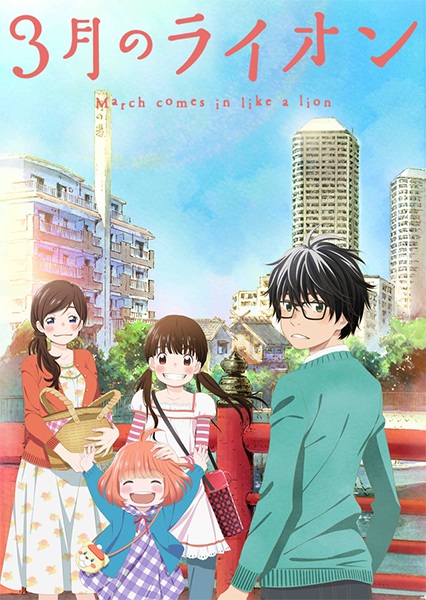

March Comes In Like a Lion
3月のライオン
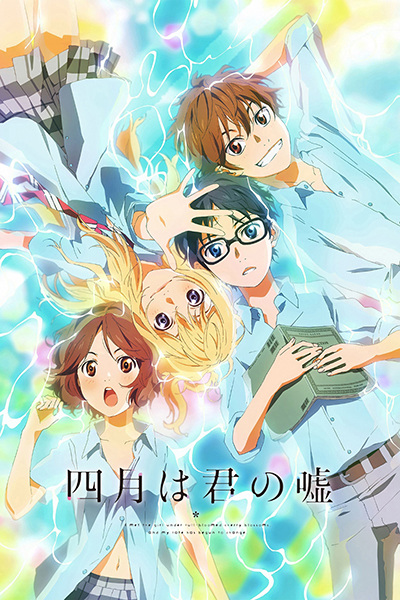
Having reached professional status in middle school, Rei Kiriyama is one of the few elite in the world of shogi. Due to this, he faces an enormous amount of pressure, both from the shogi community and his adoptive family. Seeking independence from his tense home life, he moves into an apartment in Tokyo. As a 17-year-old living on his own, Rei tends to take poor care of himself, and his reclusive personality ostracizes him from his peers in school and at the shogi hall. However, not long after his arrival in Tokyo, Rei meets Akari, Hinata, and Momo Kawamoto, a trio of sisters living with their grandfather who owns a traditional wagashi shop. Akari, the oldest of the three girls, is determined to combat Rei's loneliness and poorly sustained lifestyle with motherly hospitality. The Kawamoto sisters, coping with past tragedies, also share with Rei a unique familial bond that he has lacked for most of his life. As he struggles to maintain himself physically and mentally through his shogi career, Rei must learn how to interact with others and understand his own complex emotions. [Written by MAL Rewrite]
Main
Main
Main
Main
Supporting
Supporting
Supporting
Supporting
Supporting
Supporting
Supporting
Veronin
March 18, 2017
Sangatsu no Lion's first five minutes contain a scene I might characterise as one of the best in animation. A boy listlessly wakens, drinking out of necessity, dressing out of obligation, and leaving his sterile apartment out of confusion, an existence so fragile it could perish with the wind. He doesn't say anything. He doesn't tell people about his problems. He just moves on with his life. At first I did not understand why this scene had such an impact on me. I thought it could have been the beautiful music, or perhaps the captivating artwork so characteristic of Shaft. That wasn't it. What overwhelmedme was how illustrative it was of human life. People often describe their favourite pieces of fiction with vague terms such as "brilliant" or "life-changing". Sangatsu no Lion is not life-changing, least not in the sense of it developing for me a different personality, or in creating new passions. What it did, rather, is give me the tools to better understand myself and, more importantly, why I am here. And that is the greatest answer of all. To say that Sangatsu no Lion is powerful would be an understatement. There are numerous moments, much like the opening scene, that do much with little. Most things are left implicit and unsaid. A simple, everyday conversation between family, about what their plans could be for the next day, or a brief conversation about one's quiet hometown can contain more weight and characterisation than a series might in its entire duration. Sangatsu no Lion is as well masterfully-produced, a technical triumph, Shaft's greatest accomplishment. Sangatsu no Lion is at its surface an anime about shogi, but at its core a coming-of-age story of overcoming depression. Rei, the series' protagonist, is a deeply and inherently flawed being. He is timid - incapable of speaking his mind or getting his feelings across - and unhappy with his role in life. Many characters do not understand why he is this way, and indeed, for someone so gifted at shogi-- enough as to turn it into a career from a young age-- and blessed by such having such a kind family care for him, it is easy to be envious and to question why someone in his position could ever feel unsatisfied. He is still in his teens, after all, so it could merely be an irrational fit of teenage angst. And so they think, and so they patronise him. There is more to Rei than the people around him give credit for. He never had a real family, nor even a youth, hence why he goes to school in an aimless search of one. He has nothing he can relate to but shogi. Even shogi brings him pain, as his thirst for victory ends only with him driving the loser to disappointment and despair. He needs to feed on other people's happiness to give meaning to his own existence, as without shogi, he will have nothing. This isn't meant to instil feelings of pity in the viewer. Rei's problems, while significant and real, aren't much different from what everyone else in his world is dealing with. His eventual mentor, Shimada, struggles with a fear of disappointing others and with a chronic sickness that disrupts his ability to play shogi. Even Hinata, the carefree, younger-sister figure to Rei is dealing with issues of love and an anxiety of growing up. Rei's journey is not just about recognising and facing his own problems, but also in understanding that pain is a normal part of life, and something that everyone deals with. All one can do is to take it with stride. Rei's eventual breakdown is one of the story's most notable moments. I have read complaints of the scene being too dramatic, or that it took too long for Rei to get there. I feel that was the point. Simply being told "no, you are wrong" does not do anything to help fix a person's issues. Rei has already been told his entire life that he is wrong. It is through being kicked down, made a fool of, and, yes, breaking down completely that humans are able to grow the most. We are resilient creatures, and respond to failure with success. Rei is not meant to be entirely likeable to the viewer. He's just a dude and he has his limits, much like anyone else. He is meant to be human rather than an embodiment of all things cool and attractive, and I suppose it is this distinction that is bothersome to certain viewers. The scene where Shimada chats with Rei about Yamagata, his hometown, represents a lot of what makes the anime so special. The conversation is only 90 seconds long, and yet it encapsulates Rei's growth as a person. It culminates in his one simple quip back to Shimada, that even something dull is still "something". Rei has by this point become capable of standing his ground and arguing back, and of framing the world more positively. It is easy to not notice these things because Rei's evolution is not sudden or obvious. That is precisely what makes it great, and is why it feels so real. It is only in the small details do we notice change. Many aspects of Shaft's production are experimental in nature, and that definitely shows through in this case. While some of their other works, such as the Monogatari series, got a bit too focused on style rather than content (to the extent of being pompous or even pretentious, I would argue), the direction and artwork of Sangatsu no Lion is artful and stylish while still managing to keep genuine. The tenth episode's shogi match is one of the more prominent examples of this, where a thunderous orchestral piece plays as the two furiously and silently challenge one another. It doesn't require dialogue, as the visual and audio cues do more than enough to demonstrate who is winning and losing, and how much stress they are undergoing. There is even a scene that more closely resembles theatre, with jazzy beats playing while Smith slowly (very, very slowly) eats breakfast. Some may feel this is unnecessary, but I am of the opinion that it provided a wealth of character to someone who we really had not seen or understood much of by that point in the story. It's a bit remarkable just how reminiscent the anime is of life in Tokyo. I feel that those who have never been here are missing quite a bit, as its depiction does well to make the world the characters live in feel real and relateable. It was actually a bit surreal in my case, as Rei goes to train stations, bridges and other areas that I have personally been to, and visits Sendagi at one point in the series: the quiet little neighbourhood in which I live. He even wears the exact same black coat that I bought at a local Uniqlo some months ago. So, understandably, I think, the anime has been a fairly personal experience for me. It's nothing short of stunning how much effort Shaft has put into making the setting feel like a real place where real people live. It is not a portrayal of Tokyo - it is Tokyo. The music in Sangatsu no Lion is without doubt some of the best that has been in anime. Most of the more heavy-hitting tracks are used sparingly, often only in one specific scene for a specific purpose, and accomplish said purpose with power and with triumph. In some scenes, such as the Yamagata talk, the first time "Sayonara Bystander" began playing, or the end of the twelfth episode when Rei promises to Momo to win, the music was effective enough to make my eyes water a bit. That isn't a reaction I normally have towards music. One could argue that there is a bit too much comedy in the anime. And, certainly, if you are looking only for serious storytelling from start to finish, you may end up feeling somewhat alienated by the end. I might have preferred a bit less comedy, too, as the light-hearted scenes, while enjoyable (especially with how adorable Hinata is), are not quite as exciting as all the other pieces. But I can still appreciate its existence, as it would be disingenuous to remove it altogether and to pretend as if there are no happy moments in the characters' lives. Seeing Rei grow to accept the Kawamoto sisters is quite heartwarming, too. They care about him, even if he may not always care about himself, and by the end, they help him to find more meaning in life than shogi. It's true that Sangatsu no Lion does not have much conclusion. Most of the problems the characters are dealing with are still an ongoing struggle by the end, and Rei is far from becoming a master of shogi as most anime protagonists typically would. Part of this can be attributed to logistical issues, such as a limited production budget and the fact that the manga is still ongoing. I don't think this creates an inherent flaw with the anime, however, as Sangatsu no Lion isn't really in need of an ending. There's no plot with a specific starting point and ending point-- it is rather a moment in time, a piece of Rei's life and those of the people around him. His depression persists, and he remains an imperfect and flawed person, even if he now has friends and family by his side. He's still searching. He's still running. Perhaps that will change by the end of the second season or the manga. Maybe it won't. And that would be completely fine. I don't believe there is anyone, even on their deathbed, who has ever been complete as a person. We start imperfect, and we end imperfect, gradually, yet surely, evolving, unchanging. With most reviews, I feel compelled to discuss the anime in a mechanical way. "The animation was nice", "the characters were developed well", "the plot was inconsistent". It is because most anime feel crafted, like a specimen of sorts to be examined. How is this piece? How is that piece? Sangatsu no Lion never felt that way for me. It's bigger. It feels more real. And so I can't help but write something more personal, too. Is Sangatsu no Lion better than Honey & Clover? Maybe. Is it the best anime of the past decade? Perhaps. More than that? Could be. It is difficult right now to answer with complete certainty these questions I have been posing myself. Time is the best judgement, I feel. But I can say, without question or hesitation, that Sangatsu no Lion is the only anime since Touch that has had such a profound and visceral impact on me. And Touch was the best anime I had ever seen. Sangatsu no Lion is a statement that unhappiness is OK. Being depressed, unsatisfied or stressed does not make you weak - it makes you human. And so I find it appropriate to close with a quote from Hinata: "So what do you say at a time like this?" "You say to do your best."
Supporting
Sterps
March 18, 2017
3-Gatsu was originally an anime I started watching because I love Shaft's other animes, but a few episodes in I started watching to follow along on Rei's journey. 8/10 Story: The story resonates with me a lot. It's like a combination of figuring out life in the present and how to deal with your past at the same time. The story is more than just about shogi, it's more about the player. How he decides what pieces to use, what pieces to move, and try and overcome his next opponent/obstacle. It also applies to his life. He has his new family which currently guards him andhis past (pieces he lost) which keep coming back to attack him. 9/10 Art: This is pretty self explanatory. The art is unique and defines each situation perfectly. You can properly see how everyone is feeling in each scene. It's powerful and really makes you think back when you were hurt but then got through it thanks to a loved one. 9/10 Sound: The opening/endings always seemed to tell Rei's story just by listening to it. Everything was made well to fit the mood. It wasn't forced like laugh tracks from 90s comedies but I knew when to smile, be sad, and root for them thanks to the sound. 8/10 Character: As far from how much I like their characters, It's pretty much 10/10. The only reason it's an 8 is because some of the characters got underdeveloped in comparison to the main few. I love them all as characters from their realism, supportiveness, and silliness. Even the characters we know little about, I wanna know more about them cus they seem interesting. Rei's sister, Rei's future opponents, and pretty much everyones past. 8/10 Enjoyment: 3-Gatsu was that one anime I kept coming back to weekly. It was at times heartbreaking, heartrelieving, and at times very intense. I enjoyed the characters and the story that came with them, but at some points it was a little slow. I enjoyed it overall, and was happy as fk when they announced season 2 coming soon. 9/10 Overall: Another one of Shaft's animes that I actually liked. Hope you give this anime a chance because everything about it is relatable and enjoyable at the same time.
Stark700
March 18, 2017
The way 3-gatsu no Lion (March comes like a lion) is written is like a poetic adventure. Only thing is, the main protagonist is in his own story and we (the audience) gets to see what they experience. From that experience, the main protagonist Rei tackles through obstacles in his life, building relationships, and growing as a person. Adapted by the manga of the same name, this is a show that really takes slice of life to a unique perspective. The creator of the series is Chica Umino. Some people may recognize her work such as Honey and Clover. As such, character designs represented in thisshow may feel familiar. However, 3-gatsu no Lion stands out on its own as we are introduced to Rei Kiriyama, a young man known for his professional shogi talent. Rei may seem like a successful person at first glance but deep down, he suffers from many personal issues. The show explores those issues in ways that really makes us curious not just about his life but how society, relationships, and a career can influence a person. From the first few episodes, it’s clear that Rei has talent when it comes to shogi. People even label him as a prodigy with a unique gift. Yet, Rei feels isolated in society as his real parents no longer exists in his world. However, fortune does smile on him as he meets Akari, Momo, and Hina, three sisters with gentle hearts that welcomes him as their own family. I have to admit, those very first few episodes gave me a realistic impression of Rei’s character. There are those in our world where a prodigy can feel so alone. The expectations from their peers, coaches, and fans really put them on the edge when they deal with competition against rivals. For Rei, it seems even worse because of his unsociable personality and the fact that he has a strained relationship with his adoptive parents. On a professional level, his career hasn’t really bloomed in his adolescence years. Sound something similar? Once in a while, I’m sure we’ve heard similar stories in the news before too. Viewers coming into this show should really expect to see why Rei feels the way he views society and how he adapts to make his life better for himself. There are a lot of memorable moments in this show but perhaps one of the most influential is how Rei develops relationship with the people he meets. He’s not an outgoing person and most of the time, he seems to keep to himself. This is evidenced by the cynical thoughts and narratives he voices in his head. Often times or not, Rei has trust issues towards others because of his past. The show cleverly does a good job at storytelling as we see glimpses of his past in multi-chapter arcs. Rei’s personality is strongly influenced by his past that carries into the present. Fortunately, not everything is gloom and doom because Akari, Momo, and Hina brightens up Rei’s life. They are like the light of his dark tunnel and we see how they are able to give him affection and treat him like a real family. Their influence in the show changes Rei as he realizes that he can trust certain people. Rei also becomes more aware of how being together with people is better than being alone. That’s really what makes the storytelling and character of this show intriguing. We see the mistakes that Rei makes and life lessons he learns from. Rei’s confidence grows and he begins to develop meaningful relationship with others. Besides the Kawamoto sisters, the show also offers a colorful cast of other characters. One of the most noticeable is Kyoko, the daughter of Rei’s shogi teacher. Throughout the show, we learn the negative influence she has on him. The way this show expresses human emotions is most evident when Kyoko and Rei are in the same segments. To name a few, we got jealousy, hate, pity, among others. The way Kyoko taunts Rei can also get uncomforting to watch with her snarky attitude. What’s important though is to understand her role in the show. It’s not to just to make viewers despise her but also how Rei’s negative side is often bought out in the worst way because of her influence. That being said, the series also has a colorful cast of characters on the professional shogi scene. Rei’s self-proclaimed rival Nikadou brings in many of the comical moments between them. Kai Shimada, a man in the late 30s, also has influence on Rei as he learns quite a bit from him throughout the show. Masamune Goto, a man that has a very complicated relationship with Rei’s father stands out as a seemingly main obstacle in Rei’s life. From this series, Rei experiences different feelings when it comes to facing off against his rivals. The in-depth narratives accompanied by the inner thoughts from his shogi matches gives us even a better insight of Rei on the competitive scene. Now, I am not an expert on shogi but it’s fair to say that 3-gatsu no Lion knows its content when it comes to game perspective. While the show heavily involves psychology in those shogi matches, there’s also strategy that is narrated and presented. Colorful imagery is also added to make the matches look larger than life. Even though the show can feel very melancholic, it still has many moments where it can draw an audience’s laughter. The shogi matches, character relationships, and even non-human characters such as Kawamoto’s cats are just a few examples. In fact, the show seems to not forget any character throughout its recourse. Unfortunately, this 2-cour adaptation is simply not enough to cover everything. The manga is still ongoing and as faithful as this is adaptation is, there’s still plenty that are left uncovered. Perhaps another season can explore more options but in a span of 22 episodes, that’s not really happening. Adapted by studio Shaft, it’s pretty recognizable that 3-gatsu no Lion has its style. While Shaft’s iconic head tilts aren’t the main factors when it comes to art direction, it’s still very Akiyuki Shinobish. Inspirations are drawn from the flashy segments, dialogue usage, and background imagery are just a few to name. It feels experimental at times while demonstrating a superior feel of realism. One thing I was really impressed by is how almost every camera shot focused on Rei reveals his feelings. Character designs are influential by the author’s works and very faithfully adapted from the manga. That being said, Shaft’s art style may not be for everyone but for 3-gatsu no Lion, it hits the nail in the coffin. 3-gatsu no Lion may not be a show about music but even its soundtrack works effectively thanks to the talent of its production staff. The melancholic atmosphere is well choreographed with cleverly timed OST. The theme songs very well fits with the show’s themes. In particularl, Bump of Chicken’s OP song “Answer” really bought out the psychology of the show. However, I think the biggest praise should be given to Rei’s voice actor, Kengo Kawanishi. The way he voices Rei makes him feel very believable especially during powerful moments. Voicing a character like Rei honestly feels difficult but he pulls it off without trouble. Finally, the show’s narratives remains strong throughout the show. Rather than relying on a narrator, it doe the storytelling itself with its characters. Watching 3-gatsu no Lion feels very different compared to some of the other shows I’ve watched in relating to exploring the growth of a prodigy. It not only has heavy characterization but the psychology of the show gives a unique feeling of its storytelling. The relationship building and realism really gives slice of life more than just every day adventures. Because for circumstances, every day is a challenge for Rei as he takes on himself. Whether it’s in life or on the competitive shogi scene, we can see how Rei develops as a person. I can’t safely recommend this show to everyone however. It’s definitely a show that isn’t for anyone’s taste and for manga readers, you may feel slightly disappointed by what’s still left out in the dark. Yet in the end, 3-gatsu no Lion is able to breathe life with its powerful direction and a story of compelling melodrama.
SteekHutzee
October 17, 2018
Sangatsu no Lion is a completely pointless series, revolving around a few more than flat characters. I'll try to be as spoiler free as possible while pointing out what I think worked and what not. Story: 3 In a few words, the story in Sangatsu no Lion is "playing shogi". For as much as I would like to say that it talks about a kid growing, fighting his fears, learning how to relate to other people, eventually understanding how to live one's life, all of this is just barely touched, focusing more on "what if I moved the pawn in A7 instead of B2?". In 22 episodes, absolutelynothing relevant happens. No epiphanies, no events, no change, or if something happens, it's brushed off in an incredibly simplistic way. We could think that since this is a Slice of Life, it reflects reality as it is, and oh, it does it perfectly. But please don't tell me that your usual, every day, routine lives are worth a series. Mine, is not. Art: 6 For as much as I love shaft, the style here is pretty different from their usual. The colour palette, the watercolour-ish style, the animation itself were really pleasant to watch, as they give a warm vibe when it's needed, but doesn't work so well in the more "cold" scenes. Also, the classic shaft antics recur here as well, and maybe, they weren't so needed. What really bothers me here is the character design. From the beginning to the end of the series, the characters lose more and more punchiness and details, starting from a very specific character design (those mouths, really?) ending with a generic character from any other series of the last decade. Sound: 5 Not much to say here OTs and EDs are not so bad, but also not memorable. I finished the series half an hour ago and I already forgot what they sound like. Same goes for the background sounds and music. About the voices, the cast is galactic, it worked pretty well. Characters: 3 Let's say you try to give an honest vote to your completely normal neighbour, or the guy that used to sit on the left corner in your classroom. That would be pretty hard, I imagine. The same goes here. The characters are completely normal people, but instead of having those many hues a normal person would have, they are just parodies of their "IRL" counterparts. The MC is the usual "kind of problematic" character. Introvert, social issues, no friends, focused only on shogi. You keep watching him doing nothing, saying a lot of "I will whatever", then going back doing nothing. Just stupidly thinking about shogi. So much to forget to drink for days! Can you imagine that? The female cast is the "obliviously-incredibly-good-and-sweet-girl-that-oh-so-love-to-help-you-for-whatever-reason-and-obviously-loves-sweets". As too often, the women in Sangatsu are put in the kitchen or related domestic areas, and those are the only moments in which you see them. Since it's a shogi anime, you could think there are also female shogi players, but no, the only one that you can see doesn't play anymore. Is the rest of the cast worth mentioning? the fat but passionate kiddo, the cold and invincible player, the mentor, the blonde with weird haircut guy? Enjoyment 3/ Overall 4 I think I said everything I had to, with very bad grammar and vocabulary, though, but since this anime has been so hyped up, I could not keep it in. Sangatsu no Lion fails on every front. It fails in narrating a story, even a slice of life story, introducing elements that will be lost in the next scene, breaking tragedy or tension with out of place comedy, but still failing with both of them. It fails with its characters, with too good or too bad people that could exist in other genres, or using cliched characters that, as usual, follow the flow with no question asked. It also fails with the art, lowering the quality episode after episode. So, there are a lot of way better anime out there. Go see them.
JuneNephthys
September 6, 2018
SHAFT previously installed a pretentious series that suffers from a massive diagnosis of what I like to call dialogue schizophrenia, making a guy with ahoge hair look cool while he continually sexually assaults lolis; it reined in unlimited amounts of money, yatta yatta (muting the preface point with that because this studio is the bane of my existence). Still riding on the Bakemonogatari cash cow, I'm sure that they realized that adapting one of Chika Umeno's works (the mangka behind Honey & Clover), along with adding the overzealous, overly angular, dialogue heavy monologuing with a sexually ambiguous, teenage misfit boy that this would be a self-defininghit among narcissistic, Tumblr normies. I'm 100% sure that they weren't blind to their potential viewers. I mean, they surely didn't know that the internet would fill Reddit forums with social justice powered, too deep for you conversations and people would GIFing the overly artsy and talkative moments, right? Let me clarify this for those you who didn't know, just because something is pretentious and artsy DOES NOT mean that it has any substance! The package is often different than the content. Just imagine if A-1 had directed this instead of SHAFT. I thought it was high-budget trash, quite frankly. If you want to see tons of money put into in-your-face conveyances of depression while watching a rather privileged orphan whine to himself in exaggerated monologues while he’s allegorically drowning, than this is the series for you! This show is the primary example of what we you would call "victim culture," which I absolutely hate about modern day society. I say privileged, because the unrealistic degree of how nice people are to him is uncanny. I understand people being nice to someone because their mother, father, and little sister died. And somehow, to make it more dramatic, they show Rei, the main character, looking at their corpses in the morgue? Who lets a child look at their family's bodies like that? But, back to my point about the weird way every single character bends over backwards to make Rei happy, no seriously. EVERY time Rei is depressed: his teacher, a family that takes him in like their own, and a rich kid that he beat in shogi either talk about how great he is, or give him back pats. I've seen this before, I mean MC privilege is a dilemma prevalent in anime. It frustrated me, because it was like a self-insert fan-fiction or like Tommy Wiseau from The Room with side characters that I like to call “two-dimensional-encouragement-puppets.” But it frustrated me more, on top of everything, that main character still angsts dramatically with internal monologues. Many people on the interwebs even find this little shit "relatable" or "likable". One of his angsts were that his adoptive father loved him more than his two ACTUAL kids (***MC privilege***), so his step-sister was violent and made, what seems like consensual, sexual advances at him. I know that realistic teenagers like to wallow in their own sadness, and feel alone and alienated, but is this something that should praised? No. This is why teenagers are often made fun of. The main character is such a genius at shogi that it is stated in the show that he makes more than his HIGH SCHOOL TEACHER. What does he have to complain about? He has: • A professional shogi career. • Unanimous accolades from everyone, except his bipolar step-sister. • A family who unconditionally loves him and takes care of him, even though he's not related to them by blood. • Friends and a school teacher that go out of their way to cheer him up. As someone who was adopted, I would have killed to have my life laid out so cleanly in front of me. Where are these all of these allusions to suicide and self-hate even coming from? People complained about the melodrama in Your Lie in April, but at least there was a character that was dying from a disease, that, you know, had a reason to angst or freak out. The banality of this series is astounding, Rei loses a shogi match and doesn't eat for days and more allegorical drowning. I get that he's a child genius, bordering on Asperger's, perhaps? Who knows? The series doesn't really clarify what the hell is wrong with him. It got better toward the end of the series, because it focuses on other characters like Kai Shimada (he has Kaiki Deishuu's voice actor) that made it bearable. This anime could be categorized along with the Monogatari with how absurd it is. I mean, there's angst, then talking cats, depression metaphor then cute girls making food and talking about cute stuff. SHAFT treats you like you're some kind of intellectual when they go into the 3deep5me fucking dialogues ー that the main character has with himself. He's like one of those goths that writes poetry by candlelight. Overall, the visuals are pretty and music can be enjoyable at times, except when they insert precocious French music in episodes for no real reason. This series is what it would look like if a hack art student had gallons of money to dump into a project like SHAFT, who not-so-secretly embodies the spirit of an avant-garde student that lives in Calabasas, CA. I give it a 2/10, though barely that. I nearly dropped this garbage because of how silly and immature it was. I felt like putting my head into a cheese grinder after every episode. You would need a bidet and a degree in licking assholes to enjoy this show.
Rank
#244
Popularity
#317
Members
730,060
Favorites
16,381
Episodes
22