からくりサーカス
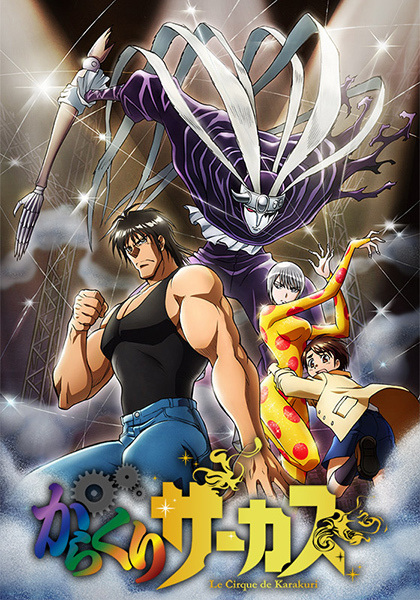
Narumi Katou is a middle-aged man who suffers from the bizarre ZONAPHA Syndrome: a rare and inexplicable disease that causes its victims to endure severe seizures at random, with the only cure being to watch someone laugh. One day, during Narumi's part time job, a young boy with a giant suitcase fleeing from three adults runs into him. The boy introduces himself as Masaru Saiga, the new owner of the famous Saiga Enterprises following his father's recent death. However, other members of his family are trying to assassinate him and claim the fortune for themselves. Determined to save the child, Narumi helps Masaru escape and ends up fighting the pursuers, only to discover that they are sentient humanoid puppets with superhuman strength. As Narumi is about to lose, a white-haired girl suddenly joins the fray and swiftly summons yet another puppet from the boy's suitcase, claiming herself to be Shirogane, Masaru's guardian. Karakuri Circus follows three people from different backgrounds whose fates intertwine and diverge as they unravel the mysteries of an ancient tale of love and betrayal, and the long, ancient battle between humans and puppets. [Written by MAL Rewrite]
Main
Main
Main
Supporting
Supporting
Supporting
Supporting
Supporting
Supporting
Supporting
Supporting
NotSoDeadZombie
June 27, 2019
I genuinely thought this story was pretty okay. It wasn't some God-tier kind of thing, but the concept was more or less unique and the plot was kind of a roller-coaster. That said, it's major flaws was just adding way too much extra stuff. Even for the crazy plot that this has, I'm pretty sure all of the characters had some tragic backstory for some reason and then it was roped in to the story in a way that felt like they did it just because. Not everyone has to have a dead family member or life-threatening disease to be an interesting character, sure somecan but not when the entire cast has one or more of those. Overall I enjoyed the show, it may not be my favorite but it was interesting to see characters get developed in some way that made them more than just a bad guy or a good guy. Even if some of that was a little overboard.
Kaidu-
June 27, 2019
This is one of the worst adaptation to ever come out in recent memory. Not only it's a bad anime, but it's also an insult to the original manga by Fujita-sensei which is considered a classic in Japan. Let's go over the biggest problem: it's rushed like hell. How rushed? Well... Imagine if you had to adapt JoJo part 5 into 13 episodes... Or HxH into 24 episodes... Or FMA into 16 episodes... Or... Well, you get the idea. The original manga is 43 volume long. This anime is 36 episode. This means that even if they adapted a volume per episode, it wouldn't doit. So they had two choices: either cut whole volumes or cut small content. They choose both. Now to the problems that this causes: it's a mess. There is barely any characterization for the characters we are supposed to care about, and the character development is so sudden it makes no sense. Characters will do things that they would normally never do for no reason at all because of it. The story also just keeps jumping nonstop from one point to another, dramatic moments will happen with no build-up whatsoever and sad songs will play at a sad moment that no one cares about. Technically speaking, it's also ugly. Character movements are too stiff, actions scenes barely have any action and are just static shots of a character delivering an attack. Excessive post-effects are added to some scenes and they also look ugly (for example, the white bloom that is present through the whole hospital arc fight). It also manages to have a terrible directing and editing. Characters will just stand somewhere or walk while talking with nothing happening on-screen (as in episode 4 when two character are talking on the side walk), some cuts are TOO SUDDEN (episode 13 cuts to the opening all of sudden almost as if it wanted to make a cliffhanger, but it just made it worse) and the narrative in general is really just too much simplified. As I re-write this review, all of my points are still valid and the show has only gotten WORST. It's downright offensive to the viewers and to the original material. There's not much too say. It's just a really bad and insulting show. A real waste of good source material. TL;DR do yourself a favor and read the great manga
Stark700
June 27, 2019
Over the past decade since I’ve been reading manga, there’s one author that I always felt underappreciated. Kazuhiro Fujita is the manga artist responsible for works such as Ushio and Tora and Moonlight Act. It’s not his first rodeo of having an anime adaptation. Ushio and Tora got the treatment of a 3-cour show (with a split break) based on his manga. Both series ran a large chunk of chapters before their conclusion. Karakuri Circus takes place in modern Japan focusing on a young boy named Masaru Saiga. The story itself contains elements of action and dark fantasy while the plot revolves with three protagonists.Masaru, Narumi, and Shirogane may all have different personalities but their roles are all pivotal for the integrity of the plot. Masaru’s inheritance from his family paints a target on his back as people are after his money. Narumi and Shirogane saves Masaru from death but also begins a complicated story as their lives changes forever. Make no mistake, Karakuri Circus is actually more complex as it seems on the surface. My original impression of Karakuri Circus felt like the anime managed to do what it could do to get the story flowing. However, several episodes in the early stages begin showing red flags. To put it bluntly, this anime adaptation went way over the speed limit in the beginning. It’s incredibly rushed and skipping many chapters to get to certain plot elements. Just for statistical references, the first four or so episodes adapted at least 25+ chapters. With 43 volumes, this didn’t come to me as a complete surprise. The staff probably wanted to cover the entire manga but by doing so, it also damages the original product as a whole. This glaring red flag told me that Karakuri Circus is a victim of modern day adaptations. What got me curious is why the show didn’t receive more episodes in the first place. Perhaps a split double cour could even remedy this a little but instead, we get a continuous triple cour of 36 episodes. If you think about it, that’s almost 11 chapters per episode if we go with the flow. Luckily, the anime doesn’t exactly go with such numbers but it still suffers from omission. As a fan of the manga, I’m rather dumbfounded. Onto the actual plot, Karakuri Circus seems to have a vision to dive deep into its background story. Events in the past heavily influences the present timeline with characters such as Shirogane based on past incarnations. What began 200 years ago has made powerful impact in the present story. However, the first few episodes didn’t follow such format. Instead, it focused more on our three protagonists attempting to live a normal life. Despite that, fate has linked them together with the past that’s practically inescapable. As more episodes progressed, there’s a so much revealed that it’s hard to take in all at once. This the second red flag of the anime. How can viewers be invested in so much content going on at once? Now, I do get that Karakuri Circus relies on character decisions. Some of these are so important that they change the outcome of the story. But really, it feels that the story goes into many directions rather than being focused in one direction. Unfortunately, that’s not all the problems it suffers. When it comes to characters, the cast itself begins to show weakness. Now on the surface, I do like our main characters. Masaru, Narumi, and Shirogane shares a unique bond together that’s hard to overlook in the beginning. There’s hints of deeper feelings between Narumi and Shirogane while Masaru and Shirogane also develops a close bond. The main problem though lies with its commitment to the characters. We are shown many flashbacks throughout the show that sometimes makes me forget our main characters. The first few episodes made me invest a lot into them but by the time half this show aired, that interest has greatly degenerated. That is, I don’t want to say the characters in the past are not important. On the contrary, they play huge roles such as the case with Francine, the Bai brothers, and members of the Saiga family. Two characters of the past also greatly resemble our main characters – Francine/Shirogane and Narumi/Bai Yin. There’s also emotional value poured into the relationships between certain characters. But as the more I watched the show, the more I felt detached with them. I wanted the anime to just be more focused in one direction and not jump back and forth between every episode. That seems a bit too much to ask because the anime adaptation had other ideas. But still, I do applaud Karakuri Circus for its expansive characters when it comes to diversity. While the anime adaptation suffers from rushed content, certain characters do make an impression. The Saiga family such as Shogi and Angelina are names that shouldn’t be forgotten easily during their arc. Members of the Midnight Circus has unique members with a variety of personalities. Furthermore, some of the antagonists in the show have impactful influences such as the Faceless Commander in later episodes. Hell, the Bai brother are responsible for causing a major story plot in the show – the Zonapha Syndrome. Known for its deadly stages, this syndrome is one of the most important elements in the entire series. So despite the story being rushed, it’s hard to deny that certain characters had great influence in the overall tone of the plot. If only the anime adaptation devoted more time on the plot to be more fluid and tolerable. Too bad. Founded in the August of 2014, studio VOLN had previously worked on Ushio and Tora. For its visual context, Karakuri Circus blends between old school art and new school. What I mean is that the show retains a style of the manga while also able to adapting it to modern standards. Character designs are crafted with precision and uniqueness. Every character seems to stand out on their own without feeling out of place. The most unique designs are the automatas, clowns, and circus acrobats. Many of the modern circus characters have a flamboyant look while the automata gives the impression of unique old school machines. Furthermore, I think praise should be given to the character expressions for being able to sell emotional content when it’s given the chance. The main characters such as Masaru and Narumi are prominent examples of this especially in early episodes. Later on, Shirogane’s emotions becomes much more apparent too. The bottom line is, VOLN managed to make a show that managed to live up to its visual expectations. Karakuri Circus is honestly a mixed bag of sometimes being great at what it does and other times falling short. Anyone who have read the manga will recognize how much the adaptation decided to skip content to get the main story going. That itself is a mistake and is hard to fix. If you came in as an anime original viewer, this might not be such a sour experience. As for me, this was more or less an average anime that could have been much, much more.
bmoore07
June 27, 2019
People evolve. We venture beyond our comfort zones, adapting and adjusting to new environments. In the end, we become better versions of ourselves. However, for the shirogane (masters of magical puppets), this is not the case. Defined by their silver hair, slim figures, and seemingly ageless bodies, they’ve been fighting monsters for hundreds of years. Their reasoning for this lies within a traumatizing event from long ago; this event permanently affected them. While the seasons change, the shirogane stay the same. It's apparent in their fighting style (the manipulation of puppets). With the issues they confront, the shirogane insist on an approach that’s not onlyunreliable but is also (more or less) outdated. To me, the shirogane are frozen in time. The same can be said of Karakuri Circus. Like the shirogane, this show is from a bygone era. July 9, 1997 was when Karakuri Circus first emerged, as the brainchild of mangaka Kazuhiro Fujita. And although it was recently adapted into an anime (thanks to Studio VOLN), the premise is typical of the era it hails from. At the outset, we’re introduced to Masaru Saiga (a timid soul with a big heart and a photographic memory), alongside his companions Narumi and Eleonore. Loyalty is established (and romance blossoms) as they voyage through a coming-of-age tale involving daddy issues, the power of friendship, and eventually saving the world. This did not grab my attention (at least, not at first). For me, the overarching story is redeemed when it connects to its various subplots, specifically the shirogane’s struggles against the automata. Here's where the magic unfolds. Masaru’s journey may be this show’s backbone, but it’s in the feud between these two factions that Karakuri Circus comes alive. Their various showdowns are engaging to watch, mostly thanks to composer Yuki Hayashi (he’s the brains behind the soundtracks for Haikyuu and My Hero Academia). It’s because of him that, for each action sequence, viewers are blessed with a colorful array of accordions, drums, and guitars. And the fights themselves are quite impressive. The puppets that the shirogane weaponize and maneuver are rendered in stunning CGI. Gaudy explosions often follow the attacks these fighters unleash (at one point, a column of fire erupts as lightning bolts dance around it). And the battles end stylishly; it’s mesmerizing to watch the automata crumble piece by piece, under grey ooze and hissing steam. Fight scenes are this show's pride and joy. However, what's said during these fight scenes isn't always as inspiring. As far as dialogue is concerned, there are certain areas I enjoy; the one-liners here are very much appreciated and the soul-stirring speeches are genuine highlights, especially in the final six episodes. On the other hand, this show is held back by a hamfisted screenplay; the dialogue is both excessive and redundant, often emphasizing the most obvious ideas. Karakuri Circus provides character development but not without pointlessly detailing the process. It presents ingenious tactics but not without long-winded explanations of how they work. It features personality traits (like Eleonore's weaknesses or a hospital patient's hobbies), but not without an extended monologue about them soon after. For most shonens, infodumping is a recurring issue, and Karakuri Circus is no exception. Ideally, these monologues would be reduced (if not removed entirely). Studio VOLN, though, were occupied elsewhere, with modifying the manga’s overall storyline. Looking to comply with the 36-episode format, they condensed the events of the source material, disposing of specific plot threads in the process. Among others, the Beast Tamer arc and the Kuroga Village training period were axed. Although it caused complaints (especially from fans of the manga), the differences, for the most part, aren’t too severe. To be clear, the editing process and the end result are by no means perfect, but they don't detract from the overall experience. By holding onto the original’s ideas and themes, Karakuri Circus remains true to Fujita’s vision. - - - - - - - It’s a mess. The table is cluttered with mess; it's practically submerged in folders, calculators, pencil shavings, ink stains, and rough sketches. However, Kazuhiro Fujita and his three assistants ignore this. An idea has caught their attention instead. “Aren’t there idiots who get excited just from being on a cliff?” Fujita wonders aloud. He then rises from his chair, gesturing with his hands to emphasize the point he’s making. After doing this, a voice intones, “For Fujita-san, if he’s not talking to people, then it appears he cannot progress in his work.” Kazuhiro Fujita is a featured guest on “Urasawa Naoki no Manben,” a 2015 documentary series that captures a mangaka’s journey in creating their material; it’s intended to provide a glimpse into the process’ inner workings. In the documentary, Fujita and his assistants are filmed at work for four days. When this is finished, Naoki Urasawa (Manben’s host) and Fujita convene to examine the footage. While doing so, they discuss a variety of manga-related topics. Naturally, the conversation shifts to detailing the early stages of Fujita’s career. At the age of 25, he was hired by Shonen Sunday and soon after he reviewed what they had to offer. Fujita scrutinized the magazine’s catalog, a lineup of sports stories and romantic comedies, and he wanted to invigorate the ranks with something new. In order to succeed, he derived inspiration from his childhood influences. Ever since his days growing up in Asahikawa, Fujita loved reading manga, especially shonens. At the time, he was entranced by series like Shotaro Ishinomori’s “Kamen Rider,” Go Nagai’s “Devilman,” and Ken Ishikawa’s “Getter Robo.” However, out of all his childhood influences, there was one that towered above the rest: Rumiko Takahashi’s “Yami wo Kakeru Manazashi.” “It was a short story with regular humans that fought the weird and won. I thought ‘Oh, I am really glad she drew something like this.’ Like, ‘This is just the kind of thing I want to read!’ It was the kind of thing that made me think ‘Manga’s amazing!’ And I think it was the thing that turned me on to doing manga”, - Kazuhiro Fujita - - - - - - - This idea would define him. Throughout his career of thirty years and counting, Fujita waged war against the unknown. In his stories, he would maneuver his everyman leads into confronting opponents of unnatural origin, like evil spirits (in Ushio to Tora), fairy-tale denizens (in Moonlight Act), and sentient haunted houses (in Souboutei Kowasubeshi). With Karakuri Circus, it’s the automata that adopt this role. However, there’s a crucial difference between this show and the rest of Fujita’s works. Beneath the speeches, the references to Chinese culture and the slapstick comedy lies Karakuri Circus’s true intent: to find common ground between the shirogane and automata through their goals. For the shirogane, that goal is learning from the past. After centuries of failure, they finally abandon their age-old stubbornness, which causes them to evolve both in combat (with a wider range of styles and tactics) and outside of it (with more openness in their personal relations). As for the automata, their purpose isn’t as detailed. There’s a backstory here but it’s a strange one, almost impossible to make sense of. Regardless, this show succeeds in providing both sides a cause worth fighting for. It’s not much but having this makes it easier to understand the automata. However, this show fails to humanize them. Excluding the Les Quatre Pioneers (the four oldest automata) and a few others, there's no reason for anyone to care about them. These guys are cartoonishly evil. They kill for sport, getting off on the worst of bloodbaths. In battle, their signature move is to take the children and slap them around before using them as bargaining chips. If children aren’t nearby, they’ll resort to removing women's clothing and gloating about it afterward. The automata are caricatures, plain and simple; they’re card-carrying villains, cruel for cruelty’s sake, cackling at the chaos they’ve created. And they’re not the only ones like this. In Karakuri Circus, almost every antagonist is written the same way. From Zenji Saiga (Masaru’s uncle) to episode 16’s suicidal samurai and even the main villain himself, they’re all reduced to stereotype, burdened with bloated egos and creepy facial expressions. This black-and-white worldview cripples the show's storytelling. It's also an issue that's appeared in Fujita's writing from the start. People evolve. We venture beyond our comfort zones, adapting and adjusting to new environments. In the end, we become better versions of ourselves. However, for Kazuhiro Fujita, this is not the case. Defined by his haunting imagery, two-dimensional villains, and references to Chinese culture, he’s been drawing manga for thirty years. His reasoning for this lies within a short story from long ago; this story permanently affected him. While the seasons change, Fujita stays the same. It's apparent in his writing style. With the stories he creates, Fujita insists on an approach that’s not only flawed but is also (more or less) outdated. To me, Kazuhiro Fujita is frozen in time. The same can be said of Karakuri Circus. Like Fujita, this anime is from a bygone era. And it shows, what with its archaic sense of humor and its bright-red line between good and evil. There's little room for nuance here, the shades of grey few and far between. However, what Karakuri Circus lacks in subtlety, it compensates with heart. The stories here truly inspire. They are love letters to the human spirit, songs of triumph over our past failings and grievances. And although they're constrained by cliches, I'll always remember these tales of personal growth, especially the ones I least expected.
7point8outof10
June 27, 2019
I would like to preface this review by saying that I have yet to read the Karakuri Circus manga, so I will be discussing the show on its own merits, rather than comparing it to the manga. That said, there are lots of elements to Karakuri Circus that make it clear that it cut out a lot of stuff from the manga. This anime serves as a case study as to what happens when you adapt a great manga (or, at least, I assume it’s great based on what I’ve seen of the anime) from 42 volumes into 36 episodes. As you might imagine, theresult is a bit messy. If I were to choose two adjectives to describe Karakuri Circus, I would go with “creative” but “rushed”. The plot is full of all sorts of brilliant and entertaining ideas, but it breezes through them so quickly that few of them really hit you with the impact they deserve. This also applies to the characters of the show. This show has an enormous cast, but few of them get enough screen time. To the show’s credit, there are still many great ideas, moments and characters, but if either there was a greater number of episodes, or the focus of the 36 episodes we do have was more narrowed, then these would’ve been more effective as a result of being more thoroughly developed. The circus motif of the series is going to be hit or miss depending on your personal tastes, but I for one think it’s great. Karakuri Circus does a great job capitalizing on different elements of the circus, creating lots of unique and entertaining puppets to be fought throughout the series. The way they twist the joyful and comedic look of the circus into something much more abhorrent is very well done. If you are afraid of clowns, then these designs will definitely add to the atmosphere of the series. These designs, as well as the varied abilities of the puppets make the fights pretty entertaining. These fights are usually quite simple, but usually have an emotionally resonant idea or important stakes in the plot that comes with them. There is also always a tangible sense of tension once it becomes clear that this series isn’t afraid to kill off its characters. In many cases, however, these things feel like they could’ve hit harder if the characters involved had received more development, and things start to feel formulaic after a while. The animation is also pretty underwhelming. The character deaths feel particularly formulaic (with exceptions). This is perhaps where the incredibly fast-paced nature of the show hurts it the most. Because of this pace, character deaths happen so frequently that the deaths of minor characters don’t have the impact they ought to, and the more major deaths feel less shocking (though they still hit pretty hard). In terms of presentation, Karakuri Circus is pretty solid. As I said earlier, it has underwhelming animation, but it is still pretty nice, visually speaking, as a result of the puppet designs and the classic ‘90s aesthetic. As for the audio side of things, the BGM is pretty darn great, as are the opening and ending themes, and the voice actors do a nice job at conveying their characters. The most recurring theme throughout the series is that of smiling (and, by extension, laughter). While this may sound pretty cliché, it fits the series rather well, in large part due to the circus motif. After all, the point of the circus is to make people smile. This idea is twisted and perverted by the villains of the series, adding a lot more to this theme than you might expect. While it certainly also indulges in the cliché elements of this theme, the accompaniment of this dark parallel makes these moments feel richer. I can certainly say that this theme, and the show in general, succeeded in making me smile. Most of Karakuri Circus’ problems seem to come from how rushed it is. It oozes creativity and heart, but so much of it feels as though it could’ve been executed a lot better had it been given more episodes. I have yet to read the manga, so I am hesitant to recommend it, but I will say this: if the manga is truly like the anime but with a much slower pace, then I am reasonably confident that it will be an excellent read. So, should you watch Karakuri Circus? I would say that it depends on how interested you are in the series. If a battle shounen between mechanical puppets with a strong circus motif interests you enough that you are convinced it is worth your time, you should probably read the manga instead. However, if you are somewhat interested, but think that a 42-volume manga is too big of a commitment, then you should definitely check out the anime! Who knows? Perhaps you will like it enough that you will be convinced to read the manga? I certainly plan on reading it.
Rank
#3758
Popularity
#1835
Members
141,511
Favorites
661
Episodes
36