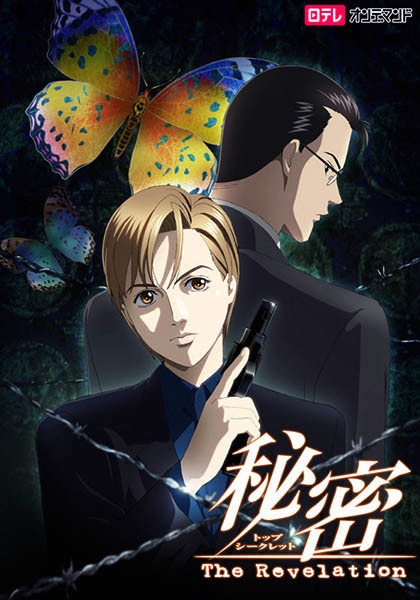
Box of Goblins
魍魎の匣
Absent-minded schoolgirl Yoriko Kusumoto only has eyes for Kanako Yuzuki. After planning for their summer trip, their journey comes to a premature and brutal end when Kanako is found severely wounded on train tracks and Yoriko in tears on the station's platform. Shuutarou Kiba, a detective who happened to be on the train that hit the girl, takes up the investigation. However, he discovers that the mystery behind this case is intertwined with an intricate network of deceptions involving the Yuzuki family, especially its most prominent member, Youko Yuzuki—a famous actress and Kanako's sister. Although Kanako survives after surgery, her critical state prompts Youko to entrust a doctor, Dr. Koushirou Mimasaka, to take care of the girl in an ominous, box-shaped facility in the forest where she will receive experimental treatment. But soon after, on a night where Kiba and Yoriko visit Kanako, the convalescent suddenly vanished. Now searching for her whereabouts, the burden on Kiba dramatically grows when he learns about other gruesome discoveries: limbs of young girls in boxes. Kiba is suggested by a colleague that the macabre findings are related not only to Kanako's disappearance but also to the truth behind her sister. As the investigation continues, the detective—enlisting the help of his partners Tatsumi Sekiguchi and Akihiko Chuuzenji—has to find a way to solve this series of crimes and find Kanako back. [Written by MAL Rewrite]
Главный
Главный
Главный
Главный
Второстепенный
Второстепенный
Второстепенный
Второстепенный
Второстепенный
Второстепенный
Второстепенный
NurseNitsuj
September 15, 2009
Score: 8.5 “..If you build an enclosure within your heart, evil things will brew. Those things he called “mouryou.” Built upon calamities of emotion, Madhouse effectively released a series worthy of a masterpiece. Mouryou no Hako hits a delectable balance, with extensive background in supernatural folklore, mystery, and science fiction – all tying in to a well-done and extensive detective, mystery story. This is how horror and mystery should be done! Story: 9 At first glance, the story seems to be about two girls – one girl who has problems at home and the other, a seemingly perfect girl, who tells her that she will be the reincarnation ofthe other and vice-versa. Then there’s a disturbing part where a mysterious man has a box in his hands, and voices coming out of it. Further down the road, you will follow detective Kiba as he tries to find out what’s going on. Do not be thrown off by the first episode’s foreshadow and its yuri themes (I might also add that Anime News Network found the first episode very compelling with “heart-achingly beautiful yuri.”) It is simply the preamble of Mouryou no Haku as to what you will see. There is also an amazing string of characters (A lot I might add) that tie in to the story and reveal connections. Indeed, Mouryou no Hako can be confusing at first, but as you follow the series, everything opens up in a mythological-like story. The story offers metaphors shrouded in secrecy, your mind questioning the whole box stuff (WTF moments too), and eventually leaving you blown as it all ties together in the end. Mouryou no Hako is indeed a multi-layered mystery/detective story. It can be complex to the point where the viewer does not understand what’s going on. Of course, this series isn’t spoon-fed to you. You actually have to think, and that’s what makes this series so great. Art: 10 Sound: 8 The animation, quality, and design were all nicely done. CLAMP finished off the designs with a professional touch while Madhouse did the animation wonderfully. If you thought Higurashi no Naku Koro ni was disturbing (It was actually), then you haven’t seen anything…yet. The gore, limbs, abstract scenes, and other “things” were certainly something. Not just enough for one to go all squeamish, though. The movements were detailed and subtle, with the backgrounds leaving a sense of awe for the viewer. Everything looked so amazing, crisp, and detailed therefore giving this piece a solid 10. Opening theme: Lost in Blue by Nightmare Ending theme: Naked Love by Nightmare The music and insert sounds were also nicely played throughout the series. I actually bought the OST for this. The soundtrack is amazingly nice to listen to. With the opening and ending by Nightmare, it adds a nice touch to this prodigious piece. I would say that this was definitely one of Madhouse’s best OP/ED’s. Overall: 8.5 No, I can’t rate this a 9. Mouryou no Hako is an amazing series, but everything is not perfect. It falls short due to its amount of talking and occasional scene changes with different characters. This certainly isn’t for everyone and thus, may turn people off. Regardless, the series storytelling is the main selling point that makes this anime so unique and refreshing. It is truly unfortunate this anime has been underrated and highly overlooked. One thing is for sure though. There’s something about this anime that leaves a lasting nostalgia or melancholy – and one that allows a few of us to treasure this wonderful rare jewel.
Absent-minded schoolgirl Yoriko Kusumoto only has eyes for Kanako Yuzuki. After planning for their summer trip, their journey comes to a premature and brutal end when Kanako is found severely wounded on train tracks and Yoriko in tears on the station's platform. Shuutarou Kiba, a detective who happened to be on the train that hit the girl, takes up the investigation. However, he discovers that the mystery behind this case is intertwined with an intricate network of deceptions involving the Yuzuki family, especially its most prominent member, Youko Yuzuki—a famous actress and Kanako's sister. Although Kanako survives after surgery, her critical state prompts Youko to entrust a doctor, Dr. Koushirou Mimasaka, to take care of the girl in an ominous, box-shaped facility in the forest where she will receive experimental treatment. But soon after, on a night where Kiba and Yoriko visit Kanako, the convalescent suddenly vanished. Now searching for her whereabouts, the burden on Kiba dramatically grows when he learns about other gruesome discoveries: limbs of young girls in boxes. Kiba is suggested by a colleague that the macabre findings are related not only to Kanako's disappearance but also to the truth behind her sister. As the investigation continues, the detective—enlisting the help of his partners Tatsumi Sekiguchi and Akihiko Chuuzenji—has to find a way to solve this series of crimes and find Kanako back. [Written by MAL Rewrite]
Второстепенный
makoa69
March 16, 2012
Let me write and explain as best I can why I think Mouryou no Hako is bad. And I don’t mean simply bad, I mean absolutely awful. My friend (who greatly adores this anime might I add) sat with me and had me watch the entire thing just today. If not for him, there’s no way I would have watched more than a single episode of this murder mystery. Now be warned, this review is really fricken' long, so prepare yourself. The review is also written for people who have already seen the show, so it's full of juicy spoilers. So be warned. So becauseof how convoluted the plot is, I’m going to save that for last. First I will talk about the exterior aspects: My first complaint is simple: the show has very little to show visually. There’s tons of events talked about in the script during many episodes that are never actually shown to the viewer. It’s actually surprising how little the show actually shows you; I’m guessing that it’s simply your job to quickly pick it up and comprehend everything via the script. You might call it a 'smart person anime’ or something akin to that, but I call it cheap. Is there any reason not to show visually what the script is talking about? I guess the makers felt it’s much more important to keep showing the three guys talking in the room, or the group of guys talking in the big room full of boxes, or the guys talking in the car, or wherever. When the show does show the viewer what it’s talking about, it’s done in a cryptic way that doesn’t really help anybody comprehend what they’re talking about. When I say this, I’m mainly thinking about the discussion about the demons. A mini complaint I have is some visual imagery in the show. In the first or second episode, we see some disturbing scenes, those being a talking dismembered head in a box, a talking doll, and a cop who sees a lot of bloody handprints on the windows of a train. However, after those three, we never see any disturbing things again. Why were they even there? Besides the head, the imagery had no purpose and was forgotten in the grand scheme. Was it just there to make viewers think this show might actually be good? I am forced to think so. My second complaint is the music. For a murder mystery about a demented man who severs little girls into pieces and puts the pieces in boxes, there’s a surprisingly high amount of calm peaceful music, so peaceful in fact that I had trouble staying awake to read the many many subtitles. Music is a very easy method of telling the viewer what kind of mood you’re trying to set. If you want the viewer to feel tense, then just put some scary high pace music in the background and, even if your story is garbage, the viewers will still feel the right tensity. The fact that this show has so much calm, slow music playing constantly during the incredibly dense episodes where they’re discussing demons, murders, or whatever tells me as a viewer that the stuff they’re talking about is not only unimportant in the big picture, but also that what I’m seeing now is a waste of time, filler if you will, in order to reach thirteen episodes. Now most of the time the fricken’ show doesn’t know what kind of mood it wants to set, so instead of having no music at all, it just has evening cicadas chirping away in the background, regardless whether cicadas actually would be chirping at that time of day. Now, plenty of times they do get the music right (good job, it’s not that hard), but those times are quite scarce. Alright, now that that’s out of the way, lets get on to the plot, and the characters. My biggest problem with this show is just how illogical the characters are. They’ll do certain things that don’t make any sense and the way the show explains it is unsatisfactory. Let’s do a quick rundown of some characters. Let’s start with Yoriko. Compared with many other characters, she’s given quite some time to develop. We find out that she hates her mother for no reason other than that she’s possessed by a Toorimono. She then falls in love with a fellow student due to her charms, and they start saying they’re reincarnations of each other. Yoriko then pushes her friend into a train for no reason other than that she’s possessed, and then blames it on a man dressed in black. She later gets apprehended by Kubo and dies. Now let’s try to justify her actions logically. I suppose she could hate her mother because she’s dating a man she dislikes, the show hints at that, but come on. The mother is her only family, probably the only person she ever received love from. It’s not like the mother hates Yoriko, she deeply loves her. The relationship should be similar to Honda Tohru from Fruits Basket. And yet, Yoriko wishes the mother would die. The show also hints that it’s because Yoriko is in those teen years and has all those hormones flowing. Hmmm, I don’t remember wishing my loving parents would die when I was fourteen. Her falling for Kanoko makes enough sense. Yoriko is unpopular in school and Kanoko approaches her for seemingly no reason at all. Yoriko listens to Kanoko’s strange stories about them being reincarnations of each other, they have meals together, read magazines together, and they both have romantic moonlit dates. And then she pushes her into a train. Huh? Why would she do that? Kanoko was crying before then, and Yoriko noticed a pimple on her neck. That somehow triggers murderous intent? These kind of things in the plot turn me away. There’s no way to explain such actions except saying that she was possessed. What a great ploy to resort to in a fricken’ murder mystery! Now let’s talk about Shunko Kubo. He awakes in a train only to have a man promptly show him a girl’s dismembered head in a box, which then moves and speaks. He then feels a desire to have a dismembered head of his own and starts cutting up girls in an attempt to achieve it. He fails and meets up with the scientist who actually did achieve it, and agrees to have himself dismembered. He then murders that guy by biting him furiously. Now please reread that and see if you can take any of that seriously. First off, there’s nothing really wrong with Kubo, he’s just an average novelist. Unlike the other novelist in the series, he didn’t go to war and doesn’t have any trauma. He has nothing wrong with his brain, and has no reason to think strangely. Though in order for the plot to hold any water, he has to for some reason have a massive desire for dismembered heads. So much that he would risk his entire life so he could have a head of his own. If this guy actually existed, he would have a reaction of surprise and shock to the head, and probably later convince himself he was seeing things when the head spoke. That reaction makes sense. After that he continues to do crazy things. Why he would agree to get his own body dismembered is beyond me, and even stranger, why he then murders Mimasaka the scientist. For one, how did he manage to murder him? He was clearly sealed inside that box, and Mimasaka had no reason to open him up, he was on the run from the cops. For two, why would he want to murder him? He agreed to become a dismembered head himself, what would biting the man to death achieve? I guess the only explanation is that he was possessed by a Mouryou, or a Toorimono, or whatever. Next up is . This guy has lived with Kanako and Yoko for fourteen years, and is in love with Kanako. So much in fact, that when he sees an opportunity to murder a scientist and claim her dismembered head for himself, he scoops it up like candy. In addition, while he’s on the run from whoever may be chasing him, he decides it’s a great idea to show a complete stranger in a train his dismembered head that he just murdered someone to attain. Need I go on? The actions these characters take really just don’t make any sense no matter how you look at it. I mean, unless you assume he also was possessed. And if everybody was possessed, this really isn’t a murder mystery at all, and just a crazy phenomenon. And that’s really just where the plot falls apart. You can’t have a good murder mystery if you’re going to blame so many events in the crime on ghosts, or demons, or whatever they are. And the anime knows that, so it tried it’s very best to explain those demons so that viewers can go ‘ok that makes sense’. But no, it doesn’t. In addition to the characters not making sense, they are also very uninteresting or very dislikable. Lets look at the characters in Higurashi no Naku Koro Ni, another murder mystery show. That show sort of split into two parts; casual every day, and scary murder. They did this so that time would be spent making the audience like and care about the characters they’re learning about. If all we see is the murder part, it would be equivalent to a news report on television, which sounds like, ‘someone got killed? Aw, that’s too bad. Oh! Looks like it’ll rain tomorrow!’ Mouryou is somewhat like that news report, but slightly worse. This could have easily been fixed by showing more visual images of the characters most involved with the crime. I am talking especially about Yoko, Mimasaka, Kanoko, and Kubo. I’m guessing the reason not much is shown or explained is because nothing they showed would have explained their irrational behaviors. This anime, for being only thirteen episodes, has a shockingly high amount of irrelevant tangents. Allow me to give a few examples. A hefty amount of time was spent talking about a famous box maker who was famous for, um, making boxes. Why he needed to even be mentioned is beyond me. Maybe because the murderer puts the ligaments inside of boxes? I thought that was because the first dismembered head he saw was inside a box. Besides, the boxes weren’t important at all. It’s similar to talking about the case of a guitar instead of the guitar itself. Another example was the story about the clairvoyant girl, the one who poisons herself after the media bad mouthed her. Why was this story even told?. Why even talk about clairvoyance in a murder mystery? Why give one of the detectives the power of clairvoyance? This actually brings up what I hate most about this anime. It has so many ‘because I told you so’ moments. Why does Chuuzenji know so much and why is he so clever? Because I told you so. Why is Enokizu, the hired detective, clairvoyant? Because I told you so, and so on. The ending and explanation to the plot has to be spoon fed to the viewers because there was no way to logically reach the conclusion yourself. Everything has to be told in a because I told you so manner by Chuuzenji because there was no other way to explain it. Many people leave this anime with high spirits because the ending somehow manages to put some small amount of sense in the convoluted plot. But they seem to have forgotten the horribly dreadful ten or so episodes before it. An anime isn’t good just because it’s ending is good. It’s not ok even if one episode is bad, especially when the anime is only thirteen episodes. Each episode should be rich in mystery and constantly have me focused and trying to piece things together with the information fed to me. Instead I found myself laying down, fighting my urge to sleep, as the episodes dragged on about the heavy lectures on demons, clairvoyance, and other things that in the end had little to do with the murder itself. Now, it’s true there’s plenty of elements of the plot that I did not pick up, and that definitely hindered by understanding and overall enjoyment of the show overall. But I feel that is certainly not my fault, but the show’s. If it was actually well written, paced, and visually presented, I would have been mentally active the entire time as well as emotionally involved. Sadly, it failed to achieve either.
Fleure
July 11, 2017
Wrapped within the coils of the night, two young girls dance as if in a trance, illuminated by the crystal-white moon. They continue twirling; hypnotized by each other’s company as waves of cherry blossoms encircle them, following their every move. The two girls are distinct from one another. Kanako is a beautiful, intelligent girl with ideas beyond her years, while Yoriko is a timid girl who aims to be Kanako, in body and mind. Kanako offers Yoriko this chance as she tells her that they ‘are’ each other and that this life is just one of many conduits that hold their endless cycle together –as one another. Cascades of cherry blossoms continue to fall menacingly as if harboring some secret and beckoning some turmoil. Elsewhere, a man traveling on a train finds himself in a deep slumber. Upon waking, he finds an unknown man sitting across from him speaking to a box. Puzzled, he looks at the stranger hoping for some answers. The stranger is quick to oblige as he slowly opens the box, revealing the head of a girl –seemingly alive and quietly vocalizing, who looks eerily familiar. Thus, sets the stage for the complex tale of Mouryou no Hako. Adapted from the novels of Natsuhiko Kyogoku, Mouryou no Hako is the second installment of his Kyōgokudō series (Kyogokudo is otherwise known as Akihiko Chuzenji; he serves as one of the primary characters). The 13-episode adaptation intertwines multiple narratives to create a dynamic mystery that’s entrenched in Japanese folklore and Eastern philosophies. Contextually, the story is set in post-WWII Japan and centers around serial killings which involve young girls getting killed and dismembered, and then left to be found in seemingly random places. The point that sets these murders apart are that the body parts always found neatly packed in a box. Mouryou no Hako can roughly be translated to “The Goblin’s Box”. Even though the bizarre nature and methodology of the murders would naturally seem to be driving factors of the mystery, it remains superficial at best. The events that define the mystery deal with the aforesaid girls, Kanako and Yoriko. Yet, the significance of the two girls lies in what their relationship represents for various entities, rather than them as individual characters. To elaborate, it is their story, which initially seems to be running independently, that is the binding force of the narrative and the characters that follow. This creates multiple story-lines that then start to run in various directions, often clashing and interjecting, in a sphere of constant chaos, while retaining the true spirit of a stellar mystery. The work breathes enigma; constantly exhaling an air of confusion tinged with curiosity and thrill, but one that never over-extends into contrivance or nonsense. In turn, then, the murders function more as an auxiliary measure to explore the full scope of multiple subject matters, which stretch far beyond just a cat-and-mouse game. Mouryou no Hako follows a non-linear, non-chronological format to relay its events. The series is broken into entries, from the perspectives of various characters, which reads like a diary that’s out-of-order. However, there is order to these events since it’s the characters that are the pieces of the overarching puzzle, rather than the events themselves. Time feels almost stagnant; irrelevant. Yet there is a cycle; a rhythm to each account that is composed through intersecting observations, literary expositions, and a calculated exploration of the supernatural and temporal. Each character has their own manner of unveiling their perspective or information. This allows the work to capitalize on many different elements. First, it gives the work the ability to move with unpredictability, making it potent in its revelations and plot(s). Second, it helps narrativize the characters as a functioning and integral part of the events and story, rather than just voices narrating them. Often stories of this nature have a hard time selling compelling characters and personalities unless they have a titular Sherlock or Poirot to go along with it. Even though there is a “central” detective (in the form of Kyogokudo an onmoyji, which is a practitioner of a niche kind of magic, occultism, and natural science), almost every character involved shares the burden and thereby moves as a unified unit or agency. This is partly what makes the structure and narration of the anime so interesting, especially when looked at from a character’s point of view and what role they play in the overarching tale. However, this also means that characterization in the traditional sense is not the show’s aim. This does not mean the characters are badly written or poorly constructed. To clarify then, the characters are not notable because of their individualistic transformation; nor do they really “develop” all that much. The characters are who they are; stagnant, but with something to say. It’s what’s being revealed through these characters that is far more important than who they are (or become) from beginning to end. Yet, they aren’t lazily constructed. All the characters have their idiosyncrasies that play into the narrative in a way that enhances it and offers much to appreciate about how this specific work uses its characters to craft its puzzle, piece by piece - and each piece matters. Nonetheless, it’s what is being revealed through the pieces that become the heart and soul of this show. The conversations and expositions carry the true genius of this series; from its substance to its style. To really distil it down to the core, it’s important to re-establish the many disciplines it invokes as Mouyou no Hako is not just a mystery, but many shades of humanity. It draws inspiration from the traditional Japanese literature, the philosophies of the East, religious paradoxes and hoaxes, spirits and spirituality, science and séance, warfare and medicine, and of course, the mystery that arises from combining all these elements and neatly packaging them into the “Goblin’s box”. The crazy thing about it is that it works, and it works on so many levels that it’s almost astounding that it's able to pull off such a chaotic cacophony and turn into an orchestral masterpiece. Therefore, the core of the series is one giant mesmerizing kaleidoscope; endlessly alluring with its wondrous elements, full of color, and mystery. What makes it really work is undoubtedly its writing, atmosphere, and presentation. First, the writing. For many, this could be a detractor, but the show (as expected) is very dialogue heavy. There are episodes just dedicated to dialogues and exposition, and to many, this may seem extremely heavy-handed or imposing. However, the quality and impact of what’s being conveyed is so well-done, and so integral to the actual plot(s) that once everything is contextualized, it’s hard to not be blown away by the sheer beauty and profundity of some of the dialogue. Furthermore, there is a serious psychological aspect attached to the writing. It doesn’t just drop containers of pretty sentences and philosophies, rather the writing is more focused on making a psychological impact on its characters and its viewer. Even with its often-detached-lecture approach, the vitality of the writing goes a long way and leaves its imprint far after all has been said and done. Thus, if there was ever a show to balance the scope of Eastern mysticism and an enthralling mystery, this is it. And nothing more than the writing – the fluidity of it, the insight of it, the prose of it, the meaning of it – crystalizes its place as one of the best of its kind. Second and finally, is the atmosphere and presentation. The writing is brilliant as are many of the other elements, but the way the show integrates them together is a feat in and of itself. The work relies heavily on atmosphere to do this and uses visual and audio cues to then heighten every frame or shot or the series. The show utilizes pauses, silence, and the occasional wind chime in the middle of dialogue or narration with such precision that it almost feels purely like a work of horror, and it wouldn’t be hard to argue that it may be given the sort of fear and discomfort it effortlessly creates. Visually, the series is haunting, too. It uses sepia tones to create a look from the past but maintains a life-like art-style both in character, and backgrounds to give it the edge it needs to remain gripping and unsettling. It feels and looks aged, but the presentation does all it can to manipulate the setting into an insidious nightmare that captivates and terrifies. Mouryou no Hako is the quintessential mystery. However, calling it just a mystery is a disservice since it transcends the very genre it assumes and transforms into something completely different. There is much to be loved about what this series accomplishes, and a holistic, first-look review such as this can barely scratch the surface of it. Yet, this isn’t a series that can ever be argued as universally appealing, even if tries to cradle the cosmos in its arms. It practices esotericism to a possibly faultable degree, which can easily be conflated with “pretentiousness” and “over-indulgence” to the dismissive mind. This does make the show highly inaccessible since a lot of the subject matter falls into very segmented niches and requires a close follow on the dialogue and its progression (which is fast-paced and dense). Nevertheless, to walk in the dark, into the unknown night is not something enjoyed by most - and Mouryou no Hako is precisely that. It tampers with subjects and themes that are arguably part of human nature, but ones that lie in the shadow. Under the veil of a serial killer’s murder spree, it’s motivations extend far beyond what’s understandable for a mystery for it tries to grasp the core of being on not just a temporal plane, but realms that lie outside cognition. However, there is a sublimity it strives for, like the fully-lit moon in the passing night, bringing forth what’s been hidden, and as such, the series rewards those who can tread in the dark; with a light at the end that’s worth basking in, even if it means struggling with the unknown and unfathomable.
Jodyqt
November 7, 2013
Have you ever wanted to be a private detective? Asking that, I beg to you another question. What is the degree of depth and detail that needs to be sought out to truly understand the complexity of a criminal mind? Perhaps this is out of my comprehension as an avid anime viewer but I'm sure Mouryou no Hako is not only scratching the surface of the true horrors of a criminal mind, but is inviting me to bathe in it. Me and dialogue story-telling have never really snuggled up together on the mattress but being a person entirely aware of that, I can wholeheartedly say,"what a truly astonishing exercise in dialogue driven story-telling we have here". As I stated in the opening segment this show stands as a tribute to detail and the huge amount of research that is required in truly understanding the mind of a criminal, the component of this series that reflects this above all else is the dialogue. Each and every spoken word is like a work of art, each uttered letter is a moment worth savoring, whether it be the simple whisper of a future lover; the withdrawn complacency of an actress; or the intelligent observations of a detective, the essence of the dialogue's writing is phenomenal. All of these moments pervade the entire series that make this an intellectual feast for any sturdy and patient viewer. As some would know, the Japanese meaning for Mouryou is Goblin and a Goblin bears resemblance to a picturesque description of madness, painting an image of its grotesquely alienating figure. This ideal crosses and intersperses itself in the eyes of its antagonist. What beauty is there, finding solace within the impurities of insanity? Mouryou no Hako answers this question with the act of deforming and preserving human ligaments, the act of preserving the human body after death, a fools hope, but an act that has been carried out by mankind for eons. I would like to say that the whole story matches up to the quality of dialogue and the mass of clever metaphors within this series, but sadly, the actual story only just missed the cut. Mouryou no Hako follows a series of brutal murders carried out by an anonymous killer, and becomes a philosophical study of the condition of those deemed mentally insane, the series asks many questions about this fortunately never wavering to far from what it originally set out to do. The negatives that I refer to would actually be the dialogue heavy story-telling. Now this might come across as unusual considering the praise that I have given the dialogue but even its phenomenal quality does not excuse the fact that spent too much time on too many details. There was a particular scene in the middle of the series that was a discussion that took place for two whole episodes. The scene in question though being necessary could probably have been a condensed a bit, as it can be argued very truthfully that it removes a lot of the tension that had been developed up to that point and the other problem with the scene is that while it was very interesting, it didn't contribute as much to the series as was probably intended. Besides that point, I have little to no problems with the story as it is well made and knew how to keep me guessing until that final moment when the mystery was revealed, which brings me to say that the story is almost masterful in its execution and that alone can make it a true gem in the anime medium's detective genre. It is not unusual for me to commend Madhouse studios in the art department for any of the series that they have released, but as it stands Mouryou no Hako's art is highly noteworthy simply because of its detail and intense elegance, which helps to accentuate and set up the mood that the series wishes to establish. There are two particular scenes that I want to take note of within this series, mostly because I believe that they capture the insecurities that lie deep within the characters. Falling cherry blossoms are a foreshadowing of death, two girls dancing a careless waltz in the moonlight, a waltz of death amidst the ascending petals of these blossoms. This scene was almost painful to watch with its melancholy but at the same time it was almost impossible to look away with how truly mesmerizing it was. The other scene that I would like to mention was a moment of disconnection, a scene of limbs moving without a body, it was highly ostracizing and highlighted a comparison to the feeling of having one's limbs removed from the body whilst in a state of consciousness. These two scenes delved into what I believe are the true horrors of this series and the art and design of the scenes are what effectively achieved it. Another aspect that I wished to mention is the attention to detail with all the characters actions, movements and display of emotion, they are fluid actions which have a realistic touch, I will delve into more of this in the character section. The characters in this series are truly immersed in the story and that is a feat in and of itself. As I stated in the Art section, many of the characters in this have a divine commitment to insanity, and to properly highlight the insecurities that these characters have requires proper development, does Mouryou no Hakou achieve this, yes. Much of the characters development is heavily influenced by the dialogue on display, and wastes little time in identifying the subtle animosity of one character, the worrisome plight of many observers and the subdued emotionally detached personality of a strong steadfast detective. Dialogue isn't the only contributor to character development as the creators are fully aware that much of what is spoken is not spoken at all, the art department did well in identifying a realistic approach to the display of body language which is a leap away from much of the quirks of your average anime series. I found this aspect of Mouryou no Hako to be very interesting and in some way refreshing. A particular point that I want to identify is the moment that a girl grins at a friend of hers, that one small action contained an unspeakable malice driving pure fear into me as a viewer and it made me question much of the intentions behind such a smile. The actions are thought provoking, like the detail and textures of the story the show is detailing, it offers an almost beautiful contrast and reflection of the richness of the series. Not one character does not contribute to the entirety of the story, which is an excellent feat again, whether it be the man and woman casually preparing for work finding the detached limb of a murdered girl beautifully preserved, just that moment is acknowledged later in the series. One problem I have with the characters is this, they are not memorable! Even though I commend the show for its detail in its characters and their actions, I simply cannot praise this series characters as much as I want to. One thing that the OST of Mouryou no Hako has going for it is that it is simply relaxing to listen to, it's not a pumping soundtrack but is more of a sound that is grounded in the traditions of the theater. There were many moments in the soundtrack that were like sweeping rustlings, carefully placed to build tension, a particular track that I want to commend is "Madoi Hito", that is an orchestration of string instruments that builds a spectacle, almost romantic display of the tension. These tracks seduced me into the moment, which does wonders for the series as the immersion exacerbates the constant build. This build made many scenes all the more potent especially in those moments of horror. I do love a good murder mystery and Mouryou no Hako is definitely satisfying that sweltering itch but the best thing and most notable thing about it was that it scratched it in the most surprising way possible. That said, it must be said that much of the reasons why I have enjoyed this series have already been listed. I believe a well made story can contribute to how much I enjoy a show and Mouryou no Hako certainly fits into that category with many twists and turns that constantly enlightened me on the depth that this series had. To its credit any series that can keep me so actively engaged with such heavy dialogue is worthy of being commended, and it is those many moments of dialogue that made this series an absolute delight. However, I can only enjoy a series such as this so much, thankfully with my large attention span I was able to take in many of the details but on some occasions I found myself yawning during a very long bit of dialogue. Despite being remarkable, at times it just simply stretched out for too long but these moments are few and far between. Would I rewatch this series? Perhaps. If I were to ever re-watch it, I imagine I would probably like it less because the mystery is so well crafted that I would probably catch on to every single moment when the culprit displayed an important piece of evidence. Mouryou no Hako is a rare series that does everything (literally) to remove itself from the norm, I probably haven't seen a series so far removed from the norm for quite a long time and for that it gets some points in my book. It is not a perfect series either, with some questionable moments here and there but for the most part many of the scene changes were fluid and the series maintained a height of consistent quality on both a technical level and story-telling level that is rarely seen. Unfortunately Mouryou no Hako is not a series for everyone and has a particular niche audience in an already niche medium, which is a pity as it is a truly excellent work in many respects that offers an experience like no other. Story 9/10 Characters 8/10 Art 9/10 Sound 7/10 Enjoyment 8/10 Overall 8/10
Reign-Senpai
December 19, 2013
This is one series that did just about everything right. Obviously it’s not for those who don’t like people talking over and over again, but it’s perfect for those who are looking for mature and complex anime. This is how mystery should be done! Story-8/10 I honestly can’t recall any other anime apart from a Mamoru Oshii-production that puts more emphasis on talking as this one. The series follows a string of bizarre murders, and the people who try to solve it. This whole mystery is multi-layered, it’s full of flashbacks and references, you’ll never know when something that passes the screen is important for the future.There are lots of scenes that don’t necessarily have any direct meaning, but instead are there to flesh out the setting or throw the viewer on a side-track, and yet the series itself never loses track of its goals, and everything comes together in the end in one of the best endings I’ve seen. Characters-9/10 Another big selling-point of the series is its cast of characters. They hardly get as much screen time or background as your average anime, and yet they’re utterly amazing. The animation knows exactly what it needs to do to show their subtle movements and gestures in order to flesh them out while many other things happen, and the background that’s there is meaningful and has a huge impact. Every character has his or her own distinctive presence, with the best ones being Kanako and Akihiko, both for very, very different reasons. The entire cast is colourful and a delight to watch, despite the huge amounts of talking within this series. Art-9/10 Then the visuals: they look utterly incredible. Especially in the beginning episodes, the characters all look crisp and very detailed. The animators throw the most beautiful shots and visual effects at the viewer. Combine that with an awesome soundtrack, and you’ve got some amazing production values. Sound-7/10- The soundtrack is amazingly nice to listen to. OPs And EDs are nothing in particular to listen to, but the soundtrack does what it needs to do. Overall Enjoyement-8/10 So overall, this has been an amazing series. The script is fresh and creative and has a huge impact. There’s a lot of symbolism, both visual and in the storyline, and an excellent recommendation for those who look for a short mature series. The storytelling is strong yet subtle, and it’s yet another masterpiece by Madhouse.
Ранг
#4061
Популярность
#3010
Участники
67,379
В избранном
270
Эпизоды
13