
SANDA
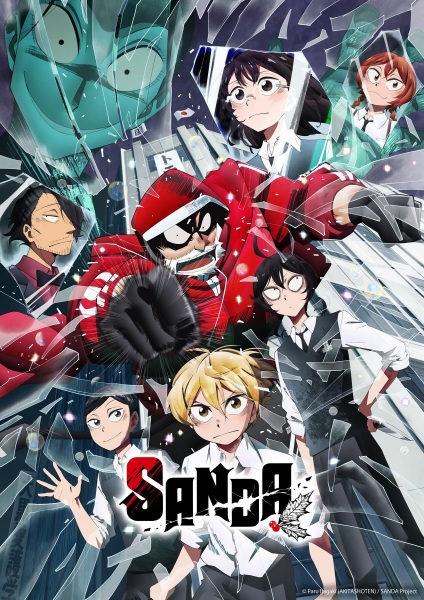
In a future where children are few and regarded as Japan's most valuable assets, Christmas has become a mere legend of the past. For the students of Daikoku Welfare Academy—a boarding school where they are educated, protected, and monitored—the mythical Santa Claus is a forgotten character of fiction. For the adults, Santa Claus is a very real menace that needs to be neutralized by the Saint Nick Pursuit Unit in case he makes an appearance. Shiori Fuyumura, a student of Daikoku Welfare Academy, is determined to find her best friend, Ichie Ono, who has been declared dead after being missing for six months. One morning, Fuyumura summons her fellow class representative, Kazushige Sanda, only to attack the unknowing boy. She is convinced that Sanda is the descendant of the infamous Santa Claus—the only person who can make her wish of finding Ono come true—and is determined to force out his dormant true self by any means necessary. [Written by MAL Rewrite]
Main
Main
Main
Supporting
Supporting
Supporting
Supporting
Supporting
Supporting
Supporting
Supporting
Tkit
December 19, 2025
Sanda is like a headless chicken, shitting out golden eggs and walking around in confusion. There are a ton of very nice ingredients here but the cook doesn't really know what to do with them. Sanda presents you a very interesting setting exploring a very Japanese problem. The big idea behind this story is fresh for anime while fitting in the larger shonen formula by adding themes that make sense for this concept. Declining birth rates, adolescence, coming of age, confidence and becoming reliable for others. All in a world that is wonderful in its exaggeration of problems related to said ideas. The production is alsostellar. Science SARU known for its bold style visually made Sanda into one of its kind looking anime, as if to match the interesting foundations of the story. The art style is wonderful, with fun character designs that may be off-putting to some, but are well executed and animated. The music is probably my favorite part. It is done perfectly, with some tracks fully embracing the connection to Santa Claus and Christmas. Of course voice acting is highly competent as well. Reading all this, you might think this will be great, they have high creative vision both visually and conceptually. Unfortunately outside the realm of concepts Sanda suffers quite a bit. Sure anime indeed delivers some nice explorations of maturity and adolescence but that is about it. The plot meanders slowly and aimlessly with a story that forces the main antagonist to be weirdly passive and lacks any sort of concrete long term goal. Believing in yourself and gaining the belief of others is basically the driving force behind this show which is unfortunate. World is interesting sure, but it is also very small. We have a school designed to hate Sanda while also having artificial roadblocks in the direct confrontation between hero and the villain. The whole school, besides the evil headmaster, lacks any teachers making that one character the source of all conflict which is weird. Only one out of three adults in the school is evil leading to this conflict being shallow. The fact that antagonist is outnumbered in his own school and is forced to be the lone force driving this struggle undermines the goal of making the place normal. This also extends to the students, with no teachers in the school it is really hard for the anime to show real effects of the flawed ideology governing their education. Sanda’s conflict is also hurt by this. He is forced to fight with temporary bad guys while prevented from actually fighting them (I will get back to it). This is why, when Sanda fights the headmaster, no one can ever really win. If hero wins he solves main problem of the show and headmaster can't really win cause this anime doesn't have anyone else who could fight against this system. It all would have benefited from this school being larger, having more bad teachers as well as giving more agency to the other characters. Speaking of characters, beside Fuyumura who is interesting and actually contributes to the fights this really isn't an inspiring sight. Even the protagonist isn't very interesting in terms of personality. It is important to mention here the vital mechanic that prevents Sanda from harming psycho kids. Where I am from Santa gives a stick instead of a present to naughty kids, but here it isn't the case and it is worth looking into. Show criticizes adults overprotective of children but does the same with Sanda for a long time. One could assume the idea anime points towards is that you need some balance in this spectrum but if so it fails at presenting this. Any kind of message of an adult that is supposed to take all of the children's anger and listen to them isn't worth it and if it was intended I fundamentally disagree. It may be controversial to say but hear me out, if a kid killed countless adults and intends to do the same with you… I won’t judge you for resulting to violence. I know, crazy stuff. Obviously this is fiction and you could point towards the above goals behind this no harming kids policy but there is one more big flaw coming with this approach. It creates a flood of fights where Sanda just stands there being shot. It's awkward, weird and boring beside two real fights that end with no interesting conclusion anyway. This weird conflict combined with the inability to fight the school system seriously makes most of the characters useless in actual fights. They have basically an assassin in this anime that can’t do anything. Fuyumura is carrying for a lot of the run time. As I said she sometimes contributes her character is interesting and she has a relationship with real drama! Basically the only person here who does. There is a lot of soul in Sanda and I really admire the originality, the looks and the soundtrack but at the end of the day writing did not deliver anything matching the potential behind this concept.
KANLen09
December 19, 2025
Sanda - When Christmas isn't a thing anymore, you have to be its figure to show children that there's still hope in Santa Claus. So...a Merry (not so) happy Christmas, I guess? I love it when personal inspirations can influence unique settings ever to grace the meaning of life, and that's not a skill that a lot of people have — to show that there's still an abundance of mystery behind it, even more so by translating that inspiration into a physical form, say, like a book or something. This is even more difficult when it comes to integrating both art and content together, which issomething that most comic book authors try to do, no matter their origin. Regardless of the fame that comes around to gain publicity from the outside press, standing out is what ultimately makes or breaks the mould to achieve great success. However, in the name of success, which when related to Japan alone, the oversaturation of the AniManga industry becomes quite the lowbrow when you have too much of the same thing and less of a personal vision that truly makes you and your content different. And different is what one author chose to do and to turn it into a wild and wacky mess that still feels great to anticipate more and more. AND...if you didn't know any better, from the brilliant mind that brought us Baki the Grappler...erm, nope...oh, that's right: Beastars, mangaka Paru Itagaki is once again back onto the anime scene, bringing us one of her most recent and completed works with Sanda, starring not a timid grey wolf, but a boy who has got quite the curse navigating around the themes of adulthood and maturity, with compliments as an action comedy series. Declining birth rate, arranged marriages from infancy, near-total utilitarianism and restricted control of the people, and social status regardless of age — these are real-world problems that our modern society faces to this very day. Yet, in the world of Sanda, this isn't fantasy, it's reality slapped in their bare faces, as its alternate future of Japan has events like Christmas wiped off the calendar, never to be seen or realized again, and people live their lives as if it's just the mundane life on crack. Yet, for the 14-year-old short and young middle school boy Sanda Kazushige, who is said to be a descendant of the burly Santa Claus, he is the only one who still holds the tradition on its feet in a society that barely even knows what it is. However, that's not all lost hope on its feet, as one student would find out that by forcing Sanda to transform into his Santa Claus outfit as a request to find a missing person, it's not exactly great for first impressions, but the secret lives on, latching as both a friend of interest and to keep that secret from being exposed to the outside world. Together, both Sanda and the somewhat Legoshi-looking tall and lanky girl, Shiori Fuyumura, circumvent the true meaning of what it means to mature and make Christmas a reality once again. If you have seen or watched Beastars in that regard, the practicality and stark contrast of an anthropomorphic world that still lives by the society of the animal kingdom is already weird to begin with, and for the daughter of one of the most iconic mangaka of all time (Baki's mangaka, Keisuke Itagaki), this is truly her lifestyle: creating works that are, simply put, unorthodox, unique, and mesmerizing to experience. In fact, with Sanda as her newest creation at the time since the serialization of Beastars came to an end, Paru Itagaki was already sought after for her next work, which surrounds Christmas as its overarching theme and a human-focused story that would just be as divisive as her former series. However, after turning that story into a one-shot, which garnered quite the negativity, the mangaka herself was not fazed and continued to find an alternate direction to pivot to, this time targeting the younger audience with her desire to continue using Santa Claus as a narrative. And when you combine the younger generation with something like Christmas and Santa Claus, it naturally gets their attention as an appropriate season that creates an enjoyable timeframe for the story to flow better, and of all places where it could've been set, it's a renovated version of the Isetan Shinjuku department store as a tell-tale sign of her closely knit family. Therefore, the Christmas season set with her character of choice, Sanda Kazushige, being "a boy who believes in kindness, even when the world doesn't," sets the precedent of her series featuring the likeable protagonist that doesn't bow down to stereotypical traits, with his Santa Claus self being able to interpret people as children, and his transformation metamorphosis being based on the influence of the below-average crappy 2010 film, The Wolfman. The mind of a boy and a man that's all-in-one—it's very hard for one to live life in a normal state, let alone Sanda, who has to deal with his transformations, thanks to a seal that was once there but broken by Fuyumura when he comes into contact with something red (which blood is always a recurrence). As if that's not enough, the world that's diminished to censor the underlying truths, for someone with a small body and a big heart for the people around him, the notion of "childhood and adulthood" becomes quite the prominent aspect of play when it comes to Sanda's struggles, as well as the antagonists who are after his life. It's always a circumvention for Sanda when he either evolves or devolves into his child or adult self, as although he can certainly go back to his child self munching down jellybeans, it's the world around him that is in total darkness — the friends and enemies that he would make over the course of his lifetime, despite him having a golden heart and entrusting himself not to get violent against minors. And what a setting it truly is for the people that Sanda will meet in the course of the anime. Fuyumura, for one, is quite the whiplash; she's closer to a bona fide terrorist to get her way, but that's because the school that they're in, Daikoku Welfare Academy, has seen a disappearance case of a female student. And with Fuyumura having close ties towards her, it's natural that she would come to find Sanda by hook or by crook in order to find her best friend, Ichie Ono, who seemingly has violated one of the school's foundations to hit puberty and is on the target reticle of its commandeering headmaster, Hifumi Oshibu. As if that's not enough, with one of Sanda's roommates, Hitoshi Amaya, accidentally discovering the truth about him, alongside other characters that would come to thwart Sanda for his Santa Claus self. Amidst a crucial identity crisis, Sanda really has his hands full just trying to stay the hell alive in the Academy, where living the normal human life without the chance to hit puberty strikes a fear within him of ever seeing the light of day, where Christmas can be a thing once again. You know it best when Science SARU gets the opportunity to showcase their finest production work again and again, and although it hasn't been long since Dandadan Season 2 finished its run last season, any work that they have their hands on is a certified winner. Led by in-house director Tomohisa Shimoyama, the anime is an ooze in both action and expression, and no other studio does it like Science SARU, who is literally "monkeying around" in their creativity and intuition to deliver works of fine art. And for the director who expressed his fascination with the mangaka herself in terms of her artistic style, as well as legendary animator Yoshinori Kanada (who passed away in 2009 and from whom animators like Hiroyuki Imaishi and Masami Obari take inspiration), as a major inspiration, you'll instantly know that the series is given a lot of love, and for a very good reason: to deliver Sanda to none other than a pristine quality, because good is not good enough. To add to the allure of the anime, the music department, led by musician and DJ Tomoyuki Tanaka (better known as Fantastic Plastic Machine), I can't emphasize how much I like the undertones when it comes to the OST. It's just an otherworldly experience to hear such a well-composed score work so well from a musician that had, up to that point, worked on high-profile projects of his own with some of the best DJs on the planet. And with Sanda being his first stint at an anime OST, it's just remarkable how it was done. Add Yama's catchy OP and Soushi Sakiyama's ED together, and you have a brilliance in anime sound design. What more can I say? For as weird as Paru Itagaki may be, her works, starting from the lineage of Beastars getting Studio Orange's adaptation way back in Fall 2019, have created quite the cult following for anime-onlies who are just beginning to experience how wacky chicken-headed mangaka can be and the lengths they go to to make their stories truly sing. Beastars for one, and Sanda for two, with a difference of 6 years, everything that Paru Itagaki does, regardless of time apart, is simply gold. Thanks to Sanda, Santa Claus, and everyone else in Science SARU's staff team for celebrating Christmas with us at the utmost right time!
Fr3gGamer
December 23, 2025
Sanda is a fabulously animated, fabulously voiced, and fabulously absurd romp through a Christmas-less and abhorrently chaste dystopian future. From first impressions I would absolutely recommend it to anyone who likes esoteric, excellently-animated, theatrical nonsense, à la Kill la Kill. But, I must warn you that it may not hold your attention for long. I'll explain in four main segments, outlined below: Animation/Visuals: Holy moly. Science Saru does the impossible every time. Fight choreography rarely is this well paced and shot, so if you love that sort of thing this is absolutely your thing. Nothing at a grand scale, but it's all super tight and lavishlyanimated. The backgrounds are simple but clean, but in fight scenes they usually take care to make a more interesting setting than you would otherwise expect. Finally, the mangaka, Paru Itagaki, is known for creating Beastars and that diversity of character design indeed appears here. Nothing too crazy, but you get lots of different stylized mouth, hair, and eye shapes that make the characters fun to look at. Fuyumura, for one, is simultaneously an assault on and delight for the senses. That hair is dumb as h*ck but boy does it work with her personality. Characters: These characters are good! They start strong and funny, and develop pretty naturally throughout the anime. The problem is their final trajectory appears 24 episodes out, and these guys only have enough budget for 12. That means that most of the development happens overnight (almost light puberty!) and still leaves the characters on a cliffhanger at the end. This run time is far too short to introduce and pay attention to this many d*ng fellows. While the setting is fairly absurdist and almost nothing is meant to be taken seriously, there are some standout plot-distractors that seriously bog down the pacing of the back half of the show, drawing time from the G.O.A.T., Fuyumura. That being said, the main protagonist is at least solid. His genuine interactions with his friends and coming to terms with his new role as a protector (who still deserves to be protected, himself) feel inspired and sweet. Though, like I said, the runtime (and excess focus on two obnoxious side characters; you know who you are, ladies) do not give him the time to develop. Themes: "Growing old is okay", "Being afraid to grow old is bad", and "Embrace your inner child" are... well, themes I suppose. The show shows this inner turmoil inside each of its leads, but seems afraid to commit to any of them shifting in their perspective. A clear example of this is with the gym teacher. He regrets how he lived his early years, and seems to be interested in altering his current habits, but we don't get a clear idea of how he might change moving forward. Our final image of him is almost exactly the same as when we first saw him: a disappointing, self-loathing adult. Personal Gripe: The ending did not make me happy, so that's too bad. I do, however, think that the reason it made me unhappy may be because it is a bad ending. Why? Well, it involves the 'system' the characters were fighting so hard against gaining one more win, without real closure on how the system will change. You may say that win was in service of forcing our characters to 'grow up', maintaining their childlike whimsy in the face of cruel adulthood and trauma, of a world that won't so easily bend, but to me it felt like a haphazard and strangely cruel knife-twist that only served to develop more drama between the leads. Shouldn't an anime about a boy battling tyranny as Santa Claus have a more fantastical ending? Why such a dark tone!? Oh, also, the lie thing never came up again or am I crazy!?? Ultimately, I fear this anime--much like the children trapped within it--had far more whimsy than the trapping system allowed. It was brimming with delightful characters and ideas, but ultimately didn't seem to know what to do with any of them. The most fitting theme for any watcher to pay attention to, one suggested by the show, is probably that the things we love the most can also hurt us the most. And you will love this anime; just also be prepared for it to disappoint you, too.
Fanfics
December 30, 2025
Sanda is overflowing with really top-notch elements - an original premise with surprisingly strong themes that it takes seriously about adulthood and growing up. Its art style is expressive and stylized, it's setting is deeper than it seems on the surface, its characters are also relatively deep, its writing is good most of the time. Despite all those great ingredients, however, the total package never really comes together. I won't belabor that point - it manages a 7/10 with its components, but could've been an 8 or 9 if it had actually done anything with them. The thing that truly makes this review mixed is that theabsolute climax of the show is based on a plot point that, without spoiling anything, is just really stupid and contrived. Failing to build to anything meaningful, the show then hinges its entire final episode on a single plot/character development that makes less than zero sense and just kinda collapses the entire project. I like Sanda, I do. It should be better than this. But it isn't. So I reluctantly declare Sanda, despite its many strengths... just ok, I guess. Kind of a letdown.
Teray
January 4, 2026
When you start watching this anime, the first thing that catches your eye is the character design and overall art style. The anime starts interesting enough to hook you in with its visuals and story. I also really liked the use of color throughout the show. The characters’ facial expressions, especially in emotional scenes, are very well done, and the voice acting is solid as well. The background music is nothing special, but the opening and ending are both good, both musically and visually. The story itself is good and creative. One of the biggest positives for me is how human interactions are written in this anime. Ina lot of anime, relationships and interactions feel unrealistic, weird, or sometimes even cringy and questionable. Here, the interactions feel closer to real human behavior, and if you watch the anime, you will know what I mean. Overall, it was a good watch. In my opinion, this anime easily sits among the top 100, and I would recommend it to almost everyone, unless you really dislike teenage dramas and coming-of-age stories.
Rank
#2237
Popularity
#2347
Members
101,631
Favorites
298
Episodes
12