NANA [ナナ]
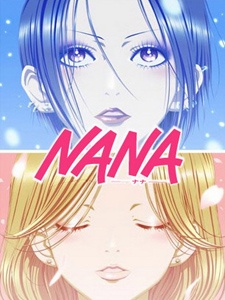
Departing from their respective hometowns, two young women with identical names are brought together in their pursuit of new beginnings. With their hearts set on going to Tokyo, Nana Komatsu dreams about blissful love, while Nana Osaki aims for a successful music career. The former has a cheerful and friendly nature, but her naivety has steered her romantic life astray until she meets her dependable boyfriend—Shouji Endo. Without letting herself be dismayed by Shouji's decision to study in Tokyo, Nana works hard to earn enough money and follow him there. Meanwhile, her namesake is a solitary punk vocalist whose impassioned romance with her band's bassist, Ren Honjou, comes to a sudden end. Though heartbroken, Nana bravely looks forward and travels to the capital with the ambition of becoming a recognized artist. Shortly after they arrive in Tokyo, the girls cross paths again due to an unexpected coincidence that ultimately leads them to live under the same roof. As they grow closer, the two strive to support one another amid their struggles to forge a future for themselves. [Written by MAL Rewrite]
Main
Main
Supporting
Supporting
Supporting
Supporting
Supporting
Supporting
Supporting
Supporting
sabermoon
August 19, 2008
Yes, I was initially drawn to NANA by Paradise Kiss. After having watched all of ParaKiss in about a day, I was left craving more of that special flavor of drama and the striking art style. However, I was not prepared for the treat I was in for when watching NANA. Story- What really struck me about the story was how the two parts of the story are weaved together. The two main characters' lives and personalities are so strikingly different that when they meld, it is truly something beautiful. The span of the story really helps one feel like they go somewhere, accomplish something, while watchingthis show. Once they intertwine and effect each other, that's when the story becomes something special. The drama, at times, feels like it is just taking soap opera cliches from the book, but for a change, I don't mind. The way it is written gives the show a feeling of reality, and the trials they face are compelling and moving. Art- I love this art style. It isn't anything you would see normally, and it never gives you the feeling that they had a low budget or were ever lazy. The detail and color is enough not to be too distracting, but enough eye candy to hold you to it. All of the characters are visually appealing, and even though some may say its hard to get used to, I love it, and had no problems at all. Sound- Its a show about music, right? So the audio must be pretty impressive, and it doesn't disappoint. Anna Tsuchiya and her gritty voice sang perfectly as NANA Osaki. I always enjoyed listening to the opening and ending themes. My personal favorite was "Kuroi Namida," more of a melancholy song, but the gritty love song, "Rose," was another one of my favorites. OLIVIA was a nice contrast to ANNA. Her voice was a bit more smooth and feminine, soft, but still strong. The first ending song, "A Little Pain," was my personal favorite of hers, because of its beauty and the sadness it bares. I always looked forward to it at the end, hearing the opening riff within the last couple lines of dialogue. I also really enjoyed the voice acting. I never at one point thought that the voices were annoying or wrong for the characters. The darker characters, like Nana Osaki and Ren, had voices that could carry that impression, while the cuter sweeter characters, like Hachiko, also had appropriate voices. Character- This is where the show really shines. Without so many understandable and meaningful characters, this show wouldn't be nearly as good. The story itself is meant to contrast the two women, and it does that amazingly. The growth of these individuals is clearly evident, and does the 47 episode length justice. At times, the choices they made made me angry, but it is then that you realize how nicely human flaws are present here. Everyone makes mistakes, and this slice of life should be no different. All in all, this is a really enjoyable show. I tore right through it, and despite the length, was left wanting more. With rumors of a season two, I can't wait to see where this show may take us next. With such personable characters, emotional music, nontraditional and beautiful animation, and the evolving story, I could definitely watch this one a next time around, and am dying to know where these characters go.
Licorice
January 24, 2010
"Say, Nana... Do you remember the first time we met?" These words are the introduction of the beautiful world of "Nana". Ai Yazawa is probably the most convincing shoujo manga writer ever. With colourful, realistic characters, breathtaking events and just a pinch of music she creates a world in witch every girl can forget about reality and fall into the embrace of romantic fantasies. One of the best things about "Nana" are the characters - we can actually see the reflection of ourselves in some of them and believe, that someone like that can really exist. This is proof that you can make a good animewithout the conventional tsundere, moe or annoying childhood friend. One thing I didn't like though is Hachi's personality. Her behaviour at times is despicable. Mainly because she has no ideals or dreams (except getting married witch is pretty boring compared to the rest of the characters). The story is also one of Nana's strong points. Ai Yazawa worked really hard on it, and did her best to create a realistic world so that the reader can almost become part of it and experience it emotionaly. Even though the plot is a typical shoujo tearjerker (with a bit of music) it has that magical something that makes you cheer unconsciously for some characters and experience emotionally some events almost as strongly as the characters themselves. Another good thing about the story is that it exposes the hard, cruel reality, which has no happy endings and pure loves. Yazawa-sensei gives her characters a big imagination (especially Hachi) But the world they live in is just like ours. As for the art, it wasn't that impressive. It annoys me how all the characters are so thin and tall. Other that that I think the art matched the story pretty well. There were lots of details regarding shadows and highlights. That's in order to underline the mood of certain moments, mainly in room 707. Nana has one of the best soundtracks I've ever heard. The openings and endings were songs by the 2 fictional bands in the show, witch was a brilliant idea imo. Olivia Lufkin and Anna Tsuchiya fit the characters perfectly. Nothing much to add here: the music in Nana is brilliant. Period. Overall, Nana is a must-see position for shoujo-fans. It tells us a lot about life, it's hardships and also teaches us an important lesson about the mistakes, that we shouldn't make. This is my first review, so please don't be hard on me ;)
algelic
September 5, 2007
One of the things I like to see the most in anime is how they portray relationships. I’m a sucker for romance, but I hate the cheesy stuff you usually see in typical shoujo anime. Sometimes you’ll find an anime with realistic characters, with the typical flaws of human nature, and usually people love them. We can identify with them. Like in Evangelion many people who have dealt with depression could identify with Shinji (in some levels…). For those of you who have watched your share of anime about love/relationships, I bet you could identify somehow with “Bokura ga Ita”, “Kimi ga Nozomu Eien” or“Kare Kano”. Or at least you felt connected with its characters. I have watched them all and know what I’m talking about. Recently, I finally sat down and watched “Paradise Kiss”. It’s a short (12 episodes) anime that, to make it short, is about relationships and growing up. I was impressed by its maturity. The art style took a while to get used to, but afterwards I loved it. After watching it, I decided to watch “Nana”, which is by the same author and deals with similar issues. Synopsis: “On board the train to Tokyo to meet her boyfriend Shoji, Nana Komatsu ("Hachi") happened to sit beside Nana Osaki who was traveling to Tokyo to fulfill her dreams of becoming a musician. The vocalist for her punk band "Blast", Nana aims for a major debut for "Blast" in Tokyo where her boyfriend, Ren, is the guitarist for a popular band "Trapnest". Sharing the same name "Nana", both girls quickly form a bond of friendship. Their paths cross again when they encounter each other while searching for accommodation in Tokyo. Eventually they decide to live together in the same unit and this further strengthens their bond as the two "Nana(s)" go through their love lives and career.” – AnimeNewsNetwork Story (10/10) I almost have no words to express how it made me feel. It’s amazing. Incredibly realistic and moving. I started watching it without knowing a thing about it (not even synopsis), though the title “Nana” sounded familiar as something popular among anime fans. The anime was broadcasted in 2006, lasting 47 episodes, but the manga first came out in Japan in 2000 and is still ongoing. The concept itself isn’t anything too extraordinary. People living together, people falling in and out of love, people trying to make it in showbiz and other stuff. You could say it blends many overused ideas, then twists them around and reinvents them, transforming itself into a completely original and brilliant idea. And it contains romance, drama and comedy, but the transition between them is really well done, so it doesn’t feel weird. What really makes “Nana” shine is the incredible character development. The evolution of each character’s personality and relationships with other characters. The things we watch them go through seem so real, like we’d probably make the same mistakes and choices as they did. No one is perfect – that’s a fact. We often think to ourselves “If I was [him], I wouldn’t have made that choice”, but the truth is we are lying to ourselves. We are insecure, emotional beings, that often ignore rational thought and make reckless decisions. “Nana” is so realistic that it’ll blow your mind away. This is a long series, but it’s not hard to watch. In the first episodes, the action often switches between the actual time and many flashbacks, but they really are important to understand a character’s background. At some point you might get the feeling that they’re repeating the flashbacks, but don’t worry. This isn’t a filler-filled series. In the end I felt that the story was really well told. But they leave you in a sort of cliffhanger… because the manga isn’t finished yet. But they made it more than obvious that at some point there’ll be a second season of Nana, so don’t worry. In fact, I loved watching this and the way it ended wasn’t too frustrating because I’d just experienced an awesome series. Visuals (8/10) The way the characters look might be a little hard to get used to (at least imo), but I really like the art style. I don’t think there’s anything too impressive or revolutionary about the visuals here… which is a good thing. I think the plot alone would be enough to hold the audience and maybe if they’d done something too extravagant visually (*cough* Air *cough*) the viewer would get sidetracked from the story itself. I think the animation was very fitting for the anime. The animation studio is Madhouse, which was also responsible for “Beck”, “CardCaptor Sakura”, “Paradise Kiss”, “Death Note” and a bunch of others. Audio (9/10) I watched the episodes with the original Japanese voice actors and English subtitles. As for the actors, I think they were perfect for their roles. KAORI gave her voice to Nana “Hachi”, which suited the character perfectly with the childish and girlish tone (but thankfully not an annoying high-pitched voice). For the tough rock singer Nana Osaki we have Romi Paku, who also voiced Edward Elric in Full Metal Alchemist. They knew that “Nana” would be an instant success, so they gave it a cast of famous actors and spared no expense. At first this seems like an anime about music, but it doesn’t play that much of a part here. I mean, we hear lots of songs, but the story isn’t focused on showing us the making of the songs in detail. Compared to “Gravitation” or “Full Moon wo Sagashite”, music wasn’t as important here. I loved the songs. The fictional bands’ songs are used as openings and endings. OLIVIA is the singing voice of Reira, and we hear many songs from her. My favourite was “A little pain”. It was the first Ending, and since each episode ended on a relatively sad tone, the song fit perfectly. When I heard the first words of the lyrics (“Travel to the moon…”) it almost made me want to cry. Characters (10/10) As I’ve mentioned, the characters are the best thing about the anime. We get the chance to know a bit about each character’s history, motivations, thoughts and desires. They are so realistic that we just can’t help but being sucked in by them. As the anime progresses, the characters gradually grow. This is a very “slice of life” genre of anime, so we watch them growing up. I love how they all interact and deal with their decisions. I love how they aren’t perfect… but as flawed as humans should be. Overall (10/10) I loved this anime and it will definitely become one of my favorite series of all time. I feel like watching it again and again, but since it is 47 episodes long and makes me very emotional, maybe it’ll have to wait until I have more time. I don’t feel like reading the manga for the sole reason that it is too damn long. If it weren’t for that, I would have already ordered all the volumes. But I gained new respect for the mangaka Ai Yazawa. There are 2 live-action movies for “Nana”. I haven’t watched them yet, but will soon. I’m curious as to how they squeezed all that plot into 2 movies (I’d say they have enough material to make a whole 11 episode drama or maybe something even longer). The anime will have a second season… I’m sure of that. But for that to happen, we’ll have to wait until the manga is finished. Hurry up!
Flawfinder
July 14, 2015
Nana is one of those acclaimed anime that everyone seems to know the existence of, but very few people have ever actually watched. The fact that it’s almost 50 episodes long is a bit of a turn-off in of itself, but even the people who have seen it barely discuss the thing anymore. Very few “favorite anime” lists that I’ve read actually include it. It’s up there with Great Teacher Onizuka, Hajime no Ippo, and most of the Major anime in terms of high-ranking MAL darlings that the majority of MAL users will go “oh yeah, I’ve heard how good this thing is. Better putit on my PTW list that I’m never going to clear out” or “that was a really good show. *Forgets about it after a few months*”. Said lack of enthusiasm along with the fact that it’s a relatively long show directed by Morio Asaka aka that flowery director who’s so slow-paced in his storytelling that even the stuff of his I’ve actually liked ended up feeling underwhelming in the end, is the main reason I never watched Nana. But part of said reason was just that I wasn’t interested. I never even cared enough to learn what happens in the show other than the fact that it was about two women named Nana who become friends and deal with relationship issues. And as much as I like the Paradise Kiss anime, part of its appeal was that it was really short. Eleven episodes, which admittedly made manga fans a bit grumpy considering an important male character and some story details got shortchanged as a result, but if it meant less boredom caused by dead space, than I was all for it. But even with the huge amount of summer anime I keep up with riding my ass like a sexual metaphor that I’m not going to elaborate on because it would be too nasty even for me, I had free time to surf Netflix for new shows to get into. And after my failure to get into the Netflix originals that I tried, along with browsing the anime selection and noticing Nana was on there, I decided it was as good a time as any to watch it and ended up finishing the show in less than two weeks. You have no idea how much free time I sacrificed regarding other activities I could have been doing - like finally playing Bioshock Infinite for one - to accomplish that, especially since I don’t actually love Nana. Not that I don’t think it’s good. It is. But if you were to ask me if I wanted to rewatch in the future, I’d just shove my Paradise Kiss DVDs in your face, and not because I managed to get those really hard-to-find DVDs for a relatively cheap price and want to brag about it. Not just because of that, anyways. And yes, it is the pacing that’s the problem. I’m okay with taking a break in-between dramatic moments in order to set them up so that they’d actually have some impact, but not breaks that go on this long. The very first episode of the anime introduces our two twenty-year old protagonists, a happy go-lucky idiot named Nana Komatsu and a rock punk chick named Nana Osaki, by having them meet on a train during their move to Tokyo and end up becoming roommates due to various circumstances. I was expecting the next episode to showcase the two getting to know each other whilst revealing their motivations for moving to Tokyo in the first place, until I read the Netflix summaries and discovered that the next five episodes would flashback to their pasts in a “how we got here” sort of way meaning we wouldn’t get any meaningful interaction between them until half a one-cour series has passed. And to top it all off, they rehash the opening episode in Episode 6, which makes me wonder why you needed a prologue to begin with. I mean there’s hooking the audience and then there’s just baiting them with cookies for breakfast. It’s an extreme, but by no means the only example of this sort of pacing dragging the show down. Certainly not the worst example from the show either. Not that the downtime is dull. It’s just pretty average. If you’ve seen one story about a quirky female trying to make friends and ends meet, then you’ve seen Nana’s light-hearted stretch of episodes. The only thing that makes it tolerable compared to most go-nowhere shoujo series is how despite Nana K trying her hardest to be independent, she’s completely dependent on others, which becomes increasingly problematic on the people surrounding her as well as herself throughout the series. This leads to a decently engaging climax ⅓ of the way through the series when said hypocrisy pushes her boyfriend towards another woman, but I couldn’t quite shake the feeling that I had just watched a romance movie that was the first part of a trilogy and stretched out to three times the length it needed to be. It wasn’t until Nana O’s circle of friends, including the band of which her former boyfriend is a member of, shows up that the average-to-engaging ratio started to tip more towards the latter. But even then, it has its slow moments. Whilst I appreciate Nana for having buildup so that I could actually care for the “will they or won’t they” part of the story rather than act like a man in his forties who’s desperate to lose his virginity, I could have completed an entire workout routine in the time it took for the buildup to go somewhere whilst still having enough time to cook some meat afterwards. The absolute nadir of the experience was with the story’s final arc, where after Nana K makes a mistake that causes her and everyone to face their own demons in a heart-wrenching string of episodes that rivals Kids on the Slope’s final stretch in terms of emotional intensity, the show then spends the next ten episodes trying to have the characters go on with their lives with each episode having about 3-5 minutes of compelling drama and 17-20 minutes of “whilst I like these characters, this doesn’t further the story in any real way” I know a bunch of people were sour on Kids on the Slope for skipping an entire volume of the manga - amongst other things - but please explain to me what showcasing the actual process of Kaoru moving on from wrecking his entire life would actually add. Sometimes, some things are best left to the imagination and you just need to end the thing right then and there. And just to make things worse, nothing even comes out of all that buildup other than a reaffirmation and closure of old plot threads that whilst engaging, don’t really lend any sort finality to the show as a whole. Without giving too much away, there’s this weird and unnecessary use of time skip before it cuts back to the present with the characters just acting like they usually do, even when major events occur. And whilst a hard decision is made in said finale, said decision is undercut by the timeskip showing that everything is going to be alright in the future, rendering it completely pointless. It feels like the anime ended right in the middle of the story, and whilst I understand that Nana’s source material hasn’t concluded even to this day - although the chances we’ll ever get a conclusion from the author at this point are about as likely as Iggy Azalea ever being relevant again after her breakdown - you could have at least had made some sort of big deal out of things. At least achieve a small last-minute accomplishment? No? Alright then, but don’t expect me to read your manga in order to find out what happens next. Especially since there’s a certain car crash that happens later on that I think I’m better off pretending doesn’t exist. Am I banging too much on how unnecessarily long I found this series? Well it’s the most unique thing I can say about it, because like me, even if you don’t know what happens plot-wise, I’d be very surprised if you didn’t have any idea what Nana was actually about. The whole story is somewhere between Beck Mongolian Chop Squad and a Seo Kouji manga in that the majority of the characters are working towards making it as a punk band whilst dealing with all sorts of heartbreak and truths regarding how complicated relationships can get. All the characters are adults and even the more assholish members of the cast are likable, which automatically makes Nana better than those works. And it doesn’t hurt that it focuses more on the latter than the former, which I prefer because my interest in the inner workings of how a band operates is virtually nil whilst my interest in the inner workings of how a relationship works is higher than the peak of Mount Olympus. Whilst there are some weird plot contrivances to further the story along, complaining about that in a drama is like complaining they’re emotionally manipulative or comedies are funny. If you don’t like the very idea of them, then you shouldn’t be watching anything from the genre to begin with. You don’t see me watching Bollywood movies for a reason you know. And whilst some of the plot points are eerily reminiscent of Suzuka, they work here because the drama fires in all cylinders rather than play favoritism towards one weak direction. Everything that happens is a result of the characters’ personalities. Events that happen to one character also affects those around them, causing all involved parties to face themselves along with their circumstances. Nobody is a true bad guy, even when it’s clear that one side is more wrong than the other. Even the high school kid who demands money from the girls he sleeps with is a lot nicer in practice than he sounds right no--get out of that chat room! I swear he’s a decent guy...sort of. And most of all, the romance and relationship stuff is ultimately just a tool for larger issues. Sure we’ve seen said issues addressed before: responsibility, personal luck, inner demons, etc. But those sorts of issues are never going to stop being relevant anytime soon, no matter what your age is. And as long as that remains true and they’re explored in a way that reminds us of said truth, I’m always going to find the stuff that Nana represents intriguing. That is why Nana continues to be remembered as one of the anime greats despite not being popular in this current generation of anime fans. Which makes it all the more frustrating that the show is to romance stories what Monster (sans conclusive ending despite the ambiguity of it all) is to crime stories. As well-written, decent-looking (although Nana’s actual animation is pretty terrible), nicely dubbed, and overall enjoyable both Madhouse productions are, my desire to ever revisit them is severely tempered by their long lengths and the inevitable dead space and repetition that comes from this sort of serialized storytelling “should have been a movie” format. Maybe if the comedy during Nana’s lower-quality stretches was funny, the pacing wouldn’t have been so much of a problem. But all the jokes come from “How to write shoujo comedy 101”, which is about as funny as a kid from a PBS show throwing a tantrum during the middle of a Lifetime drama. Sure it sounds like a good laugh on paper, but so does page 67 of the Kama Sutra. And don’t blame me if your partner never wants to sleep with you again after that experience.
Fleure
April 13, 2018
The background of NANA feels like an endless white night. Things seem to be continuously in motion; beginnings and endings wrapped up in an infinite wave of falling snowflakes waiting to melt into each other. The forefront sits in perpetual twilight; characters seem to be eclipsed by their own shadows with barely enough to catch a glimpse of who they are. The entire landscape depicts the frigidity of life rising from frosty gales to a calmer ether, only to revert to stormier lands. Movement here isn’t linear. Nothing is. NANA, as a whole, is pure kinetics; an explosion of emotional energy circling, clashing and alwaysin motion. This is all infused as a careful exploration of fate, transience, and relationships in a modernized setting. NANA as a work fully invokes the power of pathos while taking “drama” to new heights. Based on the acclaimed manga by Ai Yazawa, Studio Madhouse adapted NANA into a 47-episode series. The story follows the pivotal journeys of two incredibly “different” girls bound by the same name and circumstance. Nana Osaki and Nana Komatsu are planets apart yet exist in the same sky, tethered by each other’s gravitational force. Nana Osaki is externally a cool cat, adorned in Vivienne Westwood – the quintessential punk queen with a voracity for musical success. Whereas, Nana Komatsu, who garners the nickname “Hachi”, is a dreamer who sees, breathes, and dreams in pink; her ambitions don’t extend beyond finding her fairytale romance. Both are headed to Tokyo to pursue their various dreams (one to establish the perfect domestic life with her boyfriend, while the other wants to form her band and actualize her musical ambitions). Fate brings these two together as roommates and the narrative unfolds to reveal the tender anatomy of relationships and the power they have to shape people and their respective worlds – for better or for worse. Then, what makes this work more than a seemingly run-of-the-mill drama about two girls discovering the pains and gains of life? What does it possess that other philosophized-by-life dramas don’t? The answer is simple: understanding. Yazawa writes candidly about people and the world, not as a spectator, but as someone clearly living in it. Nana portrays an acute understanding of how people are and their complexities that are simply written off as natural proclivities. There is reason even if Fate seems to play some indiscernible part. There is meaning even if chaos seems to rule it out. However, what’s impressive is not the mere incorporation of “understanding”, but “HOW” the work manages to create a stylized drama that is as visceral as the cold touch of the wintry night that it starts on. Even with its luridly icy sensation, NANA is never detached or impersonal. It may be highly temperamental, but it never indulges in its own despair. It’s often cold but driven by the innate warmth of its living, breathing cast, who aren’t just personifications of suffering or “insert-theme.” This is partly what makes it sublime in its approach to drama. The drama isn’t a descriptor or a simple add-on. An event doesn’t happen so it can be “dramatic.” It doesn’t happen only in effect. There is an ebb and flow; a serpentine path painted with emotional uncertainty. The characters drip with it, but the difference is that they own it. There is accountability here. Events happen for the characters as an extension of them. They don't occur only as a platform for causality (which makes all the difference). Considering how easily emotional appeals can be manipulated to rehash emotional evocations, NANA remains earnest. There is a purpose in isolating feelings; to let the characters lather in them, not just merely show them; to explore them to such a degree that the feeling/the state itself becomes autonomous. Loneliness becomes its own character, as does love, as does happiness. It is as transient as it is eternal. The characters are so refined that it’s hard to separate them from the elements that define them. Drama is all about nurturing these humanistic nuances and intricacies in its own habitat. Yazawa knows this all too well. Instead of showing these conditions as mere outputs of a decision or situation, they exist on an aqueous spectrum blurring the lines used to divide them AS a part of the being that gives them shape and substance. Then, causality only becomes a mean, just like Fate, just like chaos, not the end. Ultimately, that’s what makes NANA idyllic as a drama, and even more so, as a story driven by life. Holistically, NANA showcases its prowess for drama through natural rawness, unflinching realism, and scope for understanding its subject matter(s) on a cellular level. The picture is impressive, but what makes it a pinnacle of its kind are the details – the pieces of storytelling that it utilizes to convey its narrative. First, there is perspective. Works revolving around the musings of “life” usually have a philosophy driving their vision of it; Nana has perspectives. What the series employs are contrasting, continual planes that converge with each other to give a wholesome view through Nana and Hachi. Their interconnectedness matters more than their seemingly opposing natures. The perspectives confess, observe, share, and exploit the hearts of the events and the characters. The episodes start with a stream of confessional thoughts spilling onto the screen and morphing into the events that transpired them. Structurally, this does two things: One, it offers balance. Two, it contextualizes. This approach helps establish reliability because there are two narrators. This naturally aids in mitigating the problem of the unreliable narrator. The image becomes complete even if it is in broad, disconnected strokes. This show is unwavering in its personalization, and both perspectives will establish that with an uncanny persuasion. Additionally, there is the context. The synergy between Nana and Hachi creates its own ecology. This isn’t something that is easily fabricated by romanticizing the power of friendship. It is pure symbiosis, of two lives reflected through a continually cracking mirror. As the story progresses, the bifocal gaze of the two melds into one. Even the apparent contradictions between the two begin becoming whole. At first, Nana and Hachi seem to complement each other but gradually start inverting their traits. The evolution of each character is highly dependent on this progression which is why context is crucial. Hachi and Nana, along with the supplementary cast provide this even when the truth is far from being transparent. Although, getting to the truth feels trivial anyway. What the structural decisions do at their very core is reinforce the means (never the end). The importance of every word, emotion, and event that happens is preserved and with it, parts of the individual and their entire world for that moment in time. That is what matters. These moments where time comes to a standstill and that instance singularly defines the world. Incepted through bursts of chemical reactions - frozen yet in flames - quietly burning everything around them. A tempest consumed by shadows of the past and uncertainties of the present. Where entropy orchestrates all and everything seems to fall into contradiction; where dreams are simply just dreams; where expectations are merely mesmerizing mirages in the distance; where love isn’t a fairytale; where the importance of understanding each other becomes more important than anything else that could ever exist. All of this is the essence of NANA’s characters. Hachi, Nana, and the rest of the cast are crafters of their own moments. They coat the ashen night-sky with them. Constellations composed of moments; visual strings connected by the last and the next, in a cycle of change. It is through these anecdotal glimpses that these characters take form. The characters embody this candid usage of memory, singularity, and understanding. There is much emphasis on individual events and actions. These subtleties develop to reveal how the characters are constantly at odds with themselves (even when the tone seems to be lighthearted, and all seems to be well). This is why the symbiosis between Nana and Hachi becomes so vital because their moments are not only reflected in each other but formed by each other. Additionally, it’s their relationship that breaks the feigned insularity of the other characters. That doesn’t mean they don’t have their own identities as does the rest of the cast. Everyone has a dynamism to them: their own palettes, shades, and gradients. Good. Bad. These words have no place here. Bound by insecurities, identity, and passion; constantly seeking themselves in a game of hide-and-seek, these characters are more than just adjectives and a system of traits. The show doesn’t waste time in judging its characters because it has so much to say about them. Even then, the one that seems to be the most misunderstood and unfairly scrutinized is Hachi. She is by far the most superficially flawed character. That is never shied away from. That makes her easy to hate or dismiss as a standard shoujo lead. Hachi is perplexingly idiotic. She flings herself into the worst situations and finds herself in a never-ending state of ambivalence. Not only that, she creates disharmony between many other characters like Nana and her band members. Unlike, Nana who is easily likable due to her strong candor, intense personality, and devotion to her principals and goals, Hachi is unstable, unreliable, and utterly whimsical. What really substantiates her as a compelling character is how she is unapologetically grounded in her humanistic tendencies and flaws. This gives her a kind of awareness that the other characters, except for Yasu (Nana’s longtime friend and drummer for her band), just don’t have. Everyone acts like they are in control, regardless of how fragmented their reflection is. Where everyone else is running from the phantoms they fear, Hachi absorbs them. Nana is about as broken as they come but constantly hides her inner turmoil; stubbornly trudging through hardship and heartbreak. Pride means everything to her. Nana survives by hiding her true feelings, while Hachi lives by constantly embracing them. Hachi is fundamentally an honest character. She subconsciously recognizes her lack of control and her predispositions. Though, she often seems to be driven by her pseudo-idealization of romance which often recycles itself in ways worse than the last. She owns up to her wretchedness and attempts to reconcile; to change. Though, this doesn’t make her immune. Her awareness is often drowned out by her naivete resulting in incrementally worse situations (almost to the point of becoming stuck in a self-prophetic rut). Still, amidst it all, she remains transparent. There are no contrivances necessary with her. Transparency can be far more compelling than clarifying opaqueness, for what lies under the milky sheath is never truly clear. Conclusively, the characters are superb because they are etched with all the shades of humanity. The physical and psychological are all accounted for. Character and emotion; feeling and action; change and stagnation; a sincere lust for meaning and acceptance are all encompassed by these characters. The best part is that there is no room to judge. The hearts of these characters beat in such sync with our own; that the only thing that’s left is empathy and understanding even if it shrouded in frustration. All this is packaged visually by Madhouse. They did an exceptional job adapting this series. There is a certain grittiness to the visuals and atmosphere that keeps the show from wandering too deep into the typical shoujo aesthetic. The series depends heavily on delivering rawness and realism. Otherwise, there is a nice balance of bubbly, bright scenes (in all their shoujo glory) contrasted with the necessary grunge required to keep the actual spirit of the story intact. The characters' idiosyncrasies are also poignantly preserved. The aesthetical and auditory direction kept the maturity of NANA blossoming throughout the show, despite its shoujo dispositions. One further thing to note is that the manga is still publishing. The anime ends on a controversial note. For many, it leaves much to be desired. In the context of the story and especially how its told, the ending works. The story moves retrospectively. It doesn't bring the necessary closure needed to substantiate all the complexities it introduces, but it provides enough insight into what's important. It leaves room for more because there is more, but keeps the sanctity of the story still flourishing onwards. Another criticism it has received is its slow pacing. The pacing is slow as this isn’t a show focusing on high-octane plots. It is about people. It seasons itself over time, maturing with its characters, and their lives. It never feels redundant nor inflated. There are silly subplots but they aren’t superfluous; for they always work in tandem with a character. As aforesaid, the show never treats anything as an end. Sometimes things happen with no end and sometimes things spontaneously end. The point is that there is something concrete beneath it which ultimately sheds light on those involved. That is what drama is. Time lost in an emotive frenzy. Moments molded from remnants of what passed. Transformed into what is to come. Even in the calm, something moves. The scenery here is indeed a bit too chilly sometimes, laden with the melancholy of yesterday and the loneliness of tomorrow. Even so, the present waits in an ethereal stasis; attempting to understand itself. Remembering, being, and accepting; it’s all here, often presented as unyielding blizzard internalized by those who live it. As the single snowflake finally dissolves upon touch into a pool of white, to become something more than just one, those walking in NANA also find themselves inseparable from those around them. Nothing is perfect here. Nothing needs to be. For what happens here is relentlessly flawed yet at the same time, essential and real. What happens here is, life.
Rank
#119
Popularity
#295
Members
772,939
Favorites
35,133
Episodes
47