
Windy Tales
風人物語
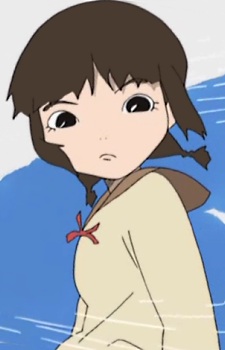
Nao, an 8th grader, is one of the only two members of a Digital Camera Club, where she also serves as the manager. It's a mystery that she shoots nothing else but the skies and clouds. One day, she finds a cat on a rooftop where she usually shoots her camera. It's a cat that knows how to manipulate the flow of a wind. Shocked to find a strange animal, Nao loses her footing and falls off from the rooftop! Miki is the other member of the club, and also Nao's best friend. Mr. Taiki is the teacher who's taught the cat how to manipulate the flow of a wind. Ryoko is a girl who has a huge crush on Mr. Taiki. And there's Jun, who helps Nao and Miki look for a cat that can fly. Then, there's Yukio, who is the widow of Mr. Taiki's deceased brother. On the outskirts of this big city, a town off the "Wind Handlers," has been formed—and a mysterious Wind Festival is about to begin... (Source: Production I.G)
Kopanda
April 21, 2007
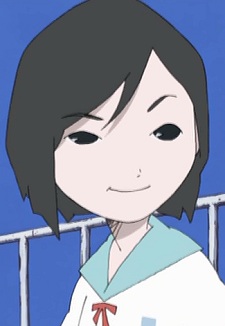
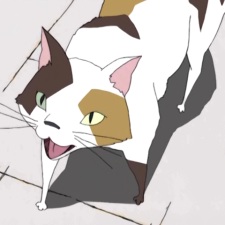
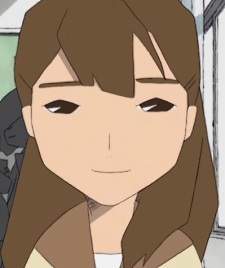
First off I will admit that I am softy for Slice of Life series. My top five anime series are all about teenage girls exploring day to day life and Windy Tales (Fuujin Monogatari) is one of them. Immediately the unique animation style struck me. Why is a story about a high school girl who likes to take pictures of clouds drawn in such an obscure way? The animation at times accentuates certain features we would not normally notice and obscures other features making the characters look a part of their environment. Whenever I see pictures of Windy Tales I get overjoyed, they satisfy ever cornerof my eyes as normal anime characters don't. There's no sparkle in their irises or shiny wetness to their hair, they look sharp, drawn and fit like puzzle pieces in the background. I see this more as a good thing, it adds a spice and an absurb warped view on the story as if we're looking through slanted glass. The stories in each episode are heart warming but not over-the-top or dramatic at all. They don't inspire or teach, but they settle. I feel calm and completely pacified after each episode but nowhere near bored. The placement of the music makes me feel like I'm lost in a happy memory and the nostalgic feel is superior to anything Azumanga Daioh ever achieved. I wanted to rest my head while watching but I didn't want to sleep in case I missed a beautiful still shot of clouds reflecting in windows with that amazing track playing, it's those small seemingly insignificant scenes which makes Windy Tales so special to those who want to appreciate it. The characters themselves are sweet, cute in a different way to girls in Manabi Straight!, and all so familiar. I would be lying if I said Windy Tales had no sentimental effect on me. Nao looks almost exactly like my older sister and in fact all the characters look similar, their almond shaped eyes and teddy bear like mouths, they all look kind and mature but at the same time very innocent. I would add other reasons why the series is special to me above all others but then you'd assume it's an acquired taste. Well, it is. Not everyone will like this, but if you're one for very niche anime then this one is a diamond in the cave. There are moments where I feel like I'm a part of the conversation, or a part of the memories. Episode 10 has some of the most astounding scenes I've experienced in anime and episode 5 is my personal favorite episode from any anime of all time. Everybody should watch it even if they don't intend to finish the series.
Tien
November 9, 2014
Fuujin Monogatari, or Windy Tales, was a real treat to watch. It's a very experimental anime, which is a rarity in the slice of life genre. Right off the bat, one will notice that the art style is seemingly messy and hastily drawn. In fact, it could even be called ugly. However, I found that it complemented the wind element of the show and meshed quite nicely with the animation. What struck me most about the art were the character designs: those tiny hands and feet, as well as those angular eyes that give the characters a distinct Asian appearance. I was also impressed by howhighly expressive the characters' faces were. Joy, surprise, and even fear were depicted very effectively, despite the rather simple facial features of the characters. Wind is the primary element that drives Fuujin Monogatari. Or rather, it starts off that way. During the first few episodes, the characters learn how to control the wind, but by episode three, these wind powers sort of fade into the background as the show becomes more episodic in nature. A more conventional slice-of-life show would have probably shown the characters using their powers in everyday situations, but we don't really see this in Fuujin Monogatari. Although the concept of wind control is revisited occasionally throughout the show, it mainly serves as a motif and is often paralleled with the occurrences and themes in each episode. For instance, the act of controlling the wind is often likened to showing responsibility and taking control of one's life. Of course, this is never stated outright; it's up to the viewers to catch the subtle messages behind an event or a character's actions. Although the show is soothing and even lighthearted at times, it's not afraid to show those darker moments in life. For example, one episode depicts the change in attitude of a character who was involved in a near-fatal motorcycle accident. Another episode contains a metaphorical scene in which the act of suicide is illustrated with haunting imagery. Fuujin Monogatari is honest in its portrayal of events — a refreshing trait in a genre full of optimism and carefreeness. As with all slice of life shows, Fuujin Monogatari is driven by its cast, and fortunately the characters here are quite likeable and respectfully represented. The main character of the show is Nao. Observant and thoughtful, she is one of only two members of her middle school's photography club, the other being her best friend Miki, who is more assertive. They are eventually joined by a boy named Jun, who becomes Miki's love interest. He's a bit of an airhead and provides much of the comic relief in the show. Although the characters don't get too much development, their personalities do get fleshed out and they feel delightfully genuine. I mean, Nao considers Benjamin Franklin her idol! Even the adults in the show, such as Taiki and even Nao's parents, are well depicted and play meaningful roles in several episodes. Oh, and I almost forgot to mention the flying cats, who have their own special moments. Another aspect of the show I enjoyed was the dialogue. It's subdued and representative of what people would say in everyday situations. After all, Nao and everyone around her are just normal people living their lives, and it's great to see that the dialogue is driven by their characterization and not by drama or plot. For example, there's one episode in which Nao listens to two adults talking about traveling. The conversation is very matter-of-fact, almost boring, but it provides a lot of insight into the adults' personalities. The music in Fuujin Monogatari is calm and very soothing, greatly enhancing the atmosphere of the show. There's the typical soft piano tracks, of course, but some songs incorporate bells and even the flute, which are very befitting for the show's wind motifs. In addition, the OP is incredible and captures the essence of the show very well. It's one of those OPs that you never skip. With all that being said, Fuujin Monogatari is not a perfect show. The characters' wind control powers are never really explored in depth, which may be off-putting. Episodes vary in quality, which is to be expected of an episodic series. While I don't consider any of them "bad," there are undoubtedly some episodes that are weaker than others. Also, the concept of wind is not incorporated in every episode (and in some, it's very loosely connected at best), making those episodes seem thematically detached from the rest of the series. From its unique art style to its down-to-earth nature, Fuujin Monogatari is worth a watch for anyone who's interested in something a little different from the typical slice of life fare.
Sneha
July 28, 2009
Wow, if ever an anime can leave me speechless, this would be it. The reviewer before me has done such a good job that I really don't stand a chance now do I? lol I'm just going to add that this anime has the most beautiful score I have ever heard. No it's not everyone's cup of tea (I know the animation style can put many people off; though personally, I find it cute and very interesting), but honestly, I could watch it without visuals or words - the music is just that captivating. So go on, if you're in the mood to watch somethingintriguing that will leave you feeling calm and strangely content, check this out. It's no masterpiece, but maybe it will have as special and mysterious an effect on you as it did on me..
NavyCherub
February 5, 2015
Slice of life as a genre has a small problem. By itself, there is not much to base an entire show on – there has to be some sort of focus, a setting or concept that allows for individual stories to exist while also providing a solid base that pulls all of the ideas together. Fuujin Monogatari takes its identity as an episodic slice of life show to heart, almost to a fault – the individual episodes contain themes and ideas that are usually interesting and sometimes even compelling, but there is just about no connection between episodes thematically. The consequence to this is thatFuujin Monogatari is a show of widely varying quality. Not to say that there is not a string tying the show together, loosely at least. That string is the titular wind, which the main characters (among others) can control at will, for some reason. This seems like it might be an important mechanic that would set Fuujin Monogatari apart from similar shows, such as having the main characters using the wind powers in otherwise normal situations to make them more interesting. In execution it is actually not so. Instead, the show offers a low key usage of the wind powers, mostly used for interesting visual effects while the story and the characters take breathing time. This is also useful for the viewer, as this downtime provides a relaxing section of an episode where one can reflect on the events that have occurred; on the other hand, these scenes could be replaced by just about any sort of relaxing or visually interesting scene, making the wind mechanic seem like little more than a gimmick in the end. A very pretty gimmick. The art in the show is a juxtaposition of purposefully rough character designs and almost impressionist background art, which works to a good effect and is most definitely the strongest part of the production. The minimalist design of the characters allows for exaggerated yet meaningful motions and facial expressions, and they also give the characters a definitively “Asian” look. There is not much detail in their designs; luckily, the show avoids characters looking too similar to each other by keeping the cast small, though in darker scenes where you can't see the color of their hair they look a little too similar. The backgrounds, though, are consistently beautiful. It's almost a shame that Nao is so obsessed with taking pictures of clouds, because the world of Fuujin Monogatari is lovely and detailed, contrasting in many ways the simple character designs – though they both share the sketchy, purposefully rushed-appearing aesthetic, keeping the overall feel of the show internally consistent, despite the huge difference in detail. There are also some cool visual ideas used sparingly in the show - portraying texts with handwritten-looking colored text on the screen, or a phone call by overlaying the characters onto each others' settings, or flashbacks and dreams indicated with characters filled in with a single color. On one hand I appreciate that it did not abuse these things, but on the other they feel a bit wasted, sometimes only being used once in the whole run. Similarly, the soundtrack and voice acting are lovely but subdued. This is a good thing – the sound is never overbearing, but is consistently supportive of the atmosphere that Fuujin Monogatari naturally builds. Voice acting is done in a subtle way, never overacting but also hardly ever relaying strong emotion, even when a scene calls for it, which is unfortunate. However, the most hit and miss aspect of the entire production is the writing. As I stated before, there is little consistency when it comes to theme. Supporting others, avoiding responsibility, and finding your worth are all examples of ideas that Fuujin Monogatari plays with, but none is given a decent amount of time before the next comes along to take its place. In this sense, Fuujin Monogatari tries to live up to its main character Nao's goal as stated in the very first scene – to capture the wind. Like the wind, Fuujin Monogatari moves and changes as it pleases. Consequentially, not all episodes are created equal. There are a handful of absolutely amazing, perfectly executed episodes, and it is not a coincidence that these episodes tend to make good use of the interesting visual style matched with an equally simple concept as well as Nao as a competent narrator, but there are many more flops, usually too self-indulgent to come off as meaningful. The episode about trying to get a perfect picture of a runner, for example, manages to use Fuujin Monogatari's strengths to much better effect than an episode about helping a momonga learn to fly, even though the latter has much more to do with the show's distinguishing idea. I should also point out an episode that takes place almost entirely in the nurse's office, featuring a fever dream contrasted by a completely normal conversation which utilizes Fuujin Monogatari's visual style to an extent never matched again. If only every episode was as simple and effective as that one, this show would be an instant classic. As it stands, though, it is a compilation of mostly uninspired stories interspersed with small moments of genius. If you are a fan of the slice of life genre, you will definitely find plenty to like in this show, but people less patient with the trappings of the genre will frequently have their patience tested.
ghosts-forever
September 5, 2015
Windy Tales is a slice of life anime. It doesn't try to be anything more or less than what it is, and that is what makes it shine. As a slice-of-life, Windy Tales premise is relevant enough in each episode to create interest, but doesn't overshadow the stories themselves. Although the main characters learn about moving the wind to their advantage, we don't see them use it to fight evil or get what they want. Instead we see them go through their day to day lives WITH this power. The power to move wind isn't the main plot, the characters are. Personally, I found this tobe a breath of fresh air. When a show has characters with powers, we don't think of slice-of-life. Instead we think of shonen anime, magical girl anime, adventure anime, anything BUT slice-of-life. Rarely is it we get to see a calm slice-of-life anime with powers in between, and it was very fun to watch it for what it was. The animation and art of Windy Tales is obviously very unique. One could even compare it to some of Masaaki Yuasa's works. The characters don't look like the typical anime characters, with small eyes, and their bodies looking like they were made up of shapes, sometimes uneven and rough. I personally loved the look of it. The art style was very innovative, and made it even more fun to watch the show. The Soundtrack was mostly in the background, barely there. It wasn't really anything new to listen to, and wasn't amazing in any way, but it didn't need to be. it was there to give atmosphere, which overall made me feel relaxed as I watched. The music was good, and fulfilled its purpose. The characters to Windy Tales, as stated above, were the main focus of the series. As such, each were fleshed out accordingly. Each character was distinct and entertaining. By the end of the show, each character would've grown on you by being themselves. Now, not EVERY single character got development, mostly just the main three, but those that did were the highlight of the show. Overall, Windy Tales was a pleasant take on the slice-of-life genre. The animation style was refreshing, the sound relaxing, and the characters enjoyable. Not every episode was enjoyable, there were some in the middle that were, at the very least, repeated themselves a bit too much, but most episodes were a lot of fun to go through. I highly recommend this show to people who like unique slice-of-life shows, as well as those who have yet to get into the genre. It has enough of the 'wind power' premise to keep one interested and entertained, and that was more than enough for me.
Ранг
#3409
Популярность
#5285
Участники
21,833
В избранном
142
Эпизоды
13