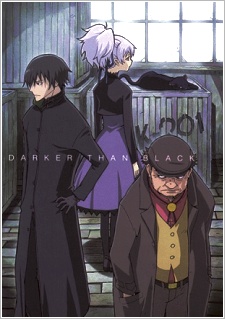

Darker than Black
Darker than BLACK -黒の契約者-
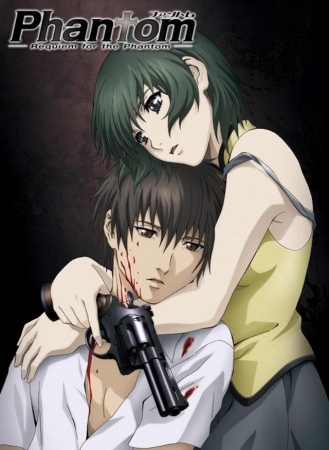
It has been 10 years since Heaven's Gate appeared in South America and Hell's Gate appeared in Japan, veiling the once familiar night sky with an oppressive skyscape. Their purposes unknown, these Gates are spaces in which the very laws of physics are ignored. With the appearance of the Gates emerged Contractors, who, in exchange for their humanity, are granted supernatural abilities. In the Japanese city surrounding Hell's Gate, Section 4 Chief Misaki Kirihara finds herself at odds with an infamous Contractor codenamed Hei. Called "Black Reaper" in the underground world, Hei, like his associates, undertakes missions for the mysterious and ruthless Syndicate while slowly peeling back the dark layers covering a nefarious plot that threatens the very existence of Contractors. From the mind of Tensai Okamura comes a sci-fi thriller taking the form of a subtle exposé on a war in which political positions and justice have no sway—a war waged exclusively in the shadows. [Written by MAL Rewrite]
Main
Main
Main
Main
Main
Supporting
Supporting
Supporting
Supporting
Supporting
Supporting
-Naami-
June 22, 2010
Darker than BLACK has grown rather popular on the net, gaining rave reviews, popularity by word of mouth and leaving trails across the forums and the net in general. With a show with such high acclaims it is only natural to expect a truly remarkable show. Funnily enough, it turned out to be one of the most unremarkable shows I have ever seen. Set in our time but in an alternate world where global warming isn’t the planets biggest threat but supernatural beings with unique powers are – these beings dubbed the name “Contractors”. They appeared the same time Hell’s Gate did; a mysterious forcethat covers Tokyo’s sky. Their powers come at a price and the wage is different for every Contractor. Rival organizations kill, back-stab, infiltrate, investigate and work together to uncover the mysteries of Hell Gate. Our protagonist is Hei, one of these Contractors working as an assassin/investigator for one these organizations. Together with Yin, an emotionless doll; Mao the talking black cat and Huang, a normal middle aged guy; Hei tries to investigate the mystery that is Hell’s Gate and locate his younger sister Pai whilst carrying out the orders/missions from the Syndicate. Oh, don’t think you’re going to get any more answers or plot revelation when watching the show. By the end of the series we’re left with the SAME standstill story and the SAME questions as the beginning: What exactly is Hell’s Gate? How did it get there? Why did it make people with supernatural abilities emerge? How did it alter the sky? Why doesn’t Hei have a payment for his power? How did he come to work for the Syndicate? Sadly, the endless line of questions we have from episode one is left unanswered. When entering Darker than Black it can either be a hit or miss – people will either say “Oh, I’ve seen it before” and dismiss it, others will be taken in by the dark American superhero story atmosphere presented in the first two episodes. For the rest of the series it is pretty much a rinse and repeat session with the two episode mini arcs. This is what DtB does well, actually. By creating these mini arcs it doesn’t danger itself into needlessly dragging the same story out and with this manages to cover quite a lot of characters as each mini arc is dedicated to one character revealing their past etc. But the characters themselves were quite unremarkable. Sure, a masked contractor; a blind emotionless girl and talking cat along with other Contractors; British MI6 agents and police agents sounds interesting enough - but it really isn’t. The characters do develop – as aforementioned there are mini arcs to show this, but they all lack something: REAL CHARACTER. Of course it is not a slice of life, therefore it can ignore the finer details but as they were TRYING to give the characters substance with the mini arcs it just made them fail even worse on giving an individual any spruce: they are all so dreadfully BORING. I ended up not caring about any single one of them. Hei, on the other hand, was the exception. Forget all the other characters; this is the one who takes the entire spotlight. Probably the most entertaining one of them all – and why not! Playing the normal innocent student by day and an apathetic assassinator by night, Hei is the master of in-character acting. What’s more, with his split personality, insane skills and a mask that screams ‘badass’ he takes control of the entire show, I only wished we got to see more of that side of him. He brought a reminiscent feeling of the character L from Death Note, notably for his crouched stance when taking on the role of the clueless student. His English voice actor captured the split personality nature of Hei; from the innocent naivety to the cold-hearted killer. It really stood out from the other voice actors, who were – at best – average. However, one of the pros of watching the dub is hearing the British accents by many of the characters. Although it is overdone, at least there is that international appeal in it that the Japanese version will not have. But if you’re not too keen on dubs in the first place then just opt to complete subs. You’ll be missing out on the accents but one of the character’s voice acting was so bad it lowered the overall quality of the sound. Speaking of sound, one of the saving graces of the show was indefinitely the music. Though the music is most likely forgettable as there was no set soundtrack or theme songs that would be played in every episode, each unique theme that would range from jazz to classical to rock always manages to stir up excitement that would fit in perfect sync with the choreograph or scene. Like Hollywood movies there is a varied track list, so it never becomes repetitive. The OP and ED on the other hand did not live up to the excellent sound during the show – it was good but with the other music they had already set themselves a high bar so that had left their OP/ED to become rather disappointing. One point that comes to mind about the opening sequences is the jogging camera movement in the animation. I thought this was an excellent way to portray the hectic and fragmented nature of the show, and made the OPs a joy to watch. Animation is flawless, as expected of BONES (those awesome guys who brought us Ouran, Fullmetal Alchemist and Cowboy Bebop). Fans of NGE, rejoice. Well fans of a ‘certain scene’ in NGE rejoice. For the show carries some resemblance to that famous mindfuck anime – with riddled monologues and the infamous “Congratulations” scene almost being replicated in the last episodes (yes, the show does not give us a complete ending). So, if you’re not a fan of the NGE ending, then DtB probably won’t be your cup of tea in terms of ending. Darker than BLACK is heavily flawed. I felt like they were trying to hard; sometimes it had bad comedy and often enough it had too many loose ends. The story lacks development and the characters do not stand out. However, the series still manages to hook the audience with its dark atmosphere, the menacing Hei and the well orchestrated action scenes (my only qualm about said scenes were that there were too few and too short). The first few episodes are the critical point for the viewer – either a hit or a miss for them, some would deem it as “seen it before”, and others will be drawn into its alluring nature. Also, regarding the second season of the show: that too does not even answer the questions formed for season one, so if you’re okay for vague roundabout answers, dull characters (excluding Hei, naturally) and well choreographed action then DtB is the show for you.
Supporting
Beatnik
January 11, 2008
I decided to check out this anime based solely on Yoko Kanno's involvement. From the first five minutes, the Matrix vibe was so heavy I thought Trinity was going to show up any minute. After the opening 'homage', the Matrixy stuff is toned down and reduced to the landscape. It's a green-hued city populated by people with powers... There's also A LOT of annoying Pizza Hut product placements in nearly every episode. This anime also has one of the most annoying anime character types in the medium: I'm talking about the character in law enforcement that is just useless and who's onlypurpose is to provide us with exposition. The premise is interesting though, random mysterious 'gates' appearing in South America and Japan, the stars being replaced by fake ones, contractors enacting weird rituals every time they kill. Some story arcs are better than others, it's a mixed bag. It's episodic, but tries to provide some plot development in each episode. There's a cool British character named after my birthday: November 11. Kanno's music is good as usual, she's sublime, but I was slightly disappointed to hear her strings aping Don Davis's Matrix style. The main character of Hei was pretty interesting, not least for the fact that he's a Chinese main protagonist in a Japanese anime, but he looks cool in that mask too, and we watch him deceive people a lot, which is always fun. Darker Than Black is let down by the writing. You know its at fault when you realise after 25 episodes they couldnt explain the main mystery of the tale; the reason why the world is the way it is; why the characters are the way they are; why we bothered to watch the anime in the first place. There's a difference between smart ambiguity and stretching an interesting premise so thin you cant even wrap it up at the end.
Uriel1988
March 19, 2011
‘’Darker Than Black’’ immerses the viewer in a fascinating world rife with cool superpowers, intrigue and mystery carried by beautiful animation and an evoking soundtrack by none other than Yoko Kanno. Well, that was the idea…… The actual series definitely boasts impressive animation and cool superpowers, but that which the series tries to pass of as a story full of intriguing mysteries is nothing more than a total mess full of inconsistencies and plot contrivances. Worse yet, it wants to be seen as a dark and serious story but nevertheless shoehorns in some anime-trappings to try and hook a bigger audience. Said story goes as follows:10 years ago a mysterious gate (creatively titled ‘’Hell’s Gate’’) appeared in the middle of Tokyo which caused the stars to disappear and prompted changes in some people. People affected could be split up into 2 types: first there’s Contractors, who get a badass power (e.g. gravity-manipulation or teleportation) at the cost of an arbitrary payment (e.g. eating eggs or kissing someone) and then there’s Dolls, (seemingly) emotionless people who can track people through an arbitrary medium, like water or mirrors. Knowledge of these things is kept under wraps by a secret international body called ‘The Syndicate’. They hunt down Contractors and offer them an ultimatum: submit or be killed. Normal people who come in contact with Contractors have their memories erased. It is in this backdrop that we follow a team of Syndicate agents consisting of a bland Batman-knockoff, a Rei Ayanami-clone, a grumpy old fat guy and Salem from ‘Sabrina The Teenage Witch’. A large part of the series consists of 2-episode story arcs detailing a random mission carried out by said team. Well that’s actually a bit misleading since it’s Batman who ends up doing all the work while Rei (being a Doll) occasionally does some surveillance. Fatso and Salem are mostly there to be grumpy and snarky, respectively. Of course a team of secret agents needs to have a couple of real ones hunting them down for some tension. Problem is that the police officers in this series are idiots who couldn’t catch a cold if they ran outside naked while it was snowing, so that’s it for tension. Their only purpose in the narrative is that one of them often ends up listening to infodumps courtesy of that episode’s exposition vessel. The story-arcs all end up having a pretty similar pattern. Syndicate team tackles a case related to either a Contractor or a Doll,the police officers have a storyline that ties into the secret mission, Syndicate team gets to pull of secret agent stuff that often involves fighting dudes while the officers get to listen to exposition and remain ignorant of all the mysterious things that keep happening around them. Batman meets X-files, basically. The series makes an attempt to shake things up towards the end by introducing an overarching storyline, but it’s so convoluted and filled with retcons and Deus Ex Machina that it ends up causing more damage than it fixes. All of this is made worse by a number of plot elements and trappings that are inconsistent either within the show’s universe or in a narrative sense. Some examples: -A big deal is made about how a Contractor has a power that has to be paid for by doing something. 1 power, 1 payment. Except that there’s Contractors whose powers can change in arbitrary ways, and there’s Contractors who don’t have to perform a payment. Worse yet, some payments aren’t really payments at all. There’s one Contractor whose payment is basically something that comes naturally with using his ability, and some payments are actually rather beneficial. -A big deal is made about how Dolls have no emotions. Except that they do, they just appear emotionless. Why? It’s never explored, in spite of the fact that it’s a crucial part of one character’s personality seeing as she’s a doll. Guess they were fine with having a Rei Ayanami clone to attract otaku. -The series wants to be viewed as a gritty and serious ‘noir’ type story only to introduce a pair of supporting characters who outright parody these concepts. This creates a jarring tonal dissonance. Playing a genre straight can work. Parodying a genre can also work. Not both. The introduction of a blatant comic relief character in a serious story basically destroys the tone the makers were trying to establish. It’s akin to putting Frank Drebin smack-dab in the middle of The Wire. I could talk about how some characters act completely out-of-character just so they can get killed or how a certain character’s power goes from a basic elemental attack to being able manipulate reality but I’ll stop here for brevity’s sake. It’s pretty clear at this point that the makers didn’t think this series’ narrative and concepts through. The whole series is deliberately ambiguous in regards to its overall plot and universe which isn’t a bad thing in and of itself. The problem is that the narrative is a mess. One could say that it doesn't matter seeing as the story is character-driven (ie. he J.J. Abrams Defense) but that's a rather weak defense as far as I'm concerned. Even a basic plot has to be somewhat coherent. Darker Than Black could’ve been great. It had an intriguing setting, stellar animation, great sound direction (the actual soundtrack is forgettable despite being from Yoko Kano) and a few cool action scenes involving rather creative use of superpowers. But the storytelling is deplorable, the characters fail to be interesting or even entertaining and for every decent fight there’s 2 fights that are essentially 3-second massacres that are there to impress you with the main character’s ‘’awesomeness’’. Just goes to show: you can have all the best ingredients but you still need to have some cooking skills to make them into a tasty dish.
Arsene_Lucifer
December 10, 2014
What format is best for telling a story of an anime series; a narrative format that’s episodic or a format that has a continuing story from beginning to end? It honestly depends on who or what story is trying to be told if any at all. While episodic is easier to get into since the format can be better use for just entertainment. Thus you can eliminate the need of continuity, making it favorable for anyone to just jump into the series at any point. An overarching story on the other hand can build up to a greater or more disappointing outcome depending on theexecution since it requires commitment. “Darker Than Black” combines both formats in its narrative will which lead to commitment issues. Thanks to it's careful execution in combining both types of story formats you have a first half that does a great job of world building and a second half that has an overarching story that remains engrossing to the end. Good: Strong Writing Darker Than Black uses a two episode format to tell its stories. Allowing side characters to receive enough development to them feel like characters part of a bigger story instead of coming across as unimportant one shot characters. Thanks to this format it offers a host of well thought out characters and storylines on a variety of themes. Each contributing to either fleshing the setting or further developing a recurring character. No matter the screen time of certain side characters, their contribution feels like they added a piece of lore to the series. The atmosphere excels due to its extensive world building in the first half. Not only does the world fill unique, but by the end of the series it’ll feel like a real place even if it belongs in the realm of fiction. For an anime that is mostly serious it knows when to have fun. The few comedic episodes in the anime don’t affect the overall plot, but are nice a diversion to lighten the mood. These episodes inclusions make the series a bit enjoyable preventing from being a downer all the time. Generally though it has the well written dialogue to keep it afloat all throughout and engaging conversation among the characters as well. A downside to the two episode format is it will take half way before the main cast gets developed. In turn, this makes sticking with the anime a risk versus reward deal. Making it more dangerous is the fact that it doesn’t have an overarching story until it reaches the second half either. So the first half focuses on Hei taking on jobs for a shady organization called “The Syndicate”. Being more in line of an episodic anime generally not connecting story arcs. This will make it difficult to want to commit to the anime since the main cast is the only guaranteed returning characters while every supporting character is not guaranteed to return. The main cast will remain underdeveloped before reaching the halfway mark. There’s no way around this issue other than having complete faith in the anime. If you’re unable to attach yourself to anything in the anime before the main cast are developed in the second half, then staying committed to the series is a task on itself. Once it starts developing an overarching story in the second half everything falls further into place. The stakes become bigger, the main cast get developed, and answers on some of the series biggest dangling questions get answered. For example, “The Syndicate” motives and goal are revealed in the second half after being mentioned heavily in the first half. There’s also the start of an overarching story that instead of creating more action goes for giving Hei a greater mental obstacle to overcome. Building it up nicely before reaching the finale and feeling the weight Hei has to shoulder. The reaction towards the finale of “Darker Than Black” will draw mix reaction. It doesn’t end with a bang making it fit more with the rest of the series. However, not everything will be answered. It’s appropriate for some questions to remain unanswered since the characters themselves don’t know all of them either. It’s more in line of capturing a noir mystery so some dangling questions will be forgivable. One thing is certain about the finale is it does close the story up and ties up all loose ends. Completely understanding everything after it ends that’s a whole other matter. Good: A Cool Cast Hei is the protagonist of the series and for more than half of the anime his past is kept secretive. Unfortunately revealing anything about him should be a consider a spoiler. Learning about Hei and seeing his backstory developed is a major part of the story. His personality can throw viewers off since the series does take its time giving background towards contractor and explain why they are emotionless. Hei is written in such a way that part of his character is difficult to read because of it. He fills the quota to be an emotionless contractor, but shows emotion in everyday life with sarcastic remarks when he interacts with other in the cast. He’s an intriguing mystery within the story and as a character becomes fully realize. The rest of the main from talking cat Mao who gathers information, to the unable to get drunk when drinking handler Huang, and emotionless medium doll Yin are handled in the same way in their characterization. Like Hei, these main characters don’t get developed until later on in the series. When they are develop the two episode format allows room for in depth characterization. Setting up the character conflict in that episode and then following up by revealing bits of their themselves once the main cast reach closer towards a solution. Seeing them interact with one another never goes smoothly. Since they have varied personalities the chemistry between the characters can be both hilarious and captivating at the same time. Half of the supporting cast tend to be done with after a single story arc. Once the story or job is finished that supporting characters will likely not be seen again. One of the few recurring supporting character is private eye detective Gai Kurusawa and his young manga obsessed assistant Kiko Kayanuma. The majority of the comedy revolve around these two characters. Gai Kurusawa is the closest the anime has to an exaggerated character. Reacting to his situation in over the top ways for a comedic effect. His interaction with Kiko usually revolve being desperate to accept any job for cash to arguing about the methods in getting cases solved. Episodes revolving around Gai Kurusawa and Kiko Kayanuma are easily entertaining with humor that hit due to their personalities and chemistry. Though the setting of the story is in Japan the cast is composed of characters from other parts of the world. It’s not racial diversity just for the sake of it, but rather more of story tool to get across how big of a crisis it could escalate too. The CIA are involved, MI6 Agents are involved, underground organization “The Syndicate”, and the organization Evening Primrose that attempt to obtain peaceful coexistence between contractors and humans are involved. That’s quite the batch of organizations to keep track off and the same applies to the characters that work in them. Fortunately each organization is given a different objective for their goals and how they operate varied from one another. What this does is create different viewpoints within the setting on how the matter of contractors should be resolved. Giving several viewpoints on the matter as it grows into a bigger issue for everyone. Good: Capturing the Intended Mood Perfectly The animation is handled by studio Bones. While not impressive in the least on the visual side or in movement the style is a good fit for the anime. Character designs don’t have any exaggerated features and the environments are kept down to Earth as much as possible. Backgrounds are detailed with careful lighting that helps create the noir feel the series goes for. Everything is portrayed with some level of realism, including the contractors powers. Whenever a contractor uses their power the animation withholds from creating an excessive visual effect. Action scenes don’t feature any flashy particle effect that draws attention to a contractor power. So everything meshes together for a unify look even when the more exaggerated element of the story are on screen. This also holds true for the action scenes which aren’t a drawing factor for the anime. Usually the action scenes are slow with the already mentioned restrained on flashy effects when a power is in used. In general, most of the action scenes have simple choreography that gets interrupted by conversations or is just slow in execution. Not counting the second opening. There are a few action scenes that combines contractors full abilities with the restraint display of powers, but unless Hei opponent Wei the action is underwhelming. CGI is used rarely, but questionable since it’s primarily used on cars which aren’t used for any elaborate scene. Cars simply go from one point to the next. Thankfully it does not stick out enough to become an issue since it’s only use from far shots. If anything can get annoying is seeing product placement for Pizza Hut in the background. Voice acting from both the Japanese and English dub cast are terrific. In both versions the low key and restrained performances give off that noir feel the anime goes for. Unfortunately in both versions, some cast members aren’t allowed much ranged because part of the cast play the emotionless contractors. However, they are not stiff performances. The voice actors walk a thin line of coming across sounding wooden that they never cross. Most notably the most balance and perfected portrayal fall under Hidenobu Kiuchi in Japanese and Jason Liebrecht for the English dub both of whom voice Hei. Regardless what language you hear Hei speak both voice actor performances are tailored for this character. Neither are a dead giveaway in their delivery always surrounding Hei in this mysterious aura. His character is very difficult read, thanks to the voice talent, even delivery their jokes in a careful manner. Both actors are able to be funny while staying in character despite how little emotion they display in general. Ikuya Sawaki in the Japanese cast and Kent William in the English both voice Mao. These two actors' voices give off vastly different vibes in their portrayal of Mao. Sawaki sounds more natural like a friendly person with many connections, while William deeper sounding voice makes him sound wiser. William older sounding voice shines when he delivers sarcastic remarks. In the English dubbed Kent William is an easy standout and my favorite actor in this season. One area where the English dub surpasses the Japanese cast are the accents for foreign characters. The Japanese cast in general don’t even come close in copying accents for foreign characters. In the English dub Troy Baker voices November 11, a clearly British character terrifically. Adding to an already accurate portrayal he fits the sophisticated character just fine. The only major differences between both version is the comedy. Depending on what version you see the humor will be written for that specific culture in mind. Aside from that the English script remains as faithful as possible. While there’s the obvious dialogue changes there are episodes where the story changes are less subtle. There’s some episodes where certain plot points are beaten over the head. It’s not damaging to the point that it’s a complete turn off as it, though the material won’t always match the quality of the original in the English script. If you had to choose how to see the anime I would say watch the series subbed since the Japanese cast is consistent throughout the whole series. While the English dub in season one is the clear victor due to the voice actors more accurate portrayal of foreign characters. However, in season two some casting choices end up backfiring as the script changes are notably different making some of the English voice cast come across as annoying. The English dubbed has a better cast for the first season, but the Japanese cast is consistently good all the way. If it’s short term English dub, but in the long run go with the English subbed. The soundtrack is filled with good music. It’s diverse in genre from rock ballads, to cool jazz, and to slower more calming sounding tracks. The two opening tracks can come across as misleading when representing the mood and pace of the series. “Howling” by Abingdon Boys School for the first 14 episodes and “Kakusei Heroism” by An Cafe is used in episode 15 and onwards (minus episode 24) for the remainder of the series. Both opening theme makes “Darker Than Black” come across as a quick pace action series. While not accurate in presenting the series the two opening songs are fine for the anime. “Tsukiakari” by Rie Fu is a slow and melancholic track. It’s the ending theme for the first 14 episodes with a more emotional feel to it unlike the opening themes. Rie Fu soothing vocals are in harmony with the soft piano ballad. The second ending theme is "Dreams" by the band High And Mighty Color. “Dreams” is more upbeat than the first ending theme in it’s serenity. Personal Enjoyment: More than thrilled I stuck with it It took me fourteen episodes before I was actually able to enjoy watching Darker Than Black. Everything is kept deliberately secretive so I found it difficult to care about my main cast in the first half of the series when they weren’t developed. Eventually in the second half I started to care about them on episode 13 & 14 both of which focused on Yin. It was with these two episodes that my skepticism were gone since it made me feel that much closer to the main cast. I was convinced with these two episodes that this anime has something else to keep me coming back beside the first closing theme “Tsuki Akari” by Rie Fu. Thank goodness too for those two episodes because episode 15 the ending theme changed. Episode 15 and onward the whole development of the main cast made the strong writing that much better in subsequent episodes. It just took a while to get into it. Calculating Points: Story: 3/3 Characters: 3/3 Technical (Animation, Soundtrack, Voice acting, etc.): 2/3 Personal Enjoyment: 1/1 Final Thoughts: Darker Than Black is not a series that will immediately hook you from the get go. The pacing is slow with it two episode structure taking half-way before developing a main story, but over time the strong writing, and great characters become far more memorable for it. Thanks to it two episode format for storytelling even side characters get fleshed out. Creating a fully realize world with diverse and complicated characters. It’s a difficult anime to fully get into, but the payoff it worth it if you trust it and stick with it through the end.
Master10K
December 1, 2007
Darker than BLACK is an exciting, heavily arc driven Sci-fi, Supernatural, Action anime; following the stories of various human beings, with various special powers, known as Contractors. ^_^ The plot of Darker than BLACK is somewhat confusing as you start but after a while you’ll become accustomed to the intriguing plot, though it does take most of the show to fully understand. For the most part of the story it is arranged into 2 episode length adventures/arcs, giving it and episodic feel. Unlike other episodic adventure anime series (Cowboy Bebop), that extra episode allows the characters to be developed far better. This helps give this animeand edge because a lot of the characters are portrayed in such a way that you can’t help but feel something towards them. Even though each arc has the same sort of structure as a 4-panel manga (Intro => Development => Turning point => Conclusion) yet each one feels unique in its own way. Apart from the episodic characters that I discussed early, there are quite a few recurring main characters in the series that have fairly complex and intriguing personalities. Hei (BK201) being the character that the story revolved around was the most interesting one of them all, because he was so difficult to comprehend. The only real negative is the annoying detective character that appears, every now and then, for comic relief. The quality of the animation can be compared with that of the more popular series, Death Note; with its superb visuals and the seamless blending of hand drawn and CG. Nonetheless there is just a little less detail, put into it, due to action but this helps create incredibly fluid animation. The music is basically a mix of Jazz, Rock, J pop and other melodies that will go well most of the different situations and moods of the show. Overall Darker than BLACK fulfilled its purpose of becoming, an incredibly, exciting anime that could compete, with the likes of Claymore, when it first aired. Even with the plot and premise being confusing in the beginning, it all ended up being easy to understand as the show went on however there were still some issues left unexplained, in the end. Even with some elements of its storyline, having already been done before, there was still enough original content to make up for it. Well I recommend this anime to anyone who feels like watching a good action anime, with some sci-fi and supernatural elements. ^_^
Rank
#652
Popularity
#187
Members
1,002,276
Favorites
16,986
Episodes
25