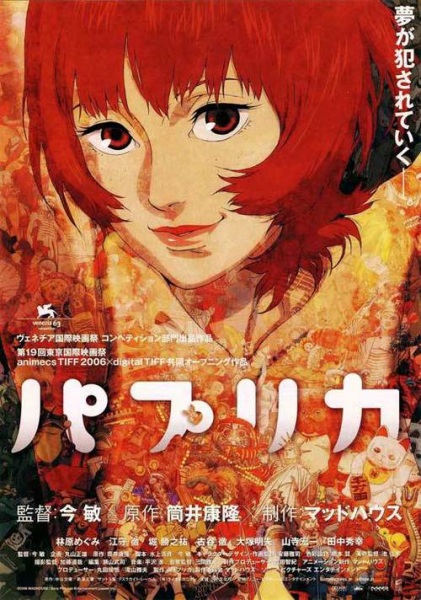
Night Is Short, Walk on Girl
夜は短し歩けよ乙女
On a mysterious night that seems to last for a year, an ordinary college student continues to chase one of his underclassmen, a girl with black hair—the girl of his dreams. Up until now, he has been relying on a simple plan, which is to calculatingly bump into her every day while making it seem like a meaningful coincidence. However, his efforts remain futile as their relationship is not progressing at all. Meanwhile, the black-haired girl believes that everything is connected by fate and endeavors to experience as many new things as possible, leaving it all for destiny to decide. While strolling along the lively streets of Kyoto, she discovers that the very beginning of her fateful journey—a book she had as a child—is currently being sold in a second-hand bookstore. Upon knowing this, the college student eyes another opportunity to run into her "by chance": this time, he hopes to get the book before she does and finally grasp the thread of fate that could connect their hearts. [Written by MAL Rewrite]
Main
Main
Supporting
Supporting
Supporting
Supporting
Supporting
Supporting
Supporting
Supporting
Zerathus
November 18, 2017
7 years after the first time Masaaki Yuasa adapted Morimi Tomihiko's work comes their second dance. Does it work this time aswell? In short: HELL YES. Night is short, walk on girl is set in tatami universe. There are no direct references just some Easter eggs but the world works on the same logic as Tatami Galaxy. Except this time it's set in Kyoto which means it's much more magical. Our Raven haired maiden begins her journey through night and our Senpai follows while trying to "coincidentally" bump into her. The movie is split into parts that are all connected via it's main theme. The fate.We have two main characters who are completely different in terms of their views on fate. One just follows while the other makes his own. That is however not the single focus on the movie as it tackles multiple different themes. Love, age, time, sexu- I mean Johnnies. Yuasa gets on his absolute A game this time. The directing is just masterful and the animation is some of the best I've seen in any anime. There are so many sakuga moments. And not just animation, the colour pallet, character designs, everything. Everything works just perfectly. The music is fantastic, the sound design is fantastic, voice acting is top notch (with everybody favourite's HanaKana as the main girl) Character wise it's another hit. We have two main characters who are completely different in terms of their views on fate. One just follows while the other makes his own. Senpai was to me incredibly relatable. Raven haired maiden incredibly likeable and the rest worked perfectly to support both their journies while experiencing some of their own. All of this climaxes during the last 20 minutes of the movie resulting into one of the most chaotic and fun rides I've had in a while. And that is my final point. This movie is incredibly fun. Even if you remove all the symbolism, if you ignore all the production, if you don't care about all the themes. You are still left with very funny, quirky and colorful comedy that will leave you smiling and possibly drop a tear here and there. So what the hell are you waiting for? Experience this journey! Because night is short, so watch this bloody movie!
manlyflower
April 12, 2017
"Yoru wa Mijikashi, Arukeyo Otome" (or "The Night is Short, Walk On, Young Maiden") is a film by director Masaaki Yuasa based on the similarly titled novel by author Tomihiko Morimi. If you are at all familiar with Yuasa's previous works as well as Morimi's adapations (including the Yuasa adaptation of "Yojouhan Shinwa Taikei"), there's a good chance you'll know exactly what you're getting into by watching this film. To put it simply: this movie is an utter, frenetic delight. The story, without spoiling too much, is a perfect match for the big screen. Covering the events of a single lively night in the imaginative world ofMorimi's Kyoto, it's not often you see so much happen in such a short amount of time. Fans of "Yojouhan" will be familiar with the unforgiving speed of the dialogue, but as you'd expect with a film adaptation, the story events move just as quickly, with scene after scene transitioning wildly into the next. To add to that, the content is as surreal as ever despite the simple premise. Most of the scenes are thoroughly steeped in a sort of magic realism, the characters seeing the strangely off-kilter world—in which people claim to be local deities, loan sharks travel along the rivers, students run around hosting guerrilla theater productions, and everyone seems to have bottomless stomachs—with a sense of relative acceptance. Though this kind of storytelling seems like it would be hard to follow, I surprisingly never got lost, as the story itself is fairly straightforward and the motivations clear. That's not to say the film's design is simple as well, however. Yuasa's portrayal of Kyoto at night is as much his as it is Morimi's. Every crevice of the city is brimming with life and abstract design to match the surreal events of the story, and following the characters as they jump from narrow, pub-filled alleyways to bustling marketplaces in the middle of the night, from brightly-lit restaurants to unreal, technological command-rooms almost feels like watching a fever dream unfold. In every new scene, the nighttime city evolves more and more into a fantastic, magical maze of mythology and wonder, something that only the combined imaginative force of Yuasa and Morimi could produce. Add to that the wild, exaggerated, but uniquely simplistic art style and the light, delightful soundtrack, and the end result is something truly refreshing. As was the case with "Yojouhan" as well, the characters are a complete joy to watch. All of them are immensely varied in personality but still somehow all manage to stay afloat amidst the chaos of the story as they effortlessly weave in and out of plot. In particular, the black-haired maiden, voiced by the equally delightful Kana Hanazawa, carries the show with her indomitable charm and a refusal to let herself be slowed down by what happens around her, instead almost encouraging the story to grow even more wild. I was a little unsure about the male protagonist at first, but his personality proves to be an invaluable foil that really seals the movie's conclusion for the better and makes for a very satisfying ending. The side cast is also extremely memorable and full of strange, amusing personalities that somehow work in perfect conjunction with each other despite being so unique and energetic. Of course, this movie isn't without its flaws. I'm honestly not even sure "flaws" is the best way to word it, but for better or for worse, there are a couple of scenes and subplots that seem to be drawn out a little excessively, albeit in true Yuasa fashion. (They certainly serve a purpose, but the experience is still a little jarring and they tend to break the flow.) In addition is the large cast. While the major side characters are given surprising depth and background despite the movie length, I feel this very strength takes away from the development of the two main characters slightly due to the limited time. Also, a lot of the more minor characters are thrown into the story a little too haphazardly. While it does add to the overall exciting and chaotic atmosphere, it can be a little overwhelming at times, and the sheer number of characters gives each of their stories somewhat less impact. This brings me to how much this movie references earlier works. In every recess of the film are nods to previous Morimi adaptations and Yuasa films, including the use of many character designs from "Yojouhan" and even featuring a brief cameo from the director's as-of-this-moment not-yet-released film, "Yoake Tsugeru Lu no Uta." This has the wonderful effect of allowing us to enter the all-too-familiar Morimi universe with minimal amounts of exposition, but it presents a somewhat high barrier of entry for people that might not be familiar with "Yojouhan Shinwa Taikei" and, to a much lesser degree, "Uchoten Kazoku." Although not entirely necessary to enjoy the film, I strongly recommend watching "Yojouhan" beforehand to get a firm grasp on the characters of this eccentric universe so you'll appreciate the film that much more. All in all, "Yoru wa Mijikashi" is an immensely delightful experience. Every second of it is filled with undeniable charm and gorgeous imagination, and the breakneck pace of the story and transitions alongside the quirky cast of characters brimming with personality come together to take the audience on a wild ride really unlike anything else. I highly recommend it.
Sinkfold
September 9, 2017
Note: I got to see this at a special premiere screening in my city, with Masaaki Yuasa himself in attendance! He's a very lovely guy. I hope that hasn't biased my review too much. This film is closely intertwined with The Tatami Galaxy, a previous Yuasa-directed work. Their original novels were written by the same author, they share a setting in Kyoto and apparently take place in the same universe - many characters from TG pop up here and there in NiS, if not always in the way you expect them to. It's not strictly a sequel, but you'll get much more out of the filmif you've seen Tatami, so that's something to consider. Night is Short, much like Tatami Galaxy, is a bit of a difficult sell plot-wise - it focuses mostly on a college student only named Senpai whose only goal is to win the heart of his crush, the titular Girl, over the course of a night in which the two are out and about in Kyoto. Of course, it's not quite that simple- inventive camerawork and use of surrealism turn what could have been a very dull story into an amazingly fun adventure through Kyoto with a bouncy, dynamic cast of lovable characters. Without revealing too much, the film retains Tatami Galaxy's distinctive, surreal visual style and sense of humour, but is much more lighthearted, comedic, and amazingly over-the-top in places without missing out on conveying its own messages. If you liked Tatami Galaxy, I can practically guarantee you'll love Night is Short. The increased film budget combined with Yuasa's direction style lead to some beautiful animation sequences, and the Girl is so amazingly cheery, she can't help but grab your interest. An easy 10/10 from me, but then again I also loved Tatami.
Lindle
October 5, 2017
This movie is a beautiful mess. Going into "The Night is Short...", a movie that has the same staff as The Tatami Galaxy, the same distinctive artstyle as The Tatami Galaxy, starring a pair of nameless protagonists (Senpai and The Black-Haired Maiden) as per The Tatami Galaxy, is adapted from a novel by Tomohiko Morimi (of The Tatami Galaxy), shares the same fictional universe as The Tatami Galaxy (featuring several of its characters), and features a theme song by Asian Kung-Fu Generation for good measure, you'd be forgiven for expecting this movie to be The Tatami Galaxy 2.0 (and if you haven't seen The Tatami Galaxy...what the hell are you doing here? Go watch The Tatami Galaxy). For all it shares with its predecessor, though, The Night is Short is unmistakeably its own movie, taking the fast-paced energy and absurd visuals of Tatami and dialling them both up to 11. The Night is Short is a manic sugar rush of a movie. It eschews any traditional story structure (or rather, won't sit still long enough to have one) in favour of introducing a colourful cast of drunken, exaggerated, morally-degenerate losers, introducing a couple hundred different plot points, and then throwing them all in a blender. The characters each have their own plots, intersecting at random, resulting in a chaotic storm of subplots. The premise, despite this, is quite simple. It revolves around a single night of binge-drinking during a Kyoto University festival. Fittingly, the movie is a dizzying, disorienting, drunken mess of an experience, with surrealist animation and a constantly shifting plot complete with mile-a-minute dialogue and narration further befuddling things. The animation is completely gorgeous, as is standard for Yuasa Masaaki, with a unique and psychedelic colour palette, goofy and free-form animation that in many ways recalls the rubber hose animation style of the 1930s, and a beautiful representation of its setting, strikingly adorned with maple trees, lanterns, and darumaka dolls. This is a movie that never sits still, demanding that you don't look away for even a second. In a way, the setting is the greatest tool this movie has at its disposal. The colourful nightlife of Kyoto is shown in vivid detail, and the intersecting plot points and cast members acting independently makes the city feel like a living, breathing thing, assisted by an eclectic soundtrack full of symphonic music, tango, rock, and baroque pop. The presentation is something that's uniquely Masaaki, with interesting camera shots, pans, and angles all over the place. There's a lot of symbolism, surrealism, and absurdism to be found here. The environment shifts to exaggerate the thoughts and feelings of the characters, there are sequences shown entirely in the minds of our characters, and the night the movie revolves around follows a series of events purposely far beyond what could ever happen in a single night. The narrative is less direct and more of a stream-of-consciousness blur. It can't be overstated just how unique a piece of work The Night is Short is, even in spite of what it shares with previous Yuasa Masaaki works. It's a movie that seemed desperate to cram every random thought it could into its runtime, common sense be damned. To demonstrate, here are a few things that happen in this movie, entirely out of context. An impromptu series of musical numbers in the second act. A tornado of fish. A black market for rare literature that competes for books by eating spicy food. A cold that infects the entire population of Kyoto within the space of a few hours. A loanshark who trades exclusively in pornographic woodblocks. Sure, you could consider these spoilers, but it's hard to spoil a movie that has absolutely no commitment to telling a coherent narrative. To say the least, The Night is Short is not a movie for everyone. There are people who will be turned off by its eccentric art style, its unique writing style, its hectic pace, its unrelenting dialogue, its refusal to adhere to a structured story, it surrealism, its absurdism, or all of the above. Additionally, with the sole exception of The Black-Haired Maiden, the cast aren't traditionally likeable people, and are all drunken losers, which can also put people off (though the point, of course, isn't to empathize with them - in any other series every member of the cast would be the sole comic relief character). But for those who can get past all that and are willing to let any ideas they have about what anime is supposed to be, The Night is Short is a brilliant, abstract, chaotic mess of frantic, frenetic joy and wonder. It's a mere hour and a half that packs in more content than a full-length series. It's a manic, incomprehensible mess of a movie, and a worthy debut for studio Science Saru. Story/Plot: 6/10 Animation/Graphics: 10/10 Music/Background: 10/10 Characters: 7/10 Overall: 8/10 For Fans Of: Mind Game, The Tatami Galaxy
Gundroog
April 17, 2018
After I finished watching this movie I felt like I missed something. It was by no means bad but the response to it all around seemed overwhelmingly positive. I didn’t want to be unfair to the movie before reviewing it so I whipped out a notepad++ to make thorough notes for it during a re-watch to make sure I didn’t miss anything. The result of that was pretty predictable, I still don’t think this movie is fantastic but I appreciate what it did right and can definitely see why people would adore it. At its most basic, Yoru wa Mijikashi Arukeyo Otome (from now on Mijikashicause I don’t hate myself) is a bare bones story crafted for the purpose of conveying a few simple but wholesome and motivational messages. Love can’t be explained rationally, instead of trying to understand and explain it - take a leap into darkness. You won’t know until you try so don’t hesitate. Second after that is that everything in the world is connected, sometimes in a way that isn’t immediately obvious so don’t lock yourself away from others and follow the thread of fate. It’s nothing revelatory but what takes it a step above other movies is the excellent presentation. During my re-watch I gained appreciation for just how tightly made this movie is, it’s not without flaws and I’ll bring them up later but there’s no denying that a lot of effort went into crafting it. Yuasa is known for his mastery of visuals and Mijikashi is not exception. The overall art style takes after Tatami Galaxy with little to shading and a lot of very vibrant and contrasting imagery. However it has a flavor of its own that comes through in textures, effects and visuals metaphors. My personal favourite moment in the film is the used book sale segment. It’s happening at night so the only illuminated parts are the various stall. Outside world is cut off from the view with trees overlaid with lace patterns. It creates such a personal atmosphere for the whole segment, like it’s a special place disconnected from everywhere else. This kind of quality is consistent throughout and Mijikashi keeps varying up visuals and locations to keep things fresh throughout. It’s not a movie you’d watch for animation alone but it’s a strong aspect of it nonetheless. The second aspect that springs to mind when talking about very meticulously crafted nature of the movie it’s how much effort went into making everything tie together. Most of what you see throughout the movie is bound to reappear later on, most characters and subplots weave in and out of each other all the time. It’s a great way to show how everything connected without hitting the viewer over the head with it (though Mijikashi still later hits you over the head with it). To say a bit about the characters I think it’s important to note that they’re not meant to be deep or particularly fleshed out. Another deliberate aspect of this movie is that most of them don’t even have actual names. Our two main characters don’t even go by names, they represent ideas. Raven Haired Maiden being an embodiment of optimism and wonder and eagerness to try new things who acts as a counterpart to Senpai who’s held back by constant doubts, hesitation and cynicism. However not everything is that good. I feel like the goal of the movie is confusing by the end of it. While it certainly does get the message across, it throws so much shit at you at any point that it’s easy to get lost and think that there’s supposed to be something more to it. Maybe it’s my personal hangup but I feel like at times Yuasa invites the viewer to further interpret the scenes but it ends up not being all that important in the long run. Everything that you might get from this movie thematically will be told to you directly at one point or another so it feels like everything else is just an unnecessary distraction. Did the Daruma heads in the bar scene have any significance? Is there a reason why Don Underpants’s play was so heavily focused on them beyond superficial connection between darumas and wishes? Are the Koi fish throughout the movie meant to say something more or is it there just for a pun? Why is Rihaku making his goons steal pants? Was there any significance to alcohol’s overwhelming presence? I feel like most of these would be easier to understand if I could read the 300 pages long book this 90 minutes long movie is based on. Music is perhaps the most unremarkable aspect of this movie. It’s well made and fits every scene to a t but with how eccentric the movie otherwise it a generic soundtrack doesn’t do it justice. The only musical segments that actually stood out to me were the musicals, it’s a rare thing to see in anime and they don’t sound much like anything else in the movie while also serving as a vehicle for interesting animation and show off the versatile talent of voice actors involved. In conclusion, Mijikashi is a good movie, not flawless but it’s a well paced ride many people will be able to relate to and enjoy. Just don’t expect it to be as complex as Tatami Galaxy or Mind Game and don’t fret over missing some details, anything you can get from this movie will be rammed into your head.
#483
Popularity
#1844
Members
140,588
Favorites
1,847
Episodes
1