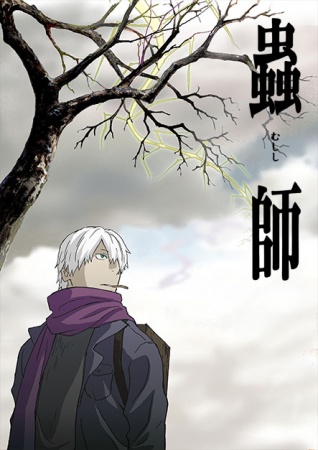

Mushi-Shi
蟲師
"Mushi": the most basic forms of life in the world. They exist without any goals or purposes aside from simply "being." They are beyond the shackles of the words "good" and "evil." Mushi can exist in countless forms and are capable of mimicking things from the natural world such as plants, diseases, and even phenomena like rainbows. This is, however, just a vague definition of these entities that inhabit the vibrant world of Mushishi, as to even call them a form of life would be an oversimplification. Detailed information on Mushi is scarce because the majority of humans are unaware of their existence. So what are Mushi and why do they exist? This is the question that a "Mushishi," Ginko, ponders constantly. Mushishi are those who research Mushi in hopes of understanding their place in the world's hierarchy of life. Ginko chases rumors of occurrences that could be tied to Mushi, all for the sake of finding an answer. It could, after all, lead to the meaning of life itself. [Written by MAL Rewrite]
TheCriticsClub
June 27, 2008
“Don’t let yourself be blinded by fear or anger. Everything is only as it is.” Story Mushishi is essentially a series of stories styled after East Asian legends and folktales. In lieu of gods, spirits, and demons, the paranormal phenomena are attributed to more primitive yet no less enigmatic creatures called “mushi”. Dealing with their kind is the expertise of “mushishi”; professionals whose role may be thought of as an amalgam of healer, exorcist, biologist, X-Files investigator, and Jedi master (well, sort of). Ginko happens to be one of these mushishi and he wanders from town to town, looking for interesting cases and lending a helping handto those adversely affected by these mushi. As formulaic as its premise may sound, no two incidents are alike and every episode features not only different mushi but a different setting and cast as well (with Ginko as constant exception). Because of these, the series is able to experiment with various concepts and human relationships and none of the stories ever end in a predictable manner. As such, there is little room for stagnation as each tale manages to be unique and refreshing. The title is often mentioned in the same breath as Kino no Tabi though Mushishi’s oriental setting and animistic influences give it a more distinct flavor and theme. Whereas Kino limits herself to exploring “what if” scenarios by visiting different countries, Ginko takes it a step further by providing possible solutions and emphasizing the importance of living in harmony with nature, with fellow men, and most importantly, with the self. Characters: While not exactly an anti-hero, Ginko’s personality is an unusual mix of benevolence tempered with common sense; a combination of “grace to accept with serenity the things that cannot be changed, courage to change the things that should be changed, and the wisdom to distinguish one from the other.” Saving lives is part of his job but he also knows when there’s reason still to hope and when it’s time to move on. He may break his own code at times for the well-being of the majority and he’s not above fooling the gullible either just to get by. His expertise stems not only from his knowledge about mushi but also from his understanding of human nature. Similarly, none of these supporting characters are shoved into stereotypes which plague most anime and manga. No catgirls, lecherous geezers, or single-minded youngsters (Believe it!); just regular folks in unusual circumstances due to encounters with mushi. Consequently, it doesn’t require much effort to empathize with these characters even if most only appear in their respective episodes. Art: Not only is the theme “everything is only as it is” evident in the content but it also permeates the manner in which the stories are presented. Mushishi doesn’t try to impress; it simply delivers. While other shows of this era tend go overboard with the fancy CG animation, Mushishi’s visuals remain spare yet aesthetically pleasing. Rather than filling up the screen with explosions and fanservice shots at every possible moment, vivid scenes of natural beauty such as raindrops falling from the heavens, cherry blossoms drifting in the wind, and sunlight penetrating the dense foliage are shown instead. Of course, the viewers are occasionally treated to fantastic scenes showing the surreal characteristics of the mushi but these are shown only when called for in the stories and nothing is done in excess. Even the character designs are relatively plain but perhaps these also contribute to the story in their own way since the audience is less likely to judge the characters based on their appearances. Sound: Likewise, the audio takes the minimalist approach. The soundtrack is comprised of simply melodies which are surprisingly effective in evoking various thoughts and emotions. Ranging from haunting and heart-rending to hopeful and bittersweet, the music often eliminates the need for more words in the most crucial scenes. Also worth noting is the lack of exaggerated voice acting which makes the cast sound more like real people rather than cookie-cutter characters. Overall: In addition to its enchanting audio and visuals, Mushishi also serves drama and thought-provoking content in balanced amounts. Its subtle content and execution never insult the intelligence and present several interesting ideas without drowning the viewers in philosophical jargon or sophistry. All in all, Mushishi truly is one of the finest anime specimen out there. This review is the final result of a review team composed of members from the "Critics and Connoisseurs" club. The team members were: Yuunagi - Writer itsmee - Contributer/Editor June - Contributer/Editor Talamare - Contributer/Editor Here are their individual scorings for the show: Catogory - Yuunagi, itsmee, June,Talamare Overall: 10, 9, 8, 9 - avg=9.00 Story: 10, 10, 7, 10 - avg=9.25 Animation: 9, 9, 9, 9 - avg=9.00 Sound: 9, 8, 7, 8 - avg=8.00 Enjoyment: 10, 10, 8, 10 - avg=9.5 In the club wide poll held for Mushishi it received an average overall rating of 9.06

mahoganycow
July 20, 2013
In spirit, at least, each episode of Mushishi strongly reminds me of one thing: A cave painting. A depiction of man and the outside world, brief and primal but perfectly expressive, radiating mysticism, possessed of more meaning than it first appears to have. From minute one, Mushishi's representation of a vast world grabs the eye and doesn't let go. Lush forests with dew dripping from every leaf; barren winter mountains peppered with stubborn snow-covered trees; an innocuous pond with lilies on the surface of the still water. The series roams from setting to setting, and all are presented with a lifelike attention to detail. The colorpalette is richly varied, reaching from the brilliant emerald of vegetation to the deep turquoise of the sea to the dusky red of a far-off sunset. Lighting is used to strong effect, whether it's beams of sun streaming through layers of foliage and mist or a candle's flame struggling to brighten a dark old house. And within those habitats, the mushi themselves are creatively rendered as a strange mix of the familiar and the utterly alien. They are shapeless blobs propelled by twitching motions, phosphorescent insects scuttling along the earth, and great legless serpents twisting skyward. Some take the shape of a natural phenomenon, and the sight of a living rainbow exploding from the earth, or a long-restrained cloud breaking free, expanding and floating away, is bound to impress. The animation on the whole is excellent, but the mushi in particular seem to move with a vivid otherworldly fluidity. At least part of Mushishi is about making sense of the mysterious and bringing reason to something that seems unreasonable. The designs of the mushi add some believability to this; it's quite easy to see how they could be thought of as ghosts, beasts, or legends, able to inspire both wonder and fear. The tranquility of the environments is consistently impressive in a low-key way, but the spectacle of the mushi can be eerie, majestic, and everything in between. Sound is part of atmosphere, and in the same way that cold urban horrors might use reverberations in dark alleys or the foreboding thrumming of electronics, Mushishi uses a chorus of insects or the roar of drifting snow to surround us, allowing the setting to speak its piece. The music is minimal but startlingly effective, in many cases fitting easily alongside and even seeming to mimic the voices of the earth. Slow piano notes overlap with rhythmic footsteps, a woodwind's sad screams resemble those of a forlorn bird. So, too, can the score sound almost unearthly, with an ominous progression of bells and chimes sometimes underscoring a haunting ending or signaling the arrival of the mushi. The result is an immersive ambiance where visuals and sound alone can convey dark, brooding tension or innocent curiosity with equal ease. It isn't just pretty, it's totally engrossing, exuding pure atmospheric mastery in almost every scene. Through this vast world walks Ginko, revenant of revenants, our looking glass. Perceptive of the nature of human and mushi alike, he uses words as careful and deliberate as his journeying stride to become the voice of reason and, with an air of serene confidence, impart his knowledge to others. To become a witness to needless death, a bearer of bad news, or a participant in deception is sometimes part of his job description. As an admirer of life and truth, he cares for none of these tasks, but he'll defy his own nature and undertake them with solemn dedication if he feels that it's necessary. He is wise, but not infallibly so. Nor is he a complete stoic; outbursts of childlike wonder at incredible sights, sarcastic retorts to smart-mouthed travelers, and emotion-laden shouts of panic and warning to his fellow humans all show him as a little more than just the nonchalant white-haired sage. His development, in the traditional sense, is sparse, but he is afforded a poignant backstory that makes him and his thought process a little less of an enigma. Of course, Mushishi gently pushes a picture of a sprawling and intricate world where all beings affect each other in ways both seen and unseen, their actions rippling outward in ever-widening circles, and in that sense, Ginko as a character is no different than any other living thing in the show, simultaneously of little and great consequence. He may be our guide, cursed and blessed to ceaselessly wander, but the world doesn't turn for him. Rather, it's in what he represents that we might find significance: The quest for knowledge, the insatiable desire to understand even while knowing that the sheer body of things in existence prevents total understanding. The need to capture the meaning of what surrounds us, spread our wisdom responsibly, and use it to form calculated reactions to the world instead of rash judgments. He truly is that silver fish swimming endlessly through dark water, opalescent barbels probing fathomless black crevices, illuminating them, if only for a brief moment. Much of Mushishi's strength lies in the ability to provoke thought without direct questions, to let an image serve as subtext, and Ginko himself represents an impressively seamless merging of humanity and idea. Mushishi is episodic, not bound by an overarching plot. It is a series of self-contained stories which vary in theme, but are always skillfully crafted. Most episodes consist of human drama, based on relatable and familiar emotions, infused with an element of the natural world. The episodic format delivers powerful and gripping tales in an extremely brief timetable, a feat which I have no problem appreciating. The scenarios are original, and the writing is rich with little subtleties and metaphors, but each episode can be understood and appreciated as successful story even if you've no desire to peer into them deeply. View Mushishi as a progression of intelligent parables full of interesting ideas, or as a bunch of moving and affecting tales; much to its credit, it is both. Part of what makes Mushishi work is its steadfast refusal to portray anything in terms as simple as “good” or “evil.” Stories where barbaric man stupidly abuses mother nature, or where nature is a hate-filled monster that comes from the hills to eat scared little man, are a dime a dozen, and while they might pass as entertainment, they often fail to say anything worth saying because they handle man and earth as if they're combatants in a holy war. Mushishi is not so black and white, and it has an idea that scales much better. The mushi are not red-toothed animals seeking to kill in droves. The humans are not greedy savages bent on scorching the earth. Both are just beings, trying to survive in the same place and at the same time. That they will cross paths, have conflicting interests, use each other, and hurt each other is inevitable; such is survival. Each episode is one meeting of mushi and human, one miniscule butting of heads in a massive world, with the implication being that this is simply what happens, everywhere. Instead of vilifying humans or portraying nature as a vengeful power, Mushishi whispers: This is just the way things are. It does give us a small shove by implying that, as the ones with the ability to reason and understand, the responsibility for mitigating the damage that humans inflict (and the damage that humans receive) falls on the humans, but it never degenerates into the preachy heavy-handedness or gross oversimplifications that plague many works with similar themes. It's that theme which allows Mushishi to navigate the spectrum of human emotion. Conflict in its world does not arise from moral failings or piggish greed, only from a lack of understanding, and understanding is a sword with many edges. Ask the child who learns of death, or the old man who learns of life. Sometimes the knowledge you gain is liberating, sometimes it's disheartening, sometimes it's terrifying. Mushishi can be all of those words and more, but even when it strays to one extreme, it never loses its humanity, its worldliness, or its feeling of being completely natural. Just as it can depict the warm orange rays of the sun and the cold white howl of the snow, it can depict innocent wonder and violent loss, and with equal sincerity. It has balance, and then some. As a caveat, I will say that this is the kind of series that practically begs me to use the phrase “not for everyone.” It's dialogue-heavy, more about the thought leading up to action than the action itself; it keeps the big guns of its visual spectacle on a tight leash, letting them explode only after a suitable buildup to assure the maximum payoff; it doesn't have the conventional storytelling satisfaction of explicitly coming full circle, instead simply tapering off and fading quietly, as episodic series sometimes do. A few episodes will likely be enough to inform you of whether or not it's to your tastes, and I've no doubt that many have labeled (and will continue to label) it as simply “boring.” I understand the origin of this opinion, but I cannot share it. Mushishi is strangely beautiful and intensely fascinating on several levels. Imbibe it a little at a time like liquor, or dive deeply into it and become drunk on its atmosphere, intrigue, and insights. In my experience, neither disappoints.
TheBrainintheJar
August 2, 2015
Some people will tell you Mushishi is great because it doesn’t contain action and fanservice. These must be the same people who praise a film for not including Adam Sandler. They also make Mushishi look more pretentious than it is. It’s far from it. The problem is, even though Mushishi has a worthwhile aim and the right methods, it doesn’t know how to use them. In order for something to be pretentious, it needs to put up a cover while not including the methods. An anime that has a realistic art style with dramatic characters is pretentious. It looks realistic, but the methods that are usedare opposed to it. Mushishi makes it clear what it wants to be in the first episode. It’s a series that’s concerned mainly with men’s relationship to nature. The mushi are just the physical embodiment of what nature can be. Some have criticized Mushishi for creating a magic system that has no rules but leads to convenience, but that’s untrue. Mushishi doesn’t have an RPG-like magic system because it uses magic to explore themes, not to offer instructions on how to do battle. The rules the magic in Mushishi follows is the theme of nature. It’s successful in that department. We often see nature portrayed as a calm, peaceful place in contrast to heartless machinery. If the person is especially ignorant, we will even hear about the good old days when men was One With Nature and everything was peaceful and good. Most people see nature though the lens of the Garden of Eden. Anyone who ever bothered to learn a little about nature – botany or geology or zoology – will understand Mushishi‘s stance on nature. Nautre is unstable, mysterious, powerful and cares nothing about us. Volcanic eruptions and meteors crashing are terrible things, but they’re produced by an indifferent world that has no malice. They just happen. Then again, it’s the same world that gives us great food and visual spectacles. There plenty of time when the terrible and beautiful merge – how many dangerous animals are also beauiful? The series achieves that by the nature of the mushi. They often benefit and harm at the same time, like allowing people to give birth to a person that died. There is always a sense of wonder and mystery surrounding the mushi. Even Ginko, despite his cold demeanor is also startled by them. What people don’t say enough about Mushishi is that this is how fantasy should be done. It’s not like Martin’s world, which is full of details to make it clear and familiar. It’s truly alien and fantastical. Where the series falls is in all other departments. The series doesn’t put enough effort into the characters and the stories. They exist solely to present the varying mushi. There are films whose purpose is only to deliver a visual experience, so abandoning conventional storytelling can be a smart decision. It’s not here. It’s not just that 26 episodes make you demand more, but that abandoning conventional storytelling doesn’t help the series’ aim. The series forgets about the ‘men’ in the relationship between men and nature. The characters feel like they have an outer life. The issues spring from life itself – art, marriage, vision – rather than having a guy preventing another guy from Being the Best. There isn’t enough character psychology to make these issues feel important. The characters are all interchangeable. I kept waiting for a reason why this person is concerned with vision, or this one with marriage. Nothing is pointless in fiction, after all. In order to bring depth to an issue, you need to connect to the character. Something in the character’s personality needs to be related to the issue so it will affect it. A lot of shounen shows know this, so they tend to give a narcisstic nature to their characters. The character doesn’t just struggle with The Problem but with his own nature. Ikki learns to curb his narcissism and stop swinging between it and depression. Tai learns (or is supposed to) how being a leader works. Despite these two not being the most developed examples, they make for different stories. You couldn’t put Tai in Ikki’s story, because Tai’s personality is concerned with relationships with others. You couldn’t put Ikki in Tai’s story, because his story is about learning that sometimes you lose some and win some. I could not remember a character that had a situation concerned with his personality. They tend to have generic wants and needs, nothing that’s unique to them. They may be ‘ordinary people’, but people are not clones even when they follow patterns. Or if the series wanted to comment on that, then the similarity should’ve been made important. Nothing is there to emphasize how similar humans are. These are just empty characters. Ginko is not much better. An episodic series isn’t an excuse to have undeveloped characters. They may not change throughout the series, but they need a personality that will affect every story. A lot of Cartoon Network shows are purely episodic, yet they’re full of quirky characters who create the stories because of who they are. We get a backstory episode for Ginko, but it doesn’t reveal much. What’s his motivation? Why is he so into mushi? How does all this exploring affected his worldview? There are sometimes hints. In one episode, Ginko agrees with what I wrote above about the cruelty of nature. This is just one instant, though. All Ginko does is visit people, help them solve the problem and that’s it. That makes him a plot device, not a real character. He exists so we’ll have someone to follow, but how different would the series be if it was a random mushishi in every episode? I do not ask to immidiately reveal who Ginko is. If every episode gave a small piece, it would be enough. The collector, who appears from time to time is the only person with something resembling a drive. He’s really into collecting, and values it more than humans. It’s a little touch that makes him more real than anyone here. There are sometimes other mushishi’s who act a little different, but the difference is never wide enough. It’s a missed oppurtunity, sure, but not one without merits. It’s as original as people say it is, and a good example of how far storytelling can go. It didn’t live up to its concept, but it’s still good that it’s out there and that it found an audience. Hopefully, one of these someone will pick up these ideas and run away with them. It’s a fun series, but one that should be easy to improve. 3.5 mushi out 5
KingIK
June 8, 2013
This anime was a very unique experience. The show introduces a very interesting concept called the mushi. It'd be very difficult to describe what the mushi are precisely. In a nutshell , they're essentially spiritual beings, but at the same time they inhabit the physical world ( Yeah I know what your thinking, you just completely contradicted yourself. I know, I know just go with it) and they use humans as a host ( very similar to a parasite). One aspect in particular that struck me about the show was how it was devoid of any western influences whatsoever. Many anime fans don't realizehow anime is indeed heavily influenced by Western culture. But Mushi-shi primarily borrows stories from many east Asian folklore and myths. Although Mushi-shi does offer an original and innovative premise/concept, the execution is most certainly flawed. Story The story of Mushi-shi follows the exploits of Ginko, who is otherwise known as the Mushi-shi or Mushi master in the English dub. Ginko's job as a Mushi-shi is to go around and help people who have been infected by the mushi. This is one of the flaws to Musi-shi, which is it's formulaic plot. As you go through these episodes you'll notice that 90% of the them play out like this: Ginko is wandering around, he encounters a village, group of people or an individual who have had an encounter with the mushi. Which in turn, leads to them being harmed to the point were they're crippled or their lives are hanging on by a thread. Ginko attempts to save them. His efforts leads them to being cured or sometimes the episode will end off tragically where the one infected dies. Basically, this formula repeats for 26 episodes. Yeah.....the series is a tad bit repetitive. Notice how I said a tad bit repetitive and not overly repetitive. Because what saves it is the mushi themselves, there isn't a single episode where the mushi are exactly the same; it's always fascinating to observe them, because the way they interact and work with humans is so compelling. Oh and did I forget to mention that Mushi-shi has no main storyline ? Yes, this is an episodic anime where each episode is it's own standalone story. This wasn't a problem for me, but I know it will be for some. Because of course, most people generally prefer a main ongoing story. Again this wasn't a problem for me. Also, when I say episodic, I mean it. It's not like Cowboy Bebop or Samurai Champloo, where it's episodic in nature but it has an overarching story. That’s not the case with Mushi-shi. Plus there's no recurring characters in the show except Ginko. I mean, if someone was to walk up to me and say "hey, I found Mushi-shi to be a phenomenal anime and I absolutely loved it," I'd completely understand. If somebody else walked up to me and said "hey, I found Mushi-shi to be extremely boring and I didn't like it," I'd also completely understand. Because of how literally quiet and subtle it is (not recommended if you got A.D.H.D), which isn't a bad thing by the way. Mushi-shi is definitely not for everyone; it's not meant to appeal to the masses, its meant for a niche audience who can truly appreciate its fascinating concept and artistry. It's very reminiscent of an independent arthouse film. Characters & Themes Now on to the themes and characters. This anime excels in that department. Mushi-shi does a fantastic job of exploring themes of loss, despair, self sacrifice, suffering and tragedy. Whenever the mushi infects people, family bonds are tested and death is always around the corner. If someone does in fact die or suffer a heavy loss, it always resonates with you. So yeah, clearly the show has a lot of emotional depth. Lets get into the characters, now as I mentioned before there are no recurring characters except for Ginko, and for the most part the anime does a fairly good job of fleshing out these nonrecurring characters. Especially considering the fact that each has only about 21 minutes (excludes opening and closing songs) of screen time. On to Ginko, whose obviously the main protagonist. You'll definitely take a liking to him as he's a very kindhearted individual. He does get a good amount of characterization and we do get a back story as to how he became a Mushi-shi/Mushi master. But really compared to other main protagonists its wasn't enough in my opinion. That's another one of my problems with Mushi-shi, Ginko needs to be fleshed out more. Nevertheless, he's an all around good main protagonist Sound Arguably the best part of Mushi-shi, from the score, to the voice acting and even just the sounds going on in the back ground. The opening track is called " The Sore Feet Song" by Ally Kerr and its a solid one overall. You'll probably enjoy it if you like folk rock. Something that is also very unique about Mushi-shi is the ending theme, or should I say ending themes, because every episode has its own closing song and I got to say, I liked all of them. It's hard to describe them because the instrumentation is so unique and each one feels so surreal and atmospheric. They have an otherworldly vibe to them. Then we have the actual score within the show which is also great and complements the mood excellently. Like the closing themes, the score has an otherworldly vibe as well that I can't put my finger on. Finally on to the voice acting, which is outstanding on both the Japanese sub and English Dub. No seriously, it's that good, especially the English dub which in my opinion surpasses the original Japanese and it ranks up there with Funimation’s best work like Baccano, Yu Yu Hakusho, and Fullmetal Alchemist. Both Yuto Nakano and Travis Willingham embody the character of Ginko perfectly, and all the other cast members do a great job as well especially considering that fact that they only appear once. Also, pay attention to the tone of the voice acting on both languages and notice how monotone and subtle it is. Don't let it discourage you. This is completely intentional because it's meant to match the quiet and subtle tone of the actual show. Art & Animation Finally, we get into the last part of the review, the art and animation. The animation is very good and smooth, but the art (especially the backgrounds) is absolutely stunning. You'll know what I mean when you watch the series for yourself, just pay close attention to the detail that is given here. From the lush green vegetation, to the mountains and rivers. It's absolutely gorgeous. I recall when I was watching it, I had to pause the show for a moment because the backgrounds were so beautiful to look at. Hands down, some of the best you'll find in all of anime. I guarantee it. Final Thoughts When it's all said and done, Mushi-shi has it's flaws and at the same time it has a lot of good things going for it. It's formulaic tendencies really held it back. Plus, Ginko could have been fleshed out more. Regardless of that, this anime was a joy to watch and it's a good solid one at that. If you have an open mind, I recommend you check it out, especially if you want something that is unique and original.
kiriska
November 30, 2008
It's pretty rare to see a purely episodic anime that isn't a comedy, and that's just another reason Mushishi was such a treat. STORY - The series follows the journeys of a traveling Mushishi named Ginko who investigates paranormal phenomenon usually caused by creatures called Mushi. Each episode describes one of his encounters with self-sustaining villagers in and around vast mountain ranges. Something is wrong, and Ginko does what he can. It's very straightforward, but even though each episode more or less follows the same format, it isn't a simple case of Ginko saving the day every single time. Sometimes things are beyond his control; sometimesnothing can be done regardless, and sometimes, nothing need be done at all. It can be frustrating sometimes when Ginko has revelations that he won't explain until later, and because of the supernatural nature of the Mushi, Mushishi has quite an expository air to it. The mysteries aren't of the sort you can really deduce yourself, and there's a lot of talking and explanation. Nevertheless, the way the Mushi and humans interact can be very fascinating at times, disturbing at other times. Sometimes Mushishi feels like a cross between a nature documentary and a paranormal investigation. Fans of either would definitely enjoy this. CHARACTER - Ginko is really the only reoccurring character in the series, though his collector/doctor friend, Adashino, does show up now and again. Each episode contributes a different situation involving different people in a different place, and they almost never have anything to do with one another. Naturally, this means the exclusive cast of each episode remains pretty generic. There is the generic little girl and little boy character, the young woman, the young man, the middle-aged woman and man, the old woman and the man. Sure, the individual characters may have unique characteristics depending on their situation, but for the most part, the cares, worries, and priorities of each of these archetypes are standard. I didn't really mind though. After all, their situations did set them apart from one another, and as almost all these characters lived in small, self-sustained villages, it's conceivable to say that their lifestyles made them similar. Ginko, as the protagonist, gives us a little more depth and insight into his personality, but even he remains a mostly enigmatic character for the length of the series. His intentions are generally altruistic, but there is more to his actions than that. Actually, I wish Ginko's thoughts and personal feelings about Mushi are touched on more -- there are definitely morals and deeper philosophies involved, but they're only touched on in one or two episodes. Still, those are the episodes that give Ginko the most personality, and I think it's very easy to relate to him as a result. His quirky habits and mannerisms are kind of endearing too, and he's just a fun character to watch. He's easy-going: very fitting for this kind of episodic series. ARTSTYLE & ANIMATION - Mushishi definitely has some of the most gorgeous backgrounds for an animated series (as opposed to an animated movie) I've ever seen. The forests are lush with detail and vibrant colors. It floors me the way every plant and flower and tree branch and leaf is expressed. Views from mountaintops are breathtaking, and the oceans glitter with tiny waves and light. Cloud formations are grandiose and powerful, and the night sky is always vibrant with stars. These are some really, really amazing environments, man. The character designs, in contrast, are pretty plain. Ginko stands out with his white hair and teal eye (which have a legitimate explanation beyond "he's an anime character!"), and his face is pretty unique in itself, but all those archetypal villagers? In every episode, you'll have deja vu. "Hey, isn't that the character from the last episode?" No. It isn't. None of the villagers get repeat episodes, but you'll think so for a while because all of them look the same! Every little girl character looks like every other little girl character, and every middle-aged man villager looks like every other in the same category. It's actually pretty amusing, and I didn't particularly mind this repetition simply because... well, it doesn't matter all that much. Since none of the characters repeat, it isn't like it's that confusing. Anyway, I can accept that they blew all their character design budget on the backgrounds; it's really not that bad of a trade-off at all. :P I also really liked that Mushishi had a very tranquil air about it. The title screens of every episode appeared quietly into the existing scene, calmly and without interruption. There is no bridge animation/page to frame where the commercial break would be. It just fades in and out very smoothly. MUSIC - Mushishi has some really minimalistic music. The soundtrack throughout the series is mostly of the traditional Japanese sort -- bells, gongs, bamboo flutes, biwas, and other string instruments. They're all very, very fitting to the series and definitely enhance the scenes they're used in. They're moody, eerie, calming, and occasionally cheerful. Sometimes there's only silence, but that fits too. For being so minimal, the sounds in Mushishi are incredibly effective. The opening theme is already an indication of this. It's soft and slow and reminds me somewhat of something they'd play in a yoga class: soothing. The lyrics are in English (not Engrish!) and also fit very well with the themes of the series. I love the name of it too -- "The Sore Feet Song." The ending theme is always an instrumental and changes with every episode, something you don't see often at all. The composer is none other than Toshiou Masuda of Naruto fame, and he once again does an awesome, awesome job (even if you don't like the Naruto anime, it's hard to deny that it has an amazing soundtrack). The end themes are generally very mellow, bittersweet, which echos the endings of many episodes. More yoga music! VOICE ACTING - I saw all of the series subbed, and interesting enough, Mushishi has a gigantic cast list because there's a different voice actor for pretty much every single random villager character in the series. I thought since many of the villagers are reasonably similar, they'd just use one voice per archetype. No! All of these people have their own voice! I guess that's a pretty good way of making up for the lack of variation in visual designs, and it works out pretty well. It's worth noting that a majority of the little kid characters aren't annoying! Some of them are actually... reasonably cute? I really did enjoy Ginko's voice also; it's pretty "normal" sounding, but it fits his character very well. Edit; I just discovered that the entirety of Mushishi is available streaming off FUNimation's website, dubbed. As such, I took the liberty of checking out a few episodes, and it's pretty good! I really wasn't sure about Ginko's voice at first, but Travis Willingham does a pretty decent imitation of Yuto Nakano's voice and it warms up to you fairly quickly. Willingham also somehow manages the same quirky kind of tone. While the American cast of villagers isn't quite as extensive as the Japanese, there are still a good number of varied talents there so it isn't too much repetition. All in all, I'd say FUNi did a pretty swell job. OVERALL - Mushishi might be one of those series you should watch a bit at a time just because it's entirely episodic and might feel a little repetitive in large doses. (I watched it all in two or three days, but hey, that's me.) There is no ending, and actually, I wouldn't mind seeing another season of this. There is an origin episode or two to flesh out Ginko's past and development as a character, but while they do help the general story along and I'm glad for them, I don't think they're entirely necessary either. If you like scientifically presented supernatural stuff and don't mind a very easy-come, easy-go story, then I'm sure you'll like Mushishi. :3
Rank
#82
Popularity
#225
Members
900,263
Favorites
28,279
Episodes
26