The Great Passage
舟を編む
Kouhei Araki, a veteran editor of the dictionary editorial division at Genbu Publishing, plans to retire in order to better care for his ailing wife. However, before retiring, he must find a replacement to complete his latest project: a new dictionary called The Great Passage. But no matter where he looks, he cannot find anyone suitable, as making a dictionary requires a wealth of patience, time, and dedication. Mitsuya Majime works in Genbu Publishing's sales division, yet he has poor social skills and an inability to read the mood in most situations. In spite of this, he excels at having an enthusiasm for words thanks to his love of reading and careful personality. It is these skills that draw Araki to him and prompt him to offer Majime a position in the dictionary editorial department. As Majime accepts his new position, he finds himself unsure of his abilities and questioning whether he will fit in with his new co-workers. Yet amid the vast sea of words, The Great Passage will bring them together. [Written by MAL Rewrite]
ZephSilver
December 24, 2016
As a reviewer, there have been numerous occasions when I struggle to find the right words to convey my thoughts. This isn't to say that I didn't know what I wanted to express to others, but rather, I wanted my message to be as clear and concise as possible. The right words can often make all the difference in how a reader interprets what you have to say. Words are capable of setting the mood, giving off tone, and in some cases, changing the very temperament of those on the receiving end. They're vehicles used to communicate feelings, painting a picture for the reader, andnaturally, when the right word, the right expression, is used, a connection between the writer and the reader can be formed. Having constantly tested my hand at writing think-pieces and reviews, I've slowly developed a knack for conveying my thoughts to others. Of course, there are still ideas that are hard to make tangible, but through constant diction retooling and communication with others, I've made strides in closing that gap. And for many, the dictionary has been an asset in aiding in this process. Well, that's what I would have said 15-years ago. Today, the dictionary—and by extension, a great deal of printed media—has almost been made obsolete by the internet and advancements in technology. Every possible definition, both contemporary and antiquated, is just a click away. But like anything that had a home in humanity's cultural development and upbringing, there are still those that cherish the ways of yesteryear. As convenient as it is to have hundreds of books stored on a tablet, nothing beats the feeling of pages between your fingers as you flip through a good book. Any MP3 nowadays can house thousands of songs on the go, but there are still those that champion the personal touch of vinyl. Saving a moment is only one phone pic away, yet the Polaroid camera still has millions of hipsters and enthusiasts alike shaking images to life. But those are just the popular examples, ones that most outsiders looking in could still comprehend the sentimentality behind it. But what about content that doesn't register with most? Appeals, that, at first glance, feel very obtuse. Fune wo Amu, The Great Passage, basically explores one facet of that kind of unique appeal, but instead of limiting it to the object of affection alone, in this case, the dictionary, it instead dials back to the core reason for why someone might cherish it, in the first place. An understandable position once you peer into the headspace of the main character Mitsuya Majime; a man who can barely mutter his thoughts out loud without clamming up, despite his devoted fascination for semantics. A bashful man with an obsession for wording and their meaning, yet unable to utilize this talent verbally. A unique passion that runs contradictory to his very closed-off nature. I know what you're thinking, an awesome setup for a story, right? Well, almost. You see, as fascinating of an idea that this may have been, when it boils down to it, the subject matter was about as exciting as the subject itself. There's a passion for dictionaries that are clearly there, but like the actual object itself, this passion was sterile and lacking in emotional range. And for a story about words and the various expressions that it can convey, that's a crying shame. But before we go any further, let's make this clear, Fune wo Amu is by no means a "bad" show, it's just a very lackluster one. In fact, it contained some of the more realistic character depictions in 2016's anime lineup, deciding to leave behind erratic personalities and commonplace archetypes for a more grounded performance in a world that's pretty much aligned with our own. Where portrayal of emotions in anime are usually capped off with exaggerated interpretations, this title instead chooses to substitute that with nuances in both their mannerism and body language, effectively defining the individuals on screen without degrading who they are. Even the changes in vocal inflections are accounted for, a detail that most shows neglect altogether. And as if that wasn't enough, to further sell these characters as proper representations of adults, the show adopted body models that are more anatomically accurate than what's usually given by the medium, recruiting the talented Haruko Kumota, the artist responsible for the look of Shouwa Genroku Rakugo Shinjuu's cast, as the original character designer. For all intents and purposes, given this dedication to craft Fune as an adult-orientated slice-of-life drama, the final product should have been something I adore. It checks off all the boxes for things I seek out in works of this nature. Shouwa Rakugo was one of my favorite anime entries of 2016 for that very reason. So when I give Fune the cold shoulder, know that I'm doing so out of genuine concern for its lack of vision. For everything that Fune could have aspired for, it ultimately veers off into ho-hum territory. Following the footsteps of an unimpressive, mild-mannered klutz named Mitsuya Majime, Fune gives us an insider perspective, as Majime makes his way through a crowd of disinterested faces. Each one of these people in the ever-shifting collective makes up the busy prefecture that hosts as the stomping grounds for Majime's unsuccessful business venture as a salesman under Genbu Shobo's publishing firm; a job he seems to be all at once perfect for, given his skill-set, but terrible at due to his personality. Passive to a fault and cumbersome in every verbal exchange he has with others, Majime is far from the ideal image of Japan's working class. With nothing to draw back on but his love for words, there are very few applicable situations where he's needed. What good is it to be a word-smith when trying to hold a conversation leads to awkward jibber-jabber? Trapped with a burning desire to express himself but not gifted with enough gusto or social tact to do so, Majime makes no reservations about his limited usefulness, as he willingly keeps his head down to avoid any further degradation. So when he's approached by Kouhei Araki to fulfill a soon-to-be-vacant editorial job for constructing a new dictionary, the stars couldn't have been more aligned. With a task that's tailor-made for his dilemma, Majime was finally given an outlet to unload his passion constructively. And in the process of doing so, was also given a chance to warm up to people in a manner he thought was previously impossible for the likes of him. With a setup that could carry with it the same potency as 2010s The King's Speech, while allowing for a more grounded backdrop due to its quaint, smaller-scale setting, Fune had all the makings of a humbling journey with promises of catharsis scattered along the way. It's the kind of screenplay that would go on to become Oscar-bait material in the hands of any veteran director, and for anime, another testament to its strength in crafting maturely handled stories. And in some ways, Fune does count as another entry in that category, just one that wouldn't register high on my list of exceptional examples. The story of this dictionary taking form was ultimately just a container to help examine the cast of characters in various stages of growth in their lives. Because of the daunting 10-year production cycle needed to create a dictionary, this time allowed the viewers the opportunity to pick apart the things that made the individual characters tick, as well as a chance to examine the small pockets of interactions that occurred among themselves, including how they all chose to deal with certain situations along the way. So in essence, Fune wo Amu, The Great Passage, was quite literally "the great passage" of these regular peoples' lives. Instead of following the accomplishments of someone destined for a space in the annals of history, Fune shifts its focus to an industry that gets no standing ovation from anyone. The unsung "heroes" in their publishing field. But despite that angle, it's never really about applauding their efforts, as it's more about showing unison of the ways of old with the changing times of new. And with a dictionary used as the vehicle to express that idea—with a young, soft-spoken protagonist who's out of touch with the rest of the world being used as a conduit to deliver it—the initial message became far more significant than any single person involved by the time we reached the final resting stop. Now, if the show had translated this idea as well as it sounded on paper, I would have been here today singing its praises, but as I've expressed before, that's not how it worked out. If I wanted a maturely handled cast of adult characters who expressed various emotions and understood their situation with sobering clarity, while at the same time being genuinely engaged with what was being displayed on screen, there are animated movies like Only Yesterday or TV series like the aforementioned Shouwa Rakugo around to fulfill that need. Both of which operated within a familiar playing field like Fune but done so in a way that any person of intended age could take seriously. Fune doesn't share in that quality in the way that you'd expect it to, coming off more milquetoast in a miscalculated attempt to be adult in quality. So despite its ability to demonstrate restraint to allow for natural human behavior in its cast, the actual content itself felt unrealistically lopsided—an issue that's easily identifiable once you key in on the kind of agenda it's trying to push forward. Fune wants its content to remain within a limited operating capacity of expression, as if it's afraid of being too playful as to lose the audience's respect. There are attempts to alleviate this problem, with characters such as Masashi Nishioka, who's the "life of the party," constantly prattling to entertain the group while also using it as a defense mechanism to keep from having to express his concerns truly. Or even with the tack-on middle sequences in every episode, that saw the series use chibi dictionary caricatures as cut-scenes to help alleviate the monotony of the constant unassertive tone. Personally, I found it distracting but the intent behind it was still understandable. When the show was in danger of being too dull, this became its defense tactic, but when it came time to demonstrate any other kinds of real emotion, it diverted from having to do so in ways too apparent to truly ignore. For example, when our main character found himself infatuated with a woman, instead of using it to explore facets of himself—as what usually occurs when we find ourselves attracted to others—it chose to take the easy route by having a romance predicated on one word of cluttered dialogue exchange and a letter chock-full of convoluted word passages. This robbed the chances for any genuine relationship to blossom over a period of time. Yes, he took the initiative to get to that point, but for a show dealing with adults in a somewhat realistic setting, the conclusion was only viable in something pumped out by a sappy Disney/Pixar production. The show has the humanistic aspect nailed down but skittishly avoids the endeavors that truly make us humans, human. The essence was missing. The struggle was removed by diverting the content away from it or by skipping any natural rough-stage altogether. Would The King's Speech win the Oscar for Best Picture by avoiding the uphill endeavor of the main character to express himself out loud? Probably not. Where other titles would display the gradual growth that molds the main character, in Fune, that struggle, that humanity, was quite literally time-skipped away. And as a result, we get content that's more suited to pacify the audience than something that you could fully take seriously. The investment was gone. All emotional range removed. A bad mixture of realistic characters given escapist solutions, making all conflict rendered pointless, no matter how much it tried to dissuade the audience from taking notice. It being so maturely handled wasn't to its benefit, it became the problem, because, at the end of the day, it wasn't realistically portrayed in all facets of adult growth. Instead of presenting the full-color spectrum of life, it chose broad monochromatic brushstrokes of melancholy and tender passages of satisfaction to box all of its content within. The only time the show doesn't suppress itself was at the very end, where it had scenes that loosen the vice grip on the characters' feelings to freely exhaust that pent-up emotion that should have been there all along. And even then, these moments of cathartic release are still registered with halfhearted resolve since the momentum to them was practically nonexistent. And again, Fune is not a bad show. It's all of its strengths that make the weaknesses too hard to look away from. You really want the best for it. You really want to put it on the pedestal as the exception to the rule. But with content that only half commits, it's frustrating to have to give it a back-handed compliment instead. From using the Ferris wheel as a motif to express the connectivity of life in a slow cyclical motion, to the very earnest appeal of its cast, Fune was a show that I wanted to fully get behind. Clocking in at 11-episodes, it's something you could finish in just one sitting. With Amazon Prime's abysmal marketing of this series, it has mostly gone unnoticed by many. And despite all of my qualms, I would still like it to receive a far bigger viewer base than it currently has. It didn't accomplish as much as I wanted it to, but the show was still able to muster up all of its efforts in the end. This all culminated towards an uplifting conclusion that sees life going on with words bringing connection from one generation to the next. This may not be much of an endorsement given how much I've put the title down, but I still think Fune has something that shouldn't be so quickly discarded. And if only for that reason alone, Fune wo Amu gets a light pass from me.
Japanese

weebna
December 23, 2016
Fune wo Amu is without a doubt a hidden gem. I'm the first person to say that when I first decided to watch this show I wasn't very excited about it and I thought I would eventually stop watching it, little did I know how amazing this was. Definitely one of the best animes of this season. First of all, there aren't any anime similar to this one, at least not that I know off and according to what I hear about it from other people. The greatest thing about the whole show is the reality behind it. The whole story and plot makes senseand so does the characters. You can find in Fune wo Amu the environment you would find in a small group working for the same department. The characters all have their qualities and flaws which, once again, relates to the real life. The group working for 'The Great Passage is full of amazing co-workers and people who you slowly start to love and get attached to them, and of course you eventually relate to one of them. The only problem I found was that some characters didn't get the deserved time and development, but if we think about it, making a dictionary takes a long time and the focus of the anime was how to make one. I like animes that inspire me to do something or animes that have a deep meaning behind it and Fune wo Amu is exactly it. While watching this amazing show I felt their passion about their job and made me curious about it. We don't see people that love what they are doing everyday, but to see Majime and his team to be so passionate about their jobs, makes you want to have the same passion about what you will do in your future. It's truly an inspiring anime. Normal people, working together to make their best and have good results; people who don't give up no matter how hard the job gets and how long it will take to get it done; people that can combine their private lives, like we saw with Majime and Nishioka, with their jobs and still be happy and not stressed... A show that represents what everyone wants for their future life, without anything extraordinary, but passion and dedication.
BlueKite
December 26, 2016
When someone opens a dictionary, what does usually come to mind first? Depending on who you ask, the answer varies from looking for definitions on unfamiliar words to just simply enjoy seeing how words are given meaning in so many unique ways. Words are very powerful, they can dictate how the world moves. They are needed by leaders, innovators, educators, and even by ordinary people in their daily activities. Without it, humanity can’t progress and evolve. Forming and stringing words are basic human skills but we often find times when we can’t clearly express our thoughts, making us seek a solution to that problem. Dictionariesserve that purpose. Even as I am writing this review, I constantly try to formulate sentences and choose words carefully. I ask myself questions, do these words clearly reflect what I’m trying to say? Will my point get through the reader despite my limited vocabulary? Words can be a double-edged sword, they can also detach people out of misunderstanding. Down to its core, words are ultimately building blocks for a person’s capacity to share ideas. It’s such a delight that a show like Fune wo Amu tries to show an enthusiasm for dictionaries and words in general that most people usually take for granted. I like how it presents a metaphor of a sea of words with a dictionary that symbolizes as the ship that sails across it which really fits in the narrative well. Several obstacles are encountered along the way in making a dictionary. It looks mundane and time-consuming, not to mention it takes years for a dictionary to make, but it’s really rewarding for people who have the passion for it. The stakes are not that high and intense as everyone can just quit when they had enough but that’s not a concerning issue because the story tries to focus more on how the cast maintains that glowing light of dedication, not to succumb to the external pressures dumped on them. The characters in the show are mostly simple but not to the point that they feel unnecessary and bland. All of them have roles in the story and they carry it out well. The only character that gets enough development is Majime who’s the main character. There is Nishioka as well, he gains considerable character development after he works with Majime for a while, but he ends up static after a few episodes later. Depth is not of immediate importance character-wise as it has become evident later that the show attempts to be more plot-oriented more than anything else. Even Majime’s romance subplot was only breezed by to make way for the story’s main objective, the completion of The Great Passage, in which his involvement is of the greatest. I like to see the cast as a part of something bigger, giving less emphasis on their individuality but remaining interesting and relevant. On the more technical aspects, I love the character designs. I looked up the person behind the character designs and found out that it’s the same person behind Shouwa Genroku Rakugo Shinjuu which is another fantastic show. The animation can get derpy at times but overall, it’s not very distracting. The soundtrack matches the atmospheric mood the show it tries to emulate. Imagery of scenes are wonderful especially at presenting metaphors and symbolisms. Overall, Fune wo Amu is a show recommended to those who are interested with words, meaning, context, the overall semantics. It’s also a show recommended to those who likes seeing stories revolving around passion and dedication for something great and noble and seeing it get fulfilled in the end. It’s a shame that some viewers overlooked this hidden gem at the season’s lineup as I personally think it’s one of the best shows to have come out this year. Just remember the next time you pick up a dictionary that it’s the fruit of hard work and dedication, a culmination of human’s curiosity for meaning.
moozooh
December 22, 2016
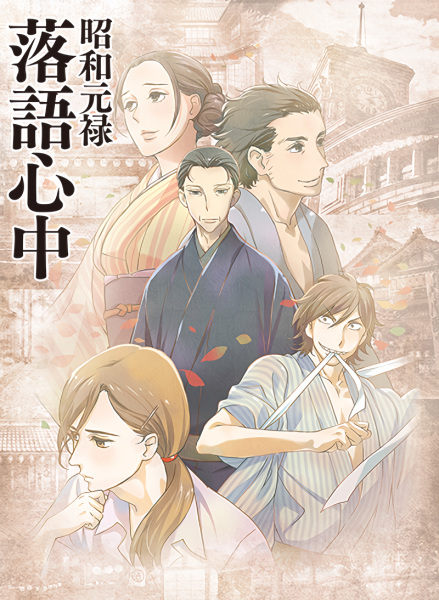
I guess I'll be that guy. Oh well. Fune wo Amu, or The Great Passage, is a series that had the right to greatness. It took a mature premise, featured adult characters in a realistic setting, didn't include unnecessary comedy nor fanservice (except for the cartoony dictionary interludes, I suppose), and tried its best not to be insulting to a thinking person's intelligence. Besides, much like the protagonist of the story, I also love words and have worked in editing—among other things that directly correlate with the characters' mission. So, 10/10, right? I wish, but... no. See, I really wanted to like FwA more, and for thefirst few episodes I had been certain it would become the strongest contender for that elusive Anime of the Season title. But I tend to value works by how well they manage to achieve what they set out to do. Giving FwA a free pass just because it took a good premise and didn't try to pander to the statistical average would be disrespectful to both the title itself and the intelligent viewer seeking it out. And the things you seek out in a mature anime like this also have to be well-executed. FwA is anything but that. It's perfectly average—very content with the little it tries to do, playing it safe as if afraid of its own ambitions. By the final episode I'd become convinced that its director didn't really like the characters he wanted to show. Let me explain. The premise the show tries to execute is really good—no doubts about that. It's something an adult could see and think to themselves, "this is something I could relate to". Adult-oriented stories are generally harder to tell because they demand steady progression of plot and/or characters. You can't just throw in a beach episode and expect the audience to be satisfied (looking at you, every single high school anime ever). Even if it's a slow-burner, things should constantly be advancing, especially if the time span covered in the story is as long as it is in FwA. FwA, however, does something really weird with the concept: it grows so visibly bored of its own slow pace it ends up introducing some amateurish, haphazardly set up dramatic moments in an otherwise tight and methodically woven narrative, and balances them out with long uneventful lulls. Virtually all the plot "twists", if you could even use that term, can be seen from a mile away. They're predictable and lack emotional impact and dramatic consequences. When instead of feeling sad for the characters who are down on their luck you end up feeling sad for the show itself, you know there's something wrong with it. But it is ultimately a character study, so then, perhaps, it has memorable characters and clever, thought-provoking dialogue? Well... Take our protagonist, Mitsuya "Micchan" Majime, for an example. He is extremely introverted, stiff, reclusive, borderline autistic in his inability to comfortably socialize and relay his feelings directly and openly—but on the inside, he burns with passion for words as an instrument of mutual understanding. Actually a solid character conflict right there! So does Majime go through some sort of character arc that helps him become more fluent with words or otherwise be developed as a person who loves them? Does his research help other characters we see understand each other? No, NOT AT ALL—he basically just becomes a more accomplished dictionary editor—the job he took on at the very beginning. All Majime manages to accomplish over the course of the eleven episodes is to be a slightly more successful version of the Majime of episode 1. He just does what he *always* does, and tackles every mundane problem the same way for years. We never really get to experience the satisfaction for his accomplishments because we don't feel like he's putting any effort into self-development. Much like the metaphorical ship oft-referred to in the story, he just drifts along with token involvement in all the events happening around him, as if knowing that the sea current will carry him to where he needs to be regardless of his actions. His on-screen chemistry with other characters is nonexistent almost to the point of being a non-person, and you end up wondering what exactly is the reason they all stick with him so much. The relationship with his love interest Kaguya feels particularly forced. It could be that I just don't understand Japanese women, but my experience tells me that is *not* how romance works. I find it hard to believe that an accomplished, strong-willed, mentally healthy woman would be easy enough to jump on the first guy who professes his love for her, especially if it's a non-person with no attractive character traits. What did she find in him? His looks, wit, charm, power, strength of character? Does he have any of that? I don't think so. He's literally a silent roommate who loves books more than he loves other people and hence lacking in any communication skills that make him pleasant to be around. Then we have perhaps the most enjoyable character, the ever-charismatic Masashi Nishioka, voiced by that crazy-talented guy you hear every season. What pains me the most is that by the middle of the show you become completely convinced that the show would be far better if he were the main character. Indeed, he is the only well-written character in the story who goes through a proper arc, endures hardship and self-doubt, and emerges a better person as a result of his *own decisive actions*, unlike Majime. Note the important difference: Majime's accomplishments feel set up by the script—he just coasts along, and everything solves itself; Nishioka's, on the other hand, are the result of *overcoming* the challenges set up by the script. We feel his hardship and we have a reason to root for him. He is a real protagonist and deserves to be the main character of the story. However, he quickly gets shelved the moment his arc is finished, and we barely get to see him afterwards. One could say there isn't enough time to properly develop characters in a single-cour anime. This isn't the case at all. Just earlier this year we had a much more accomplished adult-oriented show that slowly and methodically told a mature, compelling story where people behaved like real people, drama was poignant but not forced, and it did so with a great deal of subtlety in a similar runtime of 11 episodes out of its total 13. If you haven't yet guessed what I'm talking about, you probably haven't seen it: Shouwa Genroku Rakugo Shinjuu. Needless to say, every good movie out there also manages as much in 90 to 150 minutes of total runtime. It's a matter of directorial prowess to show what needs to be shown and cut down on anything that doesn't. Prowess that Mr. Kuroyanagi, I'm afraid, does not possess. So, to sum up, would I recommend Fune wo Amu? The answer is: just barely. It does get its point across, however weak it is and however timidly it does so. It never really feels dumb, convoluted, or otherwise bad. You can definitely tell its characters and setting are grounded in reality. It's probably better than most anime out there—and that's it. You don't have to take pity on it for the rare breed it represents, nor pretend to enjoy it more than it deserves just because you're the target audience. In everything you do or experience, you should always strive for higher standards and never settle for something that only narrowly escapes mediocrity—I believe that is one of the more important lessons to take away from The Great Passage... even if its creators haven't done so. (By the way, I hear the live-action movie is much better received. I haven't watched it, though.)
FireEmblemIke24
December 22, 2016
DISCLAIMER: Amazon Prime have low-balled this series hard. Crunchyroll would have done better with advertising. This anime has gone under the radar, sure it may just revolve around the mundane task of creating a dictionary. However, the real beauty lies in its simplicity with it being complementary to its setting. This will appease slice of life fans but for those seeking something different, you may need to look elsewhere as nothing ground-breaking occurs. A dictionary is a ship that traverses the vast ocean of words. This tool that we take for granted enables us to search up any word we like. Now I can only representfor the English-speaking anime community but going by the Oxford dictionary, we roughly have 170,000 common words at our disposal. How does one compile such a large amount of information? The answer is a dictionary, which is our best companion during our education days and beyond. Compiling a dictionary is a complicated and time consuming process which is evident in the Great Passage. It should be noted than meanings of words can change with time, therefore words can be lost but will be balanced by the new words created. Majime Mitsuya who has been redeployed to the dictionary editorial department, finds himself in a challenging position. The amount of cross-checking between older dictionaries is emphasised to ensure no words are omitted. This burdensome job must be taken seriously as a single mistake can lead you back to square one, which would be hard to endure for those meticulous with their work. Truth be told this anime would get stale fast if it weren’t for the fact that it focuses on the business aspect as well. This is where the character Nishioka Masashi begins to shine, as he is witty and takes a no-nonsense approach to his job. The man who is blessed with excellent social skills always has a way with words to get the best results for his department. The high standard of work produced by Nishioka eventually gets him promoted to the public relations department, ironically where he got rejected when he applied to company. Nishioka had fantastic chemistry with Majime and the rest of the department. The news of the upcoming transfer came as a shock to the department but this did not sway Nishioka. On the contrary, this boosted his work ethic making him more committed as he devoted himself towards the creation of the Great Passage. Now going away from the dictionary creation process, Majime develops as a person considering he has now found an occupation that meets his strengths. Majime in the beginning is viewed as being timid and quite frankly dreadful at interacting with others. Working as a pitcher for the sales department only just exacerbated the problem, as it was a poor fit from the get go and only noticed by Nishioka. Majime is known to be quite an avid reader which has ultimately led to him possessing a great vocabulary ideal for dictionary work. He has a strange but unique hobby of observing people that exit the train stations. The key idea is observation, which is one of the skill sets required for being a dictionary editor. This anime knows when to be subtle, and paying attention to certain aspects gives for a wonderful experience. Majime is an individual who struggles to express his feelings and as a form of self-deprecation usually comments about being socially incompetent compared to Nishioka, who is far more of a smooth talker. Majime during the series has written a love letter to his crush Hayashi Kaguya, who conveniently happens to be his landlady’s granddaughter. The man retreats to his room after handing his love declaration, which to me is a sign of his lack of confidence due to the fear of being rejected. I’ve waffled on about Majime and Nishioka without mentioning other characters. Araki Kouhei is the employee who had to give up his full-time position to care for his spouse, who was hospitalised for some apparent reason. He mentions his regret having to leave all the work to Matsumoto-sensei who is clocking up the years. Matsumoto has the goal of wanting to finish the Great Passage, to the point that he overworks himself just to fulfil his objective. This alone suggests the amount of dedication put into the work and can only be achieved by those passionate enough to do so. Passion can be found in every job which was the case for Kaguya who aims to be a professional Japanese chef. There is a stigma attached to women working in this sector as it is a field dominated by that of men. Majime learning about her occupation gives him encouragement to complete his own task of making the dictionary. Kaguya as a romantic partner does not get as much screen time than Majime, which kind of leaves her in the dust in terms of character development. It would have been better for the series to explore more with her situation in the culinary field, as it is subject to sexism which quite frankly makes for a more interesting story than the Jisho-tanzu sequences that aren’t important. The time-skip came at the right time after Nishioka’s departure to take up his new position in PR. We get a new character introduced in Miyoshi Remi, who finds herself in the same position that Majime used to be in. Except this time that Majime is now the experienced editor and can lead his fellow colleagues convincingly. The work towards the completion of the Great Passage concludes in a satisfying way. It is realistic as few jobs can be done effectively without experience some problems occasionally. The animation by Zexcs is standard with there being no poorly animated sequences. The character designs are quite detailed and sufficient with it reminding me of the designs used in Shouwa Genroku Rakugo Shinjuu. The animation itself is very limited in the sense that it only takes place in the workplace and Majime’s house. I would have liked to seen a change in scenery but there are occasions when it does switch backgrounds, such as the restaurant that Kaguya works at. The sound is composed by Yoshihiro Ike (Ergo Proxy, Shingeki no Bahamut) who has quite the accolades considering his recent works. The opening “Shiokaze” is vibrant and engaging with the music being used as insert music that just gets me pumped up every time I hear it. The ending “I and I” is less memorable with it being more of a relaxing song to listen to. A slice of life does not need great music to carry it but it should be complementary to the situation. This anime won’t blow you away with flashy scenes but concepts like hard works pays off will sure to put a smile on your face. It has given me a different perspective on how one can find work enjoying even if it is the most mundane of tasks. This is a good show with strong characters making it easy to recommend.
Rank
#1616
Popularity
#1925
Members
133,793
Favorites
560
Episodes
11